
| 1 | Red-tailed green ratsnake |
Maximum length: 240cm.
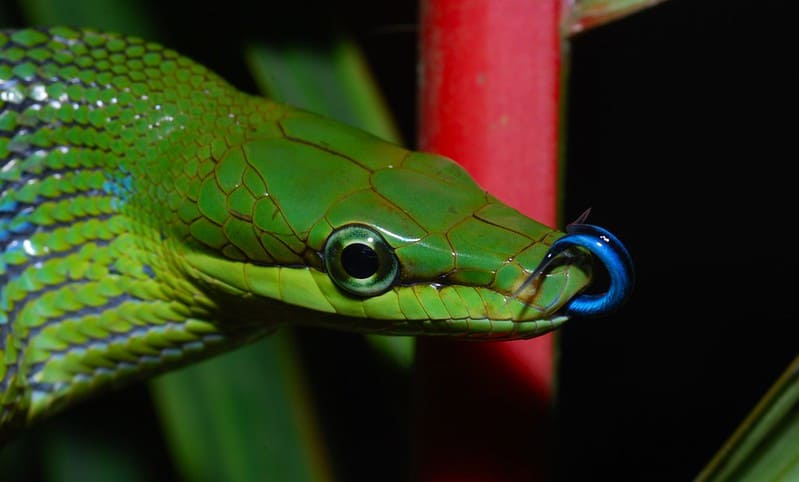
The red-tailed green ratsnake (Gonyosoma oxycephalum) is a 160-200cm species found in the wet forests of Malaysia and Indonesia. It’s an arboreal species, living on branches, with only a mildly toxic venom. Red-tailed green ratsnakes are dangerously exposed on their branches, and therefore must seek alternative survival methods.
Their green camouflage is very strong, but far from impenetrable. As a predator closes in and its heart pounds away, the red-tailed green ratsnake keeps its face steady and performs a simple action: it reveals its tongue. This is one of the most distinctive in the snake kingdom, with a vivid blue stripe contrasting against black on either side. Simultaneously, Gonyosoma oxycephalum inflates its chest to reveal blue patches between its scales.
This sudden flash of alien colour is instantly shocking to an approaching predator. It would even shock most humans, causing us to instinctively flinch, despite being able to rationally assess that it’s just a harmless warning display.
For a hawk, which doesn’t have the added skill of logic (that we know of), the blue must send all its alert systems into overdrive. The hawk flees, and the red-tailed green ratsnake lives to fight another day. This scheme probably fails sometimes too – the exact success rate has never been studied in the wild.
| 2 | Cottonmouth |
Maximum length: 189.2cm.
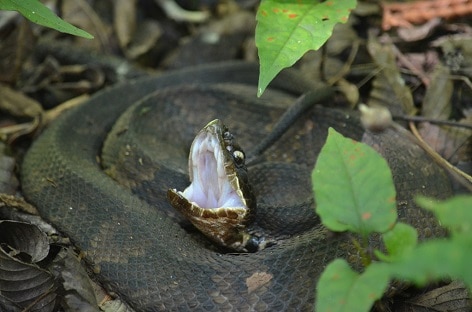
Cottonmouths do exactly what they warned people they would: they bare their mouths to reveal a snowy white inside, which is the colour of cotton wool, with no patterns, contrasting vividly against their murky brown scales.
Cottonmouths measure 65-90cm, and range from Texas to Louisiana to Florida. They have a cytotoxic venom which causes local effects like severe swelling, but rarely fatalities. Though dangerous themselves, they have a huge amount of predators in their murky swamps, including snapping turtles, alligators, blue herons, whooping cranes, and even fish like largemouth bass. They need all the defensive strategies they can get, and if they can send a bird fleeing simply by opening their mouth, then their survival chances become slightly higher.
A greedy heron could spot a murky brown snake, and wade over excitedly, thinking it’s found a tasty brown watersnake (a species which coexists with cottonmouths). Suddenly, the heron sees a flash of white, revealing its foolish mistake, and the overconfident bird flees to the opposite shore, amid a piercing hiss.
This tendency proves that cottonmouths aren’t as murderous and demented as the legends state. Do cottonmouths really chase fishermen from boats, follow them through boathouses, and slam into car doors as their victims close them at the last minute? No – they’d much rather warn you with a vivid white mouth, and not enter the chase at all.
| 3 | Thornscrub vine snake |
Maximum length: 152cm.
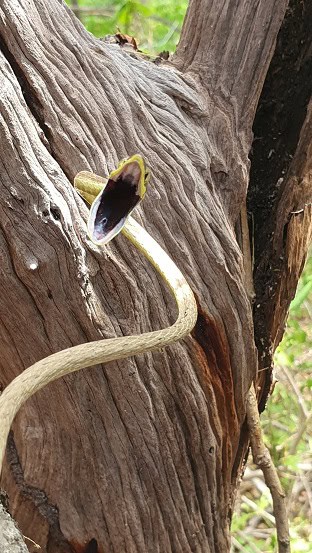
A mildly venomous tree snake, which ranges from Mexico to far southern Arizona, and is the most northerly member of the vine snake clan. Thornscrub vine snakes (Oxybelis microphthalmus) can reach 1.5 metres, but are incredibly thin, skirting over the flimsiest of branches without snapping them. They can fasten a prehensile tail to branches and dangle down, plucking up prey species like anoles.
The one thing Oxybelis microphthalmus wishes it has is a powerful venom, but this species combines several more imaginative strategies in order to compensate. The first is kinking its body to resemble a gnarly piece of vegetation, and swinging in the breeze – hence the vine snake name. The second is a flash of bright warning colour, as like a cottonmouth, this species bares its mouth open wide, but with a rich purple-brown colour instead of white.
The impression is of a lethal, fine-tuned venom flowing through every fold of its mouth, completely false but highly convincing. Thornscrub vine snakes look completely crazy while flashing these colours, and they don’t rest on their laurels. They combine the display with a piercing hiss and a tight S-coil, as though a life-ending strike is imminent.
| 4 | Ring-necked snake |
Maximum length: 85.7cm.
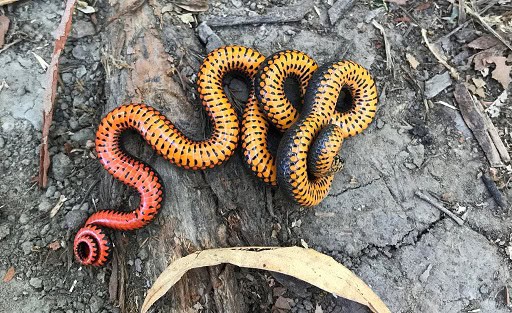
The ring-necked snake is one of the USA’s most humble (and common) species. It typically measures just 30cm, and lives in forests, often hiding in the safety of large anthills. It’s possible to find dozens of ringneck snakes in an hour, as they regularly congregate under logs, rotting bark, or manmade objects like sheet metal. This gives them a natural safety shield, yet racoons and red-tailed hawks are canny creatures which can easily tear away these shields.
Consequently, ring-necked snakes have evolved a strange defensive mechanism. When cornered, they’ll suddenly flip over, and dazzle their enemies with a bright underside. This bright underbelly varies from yellow to pink to bright red. While scientists aren’t sure how often it succeeds, the goal is believed to be stunning predators into leaving the area, assuming them to be venomous.
Ringneck snakes eat ants, earthworms, and small salamanders, while their own predators include broad-winged hawks and copperheads. They have at least 9 subspecies, with the namesake ringneck being the key ID feature. In the Florida Keys subspecies, for example, the ring is very faint, barely visible.
Ring-necked snakes aren’t complete pushovers, and will bend their heads back and bite savagely. The sweet (or sour) spot is the neck – touch this sensitive area, and they’ll bite without fail. Ringneck snakes are mega-widespread in the US, occupying 45/48 lower states.
| 5 | Wall’s bronzeback |
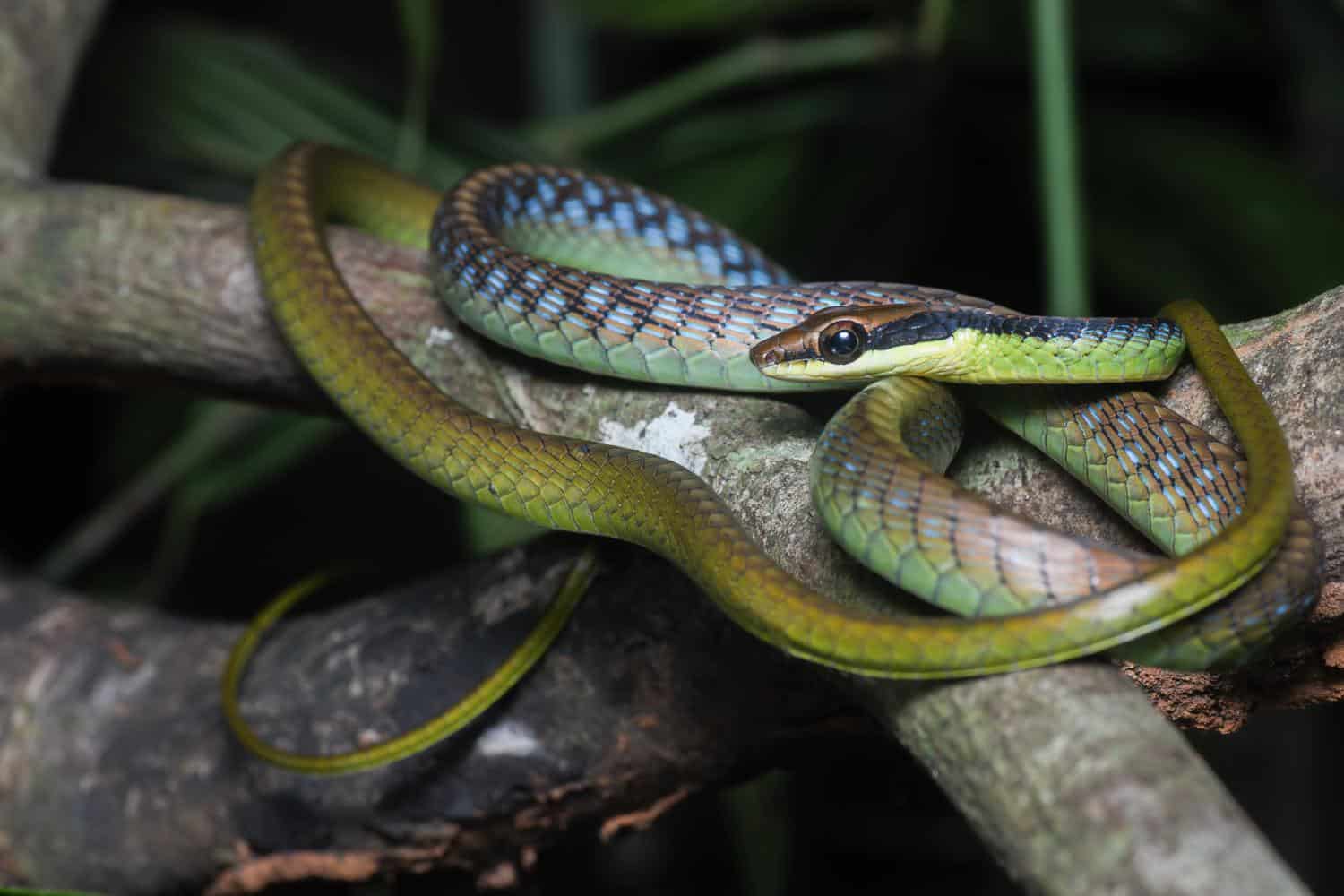
Maximum length: 150cm.
This branch-loving snake inhabits southern Thailand, peninsular Malaysia and Borneo. It has a mild venom, but one with virtually no effects in humans, as even a swollen arm would be a fluke beyond a fluke. Wall’s bronzeback (Dendrelaphis cyanochloris) has a bronze head, a creamy-green belly, and a black stripe between the two. Finally, there’s a layer of electric blue skin, which is clearly visible beneath.
Dendrelaphis cyanochloris is commonly confused with its cousin the elegant bronzeback, which also has electric blue patches. But the blue is far more encompassing in Wall’s bronzeback, and it’s much more inclined to blast predators with these bright colours, stunning them momentarily, before sending them fleeing.
Wall’s bronzeback has blue colours visible constantly, but during pressure points, they’ll inflate their chest to spread their scales apart, revealing more of the interstitial skin between.
The likes of painted bronzebacks use this power only occasionally, despite being far more common in Thailand. Perhaps the painted bronzeback has slightly superior speed and agility, ensuring its survival, without the need for blue-blasting intimidation techniques, although painted bronzebacks still have some blue on their bodies. Wall’s bronzebacks prey on a mixture of frogs and lizards, and have especially large eyes.
| 6 | Hagen’s pitviper |
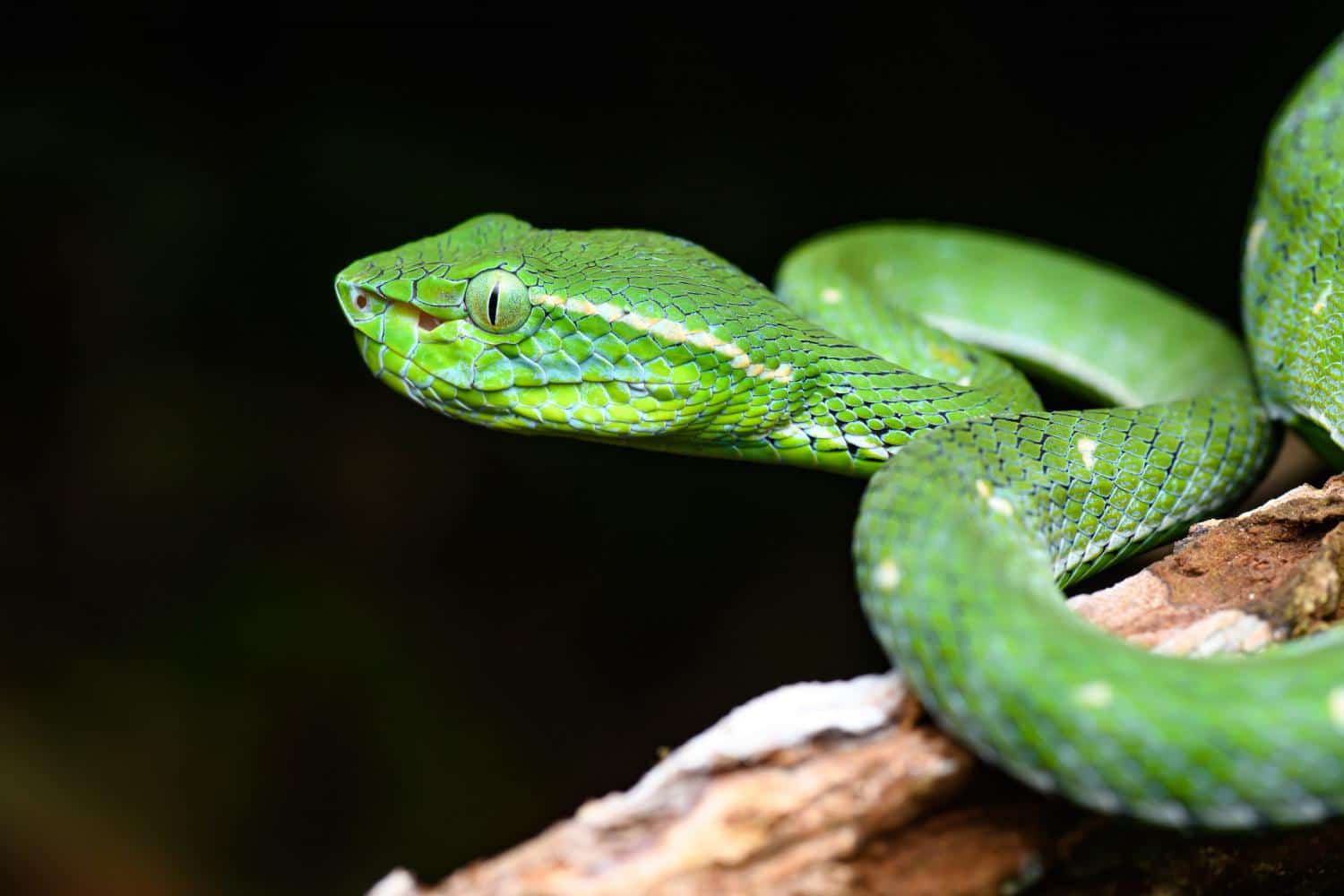
Maximum length: 123cm.
A dangerously venomous pitviper of Sumatra, peninsular Malaysia and far southern Thailand. This species lives on jungle branches, and has a venom containing 216 identified proteins. There’s almost as many colours, as Hagen’s pitviper begins with the typical jungle green for a Trimeresurus pitviper. It has an electric blue upper lip, and a white line along the flanks. Between its scales, it has silky black skin which it can show off at will.
Hagen’s pitviper (Trimeresurus hageni) enjoys the best of both worlds, as in foliage, it has a complete cloak of camouflage, with such a leafy green body that the greenness spreads to cover its eyes. At a distance, Hagen’s pitvipers are almost impossible to spot. But when cornered, they use their blue, white and black shades to create a shocking display of colours. No sane human being would want to stroke a wild Hagen’s pitviper.
The physical characteristics of a venomous snake aren’t taught in school, but are somehow universally understood. An adult Hagen’s pitviper looks venomously radioactive, as though every cell is pulsating with poison.
Hagen’s pitvipers rarely kill, but have a nasty venom rich in metalloproteinases, which causes necrosis and swelling of the skin tissue surrounding the bite site.
| 7 | Spotted harlequin snake |
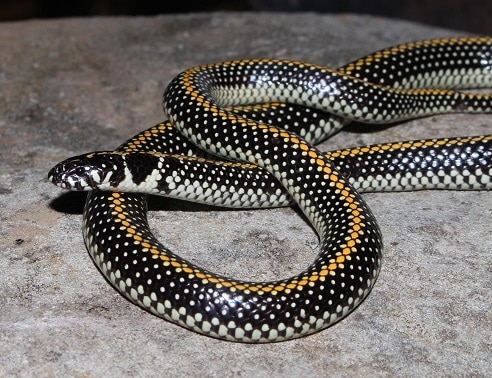
Maximum length: 65cm.
The spotted harlequin snake of South Africa has a paintbox of bright colours. Some are yellow spotted, others have a bright red spinal stripe, but they’re always dazzlingly colourful. This is a mildly venomous species, which is capable of swelling up a finger, but not killing.
Spotted harlequin snakes (Homoroselaps lacteus) are found only in South Africa and the tiny nations of Lesotho and Eswatini. They generally prefer moister areas of South Africa, such as grassland, moist savannah and lowland forest. Their diet consists of legless skinks and harmless blind snakes.
Spotted harlequin snakes are sometimes found in abandoned termite mounds, but they can’t shelter forever. They measure just 40-50cm, making them vulnerable to predators. If predatory birds swoop in, they need a way to deter them, and bright neon colours might just work. Many birds worldwide have an instinctive fear of such bright snakes, assuming them to be venomous.
It’s easy to imagine how the change would have spiralled out of control, using good old fashioned natural selection. The ancestor of the spotted harlequin snake 20 million years ago may have been far duller, but had its own ancestor 20 million years earlier with brighter colours. If the dull version had a rare mutation, a morph where the old colour genes were switched back on, that freak snake could have gained a sudden survival advantage, which the older ancestor didn’t have. Gradually, the new colours would have spread, before the entire species was eventually bright and neon-coloured.
| 8 | Red-headed krait |
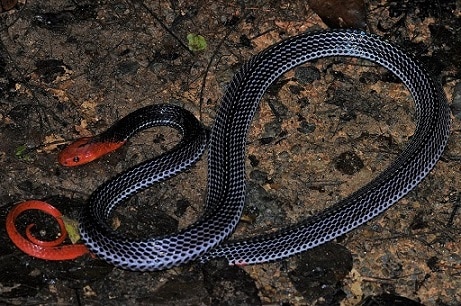
Maximum length: 207cm.
A venomous species of southern Thailand, peninsular Malaysia and Java. Red-headed kraits are dark blue against paler blue, contrasting sharply against a red head. They live in moist forests and are rarely sighted by ordinary people.
Red-headed kraits can trigger paralysis and respiratory failure, or on a weaker level, laboured breathing and weak muscles. 56.2% of their venom is comprised of the infamous beta-bungarotoxin.
A red-headed krait’s head stands out clearly, even at night when it’s most active. The goal is to scare predators away, but this time, red-headed kraits are deadly serious in what they say.
Like a red traffic light, their bright head is an instruction to freeze and not come an inch closer. They’re saying that if you touch these bright colours, your inevitable fate will be 25mg of neurotoxic venom flowing through your bloodstream, with millions of molecules distributing to every muscle receptor, and physically preventing brain signals from binding.
A Thai snake which isn’t serious is the pink-headed reed snake, which has a similar colour scheme, but is non-venomous. A red-headed krait bite can easily prove fatal, and the species has no dedicated antivenom.
| 9 | Malcolm’s pitviper |
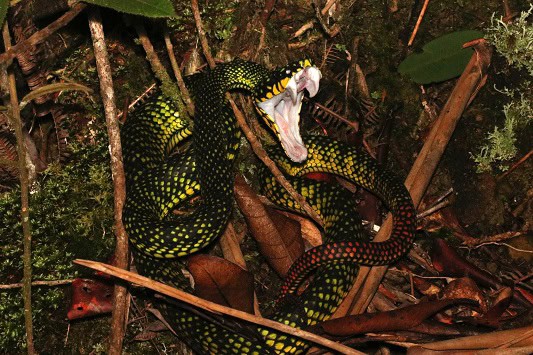
Maximum length: 133cm.
Malcolm’s pitviper is a deadly species of Borneo, the large island split between Indonesia, eastern Malaysia and the kingdom of Brunei. Within this large island, this pitviper only inhabits a small territory: Mount Kinabalu National Park of the far northeast. Like Hagen’s pitviper, this species belongs to the 40 member Trimeresurus pitviper genus, but instead, it has a very different fear-fuelling colour tactic.
As you can see, this species is just as green as its relatives, just as optimised for blending perfectly with jungle foliage. It also has the red tail for luring and deceiving prey that other members have. But this species also has a pale white mouth, with only slight hints of pink. Even its fangs are a pure snowy white.
When baring its fangs, these colours contrast sharply against its green scales. It’s not proven whether this is designed to blast enemies with bright colours, forcing them to flee. But the mouth display is a strange parallel of the cottonmouth in the southern USA, despite the two having diverged tens of millions of years ago.
It’s highly doubtful that Malcolm’s pitvipers even need this white mouth, as their ferocious expressions and long fangs are just as terrifying. Apart from its white mouth, this species might have some of greatest jungle camouflage of any pitviper.
| 10 | Black pipe snake |
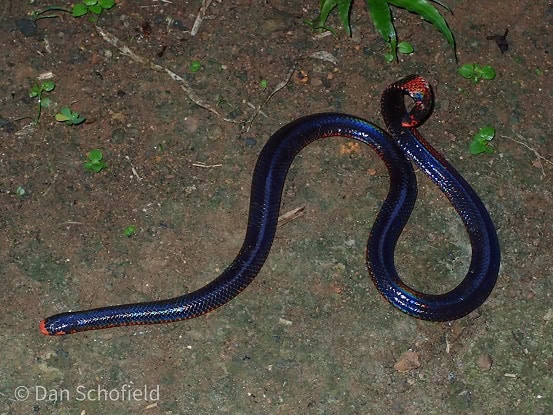
Maximum length: at least 60cm.
Black pipe snakes (Cylindrophis melanotus) are found in Indonesia, only on Sulawesi and nearby islands. Their colours are some combination of jet black and red, occasionally with white instead of red. This species appears in various types of forests, shying away from human settlements.
Ordinarily, this species is a shy black serpent grinding along the forest floor, with excellent disguise in the cloak of darkness. It often rests on thick beds of leaves, creating another instant escape avenue it can exploit. But if this species is cornered by a bird, it can deploy another weapon – a sudden bright colour flash. Like other Cylindrophis members, the black pipe snake lifts up its tail to reveal the red underside, both to distract from the head, and create a sudden flash of colour.
The strange thing is that this colour scheme closely mimics venomous snakes as well, including the red-headed krait and Malaysian blue coral snake. Yet neither of those species actually exist on Sulawesi.
The explanation might be birds, which can fly between islands, and therefore still fall victim to mimicry in snakes which don’t actually coexist with the target snake. Or the snake they were mimicking might be extinct – grass snakes in the UK occasionally spread a hood to mimic a European cobra that no longer exists.
Other pipe snakes include the Sri Lankan pipe snake, which has a snowy white tail. The most common worldwide is the red-tailed pipe snake, whose tail is similar, but has a banded body instead.