
| 1 | Tropical snail-eater |
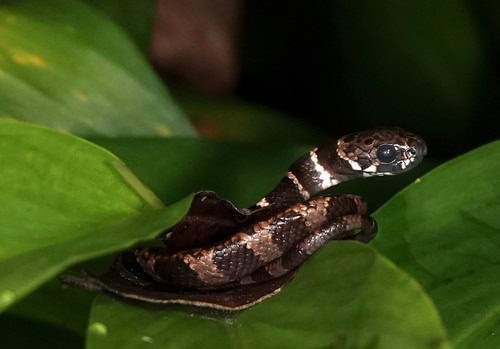
Maximum length: 93.1cm.
A harmless species which preys on snails and slugs, and sticks to high altitude forests. Tropical snail eaters (Dipsas sanctijoannis) are nocturnal, and are encountered in many situations, from crossing a shadowy forest road, to resting motionless on the spindly branches of a tree 2 metres high.
This species lives in the upper end of the Andes in Colombia, specifically the Cordillera Occidental and Cordillera Central mountain ranges. Tropical snail eaters appear at altitudes of 1585 to 2400 metres. They’re totally absent from Colombia’s lowlands, but can be abundant in the high forests above.
Locals call this snake Yaruma tobacco, due to its liking for Yaruma tree branches, and its patterns, which resemble dried tobacco leaves. When cornered, Dipsas sanctijoannis will fly into an attack positon with its upper body raised, but then stay still for several minutes, and do little. This is accompanied by head triangulation to mimic a viper, by shifting bones in its skull (sadly a skill us humans lack).
However, they can also release a vile smell that forces enemies to leave, or coil themselves into a tight ball. Fleeing into leaf litter is another survival strategy. Exactly what a tropical snail-eater does when confronted is a lottery, with the one guarantee that they’re completely harmless.
| 2 | Spix’s sipo |
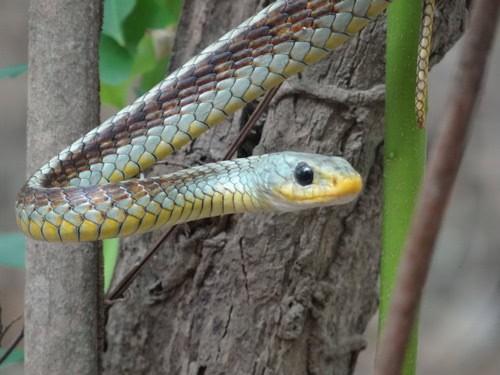
Maximum length: 175cm
A non-venomous species which lives only in Colombia and western Venezuela, yet is extremely common in those territories. Spix’s sipo (Chironius spixii) became an official species in 2006, when it was separated from the machete savane (Chironius carinatus).
This species often exceeds 1.5 metres, while its tail is especially long as a proportion of its body. Spix’s sipo is a ground-dwelling snake, yet can zip up tree trunks rapidly if need be. They also hunt their amphibian prey in forest streams. The truth is that Spix’s sipo can go almost anywhere it wants, from fast-flowing water to tree branches 5 metres high.
Spix’s sipo can be staying still and peering curiously out of forest undergrowth one second, then miles away the next second. They can blast off extremely quickly, which luckily isn’t a factor when it comes to venom, because Chironius spixii doesn’t have any. That said, this species is one of the most dangerous, aggressive non-venomous snakes, with ripping fangs that it knows how to use.
So far, Spix’s sipo has only had amphibians recorded in its diet. Species include Colombian plump frogs and drylands tree frogs, which they can capture both on the ground and in branches.
| 3 | Black Halloween snake |
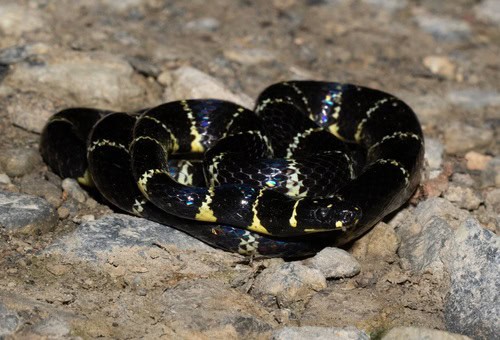
Maximum length: 79.5cm.
Part of the two member Pliocercus genus. Their cousin Pliocercus elapoides lives further north, ranging from eastern Mexico to Honduras, while the black Halloween snake (Pliocercus euryzonus) takes over in Nicaragua, continuing through Costa Rica and Colombia to Ecuador. The former species has three colours (red-black-white), while black Halloween snakes are bi-coloured. This is usually black-white (see above), with red occasionally replacing the white.
The black Halloween snake is a harmless species, which dwells on the forest floor, and hunts amphibians and occasionally catfish. They reach a record of 79.5cm, and have a strangely long tail, which accounts for 38-43% of total body length. They appear at a wide range of altitudes, from 0-2750 metres. Within Colombia, they’re found only in the western half, west of the Andes.
Black Halloween snakes are a naturally sparse species. You might hear whispers that they’re out there, haunting a particular forest, but it’s rare to actually find one. So far, most confirmed prey are amphibians, including northern rainfrogs, eggs of the red-eyed tree frog, and masked tree frogs. After capturing a frog, black Halloween snakes bury themselves in leaf litter to swallow in peace.
This snake has two names: Cope’s false coral snake or the black Halloween snake, but the latter is clearly cooler. As a coral snake mimic, they’re ineffective next to their cousin Pliocercus elapoides, as they often lack any red.
| 4 | Chocoan toad-headed pitviper |
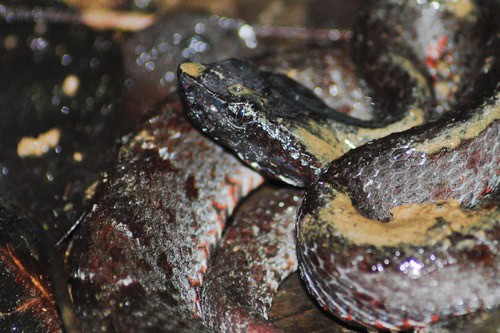
Maximum length: 75.6cm.
This venomous species lives in the Chocoan rainforests of western Colombia, and was only discovered in 2001. The Chocoan toad-headed pitviper (Bothrocophias myersi) inhabits extremely wet areas receiving over 5000mm of rainfall annually, at low altitudes of 75-200 metres.
This is a fairly small viper, at an average of just 45cm. Unlike the eyelash vipers found nearby, Chocoan toad-headed pitvipers stick to the ground. This is a nocturnal species with relatively small eyes. As far as we know, they’re endemic to Colombia, but there’s a small chance that they inhabit northern Ecuador.
As a rarer species, Bothrocophias myersi doesn’t dominate Colombia’s national snakebite statistics like the fer-de-lance, yet remains dangerous. A 2020 study found “lethal activities”, with haemorrhagic and coagulant activity, though these were weaker than the infamous common lancehead. The study included a victim who experienced swelling and myotoxicity, AKA muscle tissue destruction, as revealed by an increase in bloodstream creatine kinase.
Two viper antivenoms were tested, a Colombian and Costa Rican. Neither of these used this species’ venom in their mixture, but the Colombian version neutralized some of the symptoms in mice. The signs suggest that this is a moderately deadly viper, but don’t underestimate them.
| 5 | Shaw’s dark ground snake |
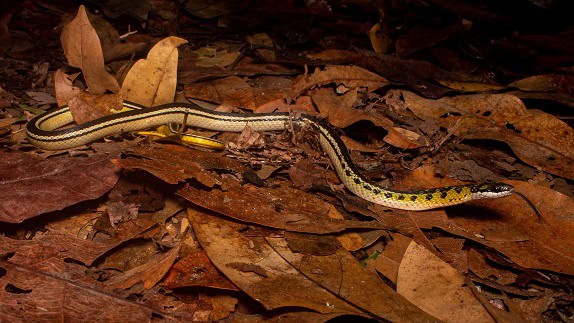
Maximum length: 75cm.
Part of the huge, 55-member Erythrolamprus genus. Shaw’s dark ground snakes (Erythrolamprus melanotus) measure up to 75cm and inhabit extreme northwest South America. They’re abundant in western Colombia (west of the Andes), as well as northwest Venezuela. They’re also one of Trinidad’s most common snake species.
This is a forest species usually found along stream edges, including in mountainous areas at up to 2000 metres. Shaw’s dark ground snake has a yellow base of scales, but occasionally red. This is always overlaid with near black patterns. Their upper body is blotchier and messier, before the dark patterns converge into straight parallel lines lower down. Their spine has a huge, thick black stripe, with a far thinner black line on either side like a pencil marking. Their ventral (belly) scales are bright yellow.
Shaw’s dark ground snakes have a flexible diet, feasting on puddle frogs (Engystomops pustulosus), reptiles like Wiegmann’s striped gecko, and unidentified fish. On Trinidad, they’ve also been observed eating the harmless three-lined snake (Atractus trilineatus), amid the fallen branches of a mango tree. Apparently mammals are the only food group this snake never eats.
One weird thing was that the Shaw’s ground snake didn’t bother to rest and digest. The moment the lined snake entered its mouth, it slithered away again, to destinations unknown.
| 6 | Shreve’s keelback |
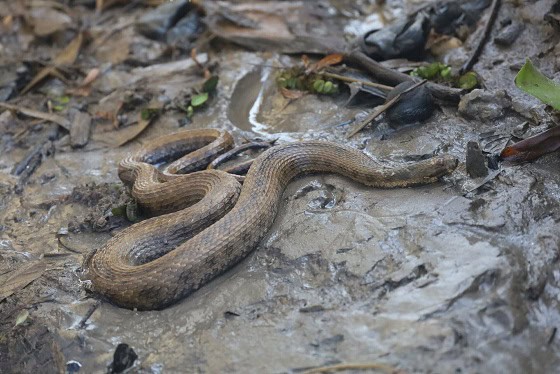
Maximum length: 66.5cm.
This species inhabits Colombia and Ecuador to the east of the Andes, and is often found in rainforest river areas covered head to toad in mud. Shreve’s keelbacks (Helicops pastazae) are nocturnal and hide under rocks during the day. At night, they search along the riverbanks, looking for any fish they can flush out, with one confirmed prey being the catfish Hypostomus pyrineusi. Shreve’s keelbacks have many classic aquatic adaptions, such as valve-like nostrils that lock out water, and eye sockets positioned higher on the skull.
Within rainforests, Shreve’s keelbacks appear in smaller streams, ponds and swamps. They’re also a confirmed creature of black lagoons. They’re theorised to be intelligent hunters which seek out fisherman’s nets and snatch the fish within.
While non-venomous, Shreve’s keelbacks don’t just roll over, as they have multiple defensive strategies. When cornered they can 1) open their mouth widely to intimidate, 2) flatten their body like a cobra, and 3) produce a vile smell.
This is an egg-laying species, which they cleverly lay amid riverside rocks, buried in a mixture of sand and decomposing vegetation. A 2019 study found a clutch of 11 eggs, one of which was assaulted by an ant swarm.
| 7 | Lined ground snake |
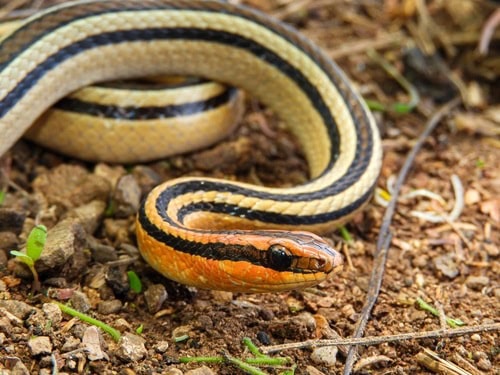
Maximum length: 60cm.
A harmless snake which typically inhabits wet areas like streams and marshes. The lined ground snake (Lygophis lineatus) is easily recognizable by its clean, ordered patterns. They have several beige-black parallel stripes, with the spine having a moderately thick black stripe, with an additional two thinner black stripes on their flanks. Between this, there are no messier blotches, or flecks of extra colours, just disciplined stripes from head to toe.
This species also inhabits Panama, Venezuela, French Guiana, and Ecuador, yet sightings are most plentiful in Colombia. Their diet is confirmed to include Leptodactylus grassfrogs and gladiator tree frogs, as well as lizards and insects. They’re fast swallowers, gulping down prey in just a few minutes.
In one brutal tale from August 2008, scientists spotted two lined ground snakes attempting to eat the same grass frog, near a farm in Venezuela. One snake gripped the frog by its head, the other by its foot. The former snake won the battle, successfully swallowing its amphibian prey, but it didn’t stop there. It kept going and fully swallowed its snake rival, getting two meals for one, but succumbing to the dark urge of cannibalism.
This is the most northerly member of the Lygophis snake genus (8 members). Others include the Lema ground snake of far eastern Brazil, and Gunther’s ground snake of Argentina (the most southerly).
| 8 | Thickhead ground snake |
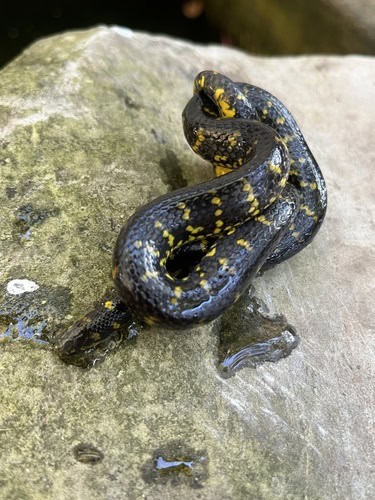
Maximum length: 49.5cm.
This is one of the weirder snakes in terms of its territory. Thickhead ground snakes (Atractus crassicaudatus) are endemic to Colombia, and then exclusively inhabit only the Altiplano Cundiboyacense plateau in the centre of the country. They cover a relatively small area, yet within that area, sightings are über-common. This snake pops up absolutely everywhere near the capital Bogota. Hotspots include Lake Herrera, 12 miles west of Bogota, and the eastern hills which directly overlook the capital.
This snake has small eyes with round pupils, smooth scales to touch, and an average adult length of 40-44cm. Thickhead ground snakes are harmless, and it’s easy to pick them up without any reaction except a flecking tongue.
This species is nocturnal, moving by night, yet is still constantly encountered by locals. They inhabit both mountain forests and mountain savannah, and their elevations span 2000-3200 metres, with Bogota positioned at 2640m, making it the world’s third highest capital city after Quito (Ecuador) and La Paz (Bolivia).
Thickhead ground snakes are common near human settlements. The best way to find them is to pull up limestone rocks, which they love to lurk beneath, usually in areas with rich grassy soils interspersed with roots.
| 9 | Red-tailed coral snake |
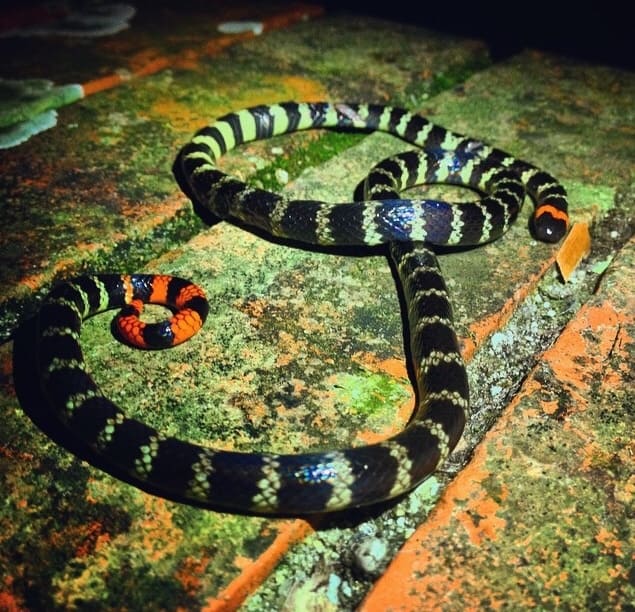
Maximum length: 140.6cm.
The Micrurus coral snake genus has 82 members, and the red-tailed coral snake is the most abundant in Colombia. This snake is also a menacing presence in Panama, western Ecuador, and northern Venezuela.
Red-tailed coral snakes (Micrurus mipartitus) live only to the west of the Andes. They favour floors of cloud forests covered with mulch and leaves, but are relatively flexible for a coral snake, appearing in coffee plantations and terrorising bean pickers, and even appearing in swimming pools in Panama.
61% of their toxins are three-finger toxins, a neurotoxic class. A specific toxin is Mipartoxin-I, which is highly lethal when tested in mice and birds, and acts post-synaptically, blocking acetylcholine brain signal receptors in muscle cells. The second main coral snake in Colombia is Dumeril’s coral snake (Micrurus dumerilii), and this was found to have a lower proportion of three finger toxins at 28%.
Bites aren’t constant, but nor are they rare. A 46 year old woman was bitten by a red-tailed coral snake in 2005, and was admitted to hospital just 2 hours later after struggling to walk and losing upper limb strength (classic neurotoxic symptoms). She rapidly received 8 vials of antivenom, and avoided more serious symptoms.
A 1968 case involved a 58 year old man who had won a television contest involving snakes. The man required artificial ventilation, and suffered respiratory depression for 17 days, and a hospital stay of 33 days. Luckily, doctors obtained a coral snake antivenom that wasn’t yet available in Colombia.
Micrurus mipartitus not only has a red tail, but red markings on its head, while the remainder of their body is black-white. Meanwhile, the nearby Dumeril’s coral snake has red bands on its entire body.
| 10 | Barred forest racer |
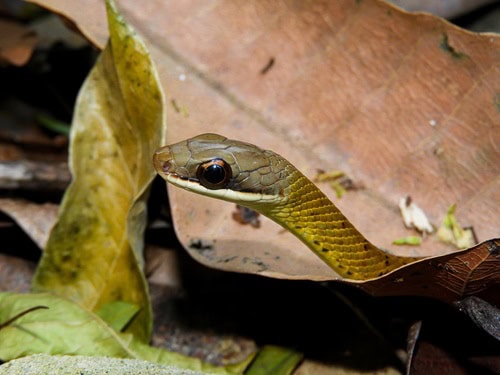
Maximum length: 113cm
The barred forest racer (Dendrophidion percarinatum) is a species of Colombia, Panama and Costa Rica, which poses no threat to humans. This is a day-faring (diurnal) snake, which moves along the ground and occasionally climbs trees, sleeping on low vegetation at night. Their habitats include tropical moist forests at lower altitudes, including near streams or more open grassy clearings. Barred forest racers have been reported to flee when confronted, but also stand their ground calmly.
Barred forest racers tend to be below 1 metre, with a record of 113cm, and are recognizable by their huge eyes with round pupils, and their complex patterns. They look greenish from a distance, but have many complex blotches and specks of red or black or white up close, instead of a clean pastel green. They vary in appearance, as some have parallel stripes, others encircling bands, and others separated blotches.
Confirmed prey include caretta rubber frogs, and the leaf litter frog Craugastor rugosus. In 2008, barred forest racers were discovered in Venezuela for the first time ever.
The Dendrophidion snake genus has 15 members. In a 2003 study, barred forest racers were compared to their relatives Peter’s forest racer (D. nuchale) and D. vinitor. All ate at least 50% frogs, but D. vinitor ate over 90% frogs and toads, while barred forest racers and D. nuchale were more flexible, adding in anoles. They also had a disadvantage: a much higher rate of broken tails, hinting that barred forest racers are highly vulnerable to bird predators.
| 11 | Brown vine snake |
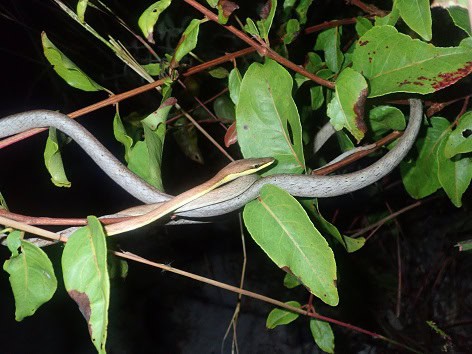
Maximum length: 200cm.
The brown vine snake (Oxybelis aeneus) is a widespread species of South America, which ranges from Panama through Colombia to the vast majority of Brazil. This species is venomous, but only capable of causing mild stinging and swelling in humans. They must chew their prey for several minutes, before the ameiva or anole they’re holding gradually weakens.
Instead of raw power, this species shines in its speed, agility, and immense camouflage. The brown vine snake’s survival strategy is to dangle itself from a branch, go limp, and sway gently in the breeze, perfectly mimicking a vine. Many a Colombian has walked right past this snake, and never realised.
The brown vine snake captures its prey by suspending itself from bushes using its tail. They prey mainly on reptiles, particularly anoles, and one of their confirmed prey in Colombia is the dusky giant ameiva.
This snake only has minor variations in appearance, as it’s fairly consistent across Colombia. Rather than fully brown, its back is mainly a tree trunk brown, but its underside and chin are bright green, allowing them to simultaneously mimic tree bark and foliage. The brown vine snake can also be found climbing metallic fences and resting snugly in garden plant pots.
| 12 | Green anaconda |
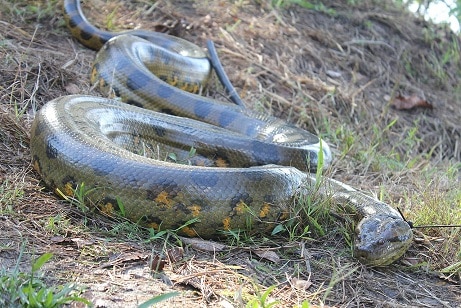
Maximum length: 5.21 metres (wild), 6.24m (captivity).
Easily Colombia’s largest snake. There are rumours of green anacondas reaching 8, 10 or even 12 metres from the early days of European exploration. The green anaconda has never been recorded to swallow a human being, but has been witnessed lunging at the legs of small women who strayed too close to their rivers.
Green anacondas are found across a large area of northern South America, including most of Brazil, Venezuela, French Guiana and Suriname. In Colombia, they’re found exclusively east of the Andes mountains, where they’re very common. This species only appears in humid areas with high amounts of rainfall annually. This includes rainforests, but also the huge Llanos marshland of Colombia and Venezuela.
The green anaconda is a semi-aquatic species, which hunts by submerging most of its body in a shallow tributary or marsh, and poking just its eyes above. Confirmed prey include capybaras, caimans, and wading birds. Some anacondas even have gnaw marks on their bodies from these capybara conflicts.
Some of the wildest tales of giant anacondas from centuries gone by came from Colombia. Biologist Federico Medem mentioned an anaconda of around 10.25 metres, as well as a “30 to 40 feet” anaconda which he supposedly measured against the length of his canoe.
| 13 | Chocoan bushmaster |
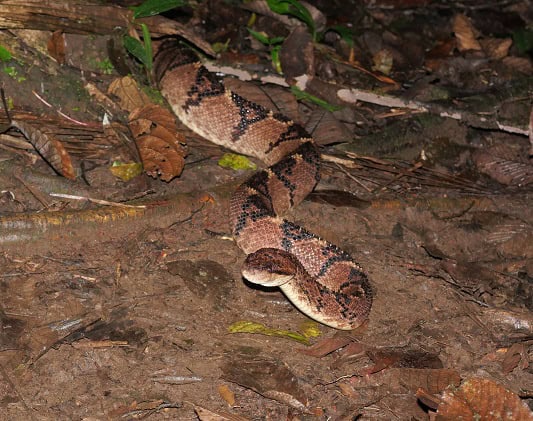
Maximum length: 243cm.
One of 4 bushmaster species to terrorise the Americas. The Chocoan bushmaster is the 2nd most common, with the South American bushmaster easily ruling for territory covered. The Chocoan bushmaster (Lachesis acrochorda) is found in northwest Ecuador, the western half of Colombia and far eastern Panama, where it inhabits humid rainforests receiving high totals of rainfall each year.
According to one estimate, the Chocoan bushmaster’s bite has a 90% fatality rate. This species is believed to cause 2-3% of snakebites in Colombia, with the common lancehead and fer-de-lance contributing the most. One of the Chocoan bushmaster’s local names is pudridora, or “rot-causing”. Another is verrugosa or warty, after its rough scales (a good ID feature).
Chocoan bushmasters have a variety of effects, causing accelerated coagulation of the blood, and even degrading heart tissue. Fortunately, this species is relatively shy, with a strong tendency to stash themselves in dark mammal burrows, while heavy downpours hammer the rainforest around them.
While the South American bushmaster is the longest viper worldwide, the Chocoan version is smaller, never reaching 3 metres. Its camouflage is extremely effective when lurking in the undergrowth, and this species is an ambush predator which can go days without moving.