
| 1 | A vicious non-venomous snake |
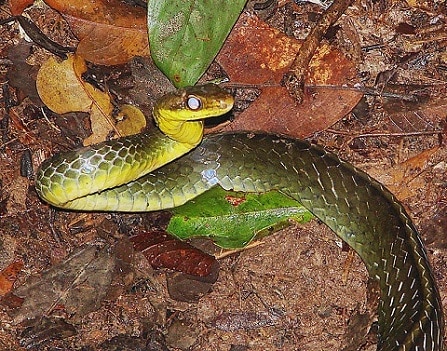
Most snake guidebooks will list a snake as either venomous or non-venomous, but those terms barely begin to explain a snake’s full personality. A snake with no venom could be a shy leaf dweller, a motionless ambush predator, or a complete maniac which bites and slashes with unbridled fury.
The machete savane (Chironius carinatus) is a snake which falls resolutely into the last category. This is a non-venomous Brazilian species, which measures 46cm at birth, and pushes to a maximum of 205.4cm in adulthood, with males being slightly longer.
Machete savanes are incapable of killing a human being, and no deaths have ever been recorded. Despite this, they’re notorious for biting and snapping at people that invade their personal space. Reports from Brazilian villages suggest that they instinctively target the face, and even the eyes in a demented attempt to blind people. This is an unpredictable snake, which could flee across a river, but could stand its ground, with no easy way to tell.
Machete savanes are flexible, and are so powerful that curious tourists have been bitten painfully while holding the tips of their tails. They’re strong enough to bend 80% of their body back in mid-air, and deliver a sudden snap to the victim’s nose. This strong tail comes in use for one of the machete savane’s favourite tricks – dangling from branches.
| 2 | Most common in wet forests |
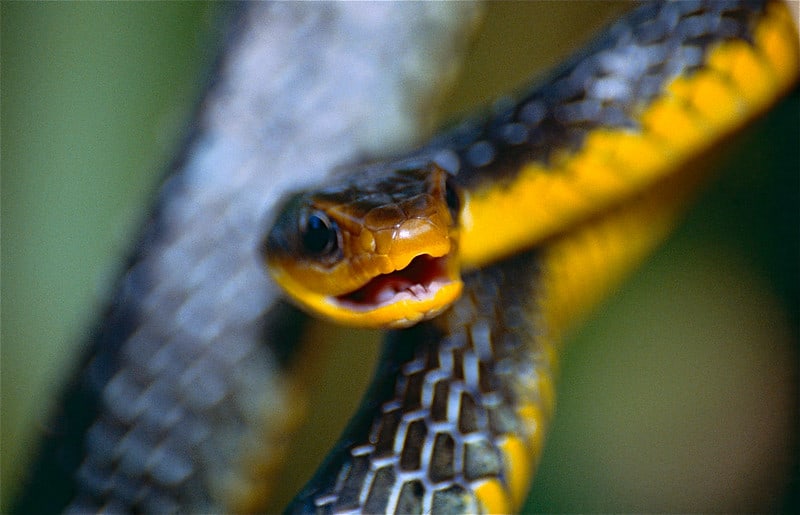
Machete savanes are widespread in northern South America, as their territories include Guyana, French Guiana, eastern Venezuela, Suriname, and a vast swathe of northern and northeastern Brazil. They never appear in bustling towns, and unlike a boa constrictor, they mostly avoid grassland. Instead, this is a forest snake through and through, particularly gravitating towards the most untouched, pristine forests which are barely affected by mankind.
Machete savanes can cope with degraded forests and forest margins to some extent, and are sometimes spotted on roads between forests, but to meet this species (which may be unwise), you may need to bring an actual machete. This habitat gives them several skills: 1) dropping onto people’s heads, 2) dangling from branches with their tail, and 3) resting calmly on enormous rainforest leaves. Machete savanes also appear in cocoa plantations, palm swamps, igapós and forest clumps along rivers (riparian forests).
Machete savanes have a strong correlation with wet forests, and are less likely to appear in drier woodlands (unlike the dangerous Mexican cantil). They’re strong swimmers as well, and won’t hesitate to cross a river to explore new areas. To avoid this angry snake, the best solution is to never enter a Brazilian forest.
| 3 | Reaches 15 metres above ground |
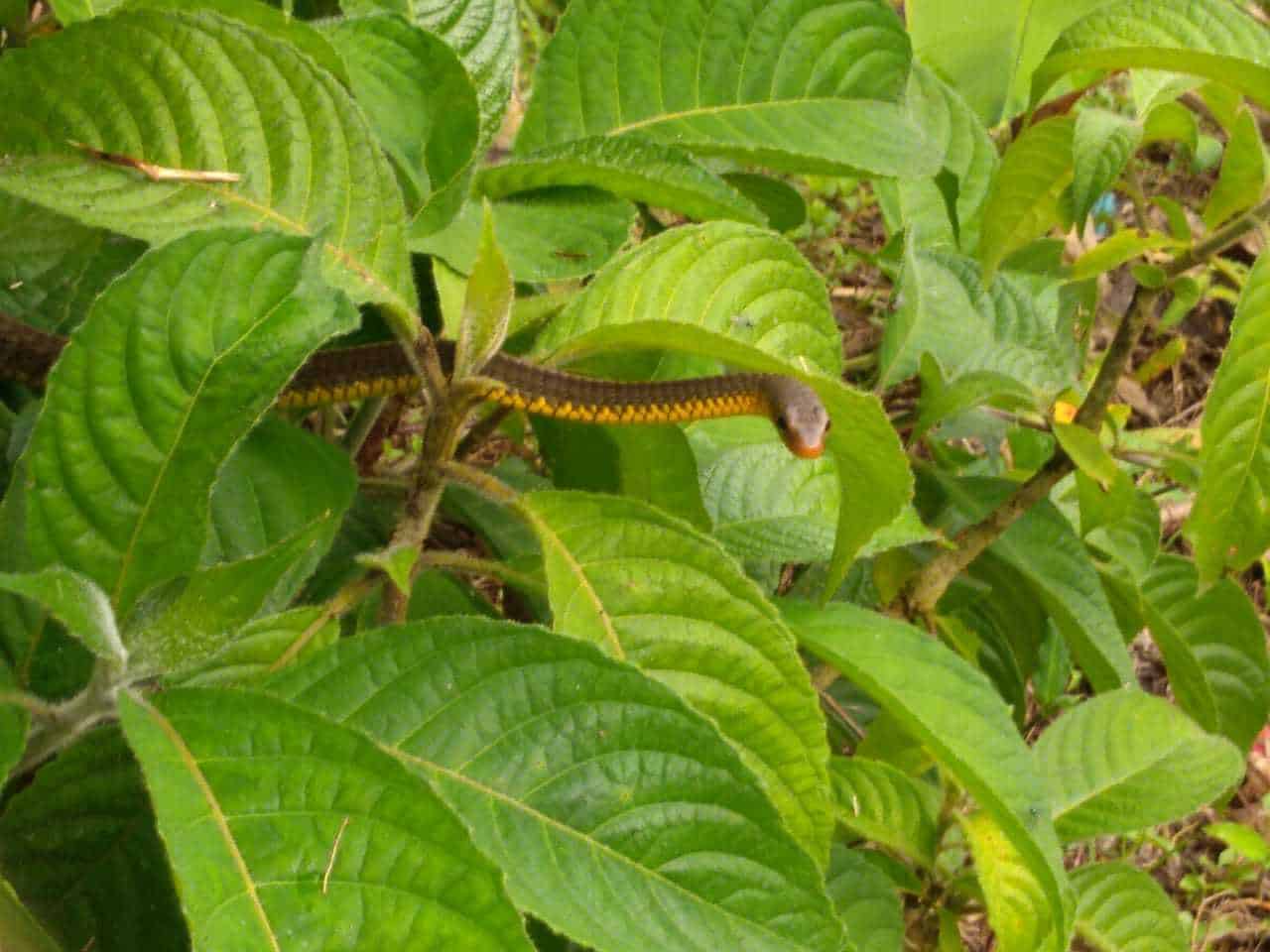
As a diurnal snake rather than nocturnal, machete savanes regularly encounter human beings, and unleash their aggressive personality for all to see. This is an abundant snake in many areas, and any moist Brazilian forest you walk past has a strong chance of containing a colony, waiting for you to foolishly enter.
Machete savanes are comfortable on the ground, but are excellent tree climbers, resting on bushes and lower branches. As a thin-bodied species, they have excellent balance, and rest lightly without causing branches to awkwardly snap.
Surveys find that machete savanes are most commonly spotted on branches slightly above eye level. At night, they retreat to the highest, most towering branches, where they set up a comfy perch and fall asleep. Machete savanes can reach 15 metres high before settling down for the night, similarly to their cousin the South American sipo (which has been spotted at 16 metres).
Once morning comes, they ditch these precipitous heights and drop down into the thick of the action again, ready to bump into photographers or tourists and raise some hell. Alternative names for this species include yellow machete, golden tree snake, Amazon coachwhip, and yellow liana.
| 4 | Kinks its body into weird shapes |
Lacking any form of venom, the machete savane has been forced to evolve new tactics in order to survive the Brazilian jungle, an oasis of dangerous lifeforms. At 1.5-2 metres, this species is too large to vanish into a pile of leaves, so becoming more aggressive was the obvious choice. However, machete savanes also kink their body at several points, forming unusual angles, mimicking a fallen stick, hoping that predators will fail to notice them.
Machete savanes can also inflate their throat to appear larger, showing pink skin between the scales. When in strike pose, they normally keep their mouths hanging open, with a wide-eyed stare. They keep their neck bent, as though they could unleash a rapid jab at any second. They could bite, or they might flee – the presence of water is the only way to predict a machete savane’s actions, as it often flees across forest pools.
As for supposedly targeting the eyes, this might seem advanced, but is easily within a snake’s capabilities. Red spitting cobras have been proven to fire their venom globules at the eyes, even two round circles painted onto a wall.
| 5 | Male on male wrestling |
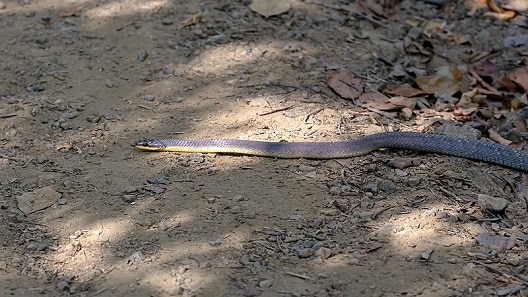
Machete savanes don’t just unleash their aggression on humans – they save a nice helping for each other. This is a classic species for male on male wrestling, which is believed to be for securing rights to females.
This wrestling is highly ritualised, and the snakes taking part never bite each other, or cause any lasting injury. Two machete savanes will coil the mid-section of their bodies around each other, like a tangled piece of wire. While keeping their necks close together, they’ll then attempt to raise their head above the other, by slamming the chest of their enemy to the ground.
Whichever snake keeps its head a few centimetres above will be the “winner”; it’ll establish dominance, and most likely gain the affections of a beautiful female machete savane. A typical wrestling session lasts for 30 minutes, and the snakes usually keep their heads tilted backwards as they duel.
This wrestling has also been observed in their close relative, the two-headed sipo (Chironius bicarinatus), not to mention unrelated snakes like the California kingsnake.
| 6 | Bulbous eyes |
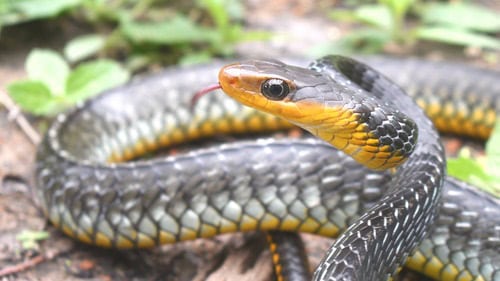
Despite Brazil having 400+ snake species, identifying a machete savane is simple, as the species has several useful ID signs.
The first is a dark green/grey back contrasting vividly against a yellow belly, with the yellow and green/grey scales being more intermingled in some. The eyes are also massive and bulbous, and it’s thought that they hunt primarily using their vision.
Machete savanes also have a sharp ridge of scales down their spine, which you could easily feel with a finger. This varies by gender too, as the ridge is far sharper in males, and only mildly sharp in females. This ridge has led to the nicknames “razorback” and “keeled tree snake”, and is just visible in the image above.
A slight black edge to each scale is another signature feature. Despite their bright yellow belly, machete savanes have surprisingly strong camouflage on a branch or tangled bush. With their huge eyes, the odds are strong that they can see you, but not you them.
| 7 | Many confirmed prey |
The machete savane is an active predator which searches the forest floor avidly for its prey, rather than waiting patiently. Rodent hairs have been found in its stomach, but lizards and frogs form most of its prey. Confirmed species include…
Rusty treefrog (Boana boans) – a brown frog with orange eyes, reaching 10-13cm long. Machete savanes have competition for this meal, as its other snake predators include green jararacas, mountain keelbacks and green parrot snakes.
Rainbow whiptail (Cnemidophorus lemniscatus) – a lizard prey measuring 30cm, which alternates between bright green and blue. Other snake predators include the green vine snake and Pacific longtail snake.
Paradoxical frog – a bizarre amphibian which has the world’s largest tadpole, at 27cm. In adult froghood, it shrinks dramatically, in a reverse of the norm. Other snake predators: Brazilian smooth snake, mountain keelback.
Nauta salamander (Bolitoglossa altamazonica) – an amphibian found on low vegetation in rainforests, or in other words, the exact same place as the machete savane. Other snake predators: Linnaeus’ sipo, royal ground snake.
Machete savanes must fight for every meal, as there’s always rival snakes attempting to muscle in on their prize.
| 8 | Nemesis: laughing falcon |
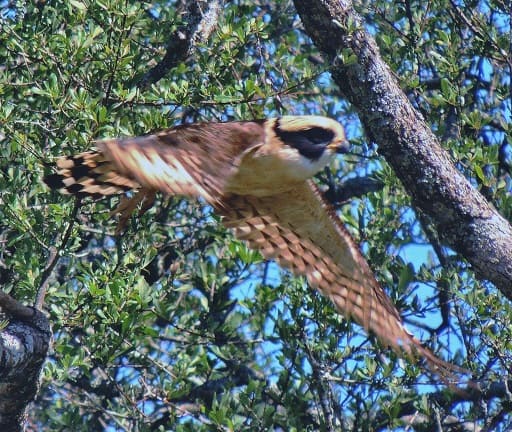
The machete savane’s harsh existence continues with its legions of predators, eagerly licking their lips.
For example, machete savanes are confirmed as bird prey, specifically for the laughing falcon. This observation was made in Macapá municipality, Brazil, and began as scientists watched a falcon fly down, pick up a machete savane in its talons, and soar away back to its tree perch, without dropping its secure prey. The snake was so big that the falcon was unable to eat it whole, instead eating it in pieces, which took 50 minutes.
Machete savanes may even be spider prey. A 2021 study documented several snakes caught in spider’s webs and predigested into a soft mush using spider enzymes, including scarlet snakes and Texas blind snakes. While not a wild sighting, one spider was recorded eating a machete savane in the captive/experimental trials.
At one point, even crabs were confirmed predators. In 1997, scientists on Tobago spotted a manicou crab feasting on a large snake, in a hollow between two large boulders, 2 metres from the river bank. They recognised it by its head colouring, but before scientists could take a picture, the crab dragged the machete savane into its dark burrow.
The only problem is that in 2024, the machete savane species was revised and found to not exist on Trinidad and Tobago. The colonies there became a separate species instead: the Trinidadian sipo (Chironius nigelnoriegai). Nevertheless, it was still a cool observation.
| 9 | Secrets of the machete savane |
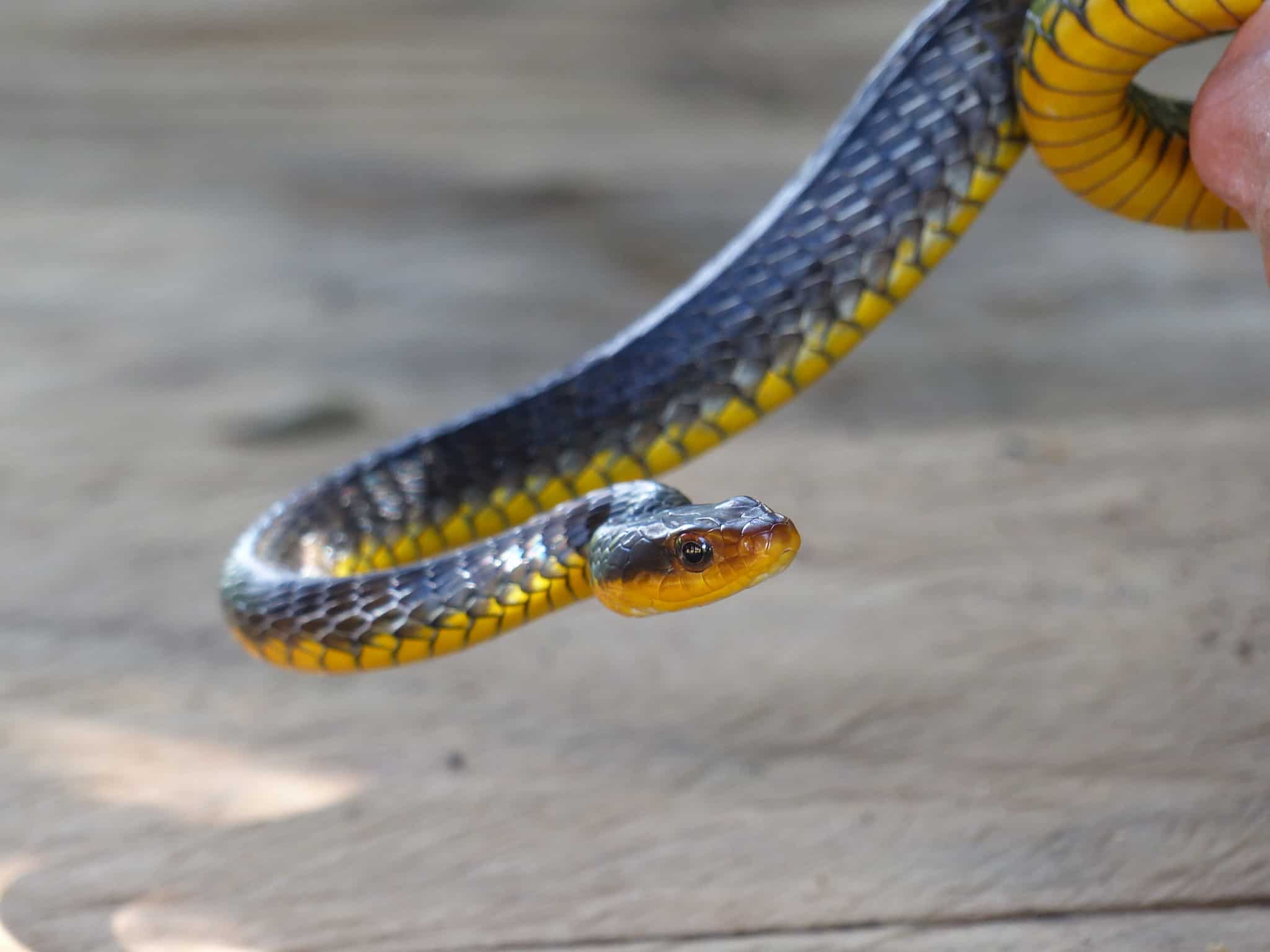
Vipers mostly lay live young, but machete savanes are traditional, and prefer to lay eggs. These eggs come in batches of 5-8, which is relatively low, compared to over 100 for the mud snake. As hatchlings, machete savanes are a lighter green, before gradually darkening with age.
It’s extremely rare to find machete savanes in captivity. There’s barely any global trade, with a few individuals appearing in the European market only once in a blue moon. This isn’t because they come from the heart of jungled Brazil – that didn’t stop the emerald tree boa. It’s because of their aggressive temperament, difficulty to feed, and a lack of knowledge about keeping them.
Machete savanes have a very long tail, and their tongue is light pink. Their eyes are not only huge, but protrude sideways from their head when seen from a bird’s eye view.
With their branch-dwelling ways, machete savanes are effortless tree climbers. A thick trunk is barely a tougher obstacle than a hotel elevator for a machete savane.
| 10 | Closest relatives |
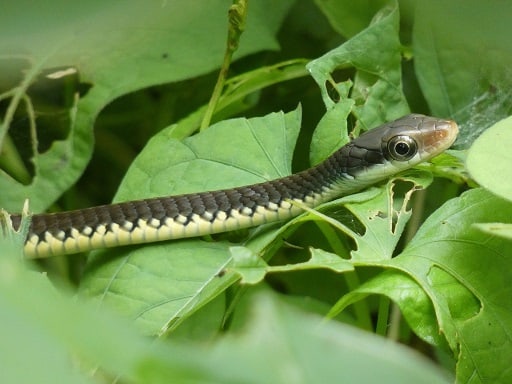
Machete savanes are part of the large Chironius genus, which has 25 members. All have large bulging eyes and a long thin tail, and most live in forests. Three of the 25 were originally subspecies of the machete savane, but have since been split off. These are…
Werner’s sipo (Chironius flavopictus) – found in western Ecuador, western Colombia, Panama and Costa Rica.
Mountain sipo (Chironius spixii) – found across a swathe of Colombia, including in the Andes mountain range. One of the few to live outside forests.
Trinidadian sipo (Chironius nigelnoriegai) – found on Trinidad and Tobago.
Out of 4000 snakes worldwide, the machete savane’s closest relative on the evolutionary tree is the long-tailed machete savane (Chironius multiventris). This version lives further west, including in Peru and Ecuador, and has a browner colour.
Versions that coexist with machete savanes in Brazil include Linnaeus’s sipo, AKA Chironius exoletus. This version is far greener, with a vibrant body and a belly that is pale green rather than yellow. The most northerly species is the Ecuador sipo (Chironius grandisquamis), which actually reaches as far north as Honduras and Nicaragua.