
| 1 | Kirtland’s snake (Pennsylvania) |
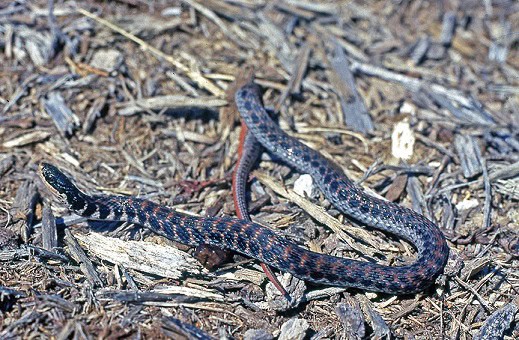
Maximum length: 62.2cm.
Scientists are working furiously to investigate the 4000 snake species on Earth, but they only have so much manpower. Even many well known species, like the red-tailed green ratsnake of Malaysia, have surprisingly little research to their name. These days, amateur observations are filling in many gaps, particularly those uploaded to citizen science websites like iNaturalist.
Within the US, there are still many mysteries surrounding snakes, which you personally could solve. Many of these relate to snakes which are still decently populous, but are possibly extinct in certain states – or then again, possibly not. One great example of this is the Kirtland’s snake, which is listed as “threatened”, and now only appears in 7 confirmed states, when it once appeared in 9.
The Kirtland’s snake (Clonophis kirtlandii) is a species of moist grassy meadows on the edges of streams. It appears in the lush countryside, taking shelter in crayfish burrows, and preying heavily on slugs and earthworms.
This species averages at 50cm and poses no threat to humans at all. Today, the bulk of its range lies in Ohio, Indiana and Illinois, with confirmed populations in Kentucky, Michigan, Missouri and Tennessee as well. 100 years ago, however, the Kirtland’s snake was also found in Wisconsin, where it hasn’t been seen since 1929. It was also found in Pennsylvania, where it hasn’t been officially observed since 1965.
It’s possible that in one of those states, the Kirtland’s snake genuinely is extirpated (locally extinct). But it’s more than possible that in one state, they still just cling on. In Missouri, for example, the species hadn’t been witnessed since 1964, but was rediscovered in 2006, 42 years later.
The same could easily happen in Pennsylvania, where its known territories are even larger. The state contains one larger pocket of territory, which mainly covers Butler County, Allegheny, Beaver, and Lawrence counties. There’s also an isolated pocket in central Westmoreland County, and an isolated pocket straddling the border of northeast Venango, northern Clarion, and southwest Forest County. See this iNaturalist map for the exact distribution.
Head to the grassy countryside of Pennsylvania next weekend, and maybe, just maybe, you could revive an army of snakes from the dead.
| 2 | Black racer (Arizona) |
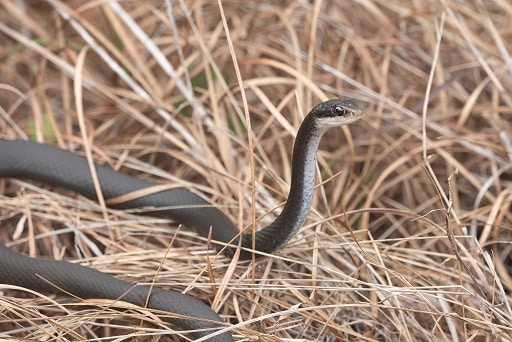
Maximum length: 190.5cm
The black racer and common garter snake are two snakes in a constant duel: the duel of which is the most common in the US. On paper, both inhabit 47 of the lower 48 states, from the east coast to west. Both are missing from Arizona only, yet the black racer has one advantage to its name: a single record from extreme eastern Arizona in 1927.
The record was made in Apache County, directly adjacent to New Mexico. It was made near the town of Eager, at an altitude of 7000 feet. Compared to the rest of Arizona, which is covered in desert, these higher altitudes create cooler and therefore more hospitable terrain for the black racer. Directly over the border in New Mexico, they’re not exactly common, but sightings are made semi-regularly.
There’s a good chance that the black racer inhabits Arizona, but then again, this is the only sighting on record, despite the far southern US being perhaps the most heavily surveyed snake haven on Earth, alongside Florida. It’s possible that this black racer sighting was made in error. There’s no sign of any future expeditions being conducted soon.
If you live in eastern Arizona, then perhaps you could be the one to solve this mystery and claim all the glory. Who knows – you could scour Apache County for years, and get nowhere. Or you could get lucky and find one in just a few hours, the first black racer to be recorded in Arizona for over 95 years.
| 3 | Pine snake (Virginia) |
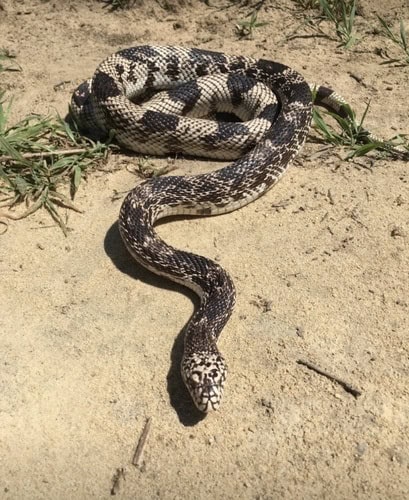
Maximum length: 233.6cm.
The pine snake is the largest burrowing snake in the USA. It reaches a maximum of 233.6cm, and can excavate such extensive tunnel networks that vast piles of earth are left by the entrance. This species is a non-venomous constrictor, and appears in spacious woodlands of the US southeast.
In certain areas, pine snakes are fairly common, such as Florida, Georgia and South Carolina, but in other areas, they’re gone, never to return – or are they?
The main debate over the pine snake lies with 3 states – Kentucky, West Virginia and Virginia. The Virginia pocket crossed the border of the two states, and was always separated from the main range to the south. However, it’s been decades now since pine snakes were last sighted in either state.
In Virginia, the last confirmed pine snake was a dead individual found on a road in Craig County in 1995. In West Virginia, the last sighting dates back to the 1940s, and was also dead on a road. As of 2025, the exact status in both states is undetermined, but as long ago as 2009, a paper stated that pine snakes were likely extirpated from both states.
With its more recent observations, Virginia is the more likely of the two to still contain this burrowing species. Their shy, underground nature is an advantage, as this species can be difficult to observe even in forests where it’s confirmed to thrive. A disadvantage is that unlike a Kirtland’s snake, this species is far larger, and it would be trickier for one to fly under the radar.
Meanwhile, Kentucky has 3 separate populations, one which is fully isolated, and two which cross the border from Tennessee to the south. Here, pine snakes are believed to cling on to this day in low numbers.
Their main surviving heartland in Kentucky is the Lake Between The Lakes Recreation Area, a protected area of suitable habitat, where they appear in patches of oak-hickory woodland. However, since 2014, only 3 confirmed observations have been made, so this would still be a great challenge to track down. Currently, iNaturalist lacks a single pine snake observation from Kentucky – you could add the first.
| 4 | Cottonmouth (southern Indiana) |
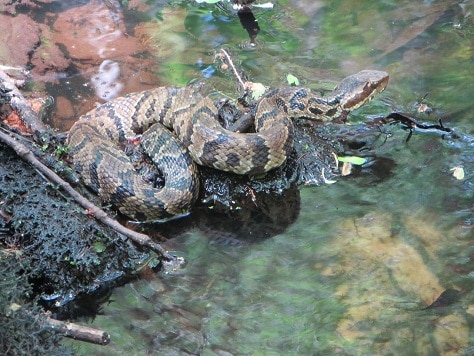
Maximum length: 189.2cm.
Most US citizens dread meeting a cottonmouth. They dread walking their dog past a lake and having an enraged cottonmouth leap out of thick reeds, and they dread sailing a fishing boat along a river only to witness a pair of cunning viper pupils emerge out of the water. However, there’s one group of people who do wish to meet a cottonmouth – herpetologists in southern Indiana.
Cottonmouths aren’t even close to endangered, and inhabit 16 states overall. Yet in Indiana, their status is debated, as the species is believed to have inhabited the far south, but hasn’t been seen in at least twenty years. Some believe them to be extirpated (locally extinct), while others scour their local swamp forests, desperate to find out if they still cling on. Many old-timers and fishermen insist that cottonmouths thrive in the state, only to produce an unusually large northern watersnake instead and be dismissed.
The first observations were made in Harrison County along the Ohio River, in 1968 and 1970. These were both adult males, but are generally believed to have been stowaways on barges, and not native to the state.
The more interesting observations were made in the early 1980s in Dubois County, which lies in southern Indiana, but is separated by one county from the border with Kentucky. The location was a single swamp within one forest, northeast of the town of Jasper, in the Buffalo Flats Nature Preserve. Most importantly, this cottonmouth colony contained adults and juveniles, and was generally accepted as being a native population. The last official observation here was made in 1985.
Another report of a juvenile in Dubois County arrived in 2001, but in the 24 years since, no substantiated observations have been made. The original swamp has been searched, to no avail.
The debate continues to rage on social media, as almost every post related to cottonmouths in southern Indiana breaks out into an argument. Crazy claims are everywhere, including one user who mentioned a lake in Indiana from which the authorities supposedly remove droves of cottonmouths each year.
If you want a snake quest to sink weeks or even months into, then finding a cottonmouth in southern Indiana would be a worthy candidate. Just make sure not to waste your entire life on the pursuit.
| 5 | Southern hognose snake (Alabama) |
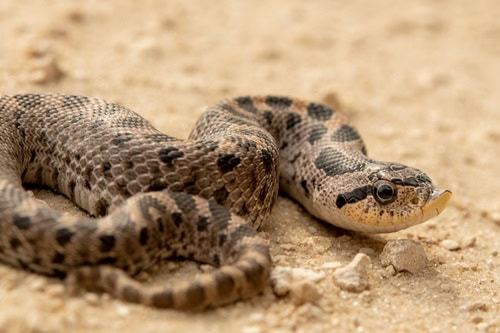
Maximum length: 61.0cm.
The southern hognose snake is one of the USA’s rarest, with a population of less than 10,000, far less than its eastern hognose snake cousin at potentially over 1 million. The latter is much more widespread, covering over 30 states, but the southern hognose snake is mainly restricted to one habitat: longleaf pine forests, with loose soils and a spacious understory. It was always rarer, and deforestation has caused its numbers to plummet over the last 150 years.
Today, southern hognose snakes are confirmed to exist in Georgia, South Carolina, North Carolina, and the northern half of Florida. But they were historically present in two other states: Alabama and Mississippi.
In Alabama, southern hognose snakes haven’t been observed since 1975, and not since 1981 in Mississippi. Alabama is probably the more likely of the two to still host this species, as its range was larger to begin with. Its territory consisted of a large central pocket, isolated from the southern hognose snake’s wider range, and a southern area which spread over the border from the Florida panhandle.
This species has many threats, including screeching car tyres, gradual habitat destruction, and excessively controlled wildfires. Southern hognose snakes are also threatened by invasive fire ants, which are common all over the southern US. These woodland invaders not only prey heavily on reptile eggs, decimating future generations, but attack snakes directly, using their large stingers. Southern hognose snakes live in the exact woodland environments which fire ants gleefully spread to.
One secret fact is that the fire ant infestation actually began in Alabama. The source was South America, and the first docking took place in 1918, at the port of Mobile, Alabama, before they gradually diffused across the nation. Consequently, the southern hognose snakes in Alabama probably suffered first. Infestation levels were reached by 1958, and the first to fall victim were Alabama, Mississippi and the Florida panhandle.
All this makes it less likely that southern hognose snakes still exist in Alabama. But an advantage is that the original range was relatively large. The central pocket encompassed over a dozen counties, from Calhoun County to Shelby County. Generally, this central range lies between the cities of Anniston and Montgomery. The southern pocket was sizeable as well, and particularly covered Clarke, Mobile, Choctaw, Baldwin, Escambia, Covington and Dale Counties.
Therefore, there’s plenty of area to get searching in. Longleaf pine forests are their ultimate hotspot. Also check out the territories of the pine snake (map) and eastern indigo snake (map) within Alabama. These species have similar spacious woodland habitats to the southern hognose snake, and could be a guide as to where to search first. Conecuh National Forest is one potential location.
| 6 | Smooth green snake (Texas) |
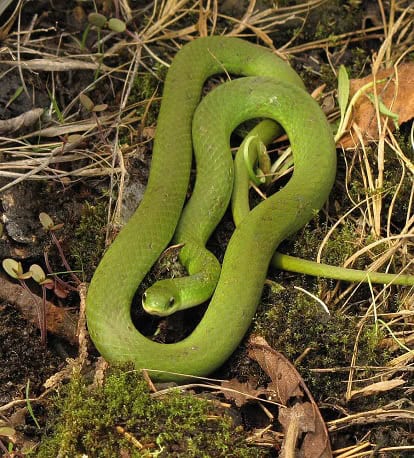
Maximum length: 79.7cm.
The smooth green snake (Opheodrys vernalis) is a mildly venomous species of the eastern US, which is widespread, and generally appears in moist meadows, grassy clearings within woodlands, and overgrown vegetation adjacent to lakes. This species has a diet consisting of various creepy-crawlies, including spiders, caterpillars, grasshoppers and ants.
One of the most interesting facts about Opheodrys vernalis is its fragmented range. In the east, its territory is mostly unbroken, but the further west you travel, the more it splits into isolated pockets. There’s over 20 of these pockets overall, with the most extreme lying in Chihuahua state, Mexico.
Naturally, this also increases the chance of this snake going extinct in certain areas. There’s a mixture, as the isolated western pockets in Utah, Wyoming and South Dakota are still thriving, with plenty of sightings. But those in Missouri and southeast Texas near Houston may be extirpated, with no sightings for decades.
The whole Texas saga began in the late 1800s, with observations near “Deming’s Bridge” in Matagorda County. This was followed by several more sightings in the early 20th century, which were often hotly debated. A 1949 observation was made 2.5 miles west of Sealey in Austin County, in a newly formed rain pool in an open prairie landscape. Another individual was found 8 miles south of Sealy in 1953, in a meadow.
In 1961, 3 individuals were found following a flood in Brazoria County, while a roadkill smooth green snake was found in 1964 just to the south of Hobby Airport. The last official sighting was made in Matagorda County in 1969, on the Texas coastal plain, meaning that there hasn’t been an official record in over 50 years.
Adding to the confusion is that their relative the rough green snake (Opheodrys aestivus) also lives near Houston. This has a close resemblance, but is a fully distinct species, with a full genetic separation, rather than a mere subspecies.
The biggest difference is in the name: both species are leafy green, but smooth green snakes are completely smooth to touch. Meanwhile, rough green snakes have scales which are so keeled that they’re clearly visible in images; you don’t have to run your finger down one, although it helps (and is completely safe). Rough green snakes also have more of a tendency to climb trees, and are more likely to appear near forests overall, often in overgrown grass on the outskirts. Smooth green snakes tend to prefer more open areas.
This species is automatically a strong candidate for rediscovery in certain locations, because of one fact – its extreme greenness. The smooth green snake has a much better camouflage than the black racer or pine snake, and this increases its chances of researchers walking right past it. It’s possible that the smooth green snake has been encountered near Houston since the late 60s, but only in someone’s peripheral vision.
| 7 | Queen snake (Missouri) |
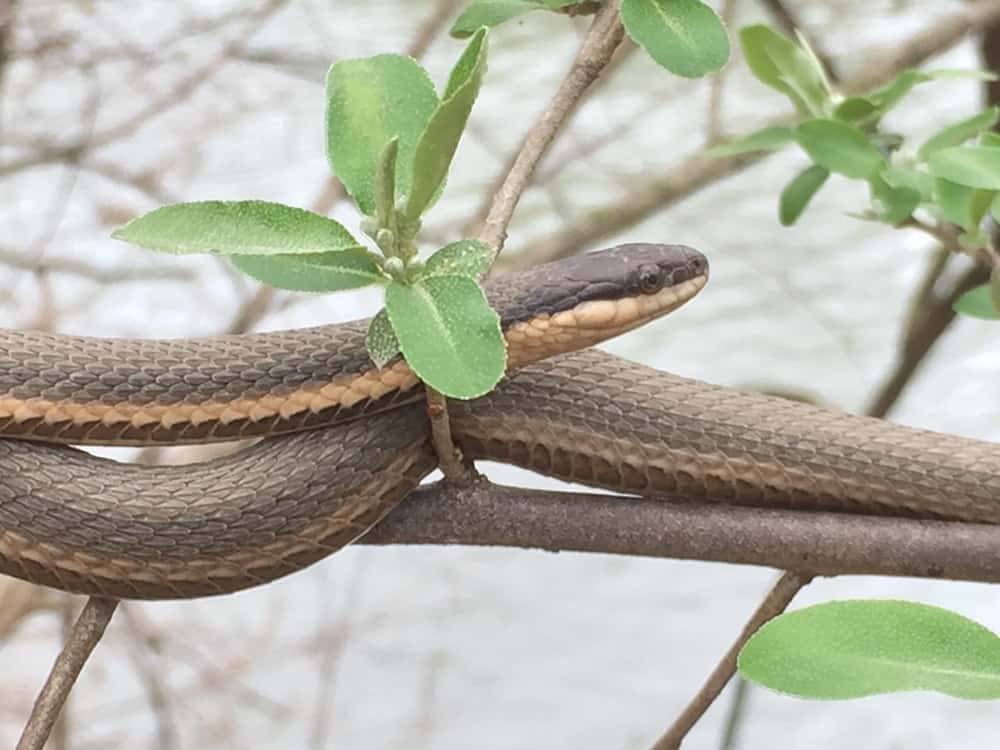
Maximum length: 93.3cm.
The queen snake is one of the less flexible aquatic snakes of the eastern US. This species measures up to 93cm, and is found only in clear water bodies with a rocky base, often fast-flowing streams or moderate width rivers. It never appears in murky swamps or backgardens, unlike the much more flexible common garter snake.
Queen snakes are also unable to cope with pollution, concrete bridges and other manmade structures. Consequently, this species is hard to find, and in two states, it was long believed to be extinct: New Jersey and Missouri.
New Jersey is connected to the species’ main range, along the east side. However, the Missouri pocket is separated from the species’ main territory by 400km. This pocket exists (or existed) in far southern Missouri, in three counties: Christian, Stone and Taney Counties. It crossed the border with Arkansas, which still has sightings today, to form an isolated outpost well away from the species’ heartlands.
If you wish to accept this great herpetological quest, then you have a particularly large mountain to climb. The queen snake hasn’t been observed in Missouri since 1927, and a 1960 report found just 3 observations in old museum records.
The construction of dams has been the largest problem, damaging their fragile riparian ecosystems, with concrete walls often replacing natural shoreline vegetation. These walls are a particular problem for queen snakes, as they gravitate towards areas with plenty of hiding spaces along the shores. This is partly due to their complete reliance on crayfish as prey, which dig burrows in these shores. It’s simple: no soft, muddy shores equals no queen snakes.
The population in Missouri was declared extirpated in 2000, and again declared as “apparently extirpated” by a report from 2010. Yet there’s definitely a glimmer of hope for this isolated subpopulation. In New Jersey, the queen snake hadn’t been sighted since 1977. In the same 2009 report, it was again declared to be “apparently extirpated”.
But that all changed in 2021, 44 years after the last sighting. Reptile enthusiast Jeff Dragon received a report of a queen snake in a friend’s basement in Gloucester County, although the snake was gone when he arrived. In 2022 and 2023, he searched the surrounding New Jersey countryside to no luck. But in 2024, when he returned, he succeeded within 90 minutes, finding a queen snake clinging to a tree, the first official record in decades.
The announcement caused shock in herpetological circles, and it’s possible that an even bigger shock could happen in Missouri, nearly 100 years after the last sighting. Fortunately, queen snakes are non-venomous, so there’s no chance that you’ll discover the species in Missouri, get bitten, and never have the chance to tell anyone, as you slowly lose consciousness.