
| 1 | The offshoot coral snake |
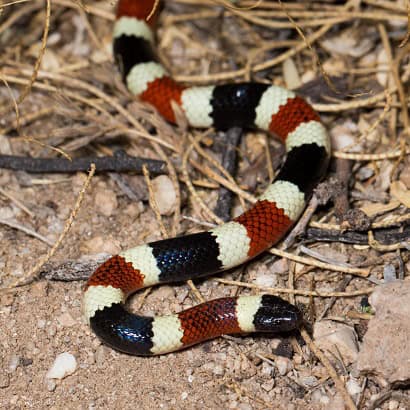
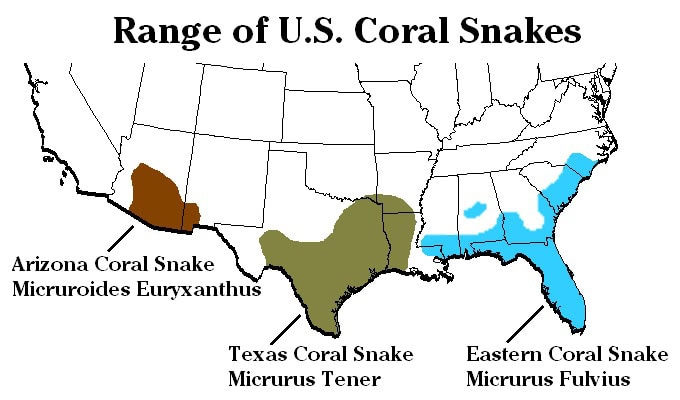
The US is home to 2 coral snakes of the vast Micrurus genus, which has 82 members, and to which virtually all western hemisphere coral snakes belong. These are the eastern coral snake of Florida, and the Texas coral snake further west. Both have a high chance of wiping out any unfortunate hiker or nature enthusiast they bite, due to their high levels of paralysing neurotoxins. However, the US also has a more unusual species: the Arizona coral snake (Micruroides euryxanthus), which is the sole member of the unique Micruroides genus.
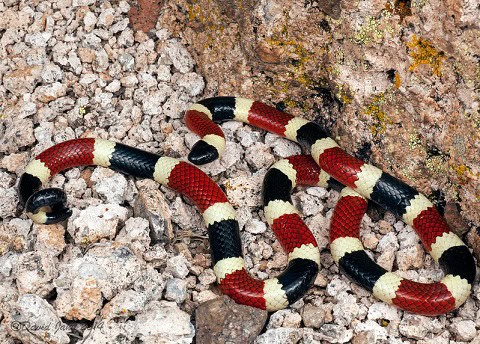
This species can be confused with many common US snakes, including the milk snake or ground snake. It features red, black and white bars in relatively even spacing, with the red always touching white. It’s easily separated from the lethal Texas coral snake by its mostly white pale bars instead of yellow. It’s believed that this species diverged from other coral snakes 18 million years ago.
Arizona coral snakes are found not just in Arizona, but western New Mexico and northwestern Mexico. They reach an all-time record of 66cm, with an average of 50cm. This species is undoubtedly dangerous, yet compared to its true coral snake cousins, all signs suggest a relatively weaker venom.
| 2 | Neurotoxic, but weaker than others |
Arizona coral snakes bite humans very rarely, particularly compared to the western diamondback rattlesnake, which inflicts the greatest number of US venomous snakebite deaths annually. One report of an Arizona coral snake bite involved a physician, who carefully noted his symptoms as they unfolded.
Within 3 hours, paresthesia (tingling) had spread to affect his entire arm. The next symptom was unusual, but normal for a heavily neurotoxic snake: the man’s handwriting deteriorated over the course of 6 hours, so that ultimately, it resembled the sloppy scribe of a 5 year old child.
The man soon experienced a headache and nausea, standard snakebite symptoms, but also a drooping of the eyelids and difficulty focusing his vision, which are typical neurotoxic effects. The man even walked into several doors by accident. Other symptoms included weakness, drowsiness and even memory loss, but no shortness of breath or accelerated heart rate.
All these symptoms came from a bite lasting just seconds, as the man had instantly ripped the Arizona coral snake away. The man ultimately survived, and walked away with new scientific discoveries about this common venomous species.
| 3 | Tiny venom yield |
According to official records, Arizona coral snakes only bit 12 humans from 2001 to 2005, although more cases have doubtlessly gone unrecorded. The bite is heavily neurotoxic, like the eastern and Texas coral snake, yet there may be effects which those species lack.
One victim was a 40 year old man, who experienced significant swelling and numbness on the arm where he was bitten. The eastern coral snake, meanwhile, often causes no swelling at all, or even local symptoms. This victim also experienced facial numbness, and a metallic taste in the mouth. There’s one other famous species for which metallic sensations have been recorded – the black mamba.
Despite this, the victim was discharged from hospital at just 13 hours post bite. One saving grace with the Arizona coral snake is a tiny venom yield of 6mg per bite, contrasting against 125mg for a cottonmouth. Its fangs are also particularly small, which makes injecting venom difficult.
Nevertheless, avoid picking up an Arizona coral snake unless it’s a complete emergency. One possibility is removing one from your bed, as this species has occasionally been found in buildings, probably attempting to escape the heat.
| 4 | A creature of dry semi-deserts |
Arizona coral snakes have no area of overlap with the Texas coral snake. They appear in two US states: Arizona and southwestern New Mexico, plus a swathe of Mexico, whereas Texas coral snakes are found in Texas, Arkansas and Louisiana, and fail to even reach New Mexico.
Appearing in Arizona, it isn’t surprising that this species avoids lush, grassy meadows. Instead, you can track down the Arizona coral snake (if you must) on deserted gravel flats and dry shrubby areas. They’re particularly common in arroyos, seasonally dried out stream beds, and in riparian habitats, adjacent to water courses.
Arizona coral snakes have a high tendency to burrow, lurking in secret underground soil tunnels, or below piles of rocks. They can reach high altitudes, appearing at 1900 metres in Arizona. Both low-lying plains and mountain slopes can be havens for this species.
This species can appear in harsh rocky deserts, though never fully fledged sand dunes. To the south, they’re common all over Sonora state, Mexico, plus western Chihuahua state. In the US, they’re abundant on the outskirts of Tucson and Phoenix.
| 5 | ID: red touches white, not black |
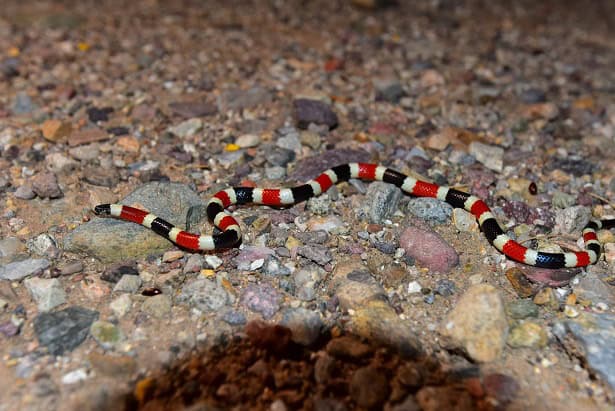
Arizona coral snakes have virtually no geographical variation in colour, as they’re a consistent white, black and red wherever they live, with the red and white always touching. Occasionally, you can find individuals with slightly yellower white bands than normal.
There’s more variation in patterns, as the thickness of the bars varies significantly. They’re usually relatively evenly spaced, but in this individual from central Mexico, the white bars are far thinner than usual, and even slightly wavy. Nevertheless, this isn’t a massively variable snake, like the predictably named variable coral snake (Micrurus diastema) of Guatemala.
Other ID signs of the Arizona coral snake include a purely black face, with no messy white stripes or dots. On the tail, the red bands completely disappear, giving way to alternating black and white.
In the US, this species doesn’t overlap with any coral snakes, and in Mexico, the only species they might overlap with is the West Mexican coral snake (Micrurus distans). This species also has red touching white, but compared to Micrurus euryxanthus, the red spaces are dramatically longer, and the white bands are razor thin.
| 6 | Lethal to lizards |
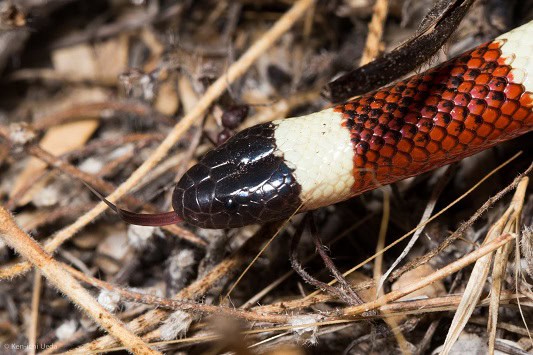
Though not deadly in humans, Arizona coral snakes act extremely rapidly against their chosen reptile prey. In one observation, an Arizona coral snake injected venom into a night lizard, at exactly 22:32. By 22:34, the lizard was already losing the usage of its hind legs. One minute later, they were fully paralysed, and the front legs were slightly paralysed. By 22:37, the lizard was breathing deeply and heavily, and lost the ability to balance. By 22:38, the lizard was dead, at just 6 minutes post bite.
Part of this is the smaller size of the lizard, but it’s also likely that Arizona coral snakes are specialised against lizard prey. For example, the aquatic coral snake has several specialisations. This is a river-dwelling species of Brazil, and tests revealed a toxin mixture unusually potent against fish and eels, but much weaker against mammals.
In one interesting finding from 1973, 16 preserved museum specimens of the Arizona coral snake were examined, and only 1 contained food. This species might struggle to acquire meals in the harsh deserts it calls home, or may be adapted to eating infrequently.
| 7 | Preys heavily on blind snakes |
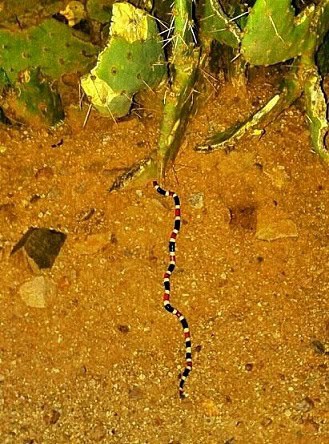
Arizona coral snakes are sometimes found lurking in the underground tunnel networks of blind snakes. This is partly to shelter from the sun, but also due to the simple fact that blind snakes comprise a large portion of their diet, particularly the western blind snake (Rena humilis).
Reptiles comprise the vast majority of this snake’s prey, and many fellow snakes have been recorded, including the night snake, ring-necked snake, western shovelnose snake, western black-headed snake and ground snake. In the dry shrubland and semi-deserts of Arizona, they have many meals to choose from. They also prey on lizards such as the western fence lizard.
This species is known to indulge in cannibalism, and scientists have found a liking for reptiles with smooth scales rather than rough. Even though the night lizard above was deactivated in 6 minutes, some prey can take up to 30-40 minutes to be defeated, partly because this species has an inefficient venom delivery system compared to many venomous snakes such as rattlesnakes.
| 8 | Always swallows by the head |
Despite having the ability to paralyse small reptiles, rendering them unable to escape, Arizona coral snakes often don’t envenomate their prey at all. In many feeding observations, prey have been chewed and held in place by the snake’s fangs, but had no visible puncture marks on their body.
Arizona coral snakes track their prey down using scent articles, detected using their tongue and analysed by their Jacobson’s organ. When they pick up the scent of a potential reptile meal, their tongue flecking noticeably accelerates.
Arizona coral snakes usually bite the lower body of their prey, without releasing their grip, preventing the meal from crawling away. Then they gradually walk their jaws closer to the prey’s head, chewing repeatedly. They nearly always swallow prey by the head, and once this is complete, they retreat to shelter. One meal of a western blind snake took 22 minutes to be fully swallowed.
Their reactions to rejected meals have also been observed. When offered a meal which they later ignore, Arizona coral snakes begin by flecking their tongue, but suddenly cease all flecking at once.
| 9 | Dangerous, but not aggressive |
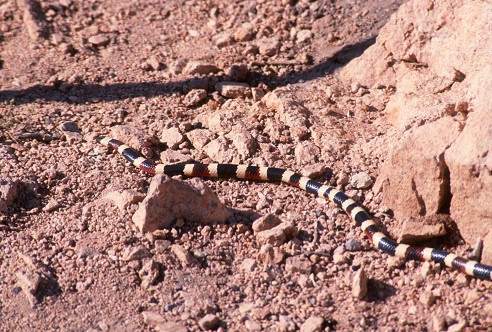
Arizona coral snakes attack in a side-sweeping motion and typically remain attached to their victims, chewing a venom in repeatedly. However, they aren’t mindless killers, and usually try a subtler defensive trick first: raising their tail in the air. Though not confirmed, the goal is assumed to be to distract from their head, and therefore brain, which they can’t live without, unlike their tail. A survey from 1973 found that 3 individuals had damaged tails.
Despite their neurotoxins, Arizona coral snakes are safe to walk past (without touching), and in Arizona or western New Mexico, their bright colours shouldn’t be cause for instant panic.
In captivity, meanwhile, this species fares poorly. While one individual lasted for 10 years, and another 3 years and 8 months at San Diego Zoo, the majority die rapidly, as their Arizona semi-desert biomes may be too complex to replicate in a simple terrarium.
Arizona coral snakes produce small egg totals, typically numbering just 3. Hatchlings measure 18-20cm, and are venomous from birth, like virtually all venomous snakes. The eggs are laid in similar places to where they lurk in the day, such as underground burrows and below rock piles.
| 10 | New locations are being discovered |
Though Arizona coral snakes are common in western Mexico, they don’t come close to Central American countries such as Guatemala and Belize. However, a 2017 observation extended their territory significantly to the south, showing that there are still pockets of this species waiting to be stumbled across.
The setting was Jalisco state, western Mexico. Scientists found a dried out Arizona coral snake measuring 39.8cm on a slope near tropical deciduous forests. The snake was dead, and as no viable roads passed though the area, the scientists assumed that grazing cattle had stomped the snake to death.
Although Arizona coral snakes were previously known in the state, this scenic observation extended its confirmed territory 81km to the southwest. This was only the 3rd Arizona coral snake ever found in Jalisco state.
Meanwhile, the northernmost reaches of this species lie in central Arizona. Though not confirmed, there’s a slight chance that they inhabit California, as they’ve been observed from near the Colorado River Reservation close to the border in far western Arizona.