
| 1 | Harmless and easily recognisable |
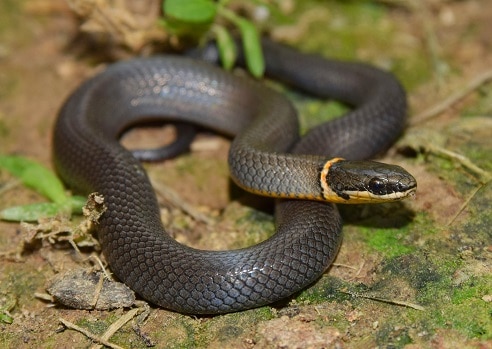
In the eastern USA, from the early period of starving colonists, to the modern era of high speed internet and fast cars, one fact of life has always been unavoidable – the ringneck snake (Diadophis punctatus).
The ring-necked snake is a harmless species averaging at just 30cm, which naturally appears in woodlands, and has a strong tendency to lurk under cover objects. It’s easily recognisable by its namesake ring, and in rural America, it’s almost impossible not to meet one over the course of your life. So many people have stories of their Granddads lifting up a rock and flushing out a whole family, or finding a lost and confused one in their garage.
Fortunately, this super common snake is also completely harmless. The ring-necked snake possesses sharp fangs, but these are too small to pierce human skin. Its saliva contains a weak venom, but is incapable of causing damage, even if it could enter the body.
There are no recorded hospitalisations from ring-necked snake encounters, let alone deaths. They often produce a foul smelling musk when picked up by a curious kid or farmer, but almost never bite – with one exception. Scientists have found that touching the base of a ring-necked snake’s head triggers a bite almost without fail. They discovered this by accident, as they were actually trying to grasp the snakes’ heads while measuring them.
The theory is that this evolved against a predator which specifically targets its neck, possibly a larger snake like the eastern coral snake. Either way, the bite is barely as painful as a bee sting.
| 2 | Dozens in a few square metres |
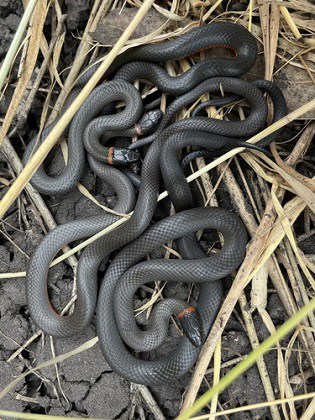
Ring-necked snakes have a huge range, covering all but 3 states of the mainland USA. They’re particularly common in the eastern half, from Florida to Maine, but are also abundant on the west coast in California and Oregon. The only three states they’re absent from are Montana, Wyoming and North Dakota.
Across some vast stretches, such as in western Texas and New Mexico, ring-necked snakes can be uncommon. But in other zones, they can swell to vast colonies and become the single most common reptile, not just snake.
One time, herpetologist Henry Fitch was examining a flat, 4.2 hectare hilltop in eastern Kansas, bordered by rocky cliffs. In just 30 minutes, he managed to discover 279 ring-necked snakes, lurking under sheet metal. Researchers Dundee and Miller had a similar story in 1968, when they discovered 300 ring-necks in a narrow zone in just under 1 hour. This was again in Kansas, this time Douglas County.
The ring-necked snake is one of the more social US species, and during winter, dozens will brumate (the snake version of hibernation) together at once. They also share these winter living quarters with other species, including black racers and ratsnakes.
| 3 | Pops up in weird places |

Forests are a top habitat of the ring-necked snake, and particularly moist areas within moderately thick forests. Ditches, ponds and muddy areas with discarded sheet metal are prime areas to spot this species. Fields on the outskirts of forests are another hotspot, and they’re particularly fond of cattle fields.
That said, ring-necked snakes can pop up almost anywhere, and that includes the magical walkways of Walt Disney World. In October 2020, a happy tourist bumped into a small black snake right outside Splash Mountain in the Magic Kingdom.
Keeping a safe distance, he summoned a cast member, who decided that it was a harmless black racer. However, internet dwellers later spotted the signature neck ring and realised that it was actually Diadophis punctatus.
The ring-necked snake is also a confirmed species to appear on “Snake Road” in Shawnee National Forest, Illinois, the only road in the world to be closed for annual snake migrations. This road bisects a boggy swamp to the west, and towering limestone cliffs to the east, which are perfect for winter hibernation. These snake migrations can take up to 2 months, and before the road was closed, many were killed by locals in cars. Here, the ring-necked snake coexists with venomous cottonmouths, the species the road is most famous for.
| 4 | A rare ant-eating snake |
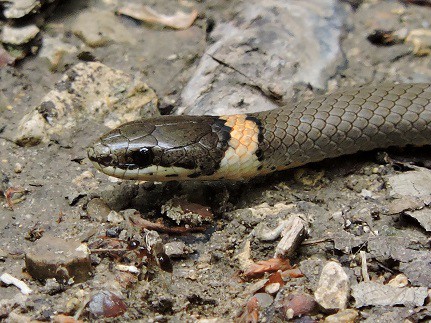
Ring-necked snakes are tiny. The longest ever reached 85.7cm (a member of the regal subspecies), but that was an extreme exception, and the average length is just 25-38cm. Their bodies are thin, meaning that unlike a puff adder, there’s no extreme thickness to compensate.
Consequently, ring-necked snakes eat a diet of worms, slugs, and insects, since they literally can’t fit anything larger in their body. Their diet varies massively by region, as those in Michigan eat the red-backed salamander almost exclusively. This amphibian measures 5-10cm, and does indeed have a red back.
In Virginia, a 1939 study found a diet of 80% salamanders, 15% ants, and 5% assorted insects and grubs. Another study examined Big Black Mountain in eastern Kentucky, and again found a salamander-munching bonanza.
But in northeast Kansas, Henry Fitch found that ring-necked snakes ate earthworms almost exclusively. In the arid parts of Texas, they’re more reliant on small lizards and even the tiniest snakes. Ring-necked snakes aren’t fussy eaters; the main controllers are size and opportunity.
| 5 | Relations with other snakes |
Nobody can agree on whether there’s a Head Snake on planet Earth. The king cobra is a candidate, or maybe the reticulated python with its longest length. Most likely, it’s a 50 foot basilisk lying undiscovered in roasting hot tunnels just below the Earth’s crust. But one thing guaranteed is that the ring-necked snake is pretty low on the hierarchy.
Being 30cm, ring-necks are regularly eaten by a host of other species. Henry Fitch spent 20 years monitoring ring-necked snakes, and found that the copperhead was their single most common predator (35 times), followed by the eastern racer (15), milk snake (2), and timber rattlesnake (just once). Somehow, the copperhead has a particular taste for them, or perhaps they bump into each other more than usual.
The one snake which ring-necked snakes are confirmed to eat is Brahminy’s blind snake, an invasive species which burrows its way through soft soils. At 10cm, this is one of the smallest snakes in the world – some say the second shortest. It looks more like a small black worm than a real snake, making it a perfect ring-necked snake snack.
| 6 | All about the neck ring |
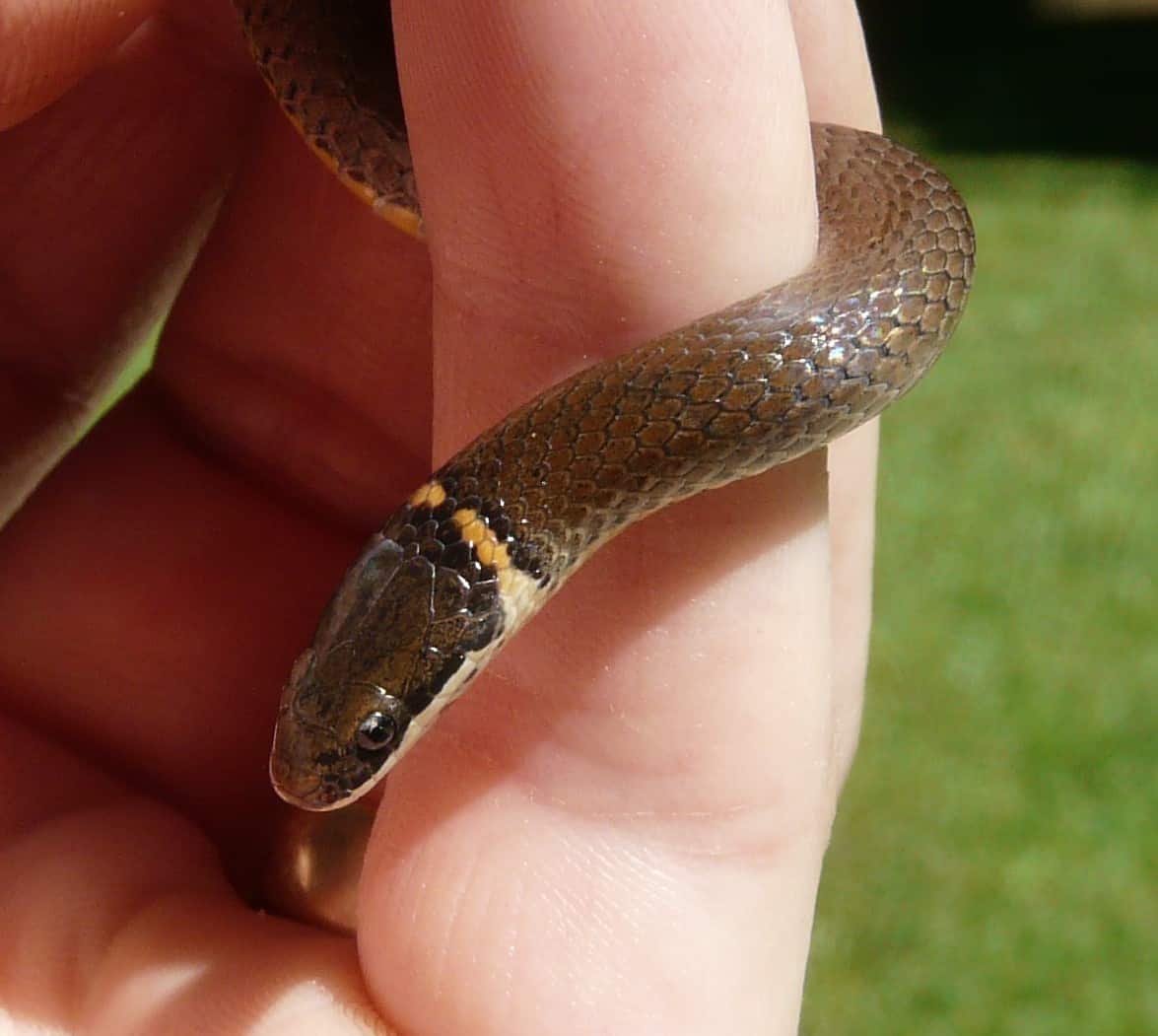
The ring-necked snake has 14 different subspecies under its umbrella. Most of the differences involve subtle scale variations, but the signature neck ring is the exception.
In the northern ring-necked snake, which stretches from northern Florida to Ontario, the ring is white/cream coloured and completely unbroken. In the equally common Mississippi ring-necked snake, the ring is much thinner and sometimes broken. The southern ring-neck found in Florida often has gaps in the middle, while the Florida keys version (very rare) has only an extremely faint ring.
The ring is the only distinguishing feature of this species. Its black colouring could easily be mistaken for a mud snake or an eastern racer (as happened at Splash Mountain).
From above, ring-necked snakes have no noticeable patterns, and are either a solid black, dark grey, or very dark blue. Their belly is more interesting, with solid red colour blocks. Be wary of some internet pictures; the colours are often ultra-saturated and make the species look more vibrant than it really is.
| 7 | Vanishes in July and August |
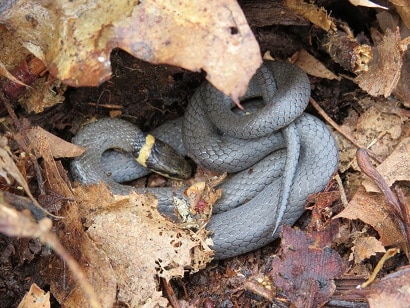
Ring-necked snakes are normally spotted lurking under shelter, like leaf litter, log piles, or warm rocks. But their favourite shelter is sheet metal, which they’re drawn to like a magnet. Whether lying in someone’s back garden or dumped on a country road, ring-necked snakes will spend hours lying below these artificial metallic shelters.
Sheet metal absorbs sunlight particularly well, and ring-necks like to lie with their backs gently touching the metal’s underside, to absorb the heat. On the hottest days, these sheet metal shelters become too warm, and the ring-necks flee to avoid roasting. In fact, it’s rare to spot this species during summer at all.
Ring-necked snakes are more sensitive to dry weather than average, and will always ensure that a stream or pond is nearby, even if they don’t live in it. Summer is when they vanish underground, invading vole or gopher burrows. Ring-necked snakes aren’t true burrowers, lacking the special spade-like nose. Instead, they invade existing burrows and power through the loose soil filling the tunnels.
| 8 | Ant alliances |

These tunnelling tendencies show up in the ring-necked snake’s physical appearance. Its body is long, its head is narrow, and its eyes are beady and small.
In the southern US, ring-necked snakes regularly live alongside swarming civilisations of ants. In 1936, Raymond Ditmars walked around a forest and started pulling the rotting bark from trees. Time and time again, a swarm of ants would burst out, followed by a sleepy ring-necked snake. He even found one ringneck inside an anthill itself.
Whether it’s their dislike of open spaces, or an innate ability to sense danger, ring-necked snakes have an advantage over many species – they tend to avoid roads. It’s much rarer to find them as roadkill compared to corn snakes or smooth green snakes. Ring-necked snakes normally stick to a home range of 70 metres, but when the itch strikes, they’re known to travel 200 feet in a single day, or even up to a mile.
| 9 | Takes hours to immobilise prey |
The ring-necked snake possesses venom, but is one of many rear-fanged species. Instead of a one-and-done venom injection through its front fangs, accomplished in a split second where you try to dodge, the ring-neck produces a slow and steady stream through its back teeth, created by a Duvernoy’s gland, which in this species is located directly behind its eye.
There’s no injection function, so the venom must instead soak into a dry fang wound. The ring-neck must chew relentlessly to force the venom in, which runs down its back teeth through miniature canals. Many species use this “manual” system, but the difference is how agonisingly slow the ring-neck is.
The red-necked keelback of Thailand can send a human to hospital after 2 minutes of chewing, but the ring-necked snake once chewed its prey for 375 minute before it was immobilised. 40 minutes of chewing is perfectly normal. The ringneck snake compensates by having an iron constriction grip, preventing the prey from wriggling free.
| 10 | Startles birds with bright colours |
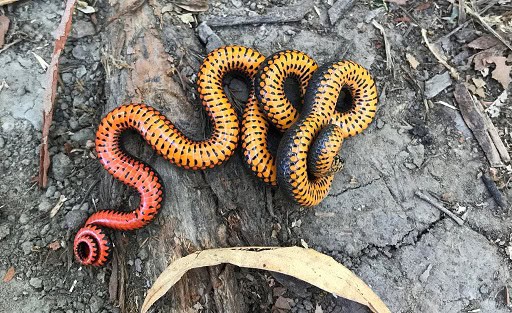
There are many ways to escape a predator in this world. Some snakes might spin 180 degrees and blast off into the undergrowth, some might change colour and blend into a tree, while others might bite back viciously.
The ring-necked snake, meanwhile, has settled on curling its tail into a corkscrew shape and displaying its bright red colours (known as tail spiralling). Ring-necks are commonly hunted by red-tailed hawks and broad-winged hawks, and these crafty birds aren’t stupid enough to be fooled for long.
But when shown bright colours in a quick flash, colours which could originate from the most venomous of snakes, it’s enough to startle them for a split second and buy the ring-necked snake the time it needs to slither away. Once inside a dark tunnel or rotting log, the snake is out of the bird’s reach. Not all ring-necked snakes use this tactic; those with yellow bellies don’t bother, including the Mississippi subspecies.
Releasing a foul-smelling musky substance is another of this species’ tactics, as is playing dead, as it rolls over onto its back and goes completely limp. Ring-necked snakes commonly hide their head within their coils as well, to protect the brain. Ring-necked snakes almost never bite predators except when gripped behind the head.