
| 1 | Brazilian smooth snake |
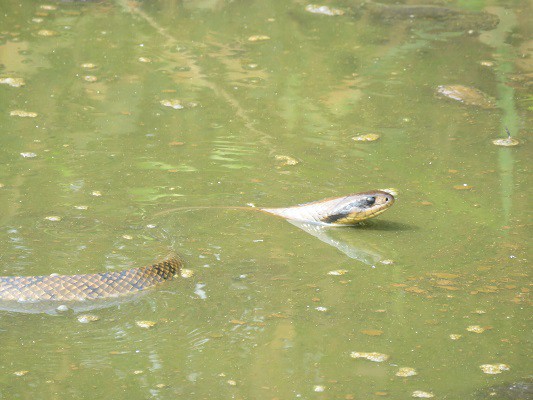
Maximum length: 3 metres.
A cannibalistic snake of southern Brazil, Argentina and Paraguay. This large species is so notorious for eating its fellow kind that reptile keepers warn beginners never to keep two in the same cage.
The Brazilian smooth snake (Hydrodynastes gigas) is a semi-aquatic species, which mainly appears in rivers, wetlands, marshes and swamps. This species isn’t passionate about cannibalism, and doesn’t conduct chanting rituals in caves like humans. The real motivation is simpler: this species is ruthless, and will eat virtually anything in order to survive.
Brazilian smooth snakes have a dietary breakdown of 30-40% amphibians, followed by reptiles at 20-30%. Mammals and fish also make up a decent share. They have a mild venom suitable for subduing small prey, and often prey on snakes such as the leopard keelback and golden liophis. Fellow Brazilian smooth snakes are granted no exemption.
The Brazilian smooth snake rolls forward like a tank and swallows its kin without thinking. This snake poses little threat to human beings, despite measuring 2-3 metres, but can bite painfully if repeatedly bothered. Another of its skills is playing dead; in fact, this is one of the largest-death faking snakes on Earth (most are smaller).
| 2 | Puerto Rican boa |
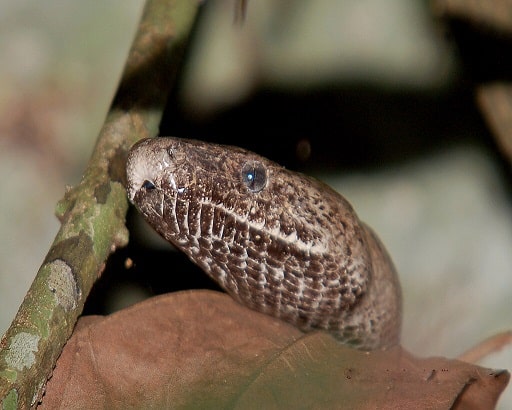
Maximum length: 241cm (at least).
A completely non-venomous species, but one with a reputation for sudden aggression in captivity. Worse, the Puerto Rican boa is confirmed to commit the grotesque act of cannibalism.
In 2004, scientists witnessed an adult measuring 100-150cm swallow up a juvenile measuring 50cm, on a karst valley floor. The boa swallowed its kin by the head, and had a full quarter swallowed when the scientists first appeared. They published their findings in Herpetological Review.
Puerto Rican boas live solely on their namesake island, particularly in karst cave regions. They move at moderate speeds, but occasionally accelerate in sudden bursts. Other confirmed prey include fruit bats, black rats, and Evermann’s anoles.
One reason for their cannibalism is that snakes have no protective instincts. Social animals such as sheep and bees have a natural instinct to defend each other. This isn’t necessarily intelligence-based, but using animal instinct, recognising a creature that looks like them.
Meanwhile, snakes couldn’t care less about their fellows (with a handful of exceptions). They’re solitary creatures, and keeping a smaller, weaker snake alive doesn’t factor into their thinking. If possible, they’d rather eat them.
| 3 | Chilean long-tailed snake |
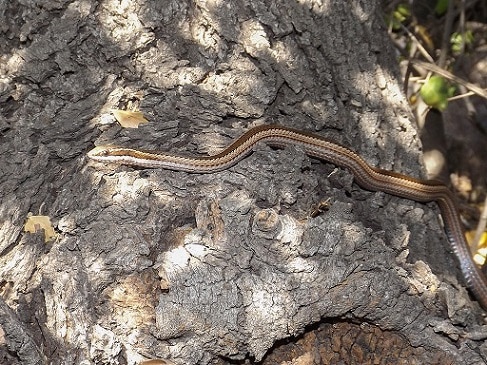
Maximum length: 220cm.
This Chilean snake has no qualms about eating its fellow kind whatsoever. In 2018, scientists witnessed its cannibalistic ways first hand. They were walking past a small stream in Chile’s Valparaíso Region, when they saw a fully grown Chilean long-tailed snake swallowing a smaller one.
60 minutes later, the swallowing was almost complete, but the snake was spooked by the scientists, and regurgitated its smaller meal. Miraculously, it was still alive, and the two continued to duel, before fleeing in opposite directions.
This species lives both in forests and grassland, and primarily eats lizards, adding mammals as it gains size. When committing cannibalism, its hunting style is identical to normal. The Chilean-long tailed snake moves steadily behind resting prey, gaining centimetre by centimetre. It’s an immensely patient species, and only pounces when it reaches virtually infallible range.
Chilean long-tailed snakes are mainly active at night, and are flexible in their lifestyle, slithering along the ground or zipping along narrow tree branches. This species is found solely in Chile, and often invades people’s houses.
| 4 | Cyprus black whip snake |
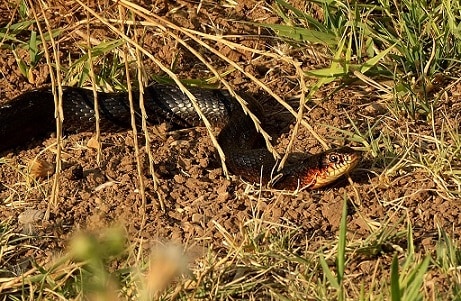
Maximum length: 250cm.
One of the most common snakes in Israel, Cyprus and Lebanon. Black whipsnakes (Dolichophis jugularis) typically measure 2 metres, and are everywhere in certain stony fields. Apparently, they’ve decided that there’s no risk in eating each other, just a little bit.
Black whipsnakes are completely non-venomous, and farmers used to trade them in olden times, for their beneficial effects on rodent populations. As well as black rats, goldfinches and snake-eyed lizards, black whipsnakes are confirmed to eat each other, for a helping of protein and nutrients like zinc.
It’s unlikely that fellow species members have any special nutritional advantage (even if they’re built with the exact same nutrients). Snakes are creatures of convenience, and even though they don’t all stoop to cannibalism, they’ll always take an easy meal rather than one which takes effort. If they don’t take easy sources of calories when they can, they’ll be outcompeted by more ruthless snakes nearby.
Black whipsnakes have never killed a human, but are extremely aggressive, producing an intimidating hiss and gaping their mouths widely. One of their characteristics is an ontogenetic colour change, as they grow steadily blacker and blacker with age.
| 5 | Smooth snake |
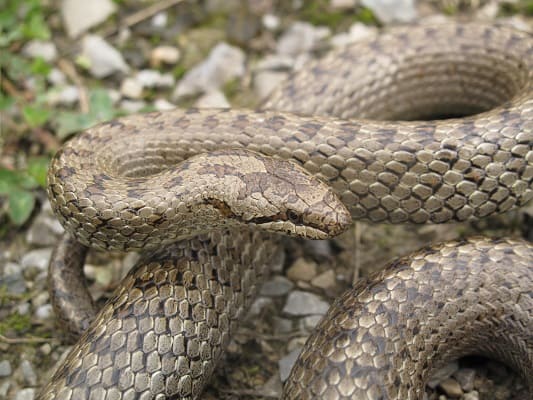
Maximum length: 92cm.
The smooth snake ranges from British heathland to northern Turkey, and derives most of its calories from reptiles like slow worms and common lizards. Occasionally, this needs supplementation, and therefore, the smooth snake (Coronella austriaca) makes the easy decision to swallow up its fellow kind.
Smooth snakes use a hybrid hunting style, combining pursuit and ambush. They position themselves in tangled heath strands, and follow their prey after they stroll past rather than instantly pouncing. The main determiner of prey is accessibility, not species, and consequently, smooth snakes have no problem with mindlessly swallowing each other.
The smooth snake would probably commit cannibalism if it was one of 2 surviving individuals of its species on Earth. Even if they were stranded in one tiny heathland patch which was about to be removed in a controlled wildfire, they would probably slither over and eat each other without thinking.
This species can live nearly 30 years, but thanks to its mid-ranking place in the food chain, it’s regularly gobbled up by pheasants, foxes and badgers.
| 6 | Mulga |
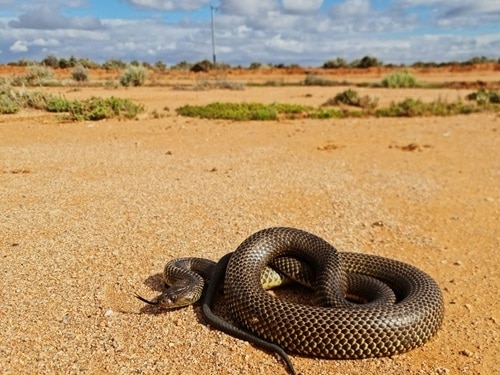
Maximum length: 3.3 metres.
The mulga is already a brutal snake, injecting 400mg of venom per bite and charging at victims in a wild rage. So cannibalism probably feels like nothing special, as the species delves ever further into the dark arts.
The mulga, AKA king brown snake, is the longest venomous snake in Australia, and has a very wide diet. Its confirmed meals include geckos, skinks and mammals, as well as unrelated snakes such as crowned snakes.
A mulga could swallow a black-headed snake, and seconds later be swallowed by an even bigger mulga. This species has multiple observations of it eating its own kind. Mulgas are even known to eat roadkill and the shed skins of fellow reptiles.
Mulgas don’t shy away from interspecies aggression in general, as males are constantly wrestling, intertwining their necks with all sinews straining. These battles can last for 2 hours, with nothing but dust on the horizon. Mulgas also invade human towns, particularly Alice Springs, where they lunge at unsuspecting people as they stow their bicycles away.
| 7 | Montpellier snake |
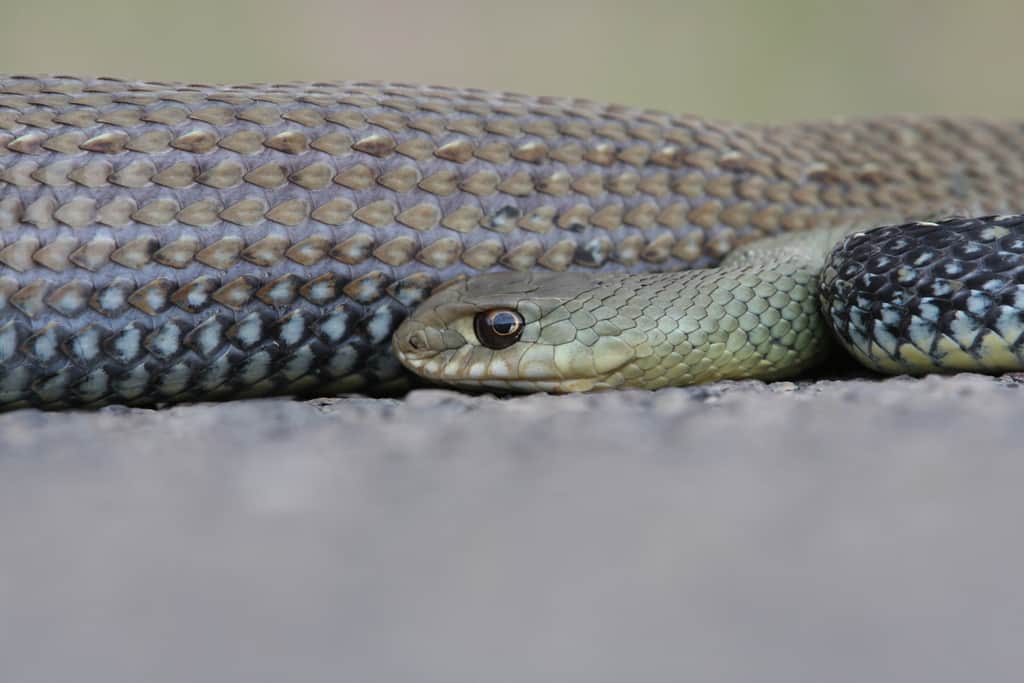
Maximum length: 216.2cm.
This mildly venomous snake devours all in its path, including wood mice, Algerian sand racers and European rabbits. Cannibalism is the next logical step, one which it gladly takes. Montpellier snakes live in virtually all of Spain, where they’re the 2nd longest native snake, regularly exceeding 2 metres. They’re a confident and adventurous species, moving around freely in full view.
The Montpellier snake has a no holds barred, anything goes philosophy, and this extends to eating members of its own species. This Spanish snake is willing to try anything once, or maybe dozens of times if it approves.
It isn’t as though Montpellier snakes are unable to recognise each other, as their scent apparatus is far more sophisticated than a human’s. Snakes need scent particles to identify each other when breeding. They simply consider belonging to the same species to be irrelevant, and gobble down their meal with enthusiasm.
Another disturbing possibility is that cannibalistic snakes are more attuned to their fellow species members, making them easier to hunt. The Montpellier snake licks its lips, and slithers off for a meal which is virtually impossible to miss.
| 8 | Western Galapagos racer |
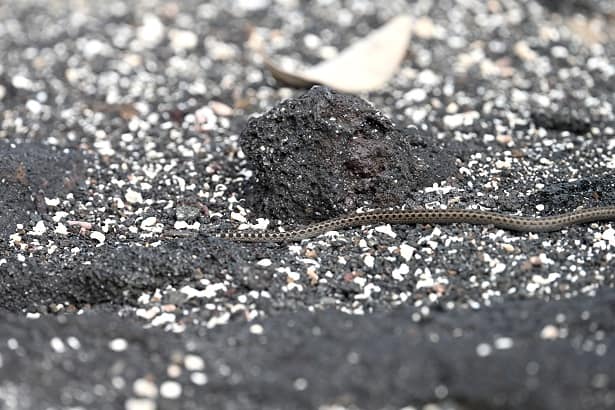
Maximum length: 128.5cm.
This species faces endless predators on its namesake island, including owls, centipedes and mockingbirds. Worst of all, even its own species is attempting to eat them. Nor can they complain, as western Galapagos racers (Pseudalsophis occidentalis) regularly give in to the temptations of cannibalism themselves.
This species occurs solely on the Galapagos Islands, and primarily feeds on reptiles, such as Galápagos leaf-toed geckos and Isabela lava lizards. Most of its life is spent on the ground, following subtle scent trails.
Though the percentage isn’t huge, Galapagos racers were proven in 2021 to eat each other, in a study examining 93 racers captured at Cape Douglas, Fernandina Island. If a fellow species member catches its eye and is in a strategic location, then the Galapagos racer will slither up and swallow it whole, with no loyalty whatsoever.
Galapagos racers live in arid shrubland and deciduous woodlands, which makes fulfilling their cannibalistic fantasies all the more easy, giving them cover to advance and burst forward at the very last second. Galapagos racers live in relatively isolated locations, and scientists are only just uncovering their secrets.
| 9 | New Guinea small-eyed snake |
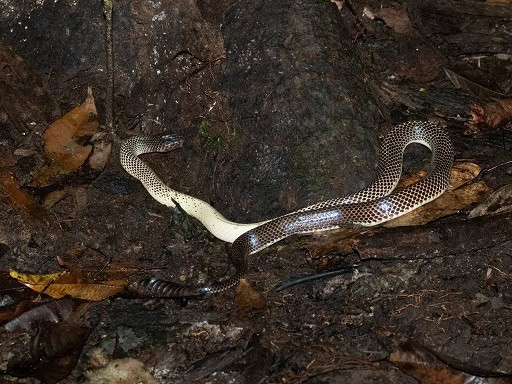
Maximum length: 2.1 metres.
The New Guinea small-eyed snake (Micropechis ikaheka) either doesn’t realise that it’s eating fellow members of its species, or just doesn’t care. This cannibalistic snake lives in deep parts of the world, which appear in low detail on maps, and are only under tenuous control by mankind.
Such places are home to the more extreme elements of nature, and Micropechis ikaheka fulfils this by swallowing members of its own species whole. Its heartlands include New Guinea and nearby islands like Karkar Island, in low-lying marshes and forests, sometimes beneath piles of coconut husks.
This species unhinges its jaws wide, starts with the head, and waits until the snake is completely swallowed before beginning the digestion process. This cannibalistic meal can sustain it for weeks, until its snake hunger hormones start cranking back up again.
New Guinea small-eyed snakes are aggressive, and a bite to a human thumb can kill within 36 hours. They’re flexible rather than restricted to one dietary niche, feeding on frogs, lizards and mammals alike. They appear in both halves of the island: Indonesia to the west and Papua New Guinea to the east.
| 10 | California kingsnake |
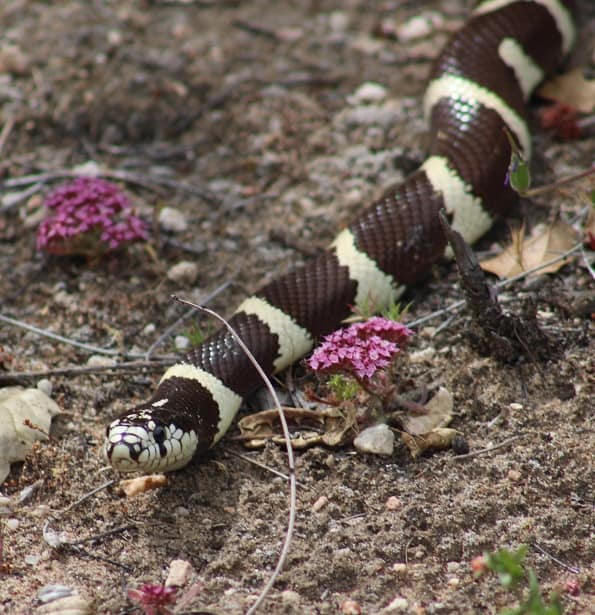
Maximum length: 142.2cm (2 metres on certain islands).
The California kingsnake (Lampropeltis californiae) is a species of the southwestern US, inhabiting mainly open areas such as grassland or dry plains. It has no venom whatsoever, and poses little threat to humans, killing its prey via grappling and pinning.
This species already has a taste for other snakes, as long as they can slot neatly into its belly. Its hunger is all-consuming, and fellow species members don’t escape its roving eye.
California kingsnakes have been spotted eating gopher snakes, sidewinders and Pacific rattlesnakes, so they have no preference for eating each other, but nor do they have a problem with it. They swallow their snake prey by the head, slotting them neatly into their own elongated body. They mainly move by day, and are active foragers rather than ambushers.
California kingsnakes generally aim for species members smaller than themselves, out of simple convenience. It’s easier to cannibalise snakes smaller and weaker than themselves – that’s one of nature’s brutal laws. Supposedly, kingsnakes will even try to eat themselves if hungry enough.