
| 1 | Everywhere in southeast Asia |
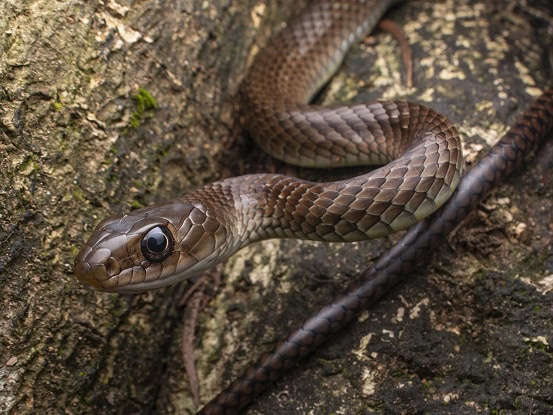
The Indo-Chinese ratsnake (Ptyas korros) is a common species of southeast Asia, which lacks any form of venom, and has an agile and energetic personality. It’s one of 9 members of the Ptyas ratsnake genus worldwide, which also includes the oriental ratsnake of Thailand, and the Chinese green snake further north, both of which are also non-venomous.
The main notable feature of the Indo-Chinese ratsnake is being one of the most common snakes in southeast Asia. This species has a truly vast empire, covering most areas of Thailand, Malaysia, Indonesia and Cambodia alike. It’s a common resident in towns and villages, paying little attention to passing human beings, despite regularly cause people to scatter in panic.
Indo-Chinese ratsnakes stretch to all sorts of distant corners of southeast Asia, including the Himalayan mountains of eastern Nepal, to the humid villages of Java and Bali. In Bangkok, they’re in full control, and likewise in Phuket, Pattaya and Kuala Lumpur.
At first, it’s hard to determine how this species became so successful, as it lacks any particular gimmick or special feature. Nor does it possess a lethal neurotoxic venom, or in fact any kind of venom. Instead, this species excels by possessing endless different skills, and being exceptionally flexible.
| 2 | Fast-moving and agile |
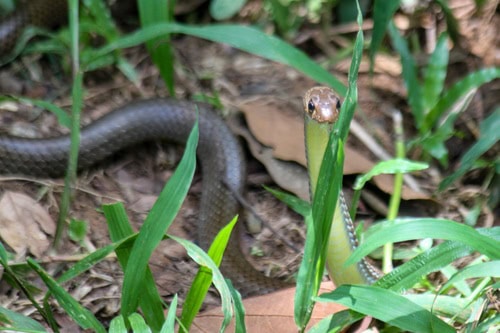
The Indo-Chinese ratsnake ticks many of the boxes required to become an all-powerful snake. Firstly, this species is very long, at an average of 120-200cm, and a confirmed maximum of 268cm. This is significantly longer than the monocled cobra, Thailand’s main cobra, which maxes out at 230cm. This species also has a very thin body, which gives it the illusion of being even longer.
Secondly, Indo-Chinese ratsnakes are excellent tree climbers, aided by a long whippy tail. They’re often found on branches 2-3 metres high, smiling down at you, and giving no explanation of what snake scheme they’re currently following.
Indo-Chinese ratsnakes also have unusually large eyes, which enhance their hunting abilities. They move quickly, not just when fleeing from danger, but when calmly exploring the countryside. Even their habitats are flexible, as Indo-Chinese ratsnakes cross rivers and marshes effortlessly, and are more than comfortable in manmade crop fields.
In certain areas, this species can be extremely abundant. The author of this old 1915 report mentioned finding 12 Indo-Chinese ratsnakes in Bangkok within 1 hour. Nevertheless, this species has a strong correlation with rainy weather. When the wet season fades right on cue each year, the local Indo-Chinese ratsnakes often vanish, becoming far less common, retreating to wetter areas in the Thai countryside.
| 3 | Flees fast or bites fast |
The Indo-Chinese ratsnake is an easily survivable snake, without an ounce of venom. The only way this species could possibly kill you is via a heart attack, or perhaps a bite wound growing bacterially infected. When confronted, Indo-Chinese ratsnakes usually flee. They’re able to blast off into thick undergrowth faster than anyone can comprehend, like an apparition.
Nevertheless, if its movement is impeded, this species will move in the only direction available: forward. Indo-Chinese ratsnakes would rather not fight, but they have aggression in their veins, and use it in certain circumstances. Their teeth are sharp, and their bite painful, more than capable of drawing blood.
If picked up, Indochinese ratsnakes will typically thrash wildly in your hands, making them difficult to hold onto, particularly given their 2 metre length. Some individuals will calm down rapidly while being handled, while others will refuse to be tamed.
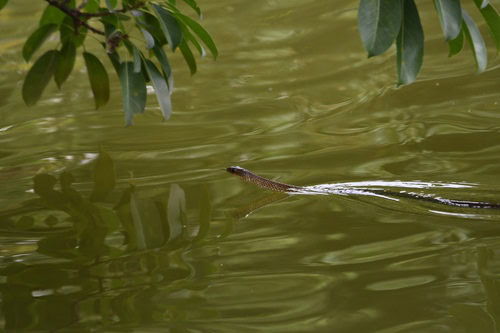
Another skill of the Indochinese ratsnake is enlarging its neck, not sideways like a cobra, but vertically, with the goal of intimidation. If close to a lake or stream, a spooked Indochinese ratsnake will plunge deep into the water, before re-emerging with its head up, swimming away at a breakneck pace.
| 4 | An ally of farmers |
Indo-Chinese ratsnakes lives up to their name, and spend a great deal of their lives devouring rodents. They have a particularly flexible diet, eating confirmed prey such as Hong Kong paa frogs, Asian grass frogs and common house geckos. But they also eat the likes of Tanezumi rats (Rattus tanezumi) and Malayan field rats (R. tiomanicus).
In fact, it’s believed that the Indonesian trade in Ptyas korros has caused local agriculture to suffer, due to the increased rodent swarms. These snakes are prized for their skins, thus reducing the predatory pressure on small mammal pests.
Near Yogyakarta, Indonesia, there’s even been a movement for farmers to re-release Indo-Chinese ratsnakes onto their fields, particularly in Sleman Regency. With their liking for water, they’re particularly beneficial in rice paddies.
The keen scent apparatus and tongue flecking of a ratsnake is superior to any human mousetrap. Another prey incident involved a many-striped skink, found inside the stomach of an Indochinese ratnsnake in 2016 in Yunnan province, China. This lizard can detach its tail to escape predators, yet both the lizard and its severed tail were found inside the larger snake. It was theorised that the ratsnake swallowed the main meal, then spotted the tail lying on the ground and enjoyed an extra snack.
| 5 | Comparison: oriental ratsnake |
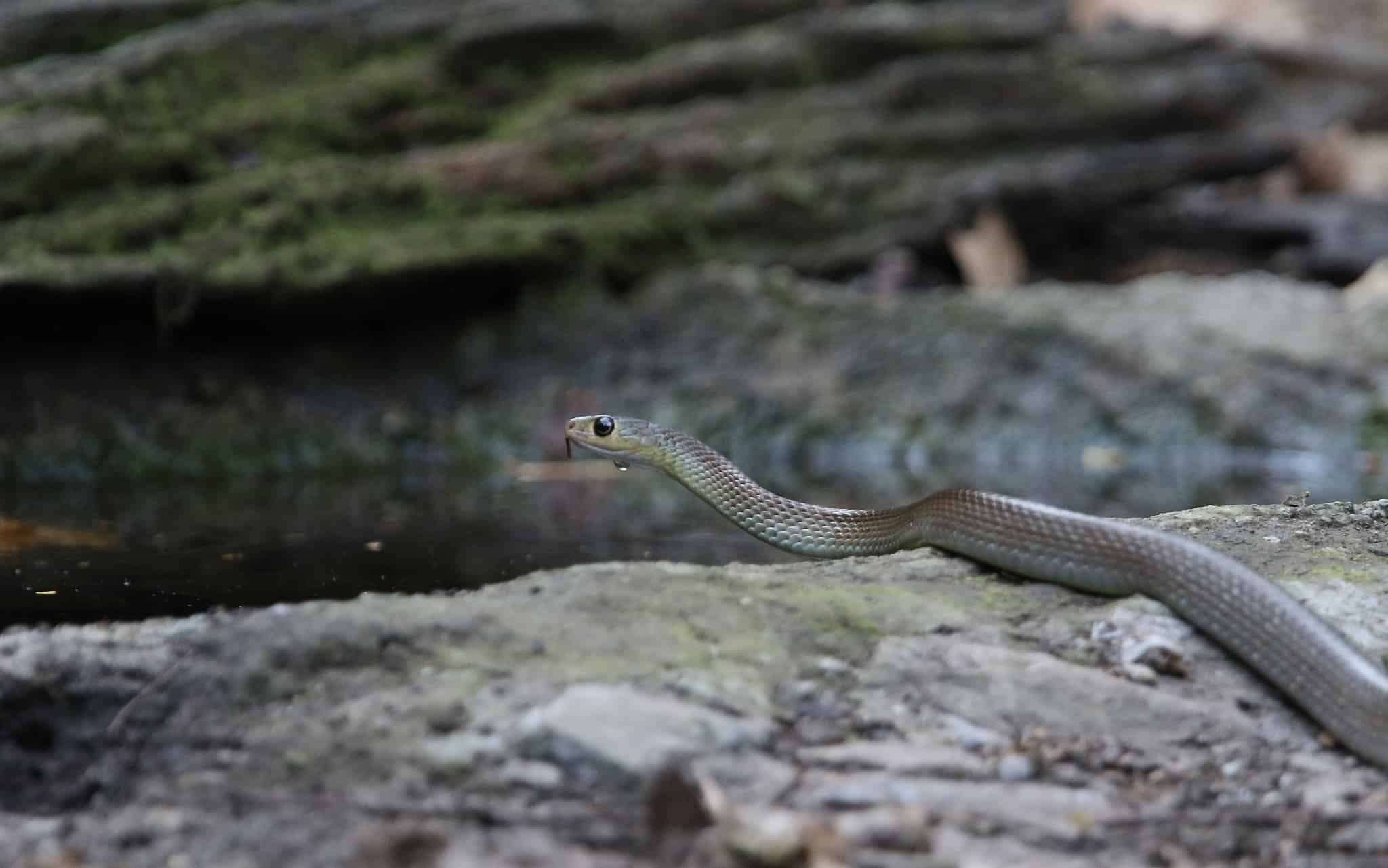
The Ptyas ratsnake family has 13 members. Rare ones include Doria’s green ratsnake, but the two most common are easily the Indo-Chinese ratsnake and oriental ratsnake (Ptyas mucosa). In fact, the two have a huge overlap. Both inhabit Thailand, Vietnam, Cambodia, peninsular Malaysia and parts of Indonesia.
The difference is that oriental ratsnakes inhabit most of India, while Ptyas korros covers only the extreme northeast (Assam state). Meanwhile, Indo-Chinese ratsnakes are overwhelmingly more common in Java, and Indonesia overall. They’re the only species to inhabit Borneo and Sumatra, and they’re more common in southern Vietnam, particularly in Ho Chi Mingh City. Both species inhabit Hong Kong.
In Bangkok, you could meet these species within minutes of each other. Physically, Indo-Chinese ratsnakes are recognisable by their much cleaner body patterns. Oriental ratsnakes have broken black bands which kick in on their lower half, while Ptyas korros only have fine, very subtle markings. The best ID sign of all is the facial markings. Oriental ratsnakes have subtle dark lines spreading downwards from their mouth, while Indo-Chinese ratsnakes have a far cleaner-looking face. Indo-Chinese ratsnakes are also more likely to have a bright yellow, almost fluorescent belly.
The two differ by habitat, as oriental ratsnakes stick to drier lands, while Indo-Chinese ratsnakes correlate more closely with riversides and marshy areas. However, neither rule is set in stone.
| 6 | A popular soup ingredient |
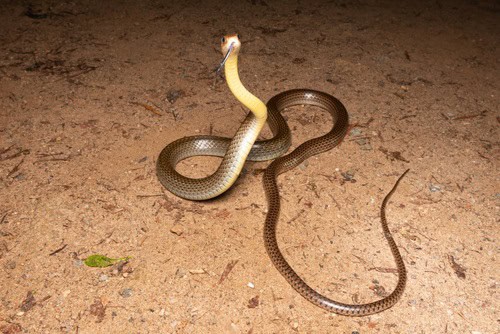
Indo-Chinese ratsnakes are a hot commodity, not so much in western countries (unlike reticulated pythons), but in eastern Asia, for cuisine and medicine. Many are caught from the wild, and many more are reared in breeding facilities.
For example, a CITEs survey of Vietnamese snake farms found that in 2014, 76,247 Ptyas korros were being held across the country, in 109 farms. This was only beaten by a few species, such as the oriental ratsnake, with 210,685 individuals in 1141 farms, and the Chinese and monocled cobras, which collectively made up 406,987 individuals in 1461 farms.
Indo-Chinese ratsnakes are especially popular (especially delicious?) in soup form. Street vendors selling snake meat and snake soup are perfectly normal in Hong Kong, not worth raising an eyebrow about. Ratsnakes are traditionally eaten in Hong Kong as a winter warmer, and theorised by Traditional Chinese Medicine to calm arthritis and improve circulation.
A 2023 study quizzed Hong Kong soup vendors, and found that 79% of shops served soup containing Indo-Chinese ratsnakes. 57% served neurotoxic banded kraits in soup, and 43% oriental ratsnakes. Flowered ratsnakes and radiated ratsnakes were also served by 79%.
| 7 | The bustling export industry |
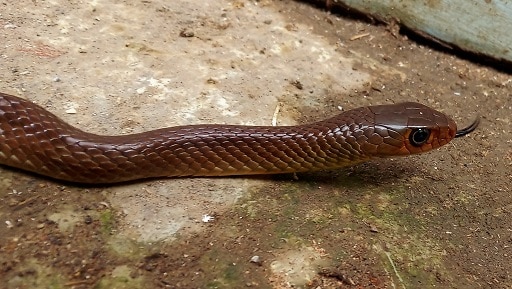
In Indonesia, the annual export quota for wild Ptyas korros is 1800 skins and 2700 live animals (mainly as pets), while those reared in captivity can be exported limitlessly.
Southern China has many live animal markets, which as the world knows, are infamous for spreading disease. Walking through the aisles is to be surrounded on all sides by hissing, growling, rattling of metal cages and the yabbering of customers bartering. A survey in Guangdong’s enormous Chatou Wildlife Market found that 3 snakes were the most commonly sold: beauty ratsnakes, Indo-Chinese ratsnakes, and radiated ratsnakes.
Likewise, a visit to a wholesaler in Java found that reticulated pythons and Indo-Chinese ratsnakes were the most common snakes processed, with Tokay geckos and monitor lizards also being popular. The geckos and monitors were drowned to death, and the monitors had their skin removed. The Indo-Chinese ratsnakes, meanwhile, were simply slaughtered, then gutted, washed and stacked on tin trays.
The house refused to accept Indo-Chinese ratsnakes under the length of 1 metre. The trade hierarchy in Indonesia begins with local villagers, who work as trappers, since they know their local countryside inside-out. The transition from dry to wet season is considered the best time to trap Indo-Chinese ratsnakes. These harvestmen then sell to wholesalers, who sell the ratsnakes on to leather craftsmen or registered exporters, who send them to China via ship while in cold storage.
| 8 | Sinister smugglers |
As well as being shipped overseas, Ptyas korros is also caught and eaten by local villagers, sold at fresh food markets, including in Thailand’s Na Haeo district. Their popularity has led smugglers to seek a slice of the profits. In 2010, an Indonesian operation was foiled while attempting to smuggle Indo-Chinese ratsnakes disguised as fruit shipments, hidden within crates on a Cathay Pacific flight to Hong Kong. 700 snakes were being smuggled, as well as 3492 rare pig-nosed turtles, which are categorised as endangered, and look exactly how you’d imagine. The offenders faced a maximum of 5 years in prison.
Planes are easier to police, but buses not so much. Local drivers can add to their pitiful salaries by smuggling wildlife, such as a bus driver attempting to cross the border from Laos into Quang Tri Province, Vietnam in 2014. He was caught with a shocking 120.5kg of wildlife on board, including 14 Indo-Chinese ratsnakes.
His stash also contained 7 pangolins, 4 oriental ratsnakes (Ptyas mucosa), one southeast Asian leaf turtle and one Asian softshell turtle. The reptiles, including the snakes, were released in National Cuc Phuong Park, while the pangolins were brought to a quarantine zone organised by Save Vietnam’s Wildlife.
| 9 | Known to invade bedrooms |
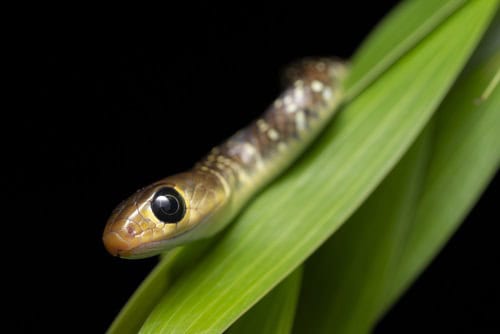
Indo-Chinese ratsnakes also have a tendency to invade people’s houses. In Indonesia, they’ve startled people by appearing in the hoods of cars and even bathroom closets. Their quest for rodents lures them to many strange places.
In July 2021, the Indo-Chinese ratsnake was confirmed to eat snakes for the first time. The location was a deciduous forest in Assam state in extreme northeast India. The victim was a common mock viper (Psammodynastes pulverulentus), a mimic which only has a mild venom of its own. The Ptyas korros was found with the snake partly in its mouth, which was still moving, and therefore being swallowed alive. The Indo-Chinese ratsnake took 14 minutes to finish swallowing, then moved to a nearby bamboo thicket to peacefully digest.
Indo-Chinese ratsnakes lay eggs, in clutches ranging from 4-17. As with many snakes, the quantity has a close positive correlation with the size of the mother. Their eggs are elongated, and on average, the eggs measure 3.6-3.9cm long, and 1.3-1.9cm wide.
| 10 | Rediscovered on Borneo |
In South China and Bangkok region, Ptyas korros is extremely common, yet there’s other regions where they’re more elusive. In 1996, for example, this species was rediscovered on Borneo for the first time in nearly 100 years. Borneo is the large landmass split between east Malaysia, Indonesian Kalimantan and the tiny monarchy of Brunei.
The first records were so old that they were now doubted, but in August 1996, scientists came across a dead snake on a road, 17km southeast of the city of Pontianak. The snake was mangled by car tyres, but easily in good enough condition to identify. The habitat was classic Ptyas korros: a road surrounded by tidal swamp land, agriculture and aquaculture, with many drainage ditches to thread through.
The rediscovery of Ptyas korros brought the number of snake species in Borneo to 158. Even today, this iNaturalist map shows just a handful of dots on Borneo. They have merely a bare foothold on the island compared to the north.
The absolute extreme of this species’ territory lies on the Indonesian island of West Nusa Tengara, which lies east of the populous Java. Their northern extremity lies in the eastern Himalaya, in the devoutly Buddhist country of Bhutan.
| 11 | Their green Japanese cousin |
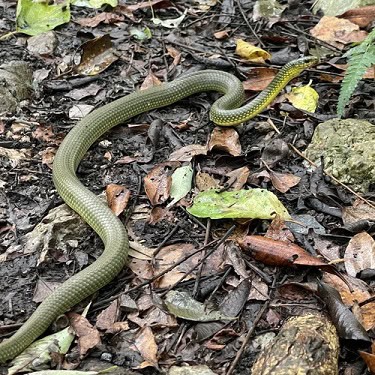
The Indo-Chinese ratsnake has 12 cousins, with oriental ratsnakes being incredibly common and others rarer. The Ryukyu ratsnake (Ptyas semicarinata) is a species found only in Japan, and exclusively in a handful of the southerly Ryukyu Islands, including the Okinawa and Amami groups.
Ryukyu green snakes are rich green with only subtle markings, while their belly is a clean pale green. They’re capable of climbing branches to 7 metres high, and lack any venom, just like Ptyas korros.
This species reaches a respectable size, at 60-95cm, and up to 110.2cm. Yet the only prey they seem to care about is small, slimy earthworms. Ryukyu ratsnakes are much more commonly sighted immediately after heavy rains, when earthworms poke their heads up from soft soils. Occasionally, they venture to beaches, where they’re eaten by one of Earth’s most heavily beach-dwelling snakes, the Loo-Choo big tooth snake.
On Okinawa, Ryukyu ratsnakes are one of the most commonly sighted snakes. While smaller and far greener than Indo-Chinese ratsnakes, they share their large eyes, whippy speed, and day-faring (diurnal) nature.