
| 1 | Green tree python |
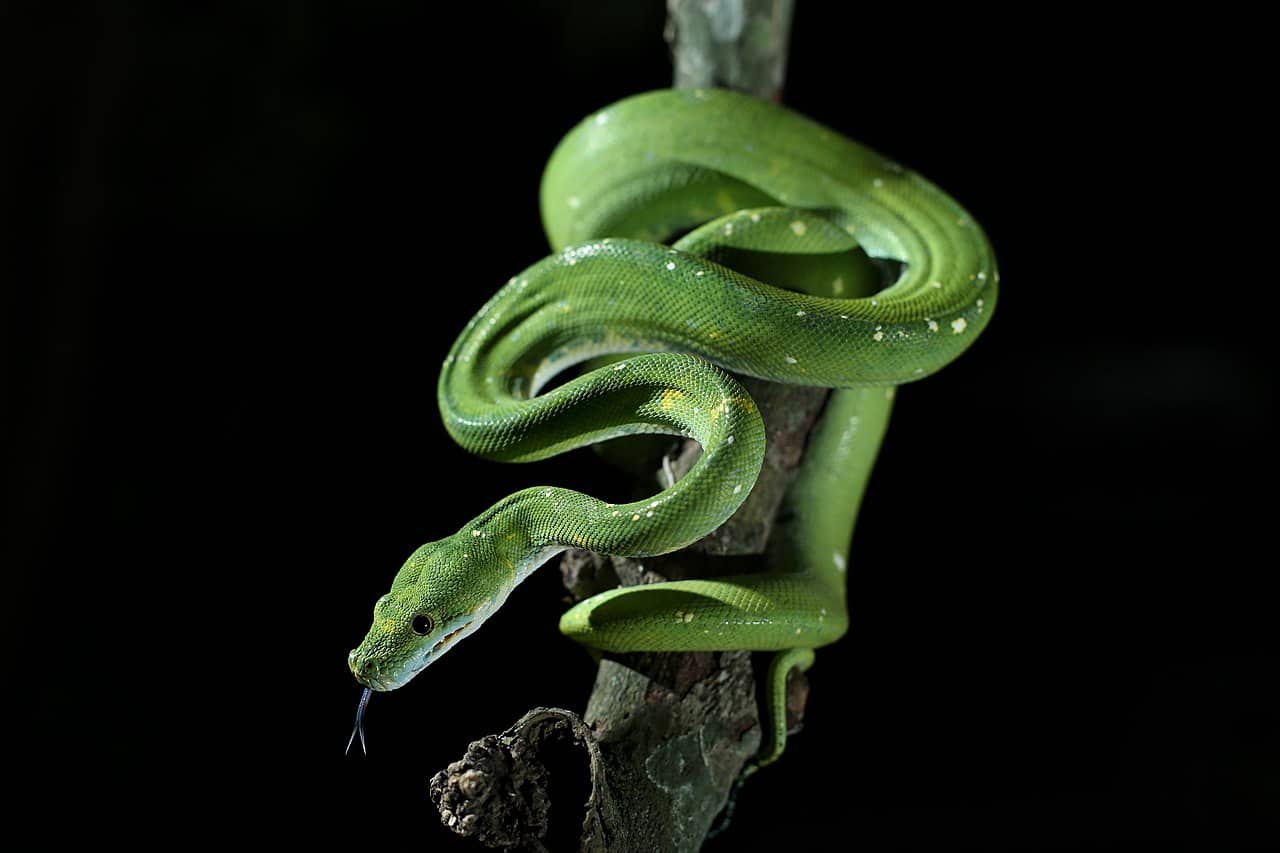
Maximum length: 220cm.
An ontogenetic colour transformation is simply a change in colour from juveniles/newborns to adults within a species. This is found in several snakes worldwide, but none can compare to the green tree python (Morelia viridis), a 1.8 metre Australian rainforest snake. This species dwells in Queensland and New Guinea, where it clings to branches in ambush posture virtually all day. It rarely strays to the ground, and can reach branch perches 25 metres high.
Juveniles have a very different lifestyle, sticking to the ground, and their colour is also completely different. Instead of fully rainforest green, they’re a bright lemon yellow, overlaid with subtle dark bands. There isn’t a trace of green on their body at birth.
The transformation usually kicks off at 12 months, and at lengths of approximately 53-59cm. Scale by scale, green begins to appear from nowhere, replacing the bright yellow. Suddenly, this accelerates, so that within just 8-10 days, the yellow Morelia viridis has become completely green. This transformation takes place with no skin shedding. At this point, wild green tree pythons ascend to the tree branches above, and never look back.
Green tree pythons are popular in captivity worldwide, due to their sedentary nature. Many keepers have been struck with awe as the sudden colour change kicks in unannounced. On Biak Island, Papua, there’s also a rare population which begins life as brick red. These then pass through the yellow phase, and finally onto green.
| 2 | Clelia clelia (Mussurana) |
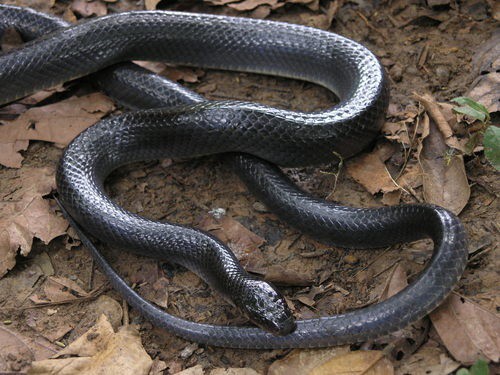
Maximum length: 275cm.
This snake-eating snake looks so different as a juvenile that many villagers fail to realise that it’s the same species. The mussurana (Clelia clelia) is South America’s most ophiophagous snake, preferentially feeding on venomous pitvipers. Confirmed prey include the fer-de-lance, eyelash viper and South American bushmaster, with 17 snake species known in its diet.
As an adult, Clelia clelia is an oily blue-black with few patterns. As a juvenile, it’s a bright red, with a black head separated by a white or yellow neck collar. Locals view the juvenile form as a “blood snake”, which triggers uncontrollable haemorrhaging on every inch of the body (its venom is actually mild).
The reason for the difference is unknown, as both adults and juveniles dwell on the ground, and prefer evergreen forests with a leafy bottom. The transformation begins when individuals reach 70-75cm. Rather than random blotches suddenly manifesting, the tip of each scale gains a small black pigment.
This spreads and spreads, until black totally displaces the red, usually at 3-4 years. The black head stays identical, and the yellow/white neck collar is always the last bright area to fade. It isn’t rare to find fully black adult mussuranas with lingering traces of the pale collar.
| 3 | Green catsnake |
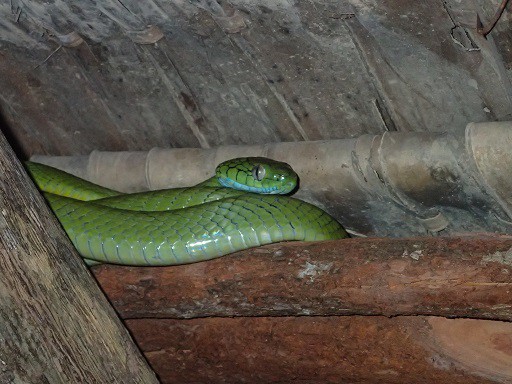
Maximum length: 187cm.
Another bright green snake which begins life as a totally different colour. Green catsnakes (Boiga cyanea) dwell on branches like the green tree python, but stick to lower levels of 2-3 metres, rather than towering canopies. This species is most common in Thailand, where it’s regularly mistaken for the venomous white-lipped pitviper, and is a top raider of birds’ nests. While it possesses a mild neurotoxic venom, this is far too weak to affect humans.
Green catsnakes lay clutches of 3-10 eggs, which are pill-shaped and snowy white in colour. After hacking their way free and slithering out into a humid Thai forest in a state of mild confusion, juvenile green catsnakes are almost completely brown, with the exception of a bright green head. The brown and green contrast vividly, and their eyes are especially bulging as hatchlings.
For several months, this elixir of greenness will be contained within their head, within strict boundaries. Eventually, the green begins to spread inch by inch. Over the coming weeks, it grows to cover the green catsnake’s entire body.
By adulthood, all traces of brown are eliminated, and a true green catsnake is born. Adults sometimes have speckles of blue as well, particularly around the throat.
Unlike the green tree python, green catsnakes dwell on tree branches as juveniles as well, so the shift in colour has a less obvious explanation. Bonus: here’s a picture of a green catsnake resting directly on a “beware of snakes” sign.
| 4 | Wagler’s sipo |
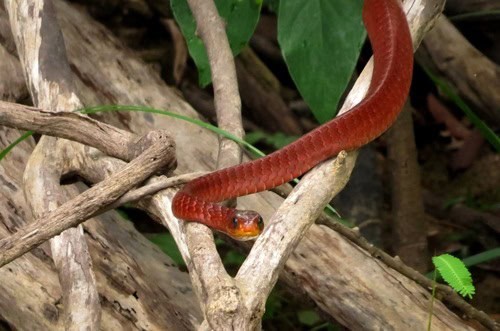
Maximum length: 243cm.
The rule is that snakes which begin life on the ground then ascend onto branches typically blossom into green, like the green tree python. However, the reverse can also happen.
The Chironius snake genus has 23 members in South America, and while all are decent climbers in adulthood, they become far less reliant on branches with age. Most members of this genus undergo an ontogenetic colour change, with the exception of Chironius flavolineatus, AKA Boettger’s sipo.
Wagler’s sipo (Chironius scurrula) is one of the most dramatic transformers. This species is found across virtually the entire Amazon region, with a particular concentration of sightings in eastern Ecuador and Suriname. It measures 150-180cm, and primarily preys on frogs.
At birth, Wagler’s sipos are a bright pastel green, with no complex patterns, just a jungle leafiness. With age, the green gradually retreats, and is replaced with uniform red.
Some adults are a plainer rusty red, while others look like a sea of molten magma, with melting chunks of earth flowing through a fiery sea. How spectacular they are depends on the individual. Wagler’s sipos barely have a presence in captivity worldwide, and would probably fare poorly given their active, energetic nature.
| 5 | Mexican cantil |
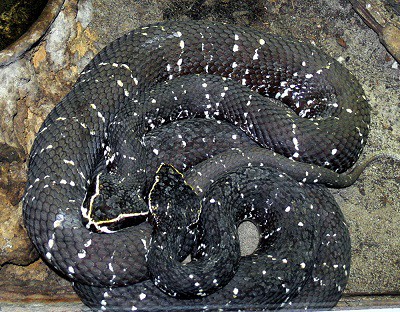
Maximum length: 138cm.
Mexican cantils (Akistrodon bilineatus) belong to the same Agkistrodon genus as copperheads and cottonmouths, but are found exclusively in Mexico, in dry thorny forests, as opposed to open deserts.
This species is a thick, stocky ambush predator which reaches a maximum of 138cm. Compared to their relatives, Mexican cantils easily have the most memorable colours. They’re almost pure black, with thin white lines and speckles of white shining through. Their goal is to blend into gloomy nocturnal forests, as they hunt their nighttime prey. There’s a catch though, as only adults possess this memorable appearance.
As a juvenile, the Mexican cantil’s patterns are much browner and less striking. The white remains, while the dark appears in similar areas, but filled in with more typical brown. Juveniles also have a bright green tail, used for caudal luring, which some adults keep.
As the years go on, Mexican cantils grow darker and darker, until only the snout has a hint of brown. To get there, they have to be patient, spending years of hard time in the dry forests of Mexico, dodging swooping hawks, aggressive coral snakes and greedy human poachers.
| 6 | Side-striped palm pitviper |
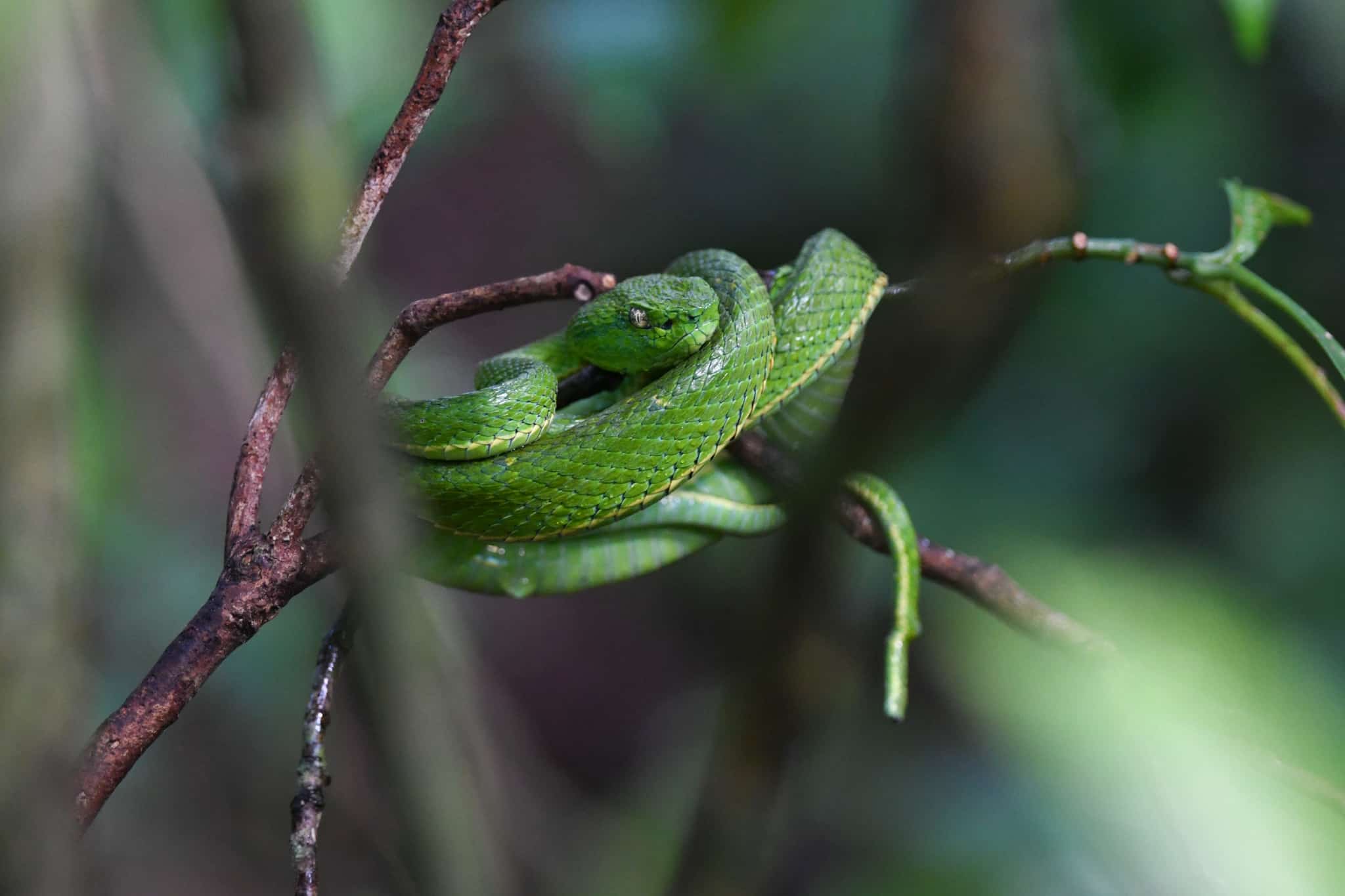
Maximum length: 95cm.
A branch-dwelling pitviper of Costa Rican mountains, which dwells at altitudes of 850-2100 metres above sea level. This species also appears in Panama, and has a dangerously haemorrhagic venom.
The side-striped palm pitviper (Bothriechis lateralis) undergoes a complete transformation from brown to green in adulthood. Within the species, Bothriechis lateralis has virtually no morphs, with most individuals having similar green colours, but age is the sole exception. All juveniles are brown, with a thin, pale line on the lower flanks of each side. The brown is overlaid with occasional darker brown blotches, with a slight white border.
Into adulthood, the thin white lines on the flanks remain. But everything else transforms, as Bothriechis lateralis becomes completely green, and the small markings become purely white.
The Bothriechis pitviper genus has over a dozen members (e.g. the eyelash viper), but none have as strict a transformation as this. Most are equally green as juveniles, and the only real competitor is Guifarro’s palm pitviper in northern Honduras. This species is always green in adulthood, while younglings have two separate morphs, with 50% being green and another 50% brown.
| 7 | Large whipsnake |
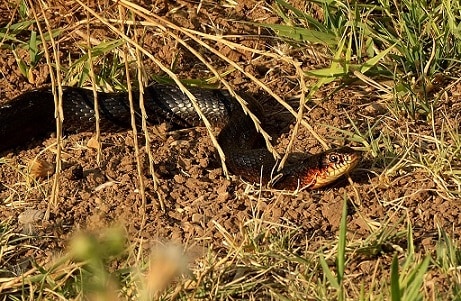
Maximum length: 250cm.
If you see a huge black snake slithering through an olive grove in Israel, you’re almost certainly looking at the large whipsnake (Dolichophis jugularis). This species is found in shrubland and coastal Mediterranean landscapes rather than arid deserts, and is wary of humans, launching aggressive assaults if restricted in any way.
Large whipsnakes prey mainly on rodents, often inhabiting farmland. Israel’s countryside has an abundance of pure black snakes, which are easily confusable, but no others reach such large lengths, making this snake easily recognisable. There’s one catch though: its patterns and colours are completely different as a juvenile.
Young large whipsnakes have a beige or tan base, overlaid with many tiny dark markings, often with red interiors. Their face is extremely messy, with many black lines. As they age, the forces of darkness spread, and large whipsnakes grow blacker and blacker, destroying all remnants of patterns.
As an adult, the only exception to their black colour is their face, which has creamy sections and a red chin. Many also have a golden eye, with round pupils.
| 8 | Great Lakes bush viper |
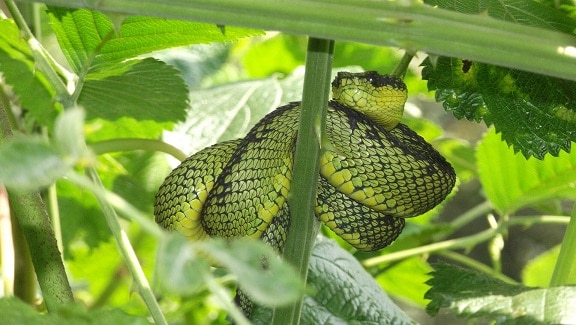
Maximum length: 75cm.
This venomous species is a favourite of reptile keepers, although it’s rare to find in captivity, mainly because it’s rare worldwide. Great Lakes bush vipers (Atheris nitschei) are found exclusively in the interlocking border regions of Uganda, Burundi, Rwanda and DRC. They live at altitudes of 1600-2800 metres, where they cling to branches for much of the day, with a preference for swampy regions.
Great Lakes bush vipers are popular for their bright green scales, overlaid with sharply contrasting black patterns. These come in thick black spinal zigzags, with many isolated black blotches on their sides, plus a wide black eye streak.
But in their youth, none of this exists. Instead, Atheris nitschei is a dull, tree trunk brown, without a speck of the green which will later come to dominate. The only pale section of the body is the tail, which is pale yellow. The purpose of this is caudal luring, wiggling the tail tip in a slow, rhythmical pattern to lure in curious frogs, and then devour them.
This bright tail is the only advantage youths have over adults in their colours. Adult Great Lakes bush vipers are much more colourful, but youths have an extra hunting strategy.
| 9 | Madagascan tree boa |
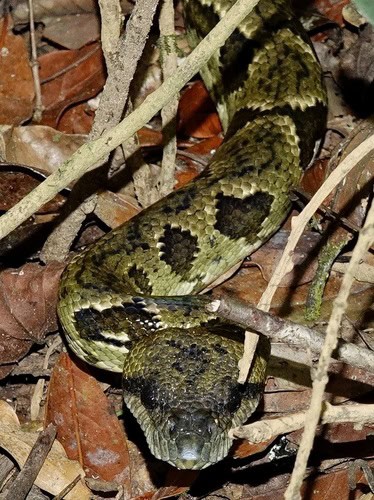
Maximum length: around 2 metres.
The third longest boa on Madagascar. Madagascan tree boas are shorter than the ground boa or Dumeril’s boa, but have heat-sensing facial pits which those neighbours lack.
Madagascan tree boas (Sanzinia madagascariensis) inhabit the north and east of Madagascar, usually in forested areas close to streams or marshes, occasionally in backgardens. Despite the name, they tend to hunt on the ground, ascending branches during the daytime to fall asleep.
At birth, this constrictor is a bright red-brown colour, with hourglass-shaped black blotches. This is speculated to be for blending with colourful treetop flowers. At approximately 8 months, and following 4 skin sloughs, Madagascan tree boas begin to gain their adult colours: forest green. The dark blotches remain, and their body only grows more thick and crushing.
Unlike other tree snakes, however, they never become a bright pastel green. With the Madagascan tree boa, it’s more like a thick layer of moss which grows gradually over their bodies, coating their scales with a funky green fur, with a base of black still visible below. This species has all the boa features you’d expect: vertical pupils and a hungry, prehistoric-looking skull.
| 10 | Bibron’s coral snake |
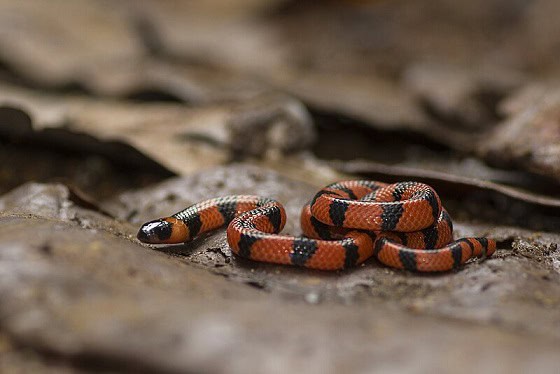
Maximum length: 88cm.
This rare, dangerously venomous species is found only in the Western Ghats mountain range of southwest India. Bibron’s coral snakes are non-aggressive, and likely only bite human beings if manhandled. Envenomations are so rare that their effects are unknown, though they’re presumed to be neurotoxic and paralysing like their Malaysian blue coral snake relative.
What is known is that Bibron’s coral snakes undergo a strong transformation in colour with age. In youth, they’re bright banded, with a red base overlaid with pure black or dark brown. These bands cover the body from head to tail, and number as many as 36.
With age, the red sections gradually darken, leading their body to become purely black, with slight red tinges, with the flanks holding out for longer. At all ages, the black tends to mask their face, so that the eyes are barely distinguishable. Bibron’s coral snakes reach a maximum of 88cm (a male), and this study found that the darkening process began at lengths of 35-45cm (excluding the tail).
This species has particularly small eyes, with a diameter of just 1.45mm. This image shows a Bibron’s coral snake mid-transformation. The black bands are constant, but the red are in crisis mode, with black speckles popping up like moles.