
| 1 | A hyper-camouflaged pitviper |
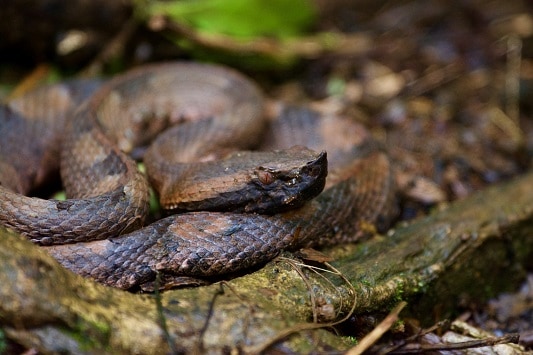
The rainforest hognose pitviper (Porthidium nasutum) is a venomous species of central America, which sticks to the ground rather than climbing trees, preferring to bury itself in layers of leaf litter on the forest floor. This is a fairly average species in many ways, as it reaches an all-time maximum length of 65.3cm, with an average of 40-60cm. Likewise, its venom isn’t particularly potent, with an LD50 score of 4.6mg, falling well short of the lethal fer-de-lance at 1.1mg. Nevertheless, this species has an outsized influence in the Central American nations it calls home.
Firstly, the rainforest hognose pitviper is highly abundant wherever it lives. In Costa Rica, this is the 3rd or 4th most widespread venomous snake overall, with an endless stream of sightings in the forested lowlands below 1000 metres. The same is true for the other nations it inhabits; Panama, Colombia, western Ecuador, Nicaragua, Honduras, extreme southern Mexico, etc.
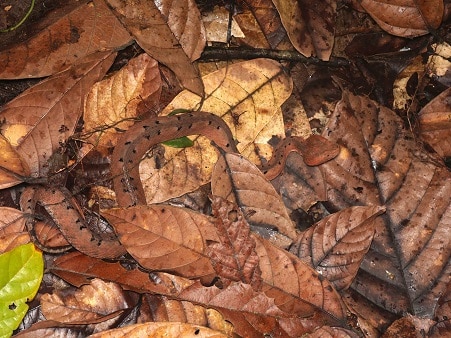
Secondly, the rainforest hognose pitviper has some of the greatest camouflage of any central American snake. It’s not only small and missable, but has patterns which are finely tuned to blend with fallen leaves on the forest floor, and their various autumnal shades and shapes.
Coupled with a hunting strategy of immobile ambush, the rainforest hognose pitviper is an expert at completely disappearing into forest undergrowth. This in turn makes it a high prospect for biting people, as it’s difficult to spot this species even when it’s right in front of you. Unlike the eyelash viper, rainforest hognose pitvipers almost never climb branches and bushes, sticking to the ground, meaning that they don’t have the safety factor of resting at eye height.
| 2 | From Mexico to Ecuador |
Rainforest hognose pitvipers are found in 9 countries overall, appearing in all 7 Central American nations except for El Salvador. This species’ main base overall is Costa Rica, where sightings are abundant in the north and east. Within Costa Rica, Nicaragua, Honduras and Guatemala, this species is generally abundant in the northern (Caribbean) half of each country, but missing from the Pacific coast to the south.
In certain areas, this species causes plenty of snakebites, such as northwest Colombia, where it accounts for 15-30%, with the fer-de-lance (Bothrops asper) dominating at 50-70%. As with the venom toxicity, the venom yield isn’t anything to write home about, injecting 12-25mg per bite compared to 300mg with the infamous fer-de-lance. Nevertheless, the rainforest hognose pitviper has caused proven deaths in Colombia, and intracranial haemorrhaging has been reported occasionally.
Rainforest hognose pitvipers have the usual vertical pupils of a viper. They have an extremely triangular head, and a fairly thick body, despite their small size. As well as forests, this species has a strong tendency to appear in plantations, including cocoa, cassava and banana plantations. Workers are at high risk of feeling a random pair of fangs sink into their feet, unless they wear a thick pair of boots. Tourists also have a chance of bumping into this calm, yet highly camouflaged pitviper.
| 3 | Eats virtually anything |
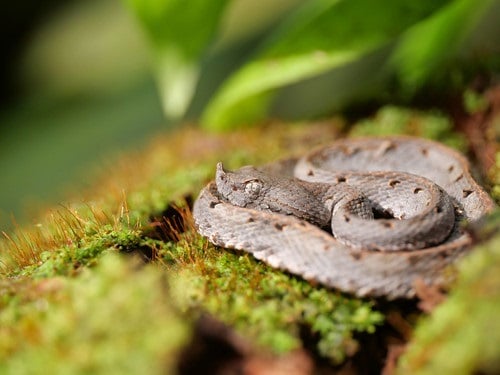
Rainforest hognose pitvipers aren’t regarded as aggressive, yet bite frequently due to their regular contact with humanity. They have a typical pitviper venom, unleashing bloodstream chaos like haemorrhaging, and dangerous local symptoms such as pain, swelling and necrosis. Unlike the average coral snake, this species produces virtually no neurotoxins, which can lead to difficulty breathing and even paralysis.
One survival advantage this species has is a variable diet, both as a juvenile and adult. Youngsters prey on toads, frogs, lizards and invertebrates such as earthworms, while adults add more mammals while retaining the amphibians and lizards.
A few pitvipers are more specialised, like the crossed pitviper of southern Brazil, which eats 100% mammals, yet rainforest hognose pitvipers are extremely flexible. Specific prey include Desmarest’s spiny pocket mouse, wedge-billed woodcreepers, Middle American ameivas, and the frog Craugastor megacephalus. They only ever hunt using ambush tactics, and they always hunt on the ground, rather than with their tail coiled securely around a branch.
| 4 | Giant meals and deceiving tails |
Compared to other Costa Rican snakes, the rainforest hognose pitviper has some particularly gut-busting meals to its name. Vipers generally tend to eat large meals, unlike the black mamba, which prefers smaller meals of just 5% of its body weight. The Brazilian lancehead, for example, was once recorded eating a worm lizard weighing 107.9% of its own weight.
Meanwhile, a juvenile of the rainforest hognose pitviper was recorded eating a spiny pocket mouse weighing 129% of its own body weight. This venomous snake has no issue with eating prey larger than itself. This is tied to its stationary, ambushing nature, as its meals can be less frequent, thus making larger ones more important.
As juveniles, rainforest hognose pitvipers boast a bright yellow tail tip, which is used for caudal luring: the tempting of passing prey by rhythmical wiggling, which mistake the tail for a bright insect. With age, this tail fades to a creamy colour, eliminating one of their hunting skills.
| 5 | Disappears fully into the forest |
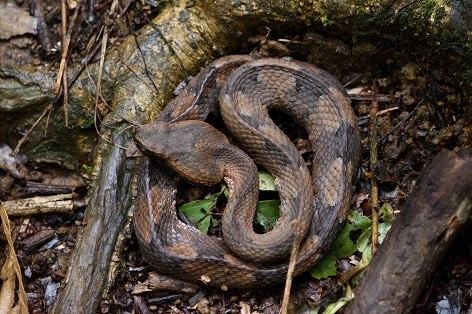
Rainforest hognose pitvipers like to hide in a variety of objects on the forest floor. They can lurk between rocks, logs, shrubs and leaf litter alike, disappearing completely with their excellent camouflage. But unlike say, a US ring-necked snake, this isn’t because of a shy personality. The real goal is attack – creating a cunning disguise before leaping out unexpectedly at any small prey that walks past.
The rainforest hognose pitviper’s hunting plan is highly reliant on camouflage, and despite having a weaker venom, they execute this plan better than almost any Central American pitviper. It isn’t unusual to find this species in a bed of tree roots, filled in with leaves, with nothing but a vertical pupil alerting you to their presence. A human being is just as vulnerable to this species’ camouflage as a pocket mouse.
Rainforest hognose pitvipers can stick to one ambush site for over 2 weeks. Like other species, the dream is to settle down directly next to a well-trodden lizard or mammal trail. If the site proves to be empty, or heavy rains flood the forest floor, then they sometimes abandon their ambush site prematurely.
| 6 | Capable of causing severe symptoms |
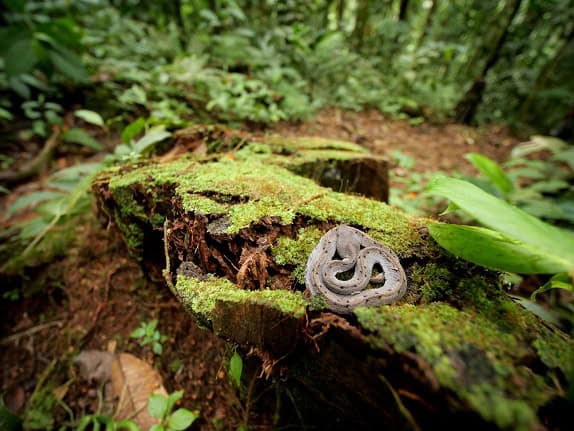
Despite its small size, and a fairly small venom yield of just 12-25mg per bite, the rainforest hognose pitviper is not to be underestimated. A 2002 study from Colombia analysed victims of several pitviper species, in the Hospital Universitario San Vicente de Paúl, in the city of Medellín.
Just two victims of the rainforest hognose pitviper were included, but one case was described as “moderate” and another as “severe”. One of these patients experienced necrosis, the rotting and sloughing off tissue, and both experienced bloody urine (hematuria).
Both patients only received antivenom 6 hours after being bitten, which probably worsened their symptoms. However, neither patient experienced complications such as kidney failure, cerebral haemorrhage, or compartmental syndrome.
Deaths have been recorded elsewhere, which were apparently caused by intracranial haemorrhage. This species is far from the deadliest in Central America, but nor is it one of the mildest. If you see a snake with vertical pupils and a sharply upturned hognose, resting on a leaf bed, you should still stand well back.
| 7 | The antivenom situation (there is none) |
It’s understandable if a pitviper found in a remote Costa Rican mountain range doesn’t have a dedicated remedy in hospitals. It wouldn’t be worth the time and resources, yet the rainforest hognose pitviper is one of the more common snakes in the Americas not to have a dedicated antivenom.
Fortunately, several other antivenoms are currently used, to decent effect. The first is PoliVal-ICP, a widely used mixture, created against the venoms of three species: the Central American bushmaster, Central American rattlesnake and fer-de-lance. None of these belong to the Porthidium genus of the rainforest hognose pitviper.
A 2023 study tested this mixture on three unrelated snakes, and found decent protection against all 3. The rainforest hognose pitviper was remedied significantly more than the Costa Rican montane pitviper (Cerrophidion sasai), a high altitude species.
Another study tested an antivenom made from US pitvipers, including several rattlesnakes. The victim was a 37 year old man, who was bitten by a rainforest hognose pitviper on his left hand, and experienced steadily worsening swelling over 3 to 4 hours. He also lost motor control of his hand, but an injection of this US antivenom improved his symptoms significantly, despite containing species from thousands of miles away.
| 8 | All the ID signs you need |
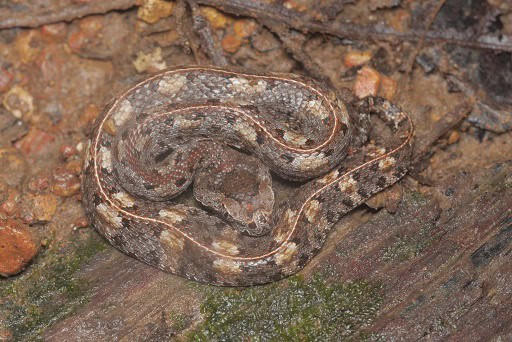
Costa Rica has well over a dozen pitvipers, and the rest of Central America (plus Ecuador) has plenty more. However, Porthidium nasutum has several clear ID signs, which should always be floating around the back of an explorer’s mind. The first is that this species lacks any bright green on its body. This species is variable in colour, but a leafy green morph has never been observed. This instantly separates them from the Bothriechis eyelash viper genus, which are mainly found on branches as well.
The second is a short body length, with maximum of just over 60cm, and an average of less than 50cm. This instantly separates it from the Central American bushmaster, Costa Rica’s longest viper, with a record of 3.6 metres.
The upturned snout is the classic ID sign, which isn’t just subtle, but is noticeable even from a distance. This is enough to provide a separation from the lethal fer-de-lance, which is also brownish, and also dwells on the ground, and could therefore be confused.
Finally, there’s a more subtle ID sign which isn’t always present, but is still very useful: a bright white stripe down the spine. Rainforest hognose pitvipers have multiple small dark blotches, but these rarely touch in the centre. They’re instead divided by a thin vertebral stripe (see above), which ranges from light brown to yellow. This is found in well over 50% of individuals, with females sometimes lacking it.
| 9 | Nemesis: mussurana |
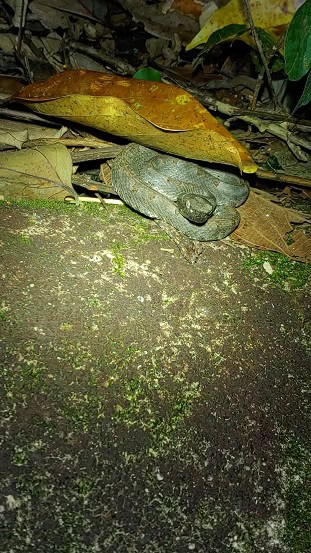
The rainforest hognose pitviper has probably scared many local villagers from entering their forests before. Yet this species has its own problems to contend with – getting swallowed whole by other snakes, sometimes while still alive.
The antagonist in this tale is Clelia clelia, AKA the mussurana, the most infamous snake-eating snake in the whole of the Americas. Clelia clelia is completely resistant to the venom of pitvipers, even including the infamous fer-de-lance, both when swallowed or subjected to a bite in self-defence. In June 2005, scientists were wandering a patch of cacao plantation, in an evergreen forest in northwest Ecuador. At their feet, they soon spotted a 123cm Clelia clelia, coiled around a small snake. It was a rainforest hognose pitviper, with an estimated length of 20cm.
The scientists inspected the duelling duo more closely, and found that the Clelia clelia had securely bitten the mid-section of its prey. The hognose pitviper bit the larger snake multiple times, with no effect whatsoever, despite juveniles being just as venomous as adults. The Clelia clelia gradually moved its jaws towards the pitviper’s head, relinquishing its grip only slightly as it walked its jaws upwards.
Most disturbingly, the rainforest hognose pitviper was still alive after it was swallowed whole. This snake encounters some truly grim fates in the wild. The Clelia clelia then left the scene, slithering away through the leaf litter, to destinations unknown. This species overlaps with the rainforest hognose pitviper in almost its entire territory, from Ecuador to Guatemala, meaning that hundreds of similar battles probably happen each year (maybe more), in forests beyond the vision of humans.
| 10 | Prefers altitudes below 900 metres |
Rainforest hognose pitvipers are virtually always found in forests, ranging from fully-fledged rainforests, to slightly drier broadleaf forests in the northern realms of Guatemala, where they sometimes appear near streams to compensate for the lower than usual moisture. This species is confirmed to occasionally take shelter in tree trunks themselves, disappearing into dark hollows, and relaxing in the woody chambers inside.
Another key is elevation. This is a low altitude species, which is found close to sea level. For example, one old study gathered 112 individuals with altitude data. Of those, 107 (95.5%) were from below 650 metres, and 49 (43.8%) from below 300 metres. The highest individuals on record at that point were two from 900 metres, near Matagalpa in Nicaragua.
The rainforest hognose pitviper is mainly a nocturnal species. Most of their hunting takes place at night, although they’re sometimes encountered during daylight, sunning themselves, or even crossing roads within forests. This is a highly likely species to encounter by the edge of a forest trail, particularly one with accumulations of fallen leaves, which might look scenic and exotic to the average tourist, but actually contain something much more dangerous.
| 11 | Pierced by a lethal meal |
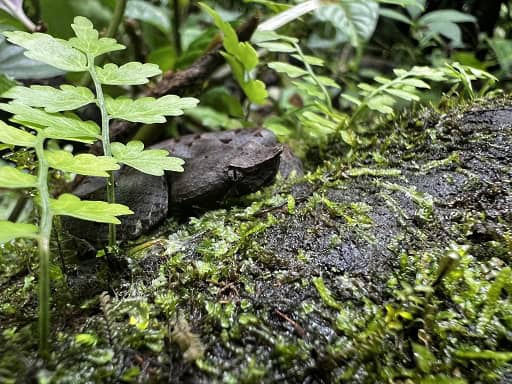
Even though rainforest hognose pitvipers can eat huge prey, certain meals can prove too challenging and lead to their untimely demise. One such incident occurred in June 2017 in the Sarapiquí region of Costa Rica. The pitviper measured 37cm, and had attempted to ingest a helmeted iguana, which was dead, and covered with flies. Something had stopped the snake, and on closer inspection, the sharp crest of the iguana had punctured the pitviper’s oesophagus. The hognose pitviper was mortally wounded, and couldn’t escape, as the sharp iguana head was still lodged in its body.
The scientists left the area, and when they returned 30 minutes later, both snake and iguana were gone. The soil was trampled by many footprints, which proved that a herd of collared peccaries had been nearby, which had probably eaten both creatures.
Collared piccaries are mammals somewhat resembling pigs, which are known to eat snakes occasionally. It’s possible though not confirmed that they eat rainforest hognose pitvipers while living as well. This snake also has a confirmed bird predator, in the great black hawk.