
| 1 | Australia’s most common blind snake |
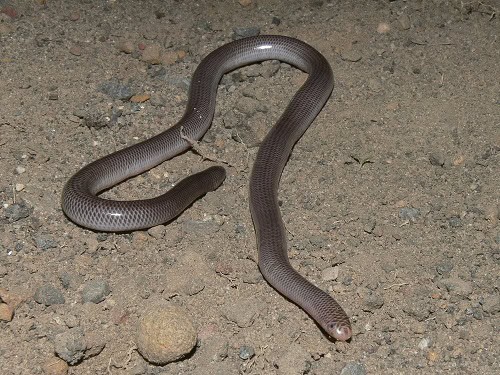
Australia is absolutely packed with blind snakes, with the main Anilios genus containing 48 members as of 2025. 47 of these are found in Australia, 1 exclusively on New Guinea, while another two are found both in Queensland and New Guinea. Of these, the most common in Australia is easily the blackish blind snake (Anilios nigrescens).
This species’ range coincides exactly with the most populous areas of Australia. Blackish blind snakes inhabit eastern New South Wales, southeastern Queensland, and parts of Victoria. They’re common in major cities such as Sydney and Brisbane, and have no issue about popping up in people’s gardens, or remnant patches of woodland surrounded by suburbs.
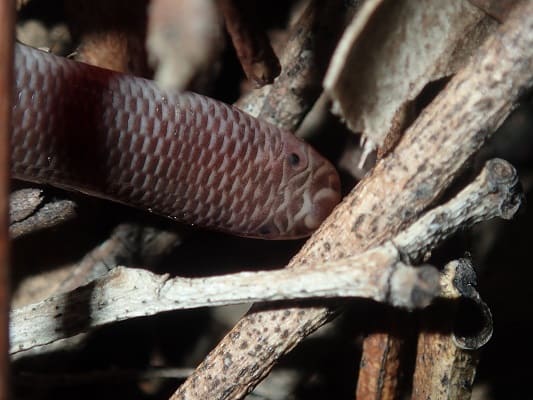
Like other blind snakes, Anilios nigrescens is almost completely blind, but probably able to detect extremely basic light intensity changes, like a sunset or sunrise. Its eyes consist simply of two biro pen dots, encased in a scale, and faintly visible to normal humans. Analysis of the blackish blind snake’s eggs shows that during the early stages of gestation, its vision develops rapidly just like any snake, but then suddenly deactivates.
Blackish blind snakes reach a maximum of 75cm, but are more typically 30-50cm. With their dull, slimy-looking bodies, they’ve been mistaken for earthworms many times.
| 2 | No threat to humans |
Blackish blind snakes are fossorial, or underground-dwelling. They seek refuge in soft soils, often in underground tunnels forged by insects. The most common time to find them on the surface is immediately after heavy rains, when the increased moisture makes the Australian countryside easier for them to explore.
It’s possible to dig up a blackish blind snake in your garden, or pick up a log in a woodland and unearth several. When on the surface, blackish blind snakes nearly always stay under cover. Their favourite spots include inside termite mounds, below rotting logs in woodlands, under piles of rocks, beneath garden tiles or deep inside dark crevices.
Blackish blind snakes are completely harmless to humans. They possess a short, spiky tail, which looks like it could stab you, but is incapable of serious damage. Other physical attributes include a forked tongue, and a sharply delineated colour pattern. Most of a blackish blind snake’s body is very dark brown, even black, but their underside is consistently pale. Their scales are smooth to touch, like most underground-dwelling snakes.
| 3 | Eats ants exclusively |
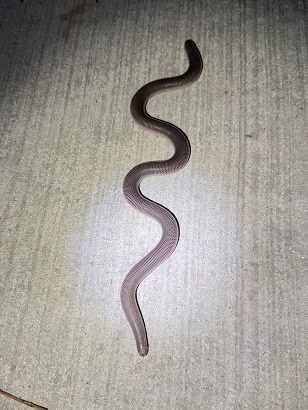
Blackish blind snakes feed entirely on ants, which they stalk back to their anthill base. Any other place where ants congregate can be a hotspot for them. They’re even capable tree climbers, which is extremely unusual for blind snakes worldwide.
One was spotted 5 metres high in a she-oak tree, and in 2023, scientists found one in a eucalyptus tree, lurking between the bark and the sapwood. The explanation was most likely a stream of ants crawling along the trunk, luring them upwards. Blackish blind snakes are even capable of coiling around tree branches like spaghetti when necessary.
Blackish blind snakes can appear on beaches as well. They appear on vegetated dunes adjacent to beaches, but can also be washed onto the sand itself, if the high tide increases far enough and the waves strike with enough force.
Blackish blind snakes lay eggs rather than live young, in clutches of up to 34. Overall, they’re fairly sluggish in their activities, but when threatened, they can move extremely quickly into shelter. Ripping up random objects in a woodland near Sydney is an easy way to find this snake, although it’s equally possible that a common death adder will strike your heels as you explore.
| 4 | Rakes ants with its upper jaw |
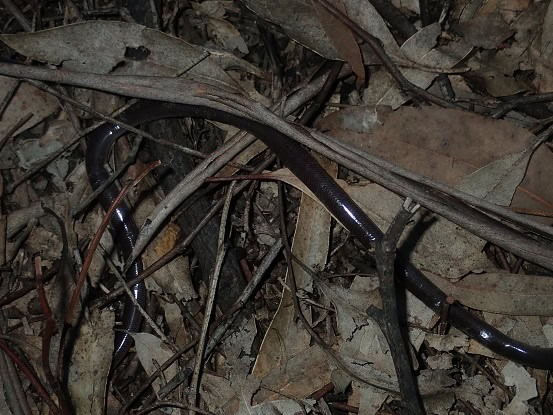
Blackish blind snakes are committed ant hunters, eating no other prey type. They’re so focussed on eating ants that the local anthills probably dread their appearances, just as an emerald spotted tree frog is terrified of a red-bellied black snake.
Blackish blind snakes begin by detecting an ant scent trail. This can apply to several species, including banded sugar ants or southern meat ants. Blackish blind snakes are more efficient at detecting regularly used trails, and weaker at following individual stray ants. Once they’ve caught a trail, they follow it slowly back to the main anthill, or perhaps a swarming outpost which is a hive of collecting activity.
When the blackish blind snake arrives, it begins consuming ants whole, using a special manouvre: a rake. Its upper jaw is capable of moving forward independently of its lower jaw, and so, the blackish blind snakes performs repeated extensions and retractions, forcing ever higher amounts of ants into its mouths.
Adult ants often try to fight back, particularly Myrmecia “bulldog” ants, which have stingers and venom. This whole raking method is extremely similar to the Texas blind snake (Rena dulcis), thousands of miles away.
| 5 | No worms, no other insects, just ants |
Blackish blind snakes stalk ants, they do battle with bustling ant swarms, and they force their way into anthills. It was obvious for years that they hunted ants, but a 1990 study decided to get more technical. It analysed 422 preserved blackish blind snakes, of which 68 snakes contained identifiable snake items.
The study confirmed that ants comprised their entire prey, with not an earthworm or other insect in sight. Adult ants formed just 1% of the total, with eggs forming only 6%.
Their favourite meal was ant pupae, the final cocoon stage before an ant emerges into an adult. This comprised 75% of meals, followed by ant larvae, the stage between eggs and pupae, which comprised 18%.
Avoiding adults was consistent across all Anilios blind snakes tested. The prong-snouted blind snake (Anilios bituberculatus) is the probably the 2nd most widespread species, appearing all over South Australia, and has a sharper snout than the blackish form, almost resembling a shark’s mouth. This species derived less than 1% of its meals from adults, with 94% sourced from the cocooned pupae.
| 6 | Swallows ants in seconds |
In any other snake, 68 snakes with food in their stomachs would probably equate to about 80 food items overall, mostly singular meals, with the occasional greedy feast.
Not so with the blackish bind snake. Across the 68 snakes, 3375 individual food items were detected. One individual Anilios nigrescens was particularly extreme, with 1431 food items in its stomach. This species can rake up endless ant pupae at once, and in contrast to other snakes, it’s an extremely rapid eater. In a 1993 study, scientists measured the species’ feeding time, and unlike a green tree python, swallowing a meal didn’t take 30 minutes. The average ant pupae was swallowed in less than 1 second (0.72s).
Ants are so tiny that blackish blind snakes must be fast, rapid eaters to make the energy expenditure worthwhile. Plus, they’re so tiny that they can rake them down like there’s no tomorrow.
The scientists also performed experiments in captivity. The blackish blind snakes never went for adult ants, but they witnessed one adult being accidentally swallowed as it furiously clutched a pupae. Therefore, they theorised that most adults are eaten accidentally.
| 7 | A communal snake |
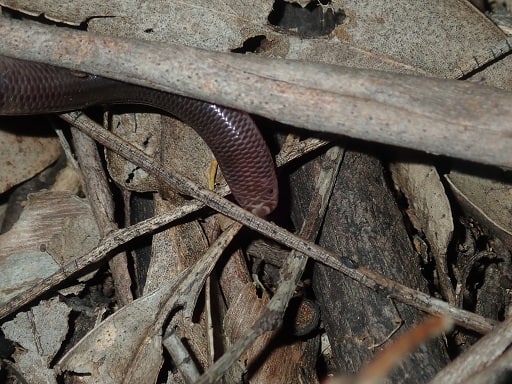
The blackish blind snake is one of several Australian species which have been recorded to get cosy with each other, gathering together under rocks or stones in large groups, in small communities.
One observation happened in 1978, on a dry sandstone ridge covered with shrubby vegetation. It was located at Belrose, New South Wales, and two researchers were exploring 3/4 of the way up a hill. They came across a large sandstone rock, covered with a layer of fallen leaves, and shaded by a 2 metre tall tree.
The researchers lifted up the rock slab, and to their surprise, found a huge, knotted mass of blind snakes. The blind snakes soon started to flee, and the researchers managed to capture 27. They estimated that 8 had escaped, meaning that the communal gathering consisted of 35 blackish blind snakes, which included both juveniles and adults.
Be careful, as blackish blind snakes often fly at high speeds when their cover object is ripped up. A slightly smaller gathering involved 7 blind snakes, and was found at Glenrock, New South Wales, near rocky sclerophyll forests in a valley. Again, the snakes were found under a large sandstone rock slab, so this seems to be a favourite for them. The gathering consisted of 6 juveniles and 1 adult, all of which were caught.
| 8 | Nemesis: bandy-bandy |
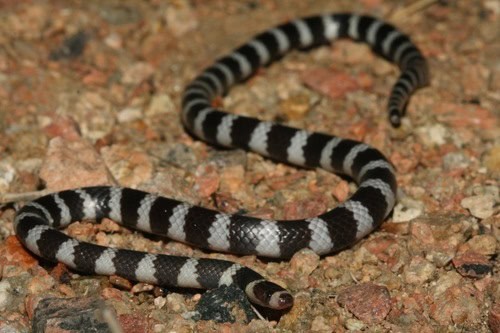
Blackish blind snakes are unbeatable when it comes to tracking ants, following even the subtlest scent trails. But they also get the tables turned on them, in the form of their greatest predator: the eastern bandy-bandy (Vermicella annulata).
This black and white snake is found across the majority of the east coast, north into Queensland. It has an unusual diet, as blind snakes form the majority of its meals. A 2005 study involved 8 captive bandy-bandies, 5 males and 3 females. Each snake was exposed to 4 scents: of distilled water, a three-toed skink, a golden crowned snake (also found in eastern Australia), and a blackish blind snake.
Not surprisingly, all bandy-bandies ignored the distilled water. They ignored the skinks, which makes sense given that skinks haven’t been recorded in their diet. But they were so specific in their snake prey that even the golden crowned snake had no allure for them. The bandy-bandies flecked their tongues when entering the arena, but only began to follow the scent trail of the blackish blind snake. Then they slowly began to follow the trail, repeatedly flecking their tongue. The scent trail lasted 1.4 metres, and three of the bandy-bandies followed the trail to completion.
The dire implication is that as blackish blind snakes follow an ant trail, eagerly closing in on their prize, they may be completely unaware that another snake is following their trail.
| 9 | Other blind snake predators |
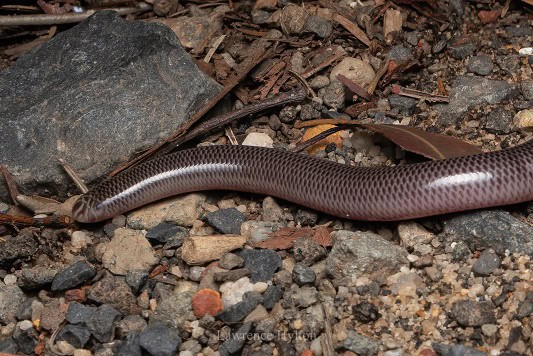
Blackish blind snakes have other predators to contend with as well. The small-eyed snake is a mostly black species, which lurks under rocks in grassy clearings in woodlands, and derives over 90% of its prey from skinks. It’s dangerously venomous, but has only killed one human being on record, due to a non-aggressive personality.
In January 2015, scientists were following a trail in Myall River State Forest in New South Wales. They found a small-eyed snake measuring 60cm, with its jaws embedded in a small snake. This proved to be a blackish blind snake, which was already dead. The small-eyed snake then fled, with the blackish blind snake still in its mouth.
Another observation took place in a red gum woodland near Canberra. A 44cm blackish blind snake was found dead at the foot of a tree, its white belly facing the sky, completely limp. It was a mysterious scene, but 9 metres above the dead snake, the researchers found the nest of a tawny frogmouth, a large predatory bird.
The blind snake had sharp indents at mid-body, showing that the bird had picked it up with its talons, before thrashing it against a branch to deliver the killing blow. The scientists theorised that the mother bird had been passing the snake meal to its nestlings, before accidentally dropping it to the woodland floor below.
Given how common and how defenceless they are, this is surely just a snapshot of the predators that blackish blind snakes face in the wild.
| 10 | Versus: bulldog ants |
Skillful rakers though they may be, ant swarms don’t meekly accept their fate. After all, ants are a rare animal to go to war, other than humans and chimpanzees.
Blackish blind snakes are much more cautious when it comes to hunting one ant group: Myrmecia, AKA the bulldog ants. These large insects not only have sharp stingers, but a potent venom, which can pierce the scales of small snakes, and potentially leave them dead within two days. They aggressively defend their brood, fighting off predators attempting to snatch the pupae and larvae, the blackish blind snake’s favourite.
A 1993 study found that compared to smaller ants, blackish blind snakes were far more reluctant to eat Myrmecia ants. Fully grown blackish blind snakes were capable of eating them, but juveniles and small adults stayed well away.
The scientists created three hypothesis: 1) that blackish blind snakes were less efficient at following bulldog ant trails, 2) that juveniles were incapable of swallowing them, or 3) that the bulldog ants were so aggressive that they were naturally averse to them…
| 11 | Vulnerable to ants’ stingers |
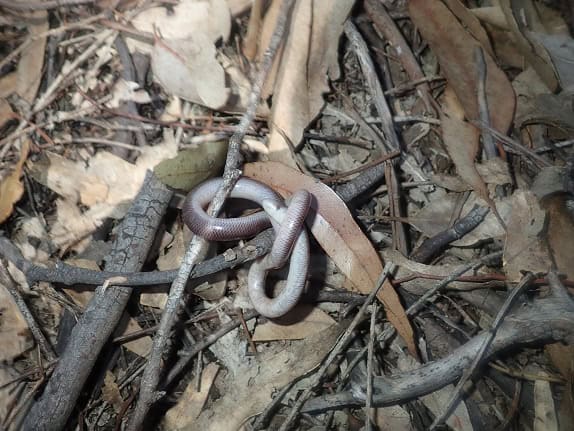
Firstly, the scientists created a scent trail of Myrmecia bulldog ants. Despite never eating them, juvenile blackish blind snakes followed the trails just as enthusiastically as large adults, proving that their detection abilities didn’t differ.
Secondly, they measured the species’ mouth width at various ages. This had more involvement, but only in juveniles. The youngest blackish blind snakes were unable to swallow bulldog ants, due to their small mouths. However, small adults were easily capable of eating them, despite doing so less commonly than large adults.
In the end, the third hypothesis was true: the bulldog ants were just too aggressive. The scientists placed several blackish blind snakes in arenas with Myrmecia bulldog ants. Within seconds of entering, the bulldog ants began to viciously assault the snake intruder, gripping them with their mandibles. Many pierced the flesh of snakes with their stingers and teeth. When two juvenile blackish blind snake were envenomated, they were removed from the terrarium, but died within two days.
Meanwhile, the bulldog ants were just as aggressive with adult blind snakes, yet their mouths were less capable of piercing their bodies, Their mandibles struggled to angle around their larger, cylindrical bodies. Some medium-sized blackish blind snakes were envenomated, but were less vulnerable, recovering from the venom’s effects.
Whenever the blackish blind snakes were bitten, they thrashed around violently as though in agony, regardless of whether they later survived. The largest blind snakes were never envenomated by the worker ants, smaller adults were envenomated but often survived, while juveniles commonly died.
Adults were better ant hunters overall, but regardless, the study showed that blackish blind snakes don’t get a free pass. Certain swarms are almost off limits, no matter how specialised they are.
| 12 | Other blind snake species |
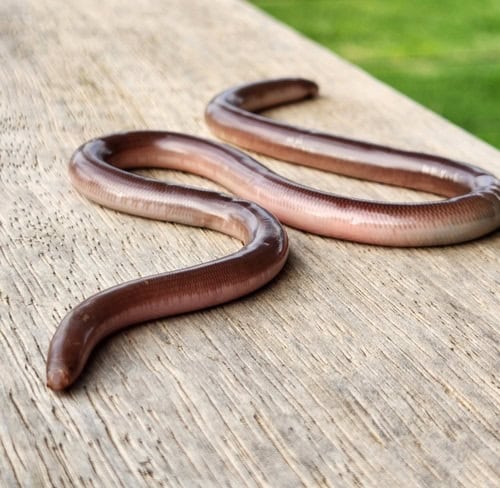
Another quirk with Anilios nigrescens is that you can see prey items in their belly after being swallowed. Their underside is not just far paler than their dark body, but the skin and digestive wall is particularly thin. Scientists can tell whether a blackish blind snake has recently fed simply by flipping it over.
Blackish blind snakes are effortless ant rakers, yet they may not be the ultimate ant raker. A 1990 study examined several blind snakes, and found that another Australian species, the rotund blind snake (Anilios pinguis) had a wider mouth than the blackish blind snake at any given size. This may allow it to swallow larger ant prey, and the same study found that 4/4 meals identified for the rotund blind snake were larger Myrmecia bulldog ants.
Rotund blind snakes are found exclusively in southwestern Australia, including near Perth. Other common species nationwide include the prong-snouted blind snake (pictured above), which rules South Australia, and overlaps with the blackish blind snake in Victoria.
The most common species near Perth is the southern blind snake, AKA Anilios australis. Meanwhile, Queensland is mostly inhabited by the northeastern blind snake (Anilios torresianus), At a glance, these species are very difficult to distinguish, with subtle scale alterations providing the ID key.