
| 1 | A miniscule soil dweller |
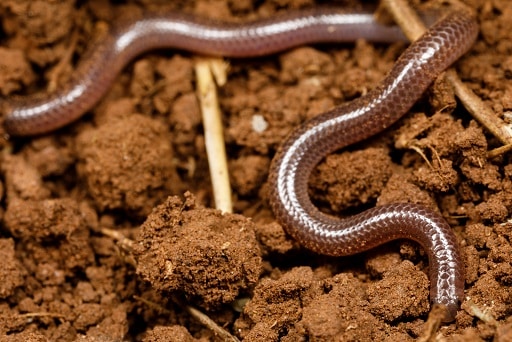
Texas is home to many cunning rattlesnakes and adventurous ratsnakes, yet one of the state’s most widespread snakes is the seemingly feeble Texas blind snake (Rena dulcis). This is a tiny species, at an average of 15-25cm, and an all-time record of just 27cm.
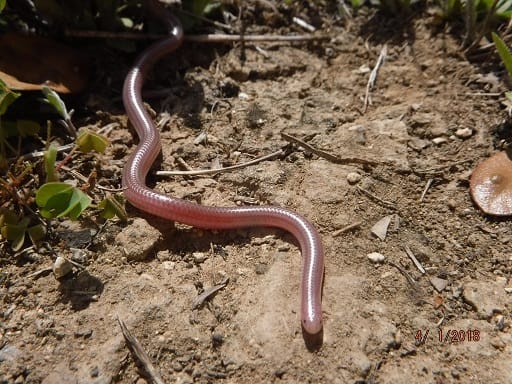
Like all blind snakes, this species lacks any venom, and poses no threat to humanity whatsoever. With no obviously defined head, and no obvious patterns, Texas blind snakes are constantly mistaken for earthworms. They spend much of their lives hiding beneath loose soil, and have an extremely smooth and shiny appearance, with a highly reflective body.
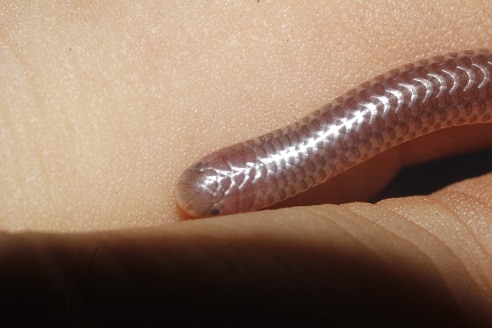
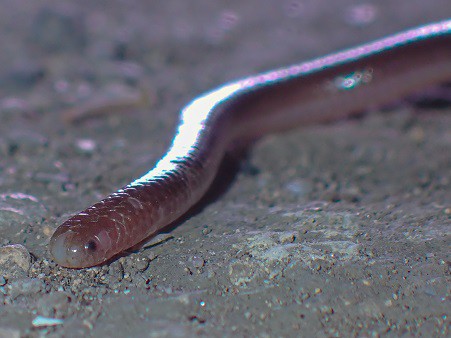
Texas blind snakes aren’t completely blind, as they retain a basic ability to sense changes from darkness to light. It’s even possible that they can make out very vague shapes. Either way, their eyes are miniscule, having shrunk steadily over the last few million years. One day, they might disappear altogether.
The Texas blind snake is a classic species where if you’re actually searching for one, you’ll probably never find one. You could spend hundreds of hours driving up dirt tracks, upturning rocks and logs, and using detailed maps with coordinates, and still not find a single individual. Yet if you’re minding your own business on a camping or fishing trip, you’ll probably end up finding a few unintentionally. Texas blind snakes sometimes appear in suburban gardens in compost piles as well.
| 2 | Common in the US south |
Texas blind snakes are widespread in the southern US, and in no danger of going extinct. Central Texas is their heartland, with constant sightings around Austin. But their range also extends well into Oklahoma, and into far southern Kansas. They’re common in New Mexico, and just reach extreme southeastern Arizona.
Texas blind snakes also have a large swathe of territory in northern Mexico. While they fizzle out further south, sightings have even appeared in Mexico City, although these are so far away that they could turn out to be a new species.
Tiny they may be, but Texas blind snakes have one great advantage over many larger snakes: flexible habitats. This species can be found in prairie grasslands, rocky hillsides, canyon floors and oak-juniper woodlands, and even desert edges as long as there’s sufficient moisture. As well as moisture, a consistent requirement is rocks, as they love areas of stony security to hide beneath while on missions to the surface.
Texas blind snakes spend 80% of their time below ground, in deep tunnels and shallower loose soils alike. Following heavy rains, they poke their heads out and perform reconnaissance missions on the surface. Logs are another shelter they commonly utilise. Texas blind snakes have a mean head diameter of just 2.6mm, ranging from 2.2-3mm.
| 3 | An expert ant stalker |
Texas blind snakes are well known for their ant-stalking tendencies, wolfing them down like breakfast cereal. A study from 1971 analysed 5 different snake species. The rough earth snake and western ground snake had no instinct to follow ant trails, but the Texas blind snake latched onto them with great interest.
The study also found that Texas blind snakes followed army ants (Neivamyrmex nigrescens) above all else. This ant mainly lives underground in huge colonies, but sometimes ventures to the surface and forms raiding columns up to 50 metres long, in epic expeditions where they rob the nests of rival ants. To orient themselves, they produce pheromones which later guide them home.
The flaw is that Texas blind snakes can also sniff these ant pheromones out. Upon detection, their eyes light up, and a few minutes later, they arrive at a bountiful food source, a swarming ant stream.
Regardless of whether these ants are carrying twigs or leaves, or just returning from a session of warfare, the Texas blind snake licks its lips and gets stuck in. In fact, the Texas blind snake is a master of scent detection in general, as it’s also particularly skilled at following pheromones to find females of its own species.
| 4 | The king of ant raking |
Texas blind snakes derive 54-64% of their meals from ants, according to a 1974 study from southeast Arizona. They only eat the hardest adult workers occasionally, as the tough chitin of their exoskeleton is theorised to give them digestive problems. Instead, they focus on the softer pupae and larvae.
Being blind makes their hunting somewhat cumbersome. Scent particles may guide them to the ant swarm, but what about when they arrive? Fortunately, the Texas blind snake has a solution; it simply swings its head violently, moving horizontally until it strikes an ant pupae or larvae. The blind snake then uses a process called mandibular raking.
Texas blind snakes are unique in having an upper jaw with no teeth whatsoever, a trait found in just a handful of Leptotyphlopidae blind snakes (among 4000 snake species). They also have a short lower jaw, which is lined with teeth, but is only 1 half the length of their snout. By placing their mouth over the swarms of ants, and performing sudden retractions with the lower jaw, they effectively rake ants down their throat, like a gardener sweeping up leaves.
| 5 | Produces its own ant repellent |
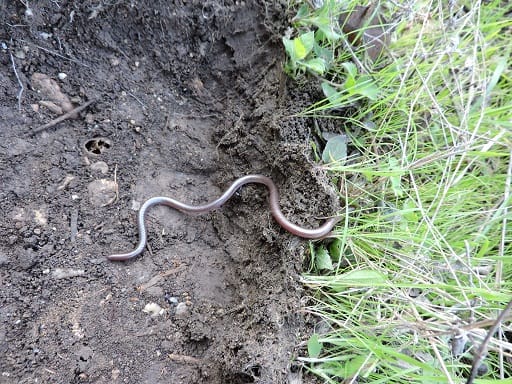
Texas blind snakes often wade into the very centre of swarming army ant columns, to feast on them. Yet ants are no cowards, and if scientists drop a blind snake from elsewhere into a column, the ants will savagely attack it. How do they stay safe while hunting? It turns out that Texas blind snakes secrete a clear, viscous fluid, which they writhe in and spread to every corner of their scales. This liquid contains free fatty acids which strongly deter the ants.
One study wiped this fluid off the Texas blind snake’s body, and placed it on a patch of floor, alongside some ethanol. The army ants spent far more time in the ethanol patch. This ant-repelling fluid also deters ophiophagous (snake-eating) snakes, such as kingsnakes.
Texas blind snakes also have a tendency to stalk earthworms, yet they don’t eat them. It’s believed that their digging skills are relatively weak for a blind snake, and hence, these stalkers are probably hoping to enlarge the worms’ ready-made tunnels.
| 6 | Rips its ant prey apart |
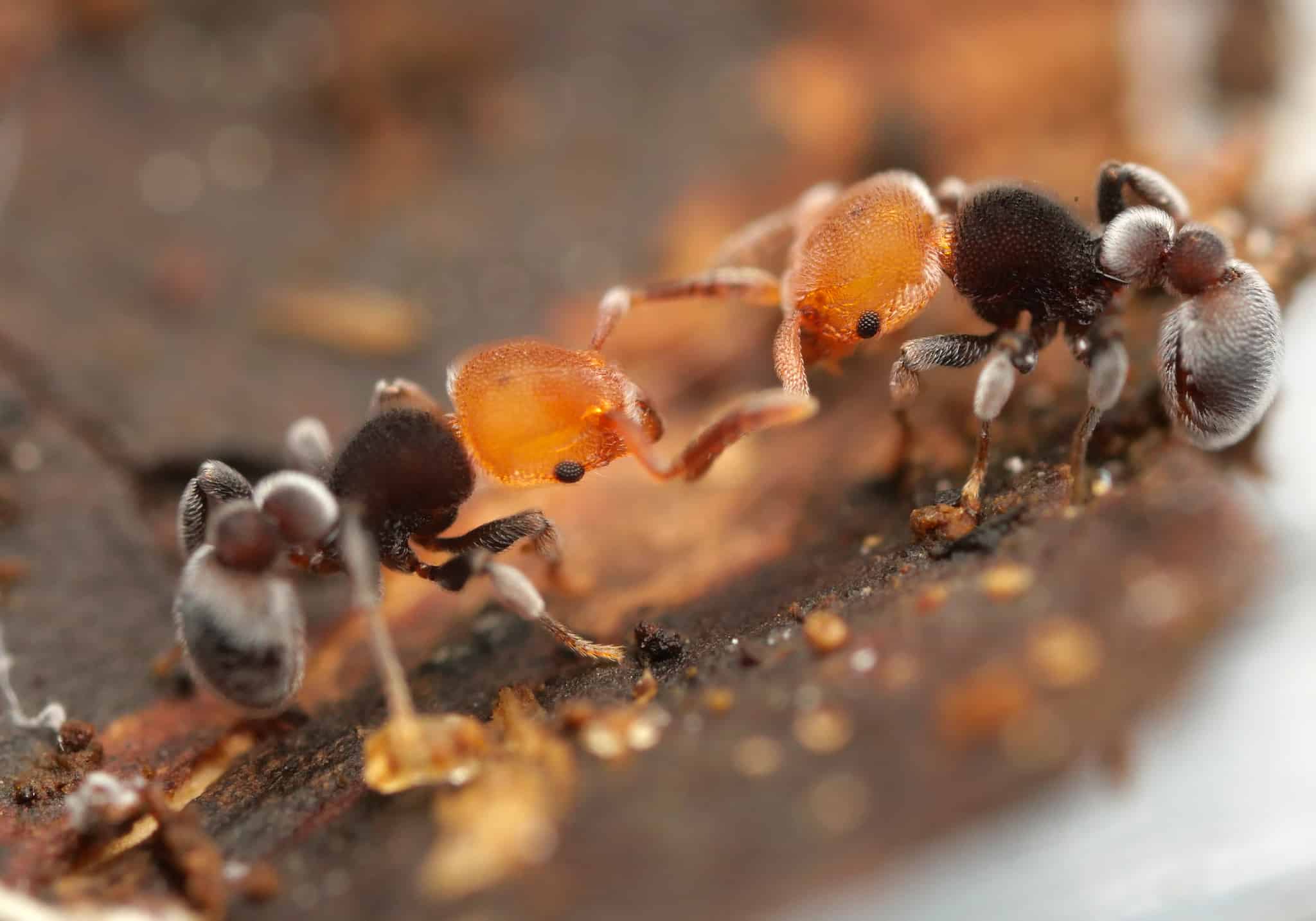
This snake has a friendly, humble appearance, and dulcis actually translates to “sweet” in Latin. Yet the reality is far more brutal. To make swallowing easier, Texas blind snakes decapitate their ant prey, by seizing the abdomen with their jaws and rubbing the head vigorously against the hard burrow walls. Another tendency is to grab an ant from behind, then crush them against the floor.
Though Texas blind snakes look harmless and helpless, they have just as many weapons as a ferocious Indian cobra. Fortunately, this species has no power to hurt a human being. If touched, a Texas blind snake will writhe its body and coil up into a tight ball, while continuing to writhe. This is the same technique it uses to smear ant-repelling fluid all over its body.
Another trick is stabbing with the tip of its tail, which is actually powerless, with no sharp point like a sharp-tailed snake. Nevertheless, it might scare predators or humans into backing off.
| 7 | Owl-snake cooperation |
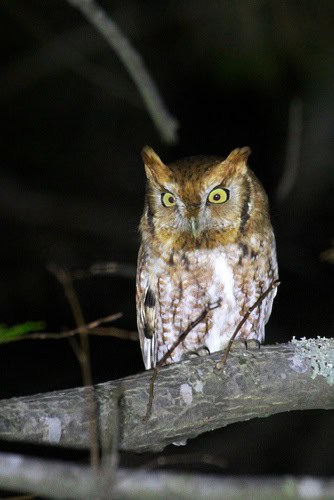
The Texas blind snake is the host of one of the most amazing symbiotic relations in the snake kingdom, involving not ants, but an owl.
Eastern screech owls are small birds which stand just 18-25cm tall. They’re famous for their loud call, and have a vicious tendency to decapitate their prey, before carrying it back to the nest, ready to feed to their beloved owlets. But with Texas blind snakes, they act more cunningly. They don’t decapitate them, and rather than seizing them in their beaks, they coil the snakes around the outside.
They then drop the snake into their nest, alive. The confused Texas blind snake begins burrowing downwards into the nest, just like in soil, and commences eating whatever bugs and insects it can find. The snake lives in the nest for days, out of sight, cleansing pests which could act as parasites in the nest. Effectively, screech owls are using blind snakes to sanitise their own living quarters.
After several weeks of monitoring, the study found that owlets in the blind snake nests grew faster, and had higher survival rates. Analysis confirmed that these nests had fewer bugs, including ants and larvae. Texas blind snakes are effectively a fancy gadget for screech owls, like a robotic lawnmower or a drone.
| 8 | Predators love their taste |
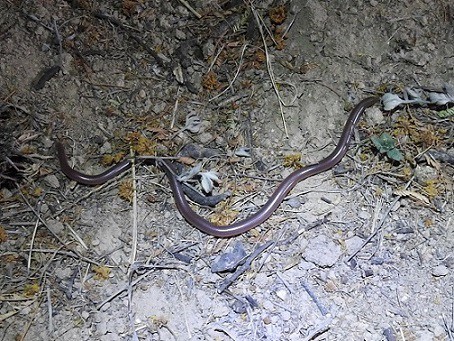
Texas blind snakes have advantages when it comes to survival. They can instantly dig down and hide in soil, and they tend to live in sweeping rockland and grassland in Texas, which covers so much area that humanity could never fully absorb it. But they’re not immune to cunning predators, and one is spiders. Texas blind snakes have been photographed suspended in the webs of the triangulate cobweb spider, a species recognisable by its triangular markings.
Spiders eat snakes surprisingly often, catching and digesting them piece by piece using powerful enzymes in their saliva. Spiders can take weeks to eat a single snake, keeping it stored in the web right next to tiny insects. Triangulate cobweb spiders have a potent neurotoxic venom which quells the snake’s resistance, although in humans, they’ve only ever caused one serious bite. The photo was taken near San Antonio, Texas.
Texas blind snakes are also eaten by fellow snakes. Texas coral snakes and Texas night snakes (Hypsiglena torquata) are confirmed predators. This image captured a California kingsnake munching on its close relative, the western blind snake (Rena humilis).
In Texas and New Mexico, Texas blind snakes live alongside the speckled kingsnake and desert kingsnake, so they almost certainly fall victim to them as well. Their other predators include nine-banded armadillos, greater roadrunners, and eastern moles.
| 9 | Tolerates its own kind |
Texas blind snakes have a strong tendency to form mating balls, sometimes featuring up to 12 snakes. The males outnumber the females 3 to 1, and the writhing sphere can be the size of a golf ball.
This is also a moderately communal snake. During hibernation, several Texas blind snakes gather in the same cracks in the deep underground, coexisting peacefully. They commonly lay their eggs in dry soil chasms used by previous snakes, surrounded by old, cracked eggs from years gone by.
The eggs themselves are long and thin, and measure 4.5-15mm, which is large for such a tiny snake. The hatchlings are tiny, with the smallest on record measuring 6.5cm.
The Texas blind snake’s closest relative is the western thread snake (Rena humilis), which it overlaps with in southeastern Arizona. A study found that the two have separated into their own niches: Texas blind snakes tend to hunt underground, while western blind snakes hunt a higher proportion of surface insects.
| 10 | Genetics and evolution |
Texas blind snakes have 3 subspecies. Rena dulcis dulcis is the most common, while Rena dulcis rubellum and R. d supraorbicularis are less widespread. Yet only an expert herpetologist could distinguish them. Their colouring is virtually identical, and the only differences are in subtle scale counts.
Originally, Texas blind snakes were placed in the Leptotyphlops genus. Advanced genetic analysis clarified the snake family tree, and revealed a new cluster of blind snakes: the Rena genus. This has ten members, and the Texas blind snake is the most northerly, crossing the border into southern Kansas. The most southerly is the southern blind snake (Rena unguirostris), which stretches all the way to central Argentina.
Through many blind snakes look similar, the Texas blind snake is the only one in its neighbourhood. One snake it might be confused with is the rough earth snake. Both measure just 25cm, are thin and have no patterns.
The rough earth snake is also a burrower, but is an olive colour instead, and looks much more clearly like a snake, rather than a mutated worm. Its head is more noticeable, whereas with the Texas blind snake, it’s tricky to distinguish head from tail.