
| 1 | Common garter snake |
Maximum length: 137.2cm.
States inhabited: 47/50.
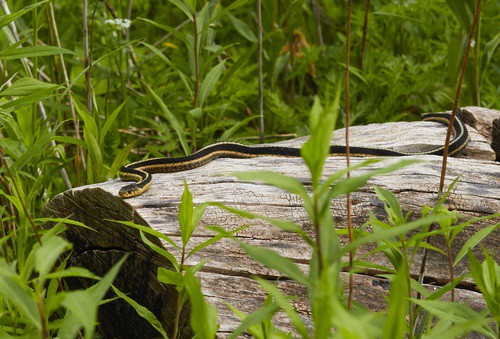
The common garter snake is a species familiar to almost every American. It’s an inhabitant of back garden ponds, scenic river shores next to grassy meadows, and sparse woodland areas with small forests pools. As long as there’s a decent source of moisture around, this species can inhabit most habitats. The average rural gardener in New York or Virginia has probably been encountering the common garter snake for years, but something they might not realise is that this is the most widespread snake in the entire USA in terms of raw territory covered.
The common garter snake completes a full spread from west to east, and north to south. It’s just as common in Florida as Washington state, and just as common in Maine as California. There’s only a single state this species doesn’t inhabit: Arizona, which is far too parched.
There’s also a handful more where the common garter snake is relatively sparse. They only just cross into western Nevada, northern Utah and northeast Colorado. They’re also relatively scattered in North Dakota and Wyoming.
Nevertheless, the common garter snake is believed to be perhaps the most abundant reptile (not just snake) by headcount in the entire US. This species is harmless to humans, and preys on a mixture of frogs and earthworms.
| 1 | Black racer |
Maximum length: 190.5cm.
States inhabited: 47/50.
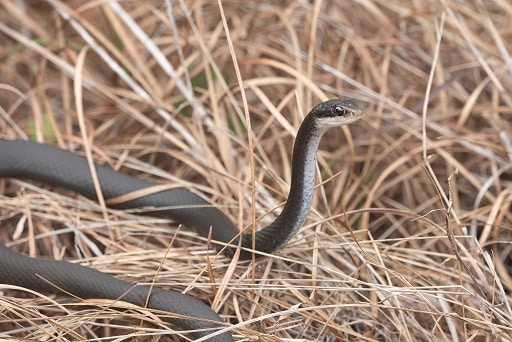
The black racer (Coluber constrictor) ties with the common garter snake as the official most widespread in the entire USA. This is a fast-moving, non-venomous, but potentially aggressive species, which can bend around in mid-air while being held and bite a curious human being in the face. Black racers often appear in towns and suburbs, and this flexibility is the main reason why they’ve gradually taken over the North American continent.
Like the common garter snake, black racers inhabit every lower 48 state except Arizona. There’s a slight caveat, as a single sighting of this species was made in Apache County, Arizona in the 1920s, directly adjacent to New Mexico, where the species is confirmed to exist. Since then, no more black racers have been sighted in the state, at least with a high degree of reliability.
Nevertheless, the black racer is just as widespread in North Carolina as it is in Oregon. It can be found on the outskirts of Orlando and San Francisco alike.
Weak spots of the black racer include Michigan and Wisconsin, where it only has a small foothold. It only appears in the far southwest of Maine, unlike the common garter snake, which covers the entire state. However, black racers penetrate deeper into Utah and Nevada, and are more likely to appear in areas further from water. Hence, the two species are granted a tie for America’s most widespread, unless another fabled Arizona record pops up and is officially verified.
| 3 | Ring-necked snake |
Maximum length: 85.7cm.
States inhabited: 45/50.
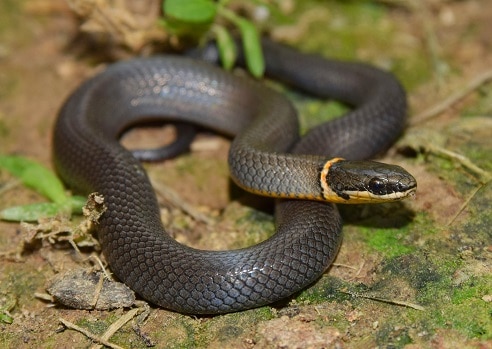
The third most widespread snake in the USA is a much more subtle species. To a woodsman in Kansas who finds 50 in an hour after ripping up wooden logs in a forest, it might not surprising to find that this species covers almost every state in the USA. The species we’re talking about is the ring-necked snake (Diadophis punctatus), which typically measures just 30cm, and spends its life hiding under cover objects such as rocks, logs, and even inside anthills.
Ring-necked snakes are officially found in 45 states of the lower 48. The exceptions are North Dakota, Wyoming and Montana, which have no officially recorded sightings. South Dakota, Idaho and Utah also have relatively few observations, but for the rest of the US, it’s ring-necked snake city. As a shy, non-aggressive species, which moves small distances per day and has no venom, there’s no particular reason why this species should have taken over most of the USA, yet this snake has succeeded with aplomb.
Ring-necked snakes cover the entire eastern US, becoming sparse again in the mid-west, before reappearing in force along the west coast. They somehow maintain strong populations in Arizona as well. Likewise, they have decent populations in colder northeastern US states like Michigan, Maine and Wisconsin.
This species preys on a mixture of ants, earthworms and salamanders. The only thing that turns this species aggressive is touching its neck, which tends to trigger a sudden bite.
| 4 | Gopher snake |
Maximum length: 267.7cm.
States inhabited: 24/50.
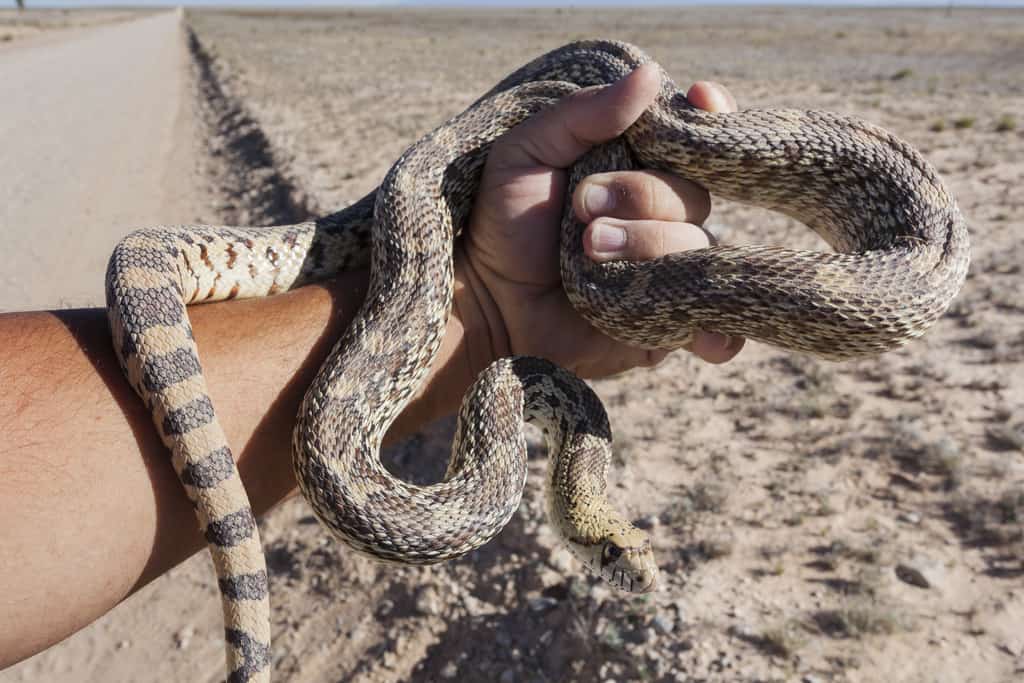
Our first three entrants are the only US snake species to inhabit over 40 states. Our final 7 members are slightly less omnipotent, but still extremely widespread. The first is the gopher snake (Pituophis catenifer), which focusses on the west coast, but spreads well into the centre as well. This is a non-venomous constrictor which prefers open areas, sometimes appearing in sparse woodlands, but favouring grasslands, plains and the margins of agricultural fields.
Gopher snakes inhabit 24 out of 48 lower US states. While this sounds relatively unimpressive, US states of the west and centre are generally far larger. Consequently, the gopher snake covers far more terrain overall than the timber rattlesnake, despite the latter covering 31 states. Gopher snakes are incredibly abundant in California, probably the most observed reptile overall. In certain areas they’re almost at infestation levels, like in Boulder, Colorado.
Gopher snakes cover the centre and western areas of Texas, but disappear in the east, with no populations around Houston. Their easternmost natural extent lies in Indiana, where there’s a slightly separated pocket of territory. The one state they barely edge into is Arkansas, where they only inhabit the far northwest.
This species preys mainly on mammals, and is hunted itself by birds. Seeing a gopher snake slithering towards you doesn’t guarantee death, but it might guarantee a bite, if you pick them up, and you’ve found an individual with an aggressive personality.
| 5 | Eastern hognose snake |
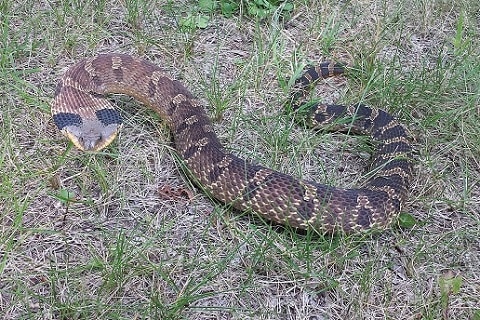
Maximum length: 126.8cm.
States inhabited: 35/50.
The top death-faking snake of the United States, with an unrivalled ability to flip onto its back, go limp, and loll its tongue out of its mouth as though totally lifeless. Eastern hognose snakes are also able to flatten their upper body to appear larger, scaring birds, and they’ve exploited these abilities to become one of the most common species nationwide.
Eastern hognose snakes (Heterodon platirhinos) are completely missing from the west coast, but reach as far west as extreme eastern New Mexico, where they just trickle over the border from Texas. They also have tiny pockets in Colorado and South Dakota.
Head eastwards, and there’s barely a state where you can’t find them. Eastern hognose snakes are easy to find in Florida, Georgia, New Jersey, Alabama, Pennsylvania and Indiana alike. They’re most commonly found in sparse woodlands, but agricultural areas and grasslands are no issue for them either.
The only eastern states this species is missing from are Vermont and Maine, which are simply too cold. This dominance poses no threat to humans, as eastern hognose snakes are venomous, but their toxin mixture is tailored against amphibians, their main prey, and very weak against mammals such as mice. Eastern hognose snakes prey particularly heavily on toads, including Fowler’s toads and eastern spadefoot toads.
| 5 | Dekay’s brown snake |
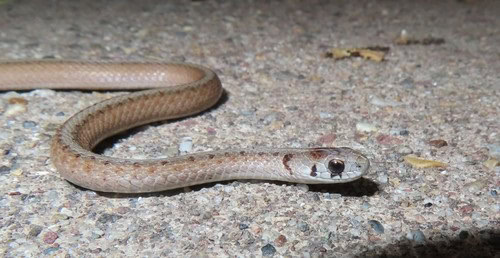
Maximum length: 52.7cm.
States inhabited: 35/50.
Dekay’s brown snake (Storeria dekayi) is virtually equal to the eastern hognose snake in raw territory covered, although it covers one less state overall. This is a completely harmless species, which is one of the main urban snakes in the USA. This species often invades back gardens, hiding under garden plant pots, and is a common diver into home swimming pools, forcing owners to rush in and rescue them, after quick debate over whether it’s venomous or not.
Dekay’s brown snakes are centred around the east and centre of the USA. They knock off multiple eastern states with ease, but grow steadily patchier as they reach Nebraska and Kansas, before suddenly disappearing. Their absolute westernmost extent lies in western Texas, where they don’t quite reach the New Mexico border. However, they do reach frosty Vermont and Maine to the northeast, as well as Wisconsin, Michigan and Minnesota.
This species has a strange correlation with ants and millipedes, often appearing alongside them, but actually feeds on earthworms and slugs. They’ve occasionally been recorded to gather together in groups of dozens, and have several snake predators, including northern redbelly snakes, milk snakes and plains garter snakes.
Dekay’s brown snakes rarely bite, but can perform aggressive mock lunges, and release a foul smell. Temperature tolerance is the key to any mega-widespread snake, and this species somehow ranges from extreme northern Maine to the sunny southern tip of Texas.
| 7 | Northern watersnake |
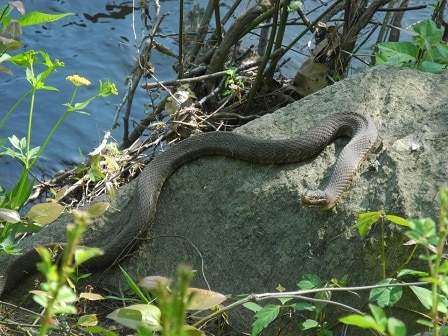
Maximum length: 149.9cm.
States inhabited: 36/50.
Also known as the common watersnake, this species managed to take over the rivers and lakes of the eastern USA millions of years ago, and has refused to relinquish its grip since. The northern watersnake is a semi-aquatic species which is flexible in all respects. It preys exclusively on fish, but virtually any type – sunfish, minnows, trout and catfish are equally acceptable. It can appear both in sparkling lakes and concrete-sided canals running through towns, adapting perfectly to urbanised areas.
Northern watersnakes are non-venomous, and reach a western extent of Denver, Colorado. They reach the Florida panhandle, Maine to the north, and Texas to the far south, with a wide degree of temperature tolerance.
Although this species covers one more state than Dekay’s brown snake, they cover slightly less territory overall. They have more states where they only have tiny pockets or patchy distribution, including Nebraska, Colorado and Louisiana. In Texas, there’s only one tiny pocket located in a few counties near Dallas.
Nevertheless, this is an all-powerful species, which is easily the most widespread member of the Nerodia watersnake genus it belongs to. The second most dominant is probably the plainbelly watersnake, which has a more southerly distribution, and is particularly common in Texas and Louisiana. This version covers 22 states overall.
| 8 | Terrestrial garter snake |
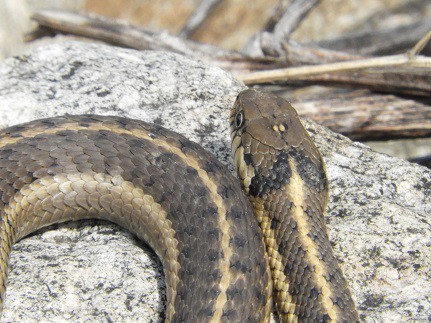
Maximum length: 109.2cm.
States inhabited: 13/50, maybe 15.
The second most widespread garter snake after the common garter snake. This species inhabits the western half of the US, hugging the coastline, with vast populations in California, Oregon and Washington. They’re equally common in Colorado, and manage to inhabit Arizona, where their common cousin fails, due to being the most tolerant garter snake of dry conditions overall. Terrestrial garter snakes (Thamnophis elegans) have been recorded at altitudes of over 3000 metres, earning them the nickname of wandering garter snake.
Like the gopher snake, this species has a relatively low tally of states, but still covers more terrain than the timber rattlesnake, due to western states being far larger on average than eastern ones. The likes of Colorado, Utah and Idaho feature vast, incomprehensible open spaces, in which a terrestrial garter snake could be hiding anywhere, as long as the terrain isn’t pure desert.
This species reaches an easterly extreme of western South Dakota and western Nebraska. The caveat lies in far northwest Texas and far western Oklahoma, in the area where the borders converge with New Mexico. Terrestrial garter snakes are believed to exist here, but haven’t been sighted in many years, and if reestablished, this could add two extra states to their tally.
Terrestrial garters are also the most venomous garter snake in the US, perhaps capable of swelling a victim’s hands. They prey on far more mammals as well, with a dose of the usual frogs.
| 9 | Timber rattlesnake |
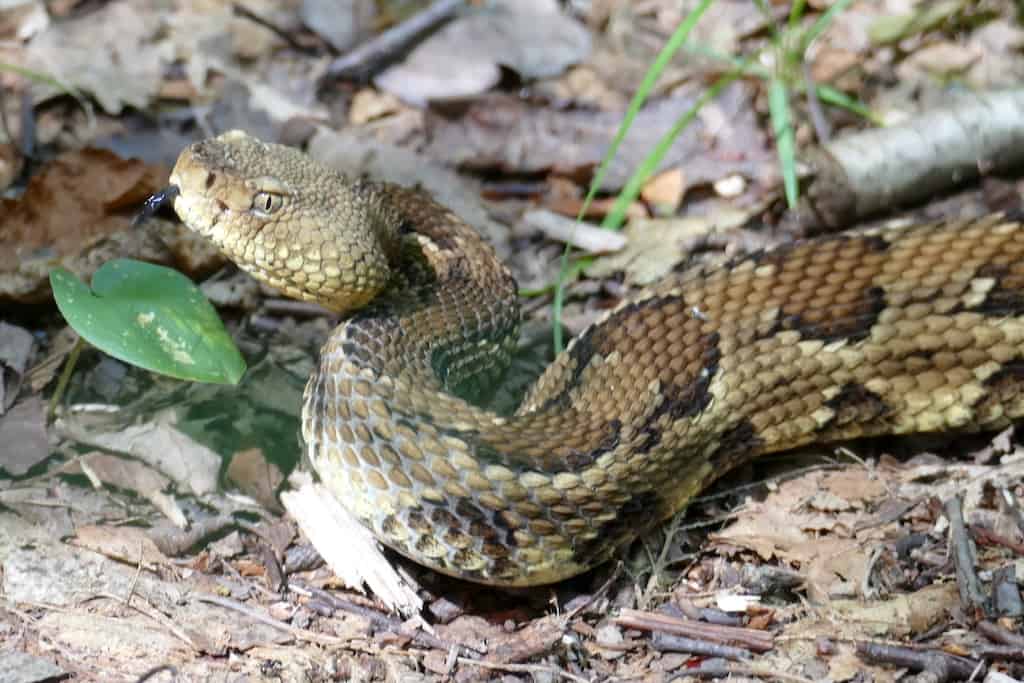
Maximum length: 189.2cm.
States inhabited: 31/50.
Easily the most widespread rattlesnake in the US for states covered, and just ahead of the prairie rattlesnake for overall US territory covered. Timber rattlesnakes are most common in forests, with an abundance of fallen logs and branches to take shelter in (hence the name). However, they’re relatively flexible in habitat, also appearing in grasslands, marshy areas and even in agricultural zones. This has allowed them to inhabit 31 states of the US overall, mostly in the east and centre.
Timber rattlesnakes are longer than average for a US rattlesnake, nearly reaching 2 metres. Their venom is more toxic than the nearby copperhead, and has killed several people since 2010, in states such as Georgia, Alabama, Virginia and Pennsylvania.
In Florida, this species only inhabits the far north, but their range then continues unbroken until central Texas, their far westernmost point. To the far north, they have a decent pocket in Wisconsin and Minnesota. The timber rattlesnake is slightly less common than it was, as they’re extirped (locally extinct) in 4 eastern states: Delaware, Rhode Island, Maine and Michigan.
Nevertheless, you’d be a very lucky man not to meet this species at least once if you live in the Carolinas, Georgia or Alabama. Their absolute world capital might be Tennessee, where they’ve pretty much taken over the entire state, leaving residents terrified to leave their homes, at least according to this iNaturalist map.
| 10 | Coachwhip |
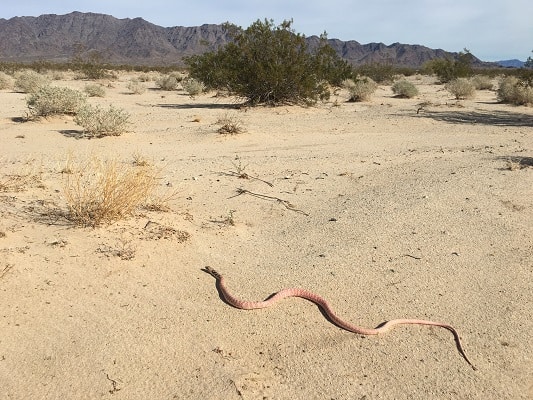
Maximum length: 259.1cm.
States inhabited: 19/50.
The most heat-adapted snake on our list, and perhaps the most heat-resistant large snake in the entire USA. The coachwhip (Masticophis flagellum) is a fast-moving, non-venomous species which charges after lizards in mad pursuit, and leaps after them when it gets close enough, sometimes successfully, sometimes not. It’s the 3rd longest snake in the USA when judged by maximum record, and has a very thin body as well, enabling its rapid speed.
The coachwhip’s territory has a completely different style to the rest of our list. Most of our species favour either the western or eastern USA, before spreading well into the centre and eventually fizzling out. But the coachwhip is defined by its love of heat, and instead thrives in the south, but grows steadily sparser further north.
Consequently, this species inhabits every single state of the southern USA, from California in the west, to Florida in the east. It’s perfectly common in Arizona, with the endless desert expanses with barely a drop of rainwater being no issue at all. Again, many of these states are huge, allowing the coachwhip to cover immense territory.
It’s only further north where this species begins to disappear. The coachwhip’s absolute furthest northern point is northern Nevada, as well as southwest Nebraska. On the east coast, they reach as far north as central North Carolina, before suddenly vanishing.
One debate centres over whether coachwhips inhabit far southern Tennessee. Some old timers claim they’ve never seen one, while fanatics point to archived records and insist that a small population once existed in McNairy and Hardeman counties, and could hang on today.