
| 1 | Everywhere in the western US |
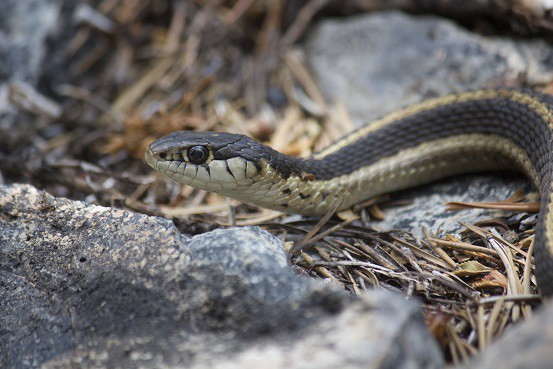
The common garter snake is the most widespread member of its group in the USA, inhabiting 47 of the lower 48 states, with the sole exception of Arizona. The second most widespread, meanwhile, is probably the terrestrial garter snake, AKA Thamnophis elegans. This is a grey species with three creamy stripes, which is virtually ubiquitous in the western half of the USA, inhabiting at least 13 states.
The terrestrial garter snake’s realms include Washington, Oregon, Nevada, Colorado and California, to name just a few. It’s also found in southern Canada, and unlike the common garter snake, this species is tough enough to inhabit parched Arizona.
Thamnophis elegans is arguably the least garter-like garter snake of all. Though slightly less common, this is the boldest and most advanced member: it’s less reliant on water, has the strongest venom and constriction abilities, and is extremely adventurous, having been recorded slithering to altitudes of 3993 metres above sea level. It’s no coincidence that the most common subspecies (Thamnophis elegans elegans) is called the wandering garter snake.
Terrestrial garter snakes are extremely flexible, in that they adapt their diet to whatever habitat they find themselves in. In a scenic stream with lilypads, they’ll eat more fish and frogs, while in a rocky field, they’ll indulge in scurrying voles. They do have one consistent rule however: they eat mammals more frequently than other garter snakes.
| 2 | The main constricting garter snake |
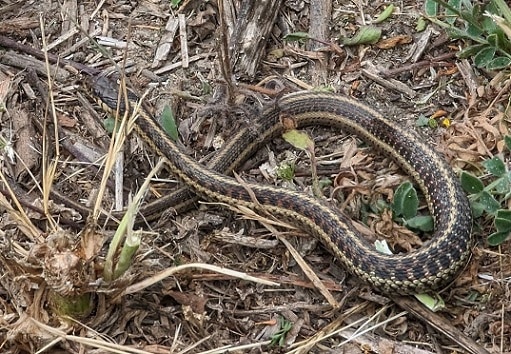
Ordinarily, garter snakes aren’t powerful, gripping snakes. When you pick one up from a terrarium, they tend to be loose and relaxed, and they don’t suddenly seize your hand in a tight grip. Their muscle tone doesn’t compare to a python’s, and their bodies are less powerful overall. Terrestrial garter snakes are an exception to this rule, as they’re noticeably stronger in your hands. This is because they’re a rare garter snake to use constriction, keeping their prey in a jail cell of coils before swallowing them whole.
Though this fails to match specialised constrictors like the gopher snake, it’s still an extra ability in their hunting repertoire. The exact strength varies by region, as one study found that terrestrial garter snakes from Colorado had stronger constriction abilities than those from the Pacific coast. They were tighter, more organised and efficient at pinning their prey.
Terrestrial garter snakes are active foragers. Rather than waiting silently in ambush, they impatiently prowl their riverside fields and search for scurrying voles, or leap into the water and search for fish.
According to a 2005 study, another skill is that terrestrial garter snakes are better at controlling their buoyancy than common garter snakes. This allows them to dive below the surfaces of rivers for fish, whereas the latter are forced to grab concentrated schools of fish by moving through shallow water.
| 3 | Appears in most habitats |
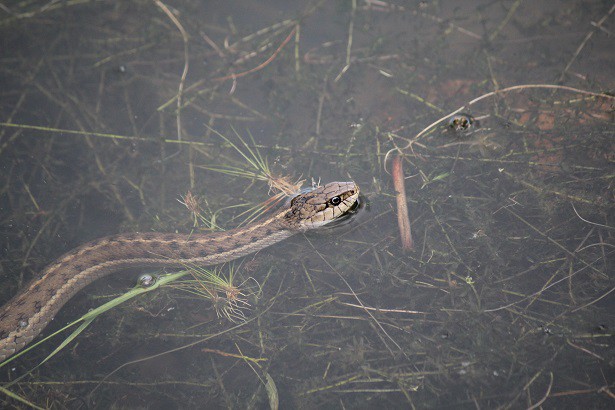
Terrestrial garter snakes are hard to distinguish at first glance, but one of the simplest ID signs is that common garter snakes have less pigmentation on their belly (ventral scales).
Another difference is more technical: terrestrial garter snakes have an 8th labial scale (above the mouth), while common garter snakes possess just 7. Additionally, the 6th and 7th labial scales cover more space in terrestrial garter snakes, because of their enlarged salivary venom glands.
Terrestrial garter snakes are active from March to October, and have highly flexible habitats. They can be found in forests, woodlands, grassy meadows, arid areas, and on mountain slopes, as long as there’s a source of water close by.
This species always requires a source of water, whether it’s a large scenic lake or a small flowing stream. However, it tends to venture further from water compared to other garter snakes. A study analysed three garter snake species living side by side in California’s St Lucia Preserve. It found that the aquatic garter snake rarely ventured more than 1 metre from water. Common garter snakes stuck to within 20 metres, while the local terrestrial garter snakes were often found 50 metres away.
| 4 | The nastiest garter snake bite |
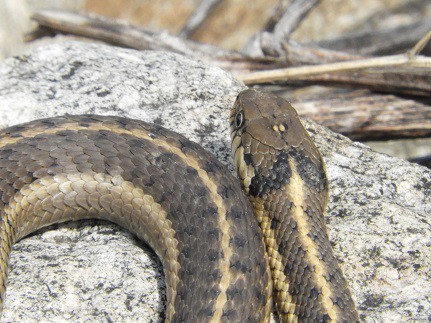
This species may have the strongest venom of any garter snake. The raw venom potency approaches some vipers, and is only softened because of the inefficient venom-injecting system. Terrestrial garter snakes must chew their venom in over a couple of minutes, rather than a black mamba, which lunges and instantly injects 400mg.
One bite happened to a 16 year old amateur herpetologist, who was removing several garter snakes from below a rock pile. He was bitten by a 51cm terrestrial garter snake on the right third finger, but wasn’t worried at all. The boy actually pressed the snake’s head down on his finger for 5 minutes while he walked home, allowing it to keep chewing.
To his surprise, his finger rapidly swelled, became severely painful, and haemorrhaging began. Luckily, there were no internal symptoms. Rather than being a simple grabber, terrestrial garter snake venom wreaks utter havoc on mice. It causes severe haemorrhaging in the lungs, stomach lining, and diaphragm, as well as mild local haemorrhaging.
| 5 | The loosest garter snake diet |
One study compared coexisting garter snake species on Vancouver Island, Canada:
- Terrestrial garter snake (Thamnophis elegans).
- Common garter snake (Thamnophis sirtalis).
- Northwestern garter snake (Thamnophis ordinoides) – a small species averaging at 40cm.
The study found that terrestrial garter snakes easily had the broadest diet of the three. Northwestern garter snakes ate slimy creatures exclusively: slugs and earthworms. The vast majority of the common garter snake’s diet was amphibians and earthworms, with a single bird and leech apiece.
The terrestrial garter snake had a small amount of amphibians and earthworms recorded, but ate a large amount of slugs. It was also the only garter snake studied to eat fish and mammals, the latter being mainly Townsend’s voles, with one wandering shrew recorded. Terrestrial garter snakes also had 4 reptiles recorded, again the only garter snake to eat them. 2 birds were recorded.
Overall, terrestrial garter snakes consumed 7/8 food groups, excluding leeches. Northwestern garter snakes ate just 2/8, while common garter snakes ate 4/8. Terrestrial garter snakes were not only the most flexible species, but the garter snakes were sequestering themselves in their own niches, allowing them to coexist and not drive each other to regional extinction.
| 6 | Dissolves its prey |
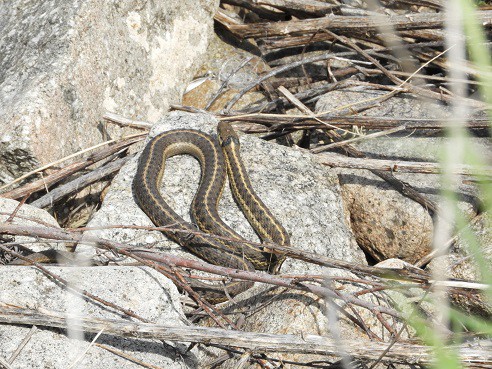
Terrestrial garter snakes are medium in length, with an average of 50-100cm, and an all-time record of 107cm. This compares to the common garter snake at a maximum of 137.2cm, and the all time longest, a giant garter snake recorded at 162.6cm.
The favourite prey of terrestrial garter snakes seems to be voles, as in Colorado, near the New Mexico border, they’ve been spotted eating Mexican voles (Microtus mexicanus). These voles were collected half dissolved, with their facial and neck skin being depilated (missing hair). This was thought to be due to the venom’s proteolytic properties, effectively predigesting a meal, showing how unusually powerful this species’ venom is. The venom is proven to have myonecrotic properties, destroying muscle tissue.
Despite liking mammals, terrestrial garter snakes rarely eat mice in the wild. In the Vancouver Island study, they never ate the white-footed mouse, despite it being extremely common. It’s thought that unlike voles, mice are simply too fast for this snake.
| 7 | Evolution and genetics |
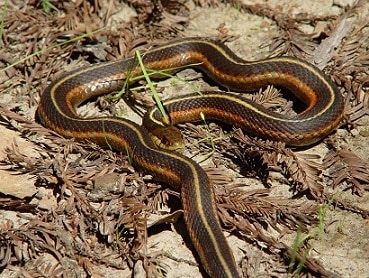
The garter snake (Thamnophis) genus has 35 members. Despite their similar appearance, common and terrestrial garter snakes are far from each other’s closest relatives. The former is most closely related to western and eastern ribbon snakes, while terrestrial garter snakes occupy a more isolated branch of the tree. Using a standard genetic drift of 1.3% per million years, scientists estimated that the divergence between the two happened 6.9 million years ago, during the Miocene Epoch.
The northernmost point of the terrestrial garter snake lies in Canada, in central Alberta. There’s also a small colony in Baja California, Mexico, which is isolated from the rest. To the east, this species fails to reach Texas, and just crosses into extreme western South Dakota.
Occasional black morphs have been found of the terrestrial garter snake. There’s at least 4 species, the most widespread by far being the wandering garter snake (T. elegans elegans). The most memorable is the coast garter snake (T. elegans terrestris), found only in California, as this has vivid red flanks.
| 8 | Fears the Californian kingsnake |
One special feature of common garter snakes is their resistance to tetrodotoxin, the heart-stopping toxin found in rough-scaled newts. This is unique to garter snakes, and is also found in aquatic garter snakes and their equivalent prey, the California newt.
It’s not proven whether terrestrial garter snakes have this ability, but the signs are positive, as in 2020, one was recorded eating a poisonous California newt (Taricha torosa) in San Luis Obispo County, California. Some garter snakes can also pass stored tetrodotoxin onto their children.
Terrestrial garter snakes have the power to recognise predators, according to a 1982 study. They were exposed to scents of two snakes, including the California kingsnake, an ophiophagous species which gets 30-50% of its calories from fellow snakes. The second was the black ratsnake, which eats virtually no snakes.
The terrestrial garter snakes flecked their tongue over 3 times more vigorously when exposed to kingsnake scents, showed a more muted response to the ratsnake. Other snake predators of this species include the rubber boa and common racer.
| 9 | Immune to toad toxins |
Like most of their cousins, terrestrial garter snakes have a juicy red tongue with a black forked tip. Another resistance they possess is to bufotoxins found in toads, such as American toads (Anaxyrus americanus). These weapons target the hearts of predators, by disabling an enzyme called NKA found in cell membranes. Disabling this causes a surge in intracellular calcium ions, prolonging the contraction of the heart muscle and decreasing the overall heart rate.
The result is simple – a heart that no longer beats. A 2017 study found that terrestrial garter snakes have mutated versions of a gene called ATP1a3, which prevents bufotoxins from disabling NKA. Furthermore, this protective gene was massively elevated in heart tissue, compared to kidney, lung and gut tissue.
Consequently, toads are a perfectly available food source for terrestrial garter snakes, whereas other snakes cannot dare to touch them. Western hognose snakes are immune to bufotoxins as well, but through a different mechanism – releasing a surge of adrenaline to counteract the heart rate decrease.
| 10 | Master of thermoregulation |
Even though terrestrial garter snakes use active foraging, and are energetic and adventurous overall, they still have periods where they stay completely in shelter. Any grassy field you walk through could contain dozens, which simply can’t be bothered to leave their rock pile that day.
One study examined terrestrial garter snakes in Eagle Lake, California, as part of a 15 year study. It found that in gravid females, their favourite resting site was below rocks of medium thickness: above 15cm, but below 40cm. Their favourite thickness was 20-30cm.
Generally, the garter snakes left their rocks during early morning to bask in the sun, then foraged for just a short period. However, the study found that even on a glorious clear day with a blazing sun, some females refused to leave their rock shelters. Some refused to leave for days at a time.
The scientists were confused as to how they maintained their temperatures, keeping their reptilian bodies in equilibrium. The rocks reached their coolest point at 6:00-13:00, shedding heat to the atmosphere, and peaked in temperature at 14:00-23:00. It turned out that a single rock had enough heat variation that the garter snakes could exploit various positions, and not leave all day, slithering sinuously around the rock’s surface.
One female managed to keep her body temperature above 23.6C for 24 hours straight, while not leaving her rock. Terrestrial garter snakes have had millions of years to perfect keeping their temperature in equilibrium.