| 1 | Oaxacan coral snake |
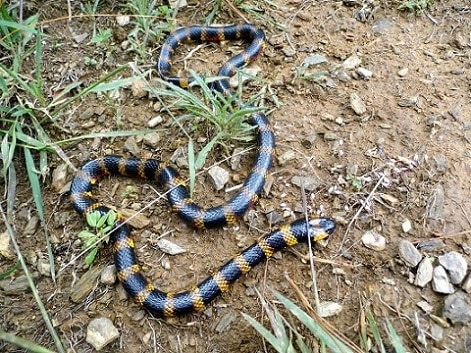
Maximum length: 92.5cm.
A Mexican coral snake, which only has a small territory, yet is highly abundant within that territory. The Oaxacan coral snake (Micrurus ephippifer) lives only in southern Mexico, in its namesake Oaxaca state, and doesn’t come close to the Guatemalan border. This is a relatively short species, at an average of just 45cm, with females exceeding males.
Oaxacan coral snakes often live in remote spots, and how many people they kill is a mystery. So is their venom composition, as the Oaxacan coral snake is almost certainly neurotoxic like its cousins, but the precise toxins and severity are yet to be properly researched.
Oaxacan coral snakes reach decent altitudes, having been found at up to 2300 metres above sea level. They’re typically found in dry scrub in rolling foothills, tropical deciduous forests, or high altitude pine-oak forests.
The unique physical characteristic of this species lies with its red bands. Oaxacan coral snakes officially have a red-yellow-black-yellow-red pattern, similarly to the eastern coral snake of Florida. However, each red scale has a black marking, giving it a unique appearance.
In some Oaxacan coral snakes, the black covers more than others, while in a few, the black takes over the red so fully that only traces are visible. See the image above for a snake where the red has been pushed back to almost nothing. This image, meanwhile, shows a more typical Oaxacan coral snake.
| 2 | Venezuelan coral snake |
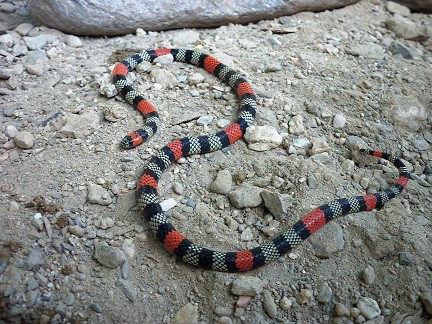
Maximum length: 150cm.
This species lives in northern South America, with no spillage into Central America. The Venezuelan coral snake (Micrurus isozonus) lives exclusively to the east of the Andes, in Venezuela, Colombia and far northern Brazil. In 2002, it was discovered in Guyana for the first time.
This is a longer coral snake species, with the absolute longest (150cm) being observed in central Colombia. When disturbed, this coral snake performs a defensive display of raising its tail high in the air, swishing it from side to side, and hiding its head and precious brain beneath its coils.
Venezuelan coral snakes stick to humid habitats, including forests. However, they’re relatively flexible, also appearing in urban areas, even within the Venezuelan capital of Caracas, sometimes in vacant lots under rubbish. This is the most common venomous snake in Caracas overall.
According to a 2011 study, this coral snake is slightly milder than the eastern coral snake of Florida, achieving an LD50 score of 0.52-0.61mg versus 0.32mg. Its venom is neurotoxic, but less commonly for a coral snake, has haemolytic properties. Its toxins are capable of blocking factor X and platelet aggregation, key ingredients in the blood clotting recipe.
Like other Micrurus members, the Venezuelan coral snake preys heavily on fellow snakes, including Leptotyphlops blind snakes and even one of its mimics, the false coral snake (Erythrolampus bizona).
| 3 | Steindachner’s coral snake |
Maximum length: 104.2cm.
A mysterious coral snake of Ecuador, with the first trickles of information arriving just recently. Steindachner’s coral snake (Micrurus steindachneri) lives to the east of the towering Andes mountain range, meaning that it appears in eastern Ecuador and northeastern Peru, but not western Ecuador.
This species varies in colour, with some having the usual bright, colourful bands, and others having much duller red and black tones (like above), which fit perfectly with rainforests. It overlaps in Ecuador with a fellow coral snake, the ornate coral snake (M. ornatissimus), but Steindachner’s coral snake is recognisable by significantly longer red bands than black.
Steindachner’s coral snakes are most common in pristine rainforests on the slopes of the Andes. They also appear in gardens, plantations and clearings on the borders of forests. This is a relatively rare species, which correlates closely with humidity and high rainfall. Micrurus steindachneri is assumed to be neurotoxic, but only one recorded bite case exists. A 46 year old woman experienced surprisingly mild symptoms, including pain and swelling.
This poorly researched species now has a handful of confirmed prey: Boulenger’s largescale lizard (Alopoglossus brevifrontalis), and the neighbouring Ecuadorian species, the decorated coral snake (Micrurus decoratus). Steindachner’s coral snakes have been spotted resting on leaf litter, bare soil, and in puddles, often immediately after heavy rain.
| 4 | Bolivian coral snake |
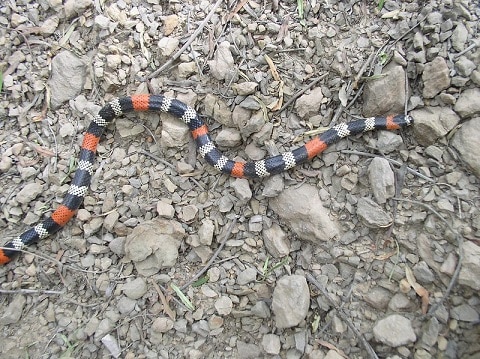
Maximum length: 82.2cm.
An extremely rare coral snake, which may be found exclusively in Bolivia, as that’s where all sightings so far have been recorded. Bolivian coral snakes (Micrurus serranus) shun the usual humid rainforests, and instead appear in dry valleys in the Andes foothills.
This species reaches high altitudes, as the limit was originally said to be 2150 metres, before a new Bolivian coral snake was discovered at 2750 metres in 2007. This snake was discovered lurking under a rock, in a dry sandy area with little vegetation, and only a handful of trees dotted around. The area was used heavily for agriculture, with numerous potatoes, corn and wheat fields. In short, the habitats of the Bolivian coral snake are completely different to almost all other Micrurus members.
This species has similar colours to the Venezuelan coral snake, but with more evenly spaced bands, as the red bands are only slightly longer than the rest. One recognisable sign is a mostly black head from above, but with a pale stripe crossing the snout.
This species is a confirmed snake-eater, having sworn itself to the dark arts of ophiophagy long ago. Confirmed snakes in its diet include the blind snake Epictia striatula, ringed hognose snake (Xenodon semicinctus) and Harvey’s blackhead (Apostolepis multicincta), another rare snake found exclusively in Bolivia.
| 5 | Avery’s coral snake |
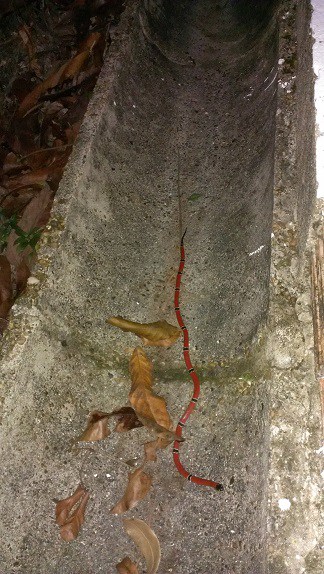
Maximum length: 71.5cm.
One of the most easily recognisable coral snakes. Avery’s coral snakes (Micrurus averyi) inhabit a small area of northern Brazil, as well as Guyana and Suriname to the north, mainly in humid lowland forests at up to 800 metres.
This species has the classic Micrurus patterns of red, white and black bands, yet this doesn’t fully explain its appearance. In Avery’s coral snake, the white bands are extremely thin, and the black not much thicker, creating 3 incredibly tightly packed bars. The red, meanwhile, covers a vast area, continuing for far longer than in other coral snakes. The overall ordering of the patterns is red-white-black-white-red.
Within South America, this species probably looks closest to the painted coral snake (Micrurus corallinus) of southern Brazil. However, Avery’s coral snake also has a jet black head, and a jet black tail interspersed with occasional thin white stripes. In some images, its head looks almost like steel. In fact, “black-headed coral snake” is another of its common names.
One confirmed bite happened to a 7 year old girl in Presidente Figueiredo municipality, Brazil. She was bitten on the foot outside the front door of her house, in an urban area surrounded by forest.
The girl reached the hospital 15 minutes later, and soon experienced pain, paraesthesia (tingling), and swelling stretching all the way up her leg. She also experienced nausea and drooling, but ultimately escaped unharmed. While relatively mild, this suggests a venom combining neurotoxins with cytotoxins.
| 6 | Carib coral snake |
Maximum length: 91cm.
A little researched coral snake, which lives in southeast Colombia, Venezuela, French Guiana, Suriname and far northern Brazil. This species overlaps with the Venezuelan coral snake, yet is easily distinguishable, featuring alternating black and gold bars, with barely a hint of the usual red.
Carib coral snakes (Micrurus psyches) measure 45-60cm, and are mainly found in humid lowland forests, but also moist meadows near streams. Like other coral snakes, they have a small mouth, and struggle to bite large surfaces.
One of the only confirmed bites happened to a man’s thumb, in the Saint-Laurent-du-Maroni area of French Guiana. The Carib coral snake initially tried to bite his shoe, failing several times. The man rapidly removed the snake, but was soon experiencing painful numbness of his left hand. Rarely for a coral snake, it had cardiotoxic effects, causing first-degree atrioventricular block and elevated T-waves under an electrocardiogram.
While mild, the neurotoxic effects took over a month to completely heal, with lingering numbness in the man’s thumb. This is the only detailed description of a Carib coral snake bite to date, but the signs suggest a potentially lethal species which you should never touch.
| 7 | Capuchin coral snake |
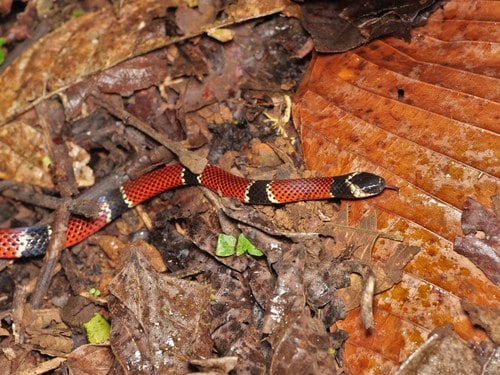
Maximum length: 94.5cm.
A coral snake of far northwestern South America. Unlike most species, which are blocked by the skyscraping Andes mountains, this species manages to cross them, hence the alternative name of Trans-Andean coral snake.
Capuchin coral snakes (Micrurus dumerilii) are mainly found in western Ecuador and Colombia. In 2015, one was discovered in central Panama, extending its territory westwards by several hundred miles. This species is mainly a forest dweller, sticking to moist/wet forests. Most of its range lies at altitudes of 0-600 metres, but in the Andes mountains, this coral snake has been found at 2133 metres.
Capuchin coral snakes average at 50cm, and have a red-yellow-black-yellow-red pattern. A signature feature is red scales overlaid with fine black markings, combined with a black head and a yellow neck collar. In tests on mice and rats, its venom had a variety of effects: neurotoxicity, swelling, and myotoxicity (muscle damage).
This snake is often found slithering slowly and patiently across a bed of fallen leaves. Diet reports are sketchy, but one confirmed prey is the Thomson’s caecilian, which it was observed eating in Colombia in 2017, at an altitude of 217 metres. Swamp eels and fellow snakes are also confirmed prey.
| 8 | Roatán coral snake |
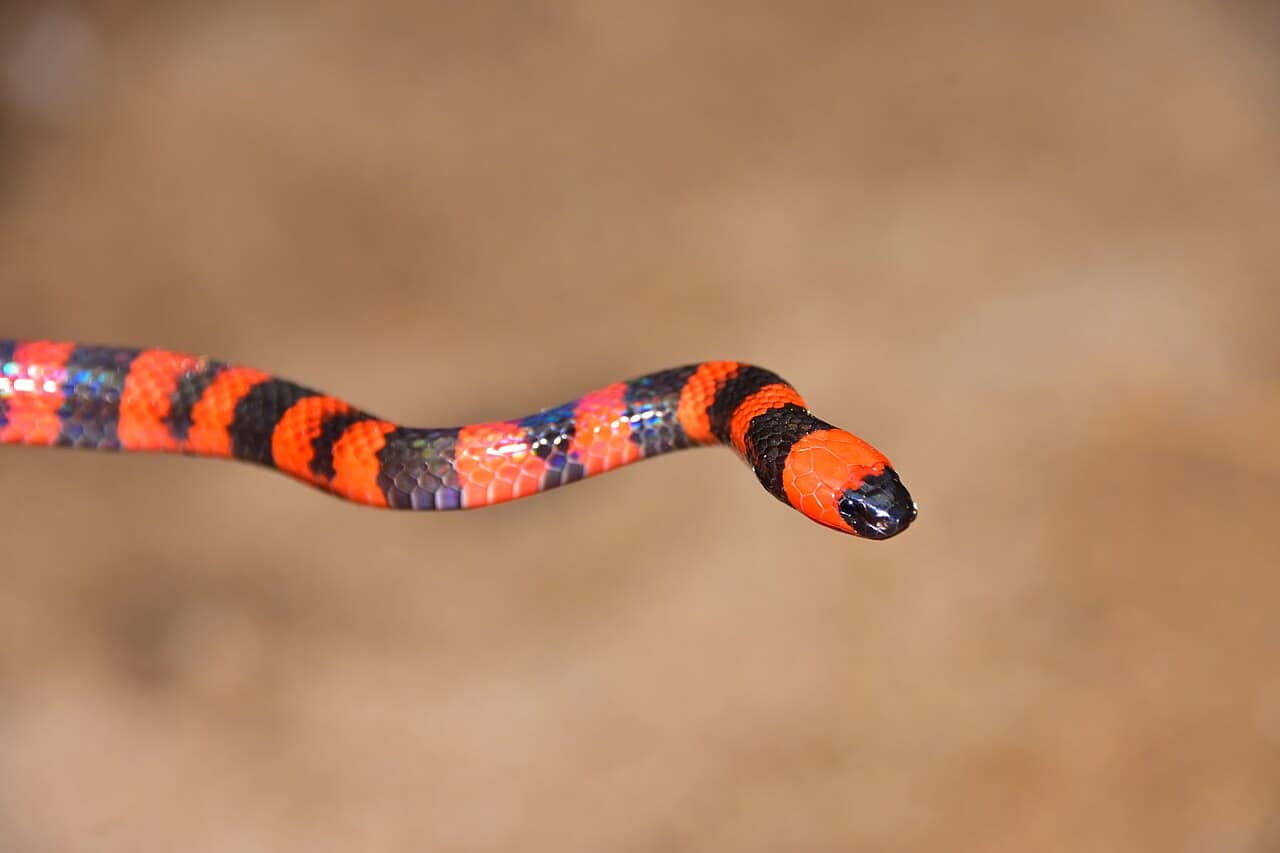
Maximum length: 60cm.
The only coral snake endemic to a small island. The Roatán coral snake (Micrurus ruatanus) is found exclusively on the island of Roatán off the north coast of Honduras, in the western Caribbean sea. Several other endemic species live on this humid tourist hotspot: the Roatán Island agouti, the Roatán longtail snake, yellow vine snake, etc. It’s possible that Caribbean pirates once stumbled onto this island and were ambushed by the native coral snakes.
Fortunately, this island isn’t too much of a tropical death trap, as the Roatán coral snake is the only dangerously venomous snake found there. This species is found mainly in low woodlands, ranging from 0 to just 20 metres above sea level.
Roatán coral snakes are particularly common under the leaves of coconut trees, slithering slowly along the ground. Their confirmed prey include the black blind snake (Epictia magnamaculata), Bay Island least gecko, and golden spectacled tegu.
A 2019 study analysed their venom for the very first time, and found a high lethal activity in mice. The venom mixture consisted of the usual three-finger toxins (standard issue neurotoxins), plus smaller quantities of metalloproteinases, serine proteinases, and L-amino-oxidases.
Human development is intense in the centre of Roatán, and the Roatán coral snake is now listed under the IUCN critically endangered category. Its remaining habitat is believed to encompass just 86 km².
| 9 | Small coral snake |
Maximum length: 80cm.
One of two coral snakes found on Trinidad. The small coral snake (Micrurus circinalis) is easily distinguishable from the Trinidad ribbon coral snake by its far thinner white rings, which are just one scale wide.
Small coral snakes measure 40-50cm, and are flexible in their habitats. They’re most common in humid lowland forests and woodlands, but also appear in adjacent urban areas and agricultural land. They lead a fossorial lifestyle, spending time underground in burrows dug by other animals, usually in the top layer of soil, so that they can emerge and slowly prowl the forest floor at will.
Small coral snakes prey on several other Trinidad residents, including three-lined ground snakes (Atractus trilineatus), Hallowell’s coffee snake (Ninia atrata), and of course each other. They also feed on insect larvae and marbled swamp eels.
This species isn’t found on Tobago, and only has a tiny enclave on the South American mainland, in neighbouring Venezuela. Small coral snakes and the ribbon coral snake overlap heavily in Trinidad, but the ribbon version is more aquatic, and derives more meals from fish and amphibians.
| 10 | Anchor coral snake |
Maximum length: 151cm.
This Ecuadorian coral snake loves forested foothills, pristine rainforests, and sometimes forests heavily degraded by mankind. Anchor coral snakes (Micrurus ancoralis) are one of the longest Micrurus members, reaching up to 151cm. They have a narrow, long spine of territory to the west of the Andes, including western Ecuador, western Colombia, and possibly eastern Panama.
This species mainly lives below 1500 metres, but has been found at 2300 metres in Colombia. Its venom is poorly researched, but confirmed to contain the usual paralysing alpha-neurotoxins. Anchor coral snakes climb vegetation occasionally, but usually stick to the ground, whether crossing roads at night or slithering over dense beds of fallen leaves.
The anchor coral snake is a classic triad species. The patterns here are red, followed by 3 black bands and two white rings sandwiched inbetween. This layout is pretty common, but the distinguishing feature with Micrurus ancoralis is a fully red face. This makes its beady black eyes stand out all the more clearly.
Like other Micrurus members, anchor coral snakes seem to love elongated prey. Confirmed meals so far include the legless speckled worm lizard (Micrurus ancoralis), and Hallowell’s coffee snake, which is also eaten by the small coral snake of Trinidad.