
| 1 | Southern Africa’s 2nd main viper |
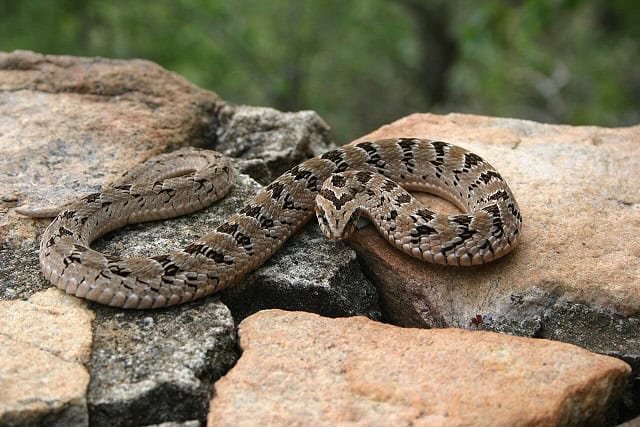
The rhombic night adder (Causus rhombeatus) is a venomous species of southern Africa, which ranks fairly low among dangerous terrors of South Africa or Zimbabwe, but is still a serious threat in the countryside and savannah, which isn’t to be trifled with. This is a relatively short venomous species, reaching an all-time maximum of 93cm, with 30-60cm being more typical.
Rhombic night adders are relatively non-aggressive, and are most abundant in southeastern Africa. Their heartlands include eastern and southern South Africa, Mozambique, Zimbabwe, Tanzania, Malawi and Zambia. Across this range, they cause plenty of bites, as they venture into suburban areas commonly, but have caused no confirmed deaths, as their venom is much less potent than their lethal viper cousin the puff adder (not to mention the black mamba).
The Causus viper genus has 7 members across sub-Saharan Africa, and this is the most common, alongside the spotted night adder (Causus maculatus) found further to the northwest (e.g. Nigeria). Worldwide, the Causus members are unique among vipers in several ways. Firstly, they have round pupils, rather than vertical and intimidating, like all rattlesnakes for example.
Secondly, they move by day (diurnal), meaning that their name is completely false. Finally, the rhombic night adder and its cousins are egg-laying, whereas the vast majority of vipers worldwide lay live young.
| 2 | Alert: a possible garden dweller |
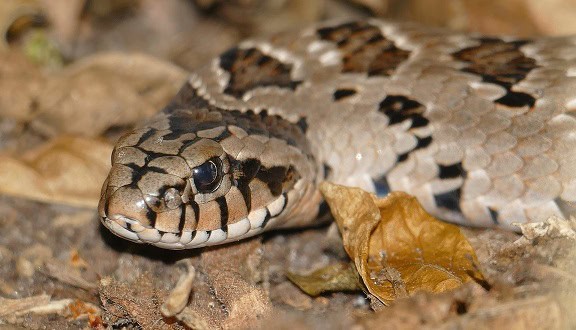
The rhombic night adder is a possible species to find at the bottom of your garden while emptying grass clippings into the corner. It’s a possible species to encounter while rummaging through your potato patch, or even while relaxing on a deck chair on a warm day while your sprinkler rotates around the garden. The reason – this viper tends to appear in moister habitats than its neighbour the puff adder.
While puff adders appear in wispy grasses or by the edges of parched game trails, rhombic night adders appear in lusher, greener habitats overall. Their range coincides with this, as rhombic night adders have no presence in the drier northwest of South Africa or deserted Namibia over the border.
Rhombic night adders appear regularly in grassy areas within suburbs, leading to encounters with dogs as well. Lake and pond shores with lush grassy vegetation are one of their ultimate hotspots. Rhombic night adders rarely invade houses themselves, but are likely to show up in your garden, or lurk there silently, causing a spike of fear as you peer out your back window.
| 3 | Search for the V-shape |
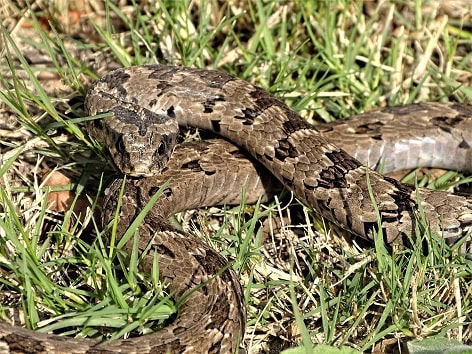
The rhombic night adder overlaps with various other vipers in its realms, especially the puff adder, the most widespread venomous snake in sub-Saharan Africa, which appears across the entire range of Causus rhombeatus, with virtually no exceptions. However, the rhombic night adder has a few ID signs to be aware of…
Firstly, this species is generally much shorter, at an average of 30-60cm, and a maximum of just 93cm. The puff adder reached an all-time record of 191cm, and 1 metre long is perfectly ordinary.
Secondly, the puff adder is not just longer, but significantly thicker relative to its size. The two species differ in their hunting styles, as the rhombic night adder is an active forager, searching the African countryside for frogs, while the puff adder is a patient ambusher, which moves around to find a new ambush position, but waits in that position for hours before unleashing a powerful rugby tackle of a strike. This strategy means that the puff adder requires much more bulk than the rhombic night adder, and this is another great ID sign, as the latter tends to be thinner.
Finally, there’s one of the clearest signs: a V-shape marking on the rhombic night adder’s head. This is clearly visible in the image above, and consists of jet black colours contrasting sharply against the grey/brown below. This isn’t present in 100% of individuals, but perhaps 80% plus, while the puff adder completely lacks a similar marking.
| 4 | No confirmed human deaths |
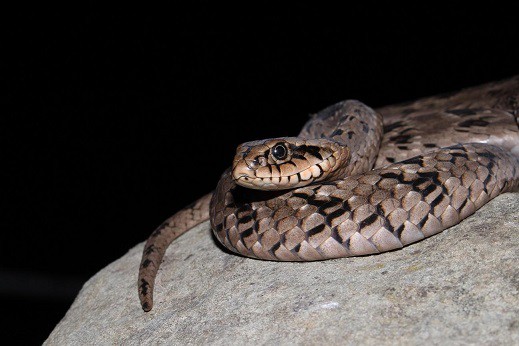
Is the rhombic night adder a deadly species? Almost certainly not, but it’s still capable of sending you to hospital. In the early 20th century, this species was referred to as the “death adder” or “demon adder” in southern and eastern Africa. The reality is much less terrifying, as Causus rhombeatus doesn’t have a single confirmed human death to its name, unlike the larger puff adder which has hundreds.
The profile of Causus rhombeatus venom is similar to many vipers – lacking in neurotoxins, but with a healthy (or unhealthy) dose of cytotoxins. Human victims typically experience massive swelling, spreading well up the affected limb. Haemorrhaging is fairly minimal, but can be noticeable in victims with lighter skin.
Necrosis is unlikely, the sloughing off of healthy tissue, but painful blisters have been reported around the wound. One child was forced to undergo a fasciotomy, an operation designed to relieve pressure in a damaged limb in order to prevent amputation.
| 5 | But dangerous to dogs |
Dogs are the most vulnerable to this snake, due to its common proximity to human households. Dogs commonly bark at rhombic night adders in gardens or in yards, or run up to them aggressively, leading to bites.
A 2012 study covered 3 confirmed canine victims of the rhombic night adder, where the owners brought the dead snake into the veterinary clinic, allowing for conclusive identification. One dog experienced PPS – painful progressive swelling. Its lips, tongue, gums and neck were all badly affected, and shaving the dog’s fur revealed extensive bruising. The dog experienced respiratory distress as a result of a swollen tongue, pharynx and neck. Sadly, this dog died within 36 hours of being bitten.
Another pair were much luckier. Both dogs experienced necrosis surrounding the bite mark, which manifested by day 2, and required surgical intervention. Afterwards, both recovered nicely, with no lasting consequences. While no specific antivenom exists for this species, the general South African viper antivenom has some beneficial effect.
| 6 | Jumbo venom glands |
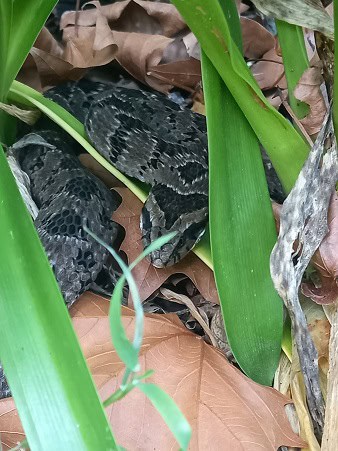
The rhombic night adder is well down the list of dangerous vipers in Africa, and when it comes to snakes overall, it’s even lower, particularly when you add mambas and cobras to the party. Its fangs are particularly short, at just 2-3mm, versus 2 inches for the notoriously fang-tastic gaboon adder of Central Africa.
Nevertheless, the rhombic night adder does beat its rivals in one area – the size of its venom glands. This species has venom glands that stretch an entire third of the way down its body. In some individuals, the glands can almost reach the heart.
Snakes worldwide with venom glands this long are rare. One example is the Malaysian blue coral snake, whose glands also measure a third of its own body length, but that species isn’t even a viper, occupying a very distant branch of the evolutionary tree.
Because of these enlarged venom glands, the rhombic night adder produces a large venom yield, ranging from 30-300mg, which is huge considering its small size of up to 93cm. It’s only the relative weakness of the venom that prevents this species from being deadlier.
| 7 | Diet: mostly amphibians (some poisonous) |
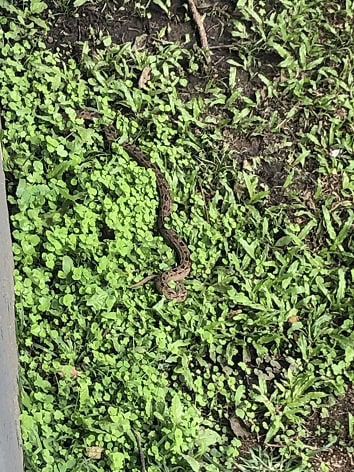
Toads and frogs form the vast majority of the rhombic night adder’s prey, with the occasional mammal thrown in, and one observation on record of a bird prey (an unidentified species). Several toad species are confirmed in their diet, but the most common are those of the Sclerophrys genus, particularly the guttural toad (Sclerophrys gutturalis) and raucous toad (Sclerophrys capensis). This love of toads is why they’re often found near ponds.
One small little detail is that many toads in sub-Saharan Africa are deadly poisonous. The likes of raucous toads secrete a deadly mixture of alkaloid toxins from parotid glands, which has a white colour and is capable of stopping the human heart.
Snakes aren’t exempt either, except a small handful worldwide which have evolved immunity. The Causus night adders are part of this happy club, allowing them access to a food source which would kill even a black mamba.
Tests on the spotted night adder (Causus maculatus) further north reveal mutations in the NKA gene. Bufotoxins kill their prey by binding to NKA in heart tissue, causing a surge in calcium ions, which itself prolongs the time of each heart contraction and slows the heartrate overall, leading to death. Just a couple of alterations to the spotted night adder’s genetic code means that they’re immune to this fate, and can swallow poisonous toads to their hearts’ content. While this resistance isn’t confirmed for rhombic night adders specifically, it’s virtually guaranteed given their similarly lethal diet.
| 8 | Capable of eating huge meals |
Worldwide, vipers are some of the snakes most likely to eat enormous meals relative to their body size. The rainforest hognose pitviper of Colombia once ate a spiny pocket mouse measuring 129% of its own body weight, while the Brazilian lancehead of southern Brazil ate a worm lizard weighing 107.9% of its own weight.
The rhombic night adder also has an impressive record of its own, if slightly smaller than those. A researcher was trawling through the Field Museum of Natural History of Chicago archives and found a preserved rhombic night adder, gathered in Huila, Angola. Examining the stomach contents revealed a large toad, believed to be part of the Sclerophrys or “true toad” genus.
The snake had a body weight of 79 grams. The toad had a body weight of 64 grams, making for a prey to predator weight ratio of 81.0%.
Also measured were the viper’s mouth width and the maximum width of the toad’s body. At 17.21mm versus 37.59mm, this resulted in a prey 218.4% of the width of the snake’s own mouth. Rhombic night adders are more than able to eat stomach-busting meals, although they can’t quite match their neighbour the African rock python, which once swallowed a 150 pound hyena.
| 9 | Territory of the rhombic night adder |
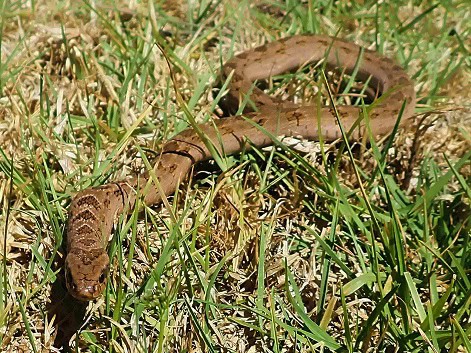
The rhombic night adder has a very large range, though is more common in some realms than others. While this snake focuses on the southeast of Africa, e.g. eastern South Africa, Tanzania, and Zimbabwe, it extends northwards as far as Ethiopia, where it covers a large area of the country. To the north, it comes short of the Eritrean border, and has no presence in Somalia on the east coast.
According to official maps, the rhombic night adder’s most extreme northwesterly point lies in Nigeria. The main Causus species here is the spotted night adder (Causus maculatus), which covers virtually the entire country, but the rhombic night adder may occupy a tiny portion of the country’s northeast. Two females were found near Dilli in 1962, but no sightings have been made since.
This Nigerian outpost is still slightly mysterious – it’s possible that the two females were actually a closely related species, or that the observation was true and the rhombic night adder really does have a tiny foothold in Nigeria.
Countries where Causus rhombeatus barely exists include Namibia, where it only appears in the extreme northeast, the wetter part of the country. The southern half of Namibia is full of deserts, inhospitable terrain for this moisture-loving viper.
Botswana is mostly free from this species, while to the north, they’re plentiful in southwest Kenya, including surrounding Nairobi. As for South African cities, rhombic night adders are plentiful near Pretoria and Johannesburg, but not Cape Town in the southwest, just falling short of this huge city, despite hugging the south coast.
| 10 | Lairs of the rhombic night adder |
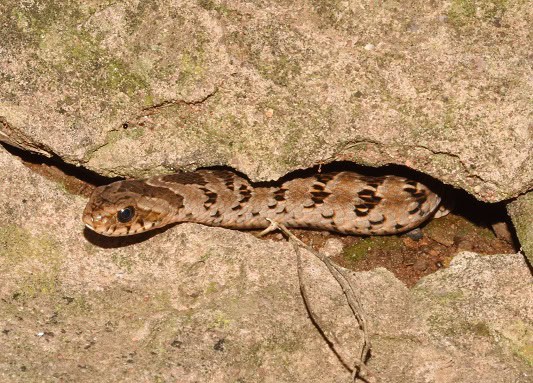
The image above proves that night adders have access to hideaways a human being couldn’t dream of accessing – dark rock cracks, and the comfortable sanctuaries inside them. This raises the possibility of a rhombic night adder poking its head out of a pile of jumbled rocks and giving you a heart attack. This is probably more likely with cobras overall, such as the black-necked spitting cobra, but still a terrifying possibility to be aware of.
One quality of the rhombic night adder is almost never climbing trees. Cape cobras regularly zip up tree trunks in order to investigate birds’ nests (and maybe raid them), but the rhombic night adder climbing even a bush is an extreme rarity. On the other hand, this species is a fantastic swimmer, and crosses ponds and small lakes with ease, in order to investigate thriving frog colonies on the opposite shores.
Roads are another place this species might turn up. While rhombic night adders have strong camouflage, they’re not dependent on it, nor especially shy in personality, and are more than willing to enter wide open spaces where they may be exposed to bird predators.
| 11 | Able to jump? |
Many rumours have circulated about Causus rhombeatus over the years, leading to its “demon adder” nickname. One which reached Western shores was a disturbing ability to jump.
Correspondence from 1961 showed this fear all too well, as C. R. S. Pitman wrote that “the best exponent of “jumping” in Africa is the Night Adder, Causus rhombeatus“. He continued: “I have frequently seen examples of the Night Adder lift themselves off the ground the equivalent of their own length“, while cautioning that not all individuals of the species acted this way.
Modern day sightings chime with what Pitman wrote, as Causus rhombeatus cannot spring itself magically into thin air, but has a surprisingly aggressive and vicious lunge for such a small snake. This species has the ability to puff its upper body up, inflating itself with air. It hisses loudly and launches itself at enemies with such force that it almost leaves the ground, propelling itself forward with sheer muscular power. Rhombic night adders are even rumored to gain height in their lunge by deflating their chest in mid-air.
Snakes which can almost jump include the dog-faced watersnake, which lives on Indian mudflats and can propel itself into mid-air over unstable surfaces. The painted bronzeback of Thailand is able to make a daredevil leap between thin tree branches which don’t quite touch.
| 12 | More facts you need to know |
Another feature of Causus rhombeatus is flattening its neck slightly like a cobra. It does this while raising its chest and protruding its tongue, before moving forward towards the enemy aggressively.
Rhombic night adders are also relatively quick-moving, if their hand is forced. They ordinarily move slowly and patiently, but if disturbed, can flee into longer undergrowth at high speeds (if they decide on flight rather than fight).
Despite generally preferring moister areas, rhombic night adders are flexible in their habitats. This includes their altitude preferences, as rhombic night adders appear at heights ranging from sea level in South Africa, to around 2000 metres on the Marungu Plateau in the DRC.
The colour of this species is variable as well. The majority of rhombic night adders have a grey backdrop, but in others this can be beige. One colour scheme is consistent: this species never has any hint of green on its body.
Despite the signature V-shape marking, individuals further north tend to lack distinct markings, including those in Angola, DRC and Zambia, eliminating the classic ID technique. Another spanner in the works is the common egg-eater, AKA Dasypeltis scabra. This species mimics vipers, and particularly the rhombic night adder, as it has a dark V-shape marking of its own. Fortunately, common egg-eaters are completely non-venomous, meaning that if you stand well back from any V-shaped marking, you’ll fulfill your survival obligations anyway.
