
| 1 | Saw-toothed necked bronzeback |
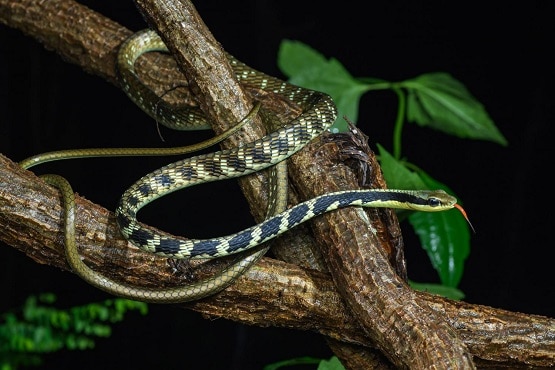
Maximum length: 163cm.
The bronzeback snake genus (Dendrelaphis) is huge, with 11 members living in Thailand alone, and over 40 existing worldwide. These snakes share various characteristics, such as a thin, whip-like body, spending most of their lives in trees, and possessing a mild, mostly harmless venom. One of the more recent additions was Dendrelaphis nigroserratus, the saw-tooth necked bronzeback, which was discovered only in 2012, amid a vast survey that saw 367 new species identified in Mekong.
This species lives in western and southwestern Thailand, on the Myanmar border. The saw-toothed necked bronzeback has been known about for over 100 years, but was originally declared as a subpopulation of the Wall’s bronzeback (a species with particularly huge eyes). Patterns revealed the difference, as this version had a unique black stripe travelling tailwards from each eye. At the neck, the colour becomes intermittently broken, and this creates the namesake sawtooth patterns, alternating repeatedly with yellow.
The sawtooth necked bronzeback is found in evergreen forests at around 800 metres in altitude, including in bamboo thickets, often on branches close to streams. This species moves by day, and has been observed eating frogs, like most bronzebacks.
This is also one of the largest of the bronzeback clan. 80-100cm is the norm, while one roadkill female measured 1.63 metres. No matter how long they are, they keep the usual thin, whiplike body.
| 2 | Hua Hin kukri snake |
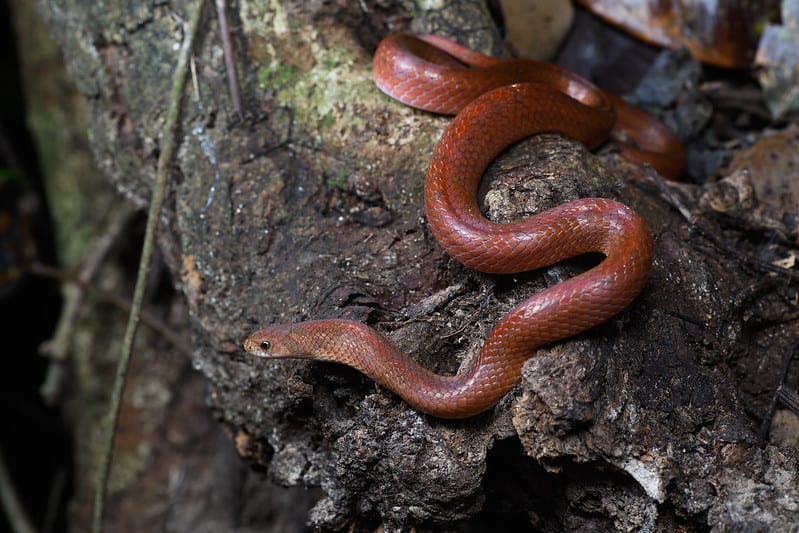
Maximum length: 55.4cm (so far).
Only 7 living members of this species have ever been discovered. The Hua Hin kukri snake (Oligodon huahin) was discovered in 2016, somehow going unnoticed over thousands of years of human civilisation. The 7 living snakes were found in a 1000 square metre area of Thailand.
The Hua Hin kukri snake typically has an amber colour, but sometimes a dried leafy colour, which is convenient given that it often lives in dried leaves. Hua Hin kukri snakes also live in bamboo forests, and coexist with several far more common species, such as monocled cobras and green catsnakes. The most common kukri snake in Thailand is the small-banded kukri snake (Oligodon fasciolatus), which inhabits virtually the whole country and is abundant in Bangkok itself. That version is a sandy colour with noticeable brown bands, while the new species was significantly darker.
Although little about its lifestyle is known, all 7 Hua Hin kukri snakes were found crossing a road near bamboo stalks at 6:15-7:15pm, which hints that they’re most active at dusk. The location was approximately a 4 hour drive from Bangkok.
Later, the team found a dead Hua Hin kukri snake on a road 12km away. Clearly, its range wasn’t as narrow as first thought; the species was just an expert at flying under the radar for centuries. The largest Hua Hin kukri snake so far measured 55.4cm.
| 3 | Indochinese long-nosed whipsnake |
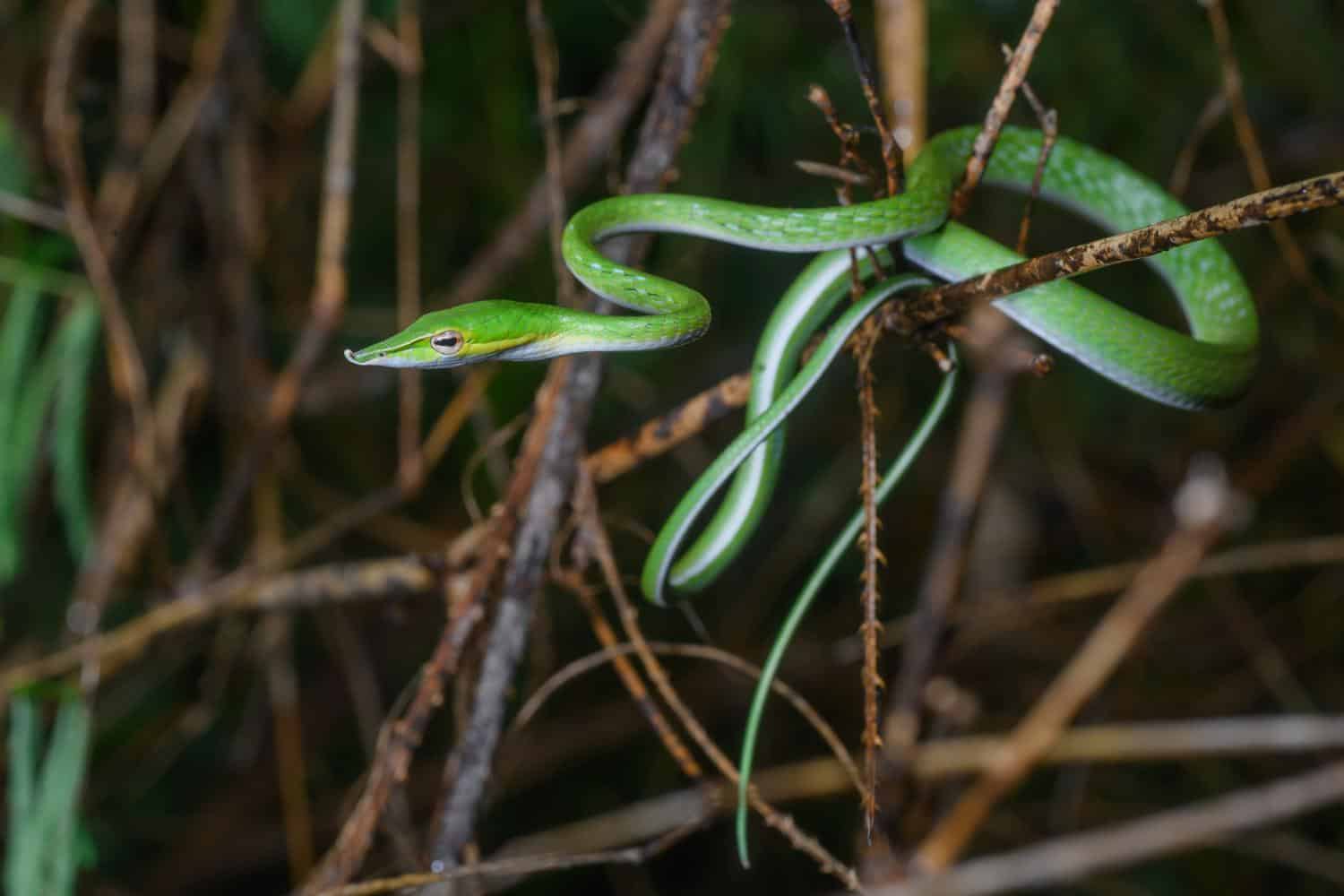
Maximum length: 2 metres.
A relative of the bizarre Asian vine snake, with similarly bizarre attributes. There’s an ultra green body, which can easily be mistaken for a swinging vine, only for a set of serpent jaws to open from nowhere and swallow a lizard. There’s disturbingly shaped pupils, which in this case are horizontal. Finally, there’s an ultra-thin body, and a mostly tree-dwelling nature.
The Indochinese long-nosed whipsnake (Ahaetulla fusca) is found all over Thailand except in the southern peninsula region, and is common around Bangkok. Originally, it belonged to the species Ahaetulla nasuta, also found in India and Sri Lanka, but this was split in two, with the eastern colonies becoming Ahaetulla fusca in 2022.
This species has a weak venom, which only passes the effect threshold if it chews repeatedly. This snake coexists with the Asian vine snake (Ahaetulla prasina), but the two are genetically separated enough not to interbreed. The main difference is this species’ extremely long nose, produced by a protruding scale. This is particularly noticeable head on.
The Asian vine snake has a smooth face, while the long-nosed whipsnake looks crinkled, as though it should be wearing reading glasses. This nose even upturns at the end, to produce what looks like a scooping tool (a theory which may turn out to be true).
| 4 | White-bellied ratsnake |
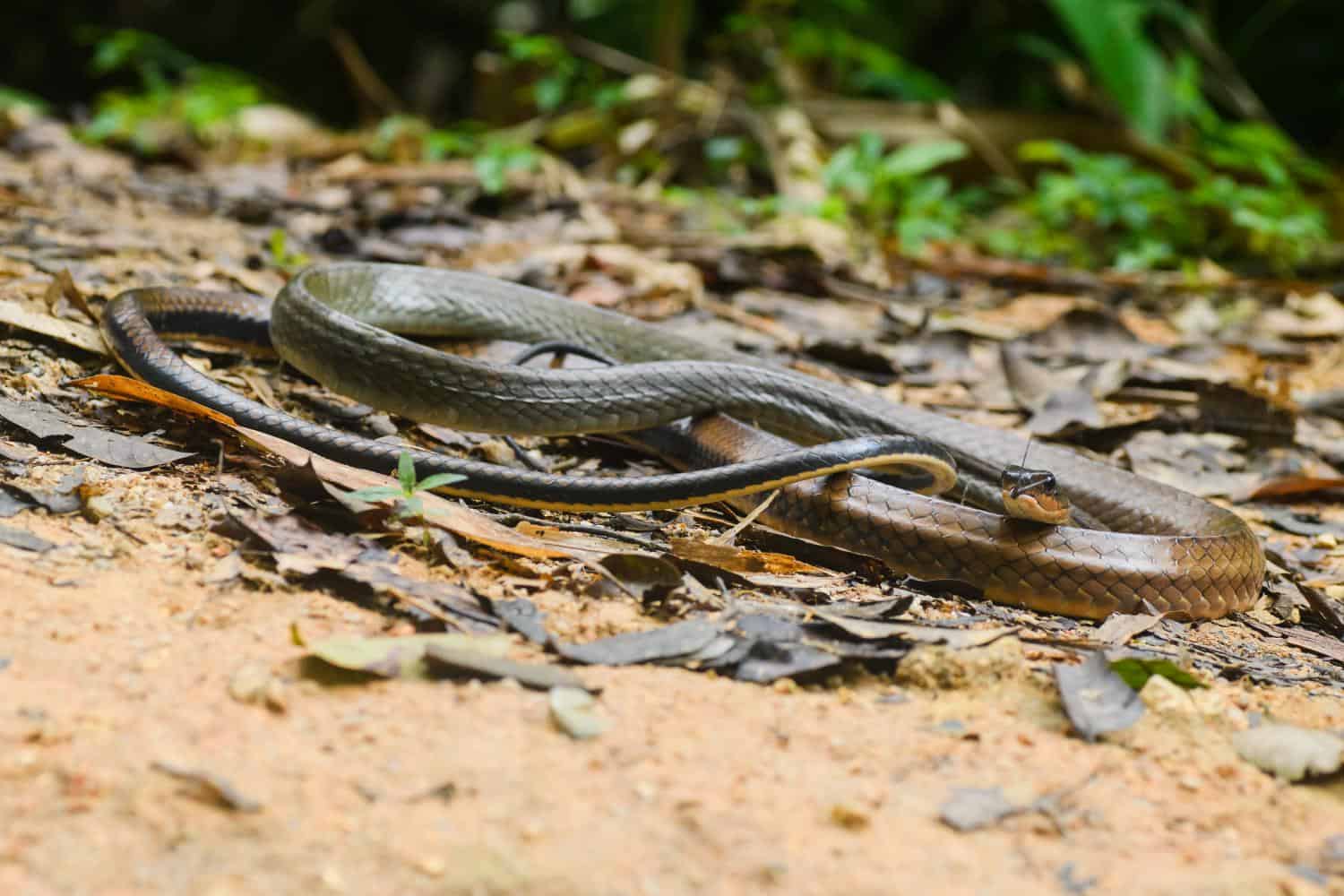
Maximum length: 290cm.
Named for its pristine white belly, which is a monolithic white and has no patterns. This is the less common relative of the ubiquitous oriental ratsnake, which strides aggressively around Thailand’s towns and cities. White-bellied ratsnakes (Ptyas fusca) are more common along forest streams well away from towns, but will also venture to hillsides and clearings within 50 metres of the forest edge.
White-bellied ratsnakes stick mainly to the southern peninsula regions of Thailand, and are also common in Singapore. At a record of 290cm, they’re quietly one of Thailand’s longest snakes. Fortunately, they’re completely harmless, and have a classic tendency to freeze when confronted.
When the white-bellied ratsnake detects a human, it usually stays motionless rather than fleeing, keeping its neck raised up. Eventually, it begins to move its neck from side to side, in a strange intimidation ritual. This species also has white eyes, which brightly reflect a camera’s flash.
Its colours looks generic at first glance, but they have a clear order. Ptyas fusca has a brown back, a clean white belly, and a black stripe on each flank separating the two. Its tongue is an oily blue colour, while its freezing tendencies make it easy to photograph, as this species commonly stays still for 1 minute.
| 5 | Hagen’s pit viper |
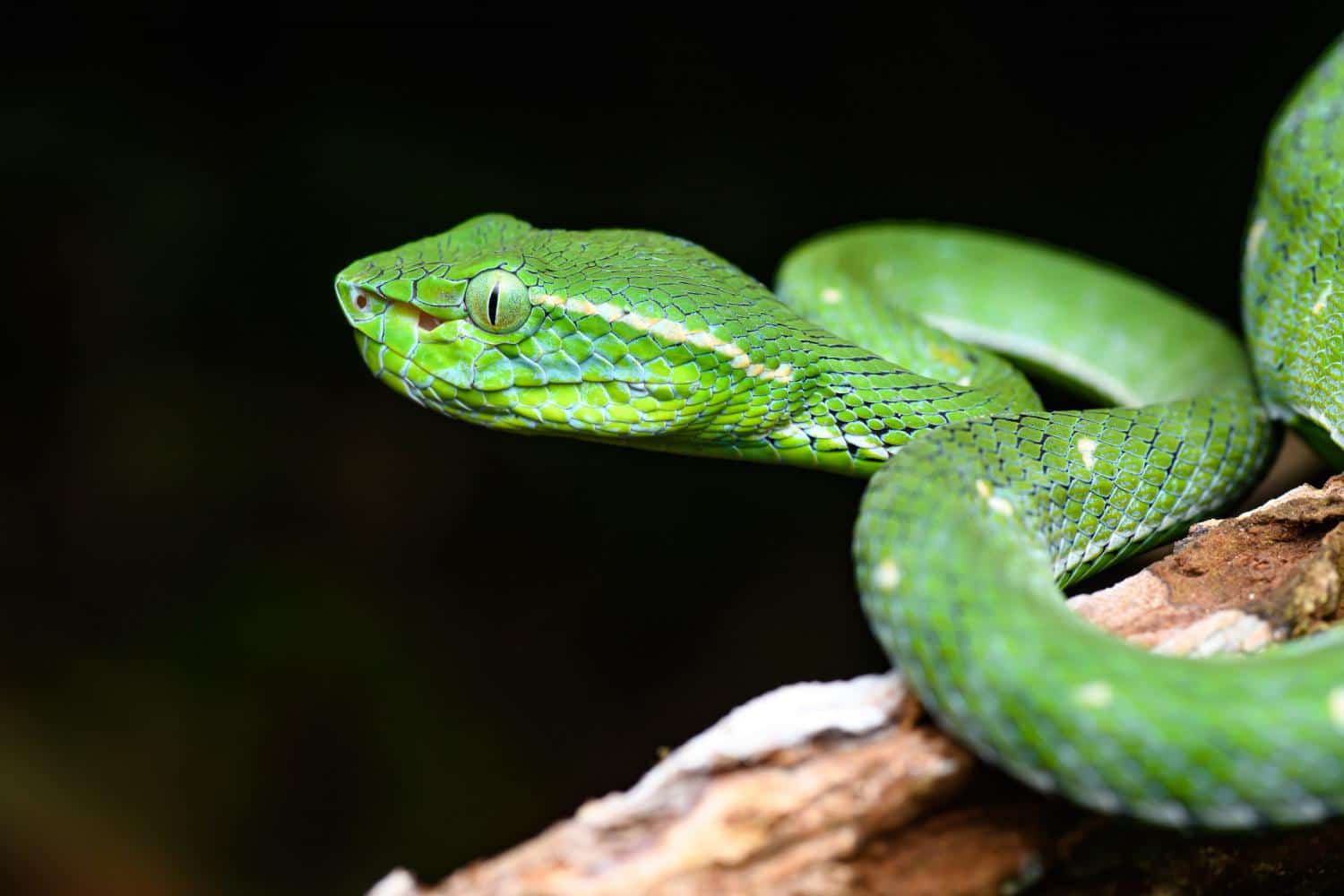
Maximum length: 123cm.
A savage, dangerous pitviper, which thankfully only exists in the far south of Thailand. Hagen’s pitvipers (Trimersurus hageni) also live in Sumatra and peninsular Malaysia, and closely resemble other Trimeresurus pitvipers at first glance. They have razor sharp vertical pupils, and are cloaked thoroughly in jungle green. They dwell mainly in forests, and are excellent tree climbers.
However, Hagen’s pitviper has subtle yet clear differences to the most widespread member in Thailand, the white-lipped pitviper. Its eyes are green rather than yellow, continuing unbroken from its scales. It has a blue patch above its lips, and its head is particularly bulky.
Hagen’s pitviper also has vivid black skin between each scale, looking like cracks in its armour. These black cracks also bleed into the signature white line on its flanks. Hagen’s pitvipers are slightly longer too, at a record of 123.0cm.
The venom of Hagen’s pitviper contains 216 proteins, and is richest in metalloproteinases, which cleave through and disintegrate living cells. Its diet mainly consists of mammals, and it rarely appears above 600 metres in altitude.
In 2022, this species lost some territory, as three new Trimeresurus species were split off, replacing Hagen’s pitviper on Siberut Island, Nias Island and Simeulue Island. The Trimeresurus pitviper genus is gaining new members almost every year nowadays.
| 6 | Large-eyed bamboo snake |
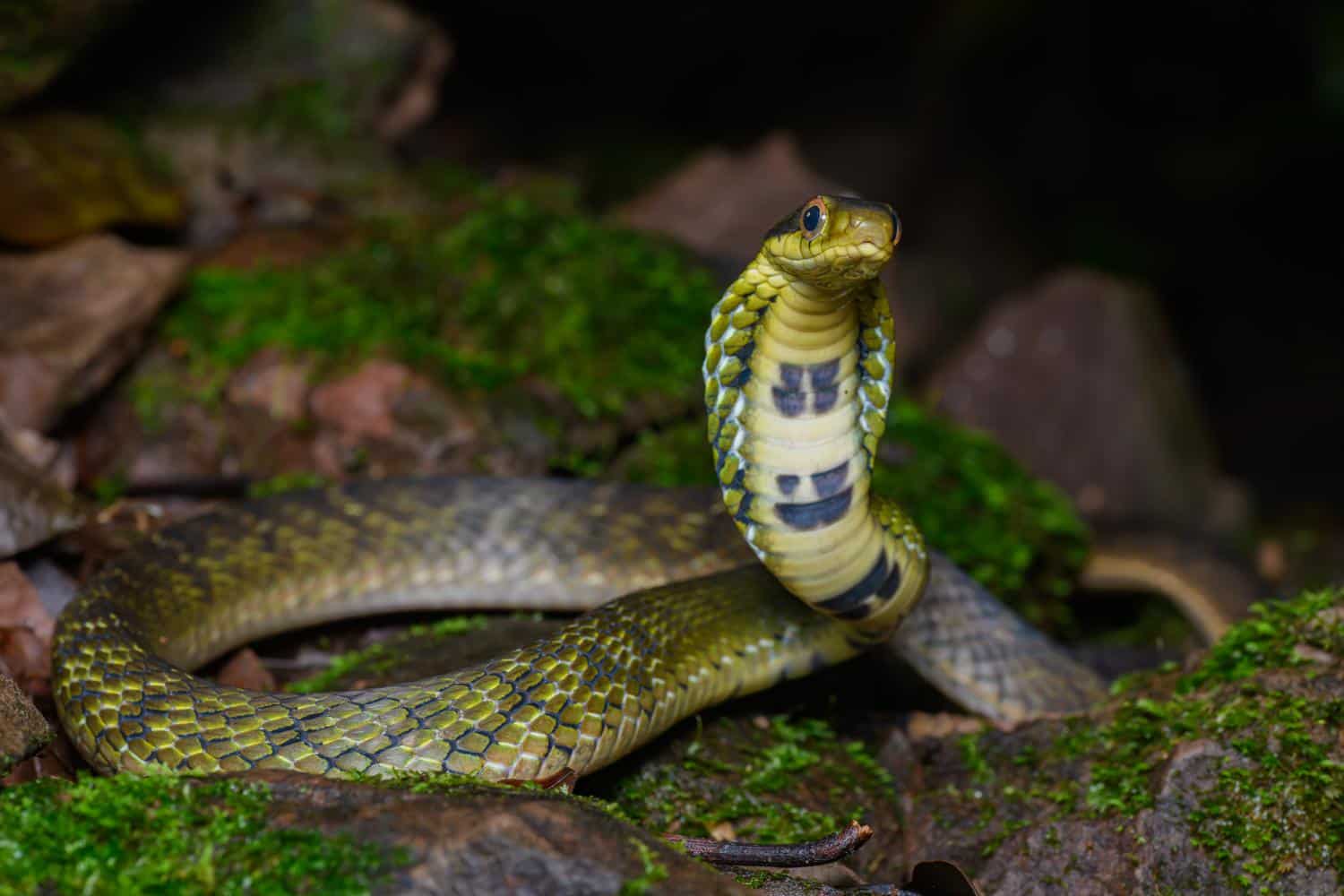
Maximum length: 140cm.
This weird snake looks like a cobra with at least one frog grandparent. It’s also called the Chinese false cobra, as imitating a cobra is one of its schemes to stay alive, complete with spreadable hood.
The large eyed bamboo snake (Pseudoxenodon macrops) measures up to 140cm, and also has a venom of its own, though the exact strength is a mystery. This snake lives in forests at moderate to high altitudes, and rarely appears below 1200 metres in Thailand. Its realm is primarily western and northern Thailand, meaning that you’ll never encounter this snake in the hustle and bustle of Bangkok, Phuket or Pattaya.
Large-eyed bamboo snakes will either flee or bite, if their cobra-mimicking schemes fail – they’re a hard snake to predict. They might even flip onto their back and play dead. Frogs are thought to be their favourite prey.
The Latin name of macrops references their large eyes. Some believe that the hood spread didn’t directly evolve to mimic cobras, but was advantageous independently, as it made them appear larger. However, they also have the signature black chest patches of a cobra, against a paler background, hinting that it really was mimicry.
| 7 | Indochinese ground snake |
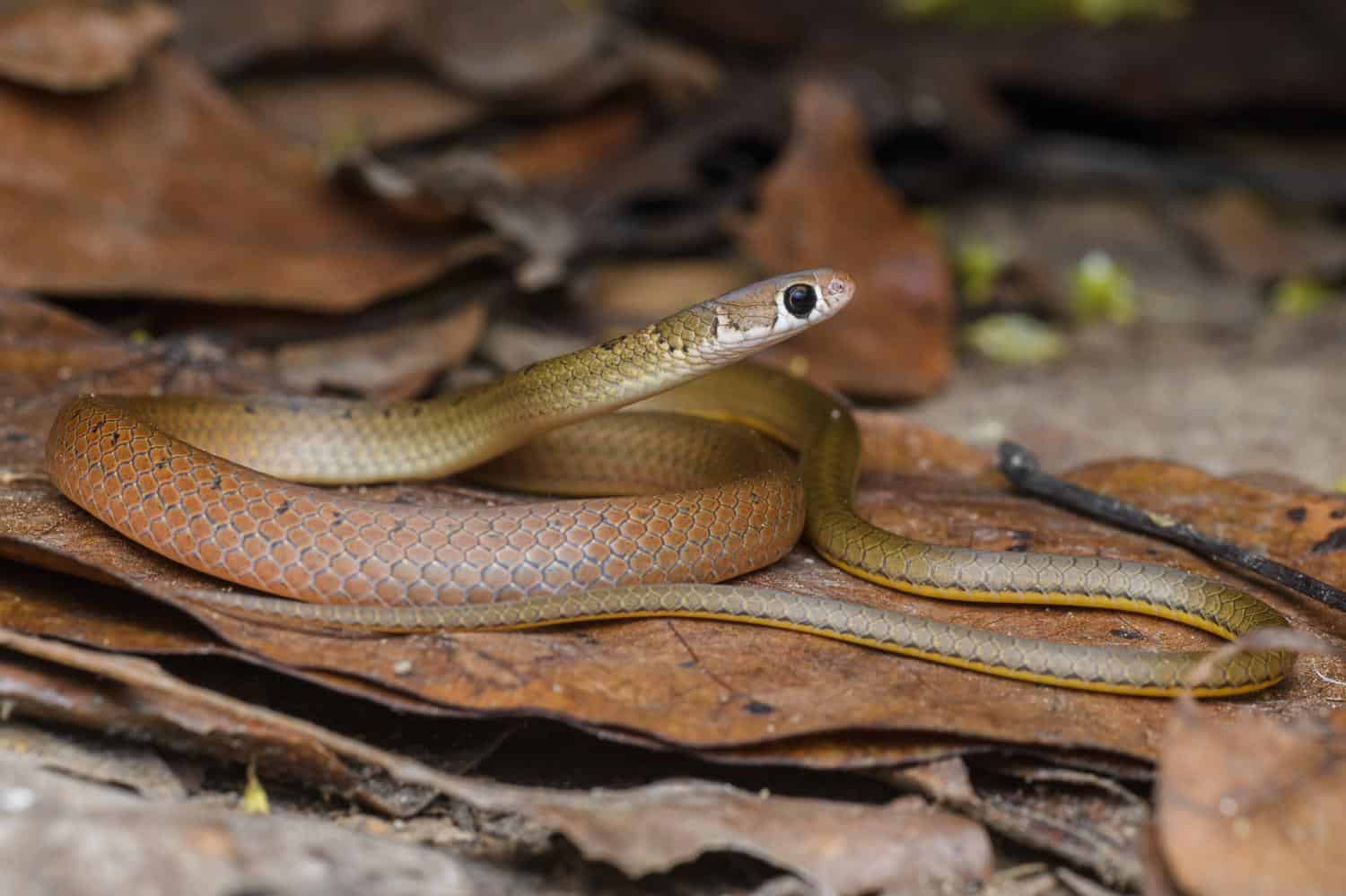
Maximum length: 46.5cm.
“Little known”, “obscure” and “rarely seen” are some of the phrases used to describe this harmless Thai snake. Gongylosoma scriptum inhabits the low hills of western Thailand, also crossing the border into Myanmar. It moves by day, lurking stealthily in mulchy forest debris. Finding the exact locations of this snake is a nightmare, and even then, spotting one is incredibly difficult.
Indochinese ground snakes have extremely large eyes, a pale brown body, and a yellow or cream-coloured belly. They’re also found beneath fallen leaves and in loose soil next to forest paths. Almost all individuals discovered so far have been below cover of some kind. They’re so hard to find that only a handful of Indochinese ground snakes are stored in museum collections worldwide.
This species has a thin body and a blunt snout. Nothing is known of its diet in the wild, or its daily life cycle, except that it’s active by day. A 2020 study found 3 more living Indochinese ground snakes, but mainly reconfirmed old findings.
| 8 | Butler’s wolf snake |
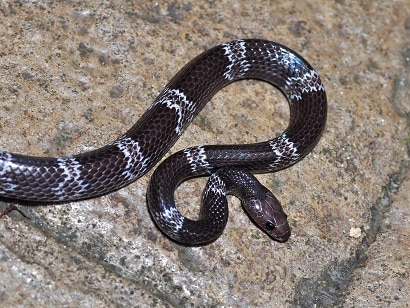
Maximum length: 100cm.
A harmless, medium-sized species which reaches poses little threat to humans. Butler’s wolf snake (Lycodon butleri) lives in the southern peninsular regions of Thailand, and is just another humble member of the giant Lycodon genus (73 members).
Thailand’s most common Lycodon member is the common wolf snake (Lycodon capunicus), but this is easily separable, with a white neck collar that Butler’s wolf snake totally lacks. Butler’s wolf snake has a precise 40-50 white bands covering its black body. These are large and widely spaced around the neck, but grow closer together as the (thin and whiplike) tail approaches. Butler’s wolf snakes have no colour change on their bodies; the black and encircling white just continue unaltered.
Butler’s wolf snakes are nocturnal and very dark, two facts which combine to make them rarely seen. They dwell on the ground, mainly in mountainous forests, and only bite humans if severely provoked. There’s no bad attitude or nervous twitchiness with Butler’s wolf snake, just the calm spirit of the Thai countryside.
Butler’s wolf snakes lack the power to swallow a human whole. They lack any form of venom at all, and mostly prey on lizards. Watch out though – their patterns closely resemble the deadly venomous Malaysian blue krait. Make sure it really is Butler’s wolf snake you’re about to touch.
| 9 | Red whipsnake |
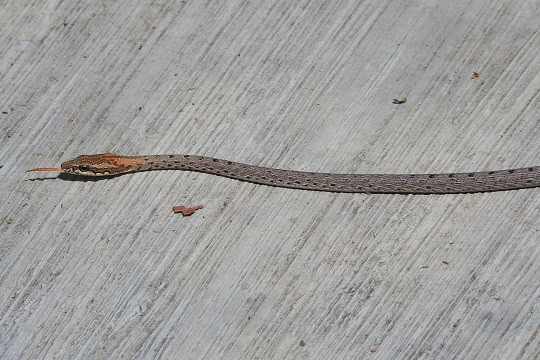
Maximum length: 100cm.
A mildly venomous species which has never killed a human on record. This species has a large range, including most of Thailand, peninsular and eastern Malaysia, Singapore and Indonesia. Yet across the majority of Thailand, it’s rarely observed, except for in the far south.
The red whipsnake (Dryophiops rubescens) is a very thin species, allowing it to slip through gaps in bushes and tree root clusters with ease. Its favourite habitats are evergreen forests below 500 metres. This species mainly feeds on reptiles, such as common flying dragons. In Singapore, a flying dragon landed in a rubber tree directly next to a 45cm red whipsnake, and was photographed being swallowed.
Red whipsnakes like forests, but prefer to stay at the sunnier edges rather than the gnarly interiors. They’re capable of traversing open land, unlike some green pitvipers, which never leave the safety of the canopies.
Red whipsnakes vary in colour from clay to brown, and hence are sometimes called brown whipsnakes. They’re never actually that red, nothing denser than a brick colour. The reddest part is their bright tongue, which almost looks like lipstick when viewed on, as though this is a flirty snake.
| 10 | Berdmore’s slug snake |
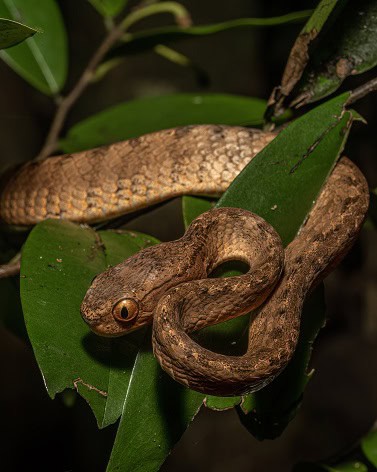
Maximum length: 77cm.
This snake is fairly widespread in Thailand, yet virtually nothing is known of it. Berdmore’s slug snakes (Pareas berdmorei) live across mainland Thailand, including near Bangkok, though are absent from the southern peninsular regions. They’re most often seen resting on juicy green leaves, with their thin bodies entwined around a branch for stability. They have the typical round head of a slug-eating snake, with their eyes a rich orange colour which is barely any different to their scales.
Berdmore’s slug snakes have an exceptionally thin tail, which would probably snap if it tried to poke you. Though normally orange, some are a duller grey. Their bodies have consistent encircling bands which are only faint in intensity.
About their lifestyle, or the precise breakdown of their diet, we know virtually nothing. We only know what we see – that they generally prefer bushes and low tree branches 1 metre above ground, rather than 20 metres high in the towering canopies.
The keeled slug-eating snake (Pareas carinatus) is another member of this genus found in Thailand. However, the Berdmore’s version is slightly longer, at 60-70cm versus 50-60cm.
| 11 | Green-headed catsnake |
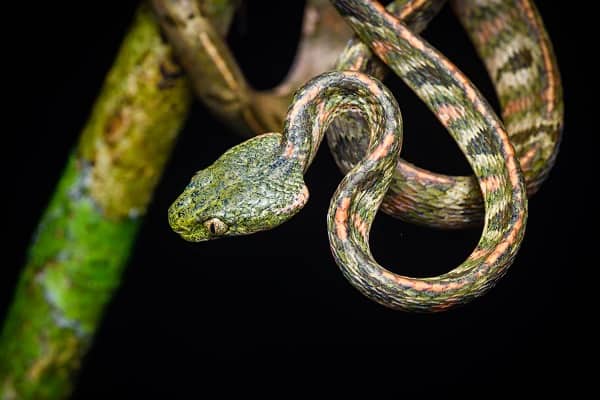
Maximum length: 167cm.
One of the ultimate snakes in Thailand for jungle camouflage, and that’s saying something. The green-headed catsnake (Boiga bengkuluensis) resides in southern Thailand, peninsular Malaysia, and Sumatra, where it was first discovered. Originally, it was believed that those in southern Thailand were a green morph of the white-spotted catsnake, but in 2021 they were shown to be green-headed catsnakes after all.
At one point, this species had almost no research, and it still has very little. But amateur photos are beginning to accumulate, and consequently, this species is now confirmed to prey on lizards like pricklenape agamas, and the dusky earless agamas (Aphaniotis fusca). Around two thirds of photos show the green-headed catsnake on low branches or bushes, and another third on the ground, sometimes on large forest rocks.
This snake is nocturnal, as most images show it cloaked in darkness. Boiga bengkuluensis has the ability to rest on extremely thin branches, which sometimes match the snake’s body colour almost exactly.
Something that photos cannot reveal is the exact potency of its venom, and no studies or experiments have ever been conducted on the green-headed catsnake. There’s no need to worry, as this species has no demented wish to attack humans.
| 12 | Triangle many-tooth snake |
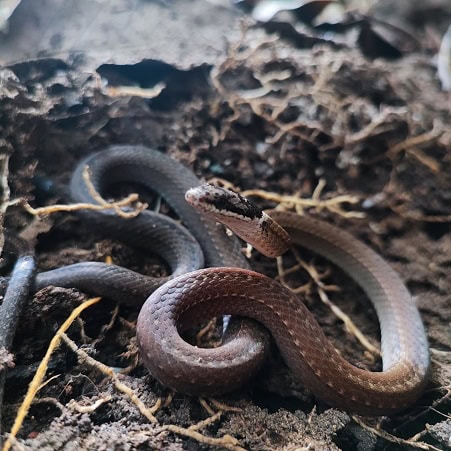
Maximum length: 70cm.
The triangle many-toothed snake (Sibynophis triangularis) is as harmless as snakes get. It lacks venom, a pair of vicious fangs, and even visually, there’s nothing even the most nervous ophiophobe could be terrified of.
This species is mostly found in central and eastern Thailand, as well as Cambodia. It’s most common in lowland forests at altitudes of up to 1000 metres, and its diet is believed to include skinks, geckoes and blind snakes. The Sibynophis genus has 9 members, and this is one of the rarest. There’s no chance of meeting this snake in an urban area, unlike the monocled cobra.
The triangle many-toothed snake lays eggs rather than live young, with one clutch containing 5. This observation was made in northern Thailand’s Sakaerat Biosphere Reserve, a heartland of snakes. The circumstances were unfortunate though – the triangle many-toothed snake was in the clutches of a centipede. The centipede was gripping using multiple pairs of legs, and was preparing to eat its meal. Three of the eggs had left the snake’s body, while another two remained inside.
The triangle many-toothed snake is also confirmed to be prey for scorpions. This harmless Thai snake has a tough life, and that’s without considering king cobras or Malaysian blue coral snakes, two top snake predators.