
| 1 | Asp viper |
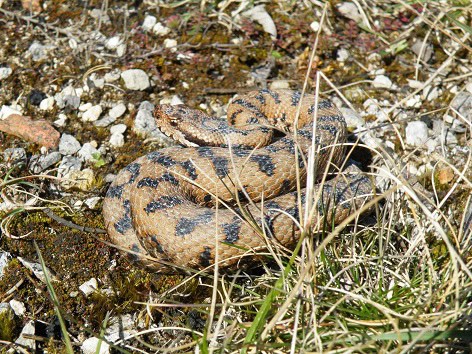
Maximum length: 82cm.
The most widespread venomous snake in France, the one a tourist or villager alike is most likely to meet. The asp viper (Vipera aspis) inhabits the lower three quarters of France, with the adder (see below) occupying the northern quarter.
Asp vipers are never found in towns, instead inhabiting the green, grassy countryside. Their favourite habitats are meadow areas, including thick hedges along their borders. Here, they eat a diet largely consisting of mammals, even up to 98% voles according to one extreme survey.
Asp vipers have the usual viper features like a triangular head, vertical pupils and blotchy beige and black patterns. As for their venom, deaths occur semi-regularly, with two recent fatalities being in 1996 and 2014.
This species bites 300 French people per year on average. While its venom is generally haemotoxic, a few local populations have far more neurotoxins than the rest, and therefore the potential to cause slurred speech, trouble breathing and twitching eyelids.
| 2 | Barred grass snake |
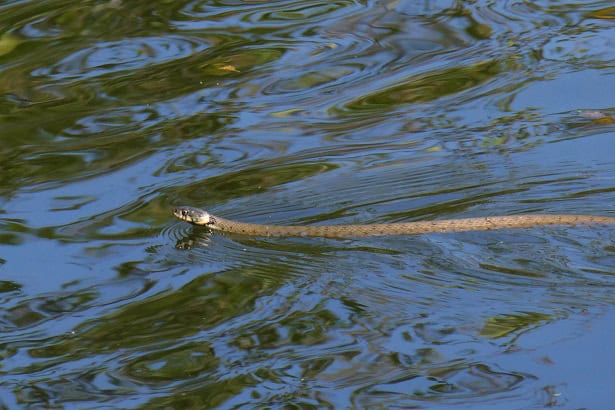
Maximum length: at least 180cm.
The most widespread snake in France, as this species covers about 99% of the country overall, except maybe a tiny portion of the southeast near the Pyrenees. The barred grass snake (Natrix helvetica) is a harmless semi-aquatic species, which has no power to kill a human being, and rarely bites even if picked up and manhandled.
Barred grass snakes derive the majority of their prey from frogs, including European staples like the common frog (Rana temporaria). They also prey on mammals and fish occasionally. Despite the name, they spend the majority of their lives near water bodies, including ponds and lakes.
Barred grass snakes have one advanced defensive technique: hiding their head beneath their coils, to protect their brain from predators such as birds, and even household cats. A white neck collar contrasting against an olive green body is a clear sign of this snake. Unlike the asp viper or adder, there are no thick, black blotches.
| 3 | Green whipsnake |
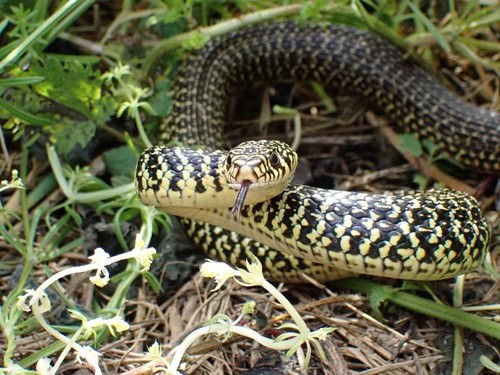
Maximum length: just under 200cm.
The fastest, whippiest snake found in France. The green whipsnake (Hierophis viridiflavus) is a mildly venomous species, which has an aggressive personality, and should only ever be handled with extreme caution.
Green whipsnakes are found across the south of France, where they’re extremely abundant, but disappear further north. Rather than forests, they mainly appear in open areas, such as dry grassy fields and scrubland, where they can bask in the sun. Most of their diet consists of lizards, with some mammals as well, and their hunting strategy consists of little more than manic pursuit and grabbing.
Green whipsnakes aren’t traditionally venomous like a viper, but possess a rear-fanged venom which is more potent than once believed. A drunk man near Bordeaux once wrapped a green whipsnake around his body, allowed it to bite for several minutes, and later ended up in hospital with muscle weakness and dizziness.
Further afield, green whipsnakes appear in Italy, parts of Switzerland, Slovenia and Croatia. Within France, they’re highly recognisable due to their sharply contrasting yellow/green and black patterns.
| 4 | Adder |
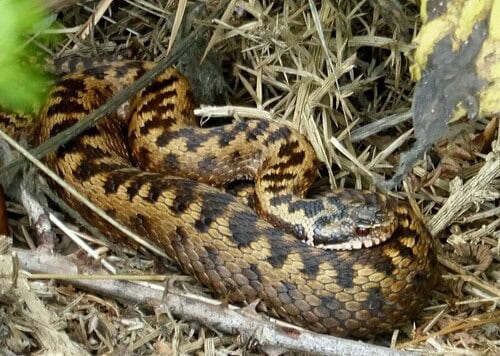
Maximum length: 93.5cm.
The main viper species of Great Britain, including Scotland, England and Wales. Most British citizens fear the adder, though never actually meet one, but this species actually exists across a vast stretch of Eurasia, only ending in Kazakhstan. Within France, it’s found mainly in the northern quarter of the country, but reaches high numbers there. It also has an isolated population in the Massif Central further south, and a small alpine population near the border with Switzerland.
Adders are similar in nature to the asp viper – relatively shy, but more than willing to bite if cornered. They avoid urban areas and towns, whereas grass snakes occasionally appear in ponds and small rivers within small towns. The consequences of an adder bite usually include local symptoms like swelling and possibly necrosis, but deaths have been recorded, including a British man in 1975.
One advantage of this species is that unlike the asp viper, its venom never contains neurotoxins. Meanwhile, the main antivenom used in French hospitals is Viperfav – a mixture containing the usual immune system antibodies generated by hyperimmunised horses. The venoms injected into those horses come from the asp viper, adder and nose-horned viper, meaning that the mixture can benefit victims of the two main French vipers.
| 5 | Viperine watersnake |
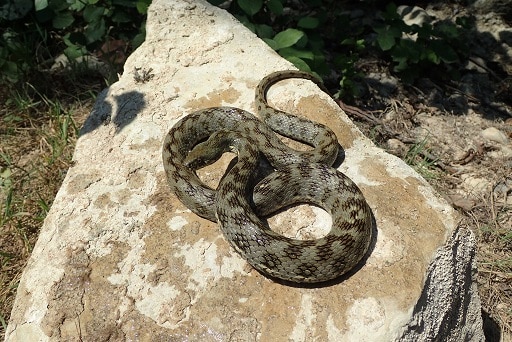
Maximum length: 92.9cm.
This harmless species belongs to the same Natrix genus as the grass snake, but is slightly less widespread in France, only covering the southern two thirds of the country. Nevertheless, it’s extremely abundant within that territory, appearing constantly in rivers, ponds and crystal clear lakes.
The viperine watersnake (Natrix maura) is more aquatic than the grass snake, though it still strays to land regularly. Its diet is more reliant on fish, but in certain areas frogs and toads take over, and it’s capable of eating mammals if necessary.
Viperine watersnakes have no means of killing a human being or large predator. However, they have a variety of sneaky survival skills. One such strategy is triangulating their head to mimic a viper. The viperine watersnake is able to flex bones in its skull to an extreme degree, which it combines with blotchy patterns, which look somewhat similar to the asp viper’s, completing the disguise.
| 6 | Aesculapian snake |
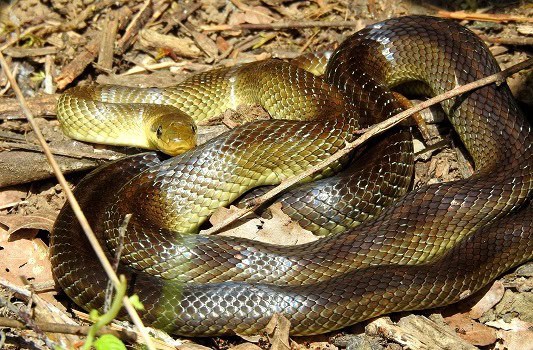
Maximum length: 225cm.
The most heavily forest-dwelling snake of Europe, and the continent’s top tree climber. The Aesculapian snake is also the second longest snake in Europe, but since the longest (the four-lined snake) doesn’t live in France, this species officially tops the charts for size nationwide.
Aesculapian snakes are also relatively thick, as they dispatch their prey using constriction rather than venom. Most of their meals consist of mammals, with plenty of birds thrown in as well. This is a rare European snake to hunt bats, hanging from sharp stalactites by the entrances of caves, or even hiding in dark holes inside caves, and withdrawing into them menacingly after capturing a meal.
Aesculapian snakes appear in the southern two thirds of France, as the north is too cold for them. Across Europe, they also appear in Italy, southern Austria, Croatia, Slovenia, Serbia, Greece, and more.
| 7 | Smooth snake |
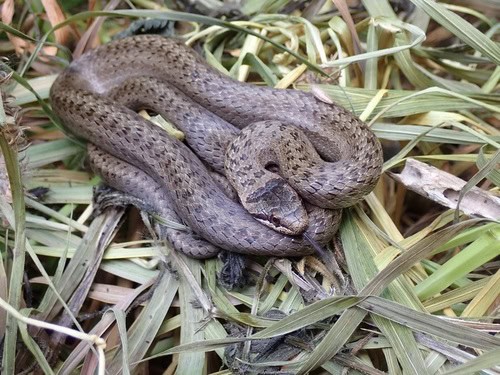
Maximum length: 92cm.
Another species with the shocking ability to triangulate its head. Smooth snakes lack a lethal venom, and they know it. They have sharp fangs which they often unleash upon people when picked up, but they’d still rather avoid being picked up in the first place. So instead, they change their skull shape, giving birds a momentary pause, which the smooth snake uses to flee into the undergrowth.
Smooth snakes generally appear in thickly vegetated areas, which they sneak through stealthily, before preying on lizards such as the common lizard (Zootoca vivipara). Their smooth scales are an adaption to this lifestyle, as rough scales would snag and get caught more easily in the undergrowth.
The smooth snake is a completely safe member of the French countryside. It never appears in towns and cities, and due to its love of thick undergrowth, it’s difficult to find even in countryside areas where it’s proven to be common.
Beware of the smooth snake, as it can be feisty when picked up, more aggressive than its southern smooth snake relative (see below).
| 8 | Meadow viper |
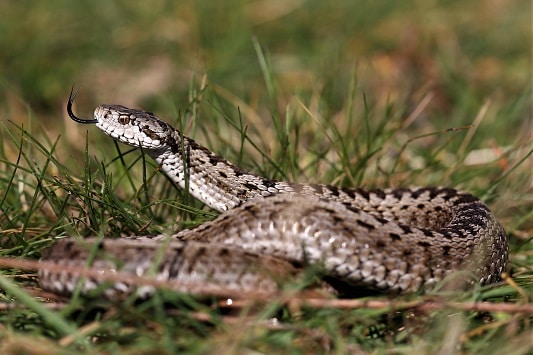
Maximum length: 66cm.
The rarest viper in Europe. The meadow viper (Vipera ursinii) is a mountainous species, which appears exclusively in open areas. In lower valleys, this includes green meadows with plenty of wild flowers and rocks, while higher in the mountains, it includes sweeping alpine slopes with plenty of juniper bushes, and even melting snow patches.
Meadow vipers are inflexible in their habitats, and declining across Europe, but France holds the highest populations of any country. These are located in the southern portion of the French Alps, where in some areas they can be fairly common, despite dwindling down to nothing in Austria (where they once existed) over the decades.
While asp vipers occasionally appear in forests, meadow vipers avoid them completely. Due to their smaller body size, they prey on smaller prey, including grasshoppers, crickets, caterpillars, and even wasps. Their venom is proven to be specialised against these tiny creatures. As for humans, very few bites have been documented, but the signs suggest mainly local symptoms like swelling rather than death.
| 9 | Southern smooth snake |
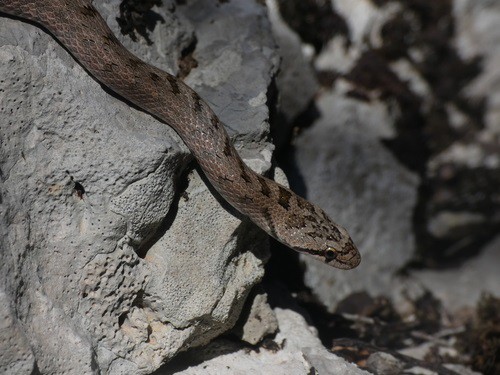
Maximum length: 96cm.
The southerly relative of the main smooth snake. The southern smooth snake (Coronella girondica) inhabits Spain, Portugal and North Africa, but also the southern half of France, where it appears in plantations, scrubland, hillsides, and occasionally forests.
In some areas, this species is endangered and disappearing, as it’s unable to survive in manmade areas, yet it’s still rated as least concern by the IUCN. Like the main smooth snake, it preys chiefly on lizards, including the common wall lizard in Italy. It also adds a crunchy helping of millipedes and centipedes.
This species is similar to its northern relative in many ways, but one difference is a more checkered and irregularly patterned underside, versus a smoothly dark underside for the main smooth snake. Southern smooth snakes are also less aggressive, and even more secretive. The hugest difference is that southern smooth snakes lay eggs, while the main smooth snake lays live young.
| 10 | Montpellier snake |
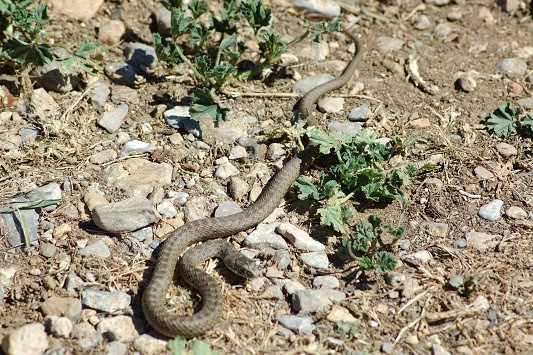
Maximum length: 216.2cm.
Europe’s third longest snake, and an exceptionally fast and whippy one, with the ability to escape humans within milliseconds by blasting off into thick undergrowth. Montpellier snakes are venomous, perhaps even dangerously so, with one supposed fatality involving a Libyan back in the 1980s (though details on this death are hard to track down).
Nevertheless, Montpellier snakes virtually never bite people due to their tiny mouths. Instead, their default strategy is to flee, which they easily accomplish to their thin body and high agility.
Montpellier snakes are extremely flexible eaters, hoovering up rodents in crop fields and even trash dumps. In Spain, they’re extremely widespread, but in France, they only cover the lower 20% of the country, hugging the Mediterranean coastline. When it comes to fast, whippy and energetic species, the green whipsnake is the more common of the two in France.
Montpellier snakes also have a unique ability among snakes: shining their own scales, using a mysterious secretion from their snout.
| 11 | Ladder snake |
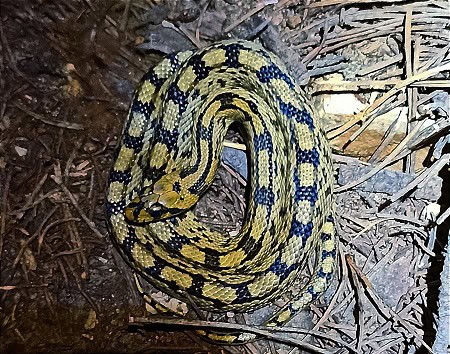
Maximum length: 165cm.
A species named after its striking patterns. The namesake pattern runs down the spine, and consists of olive pale squares alternating repeatedly with pitch black squares. This pattern is most prominent in juveniles, creating an instant ID key for the species, and fades away in adults, but still remains faintly visible in some individuals.
The ladder snake isn’t one of France’s more common species. It’s really more of a Spanish species, where it inhabits almost the entire country, but where this species does exist in France, it’s very common. Ladder snakes appear exclusively along the warm Mediterranean coast in the far south, inhabiting the outskirts of Marseille and Montpellier alike.
The ladder snake is a constrictor, but attacks and rips through human skin with a sharp pair of fangs if hastily picked up. Its diet is rich in mammals, and the skies above it are rich in birds, which simply love the taste of this 100-150cm snake. The ladder snake’s solution is sometimes to hide in tree trunks, or underground mammal burrows, where not so coincidentally, its mammal prey also hang out.
| 12 | Baskian viper |
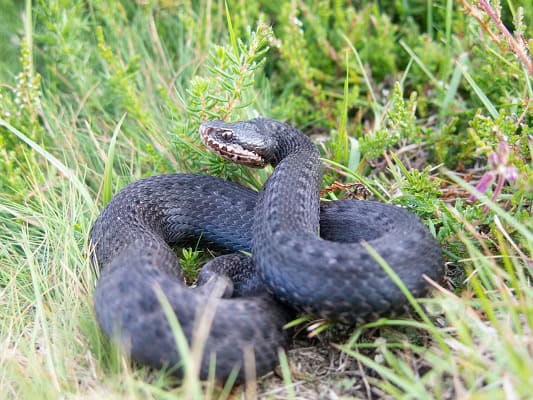
Maximum length: 75cm.
The fourth and final viper species to inhabit France. The Baskian viper only covers a tiny area of territory in southeast France, bordering Spain. This species is mainly found in northern Spain, but just crosses the border into France.
Across Europe, this is one of the weakest vipers of all. Its venom has an LD50 rating of 6.9-9.9mg, or sometimes weaker, which is exceptionally weak next to the adder or asp viper at 0.11mg and 1mg respectively. No deaths are known from this species, although it’s possible that small children have died unrecorded.
Baskian vipers are tricky to distinguish from the asp viper they coexist with, as they vary massively in appearance. Some can be a plain stony colour or olive colour, but others have blotches arranged in uneven parallel stripes.
Likewise, the asp viper sometimes has disconnected black botches, but occasionally disordered stripes of its own. The main difference is that the asp viper has a more upturned snout, whereas the Baskian viper has a blunt nose.
| 13 | Red-eyed grass snake |
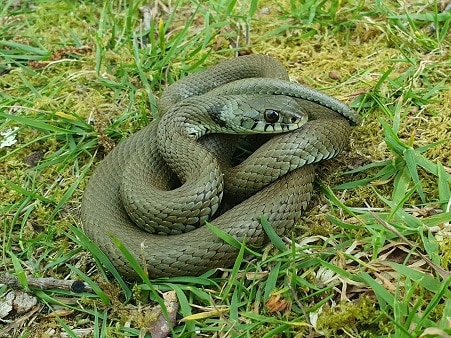
Maximum length: 119cm.
A grass snake relative which was only declared as an independent species in 2016. This species is completely harmless, and lacks the will to bite humans, let alone the ability to actually cause serious harm.
Red-eyed grass snakes spend plenty of time in water, but are slightly less aquatic than the barred grass snake further north. Across Eurasia, they’re the rarest of the Natrix genus (5 members) they belong to, inhabiting the Iberian peninsula (Spain, Portugal), as well as extreme southern France. Alongside the Baskian viper, this species occupies the smallest territory in France of our 13 snakes.
Red-eyed grass snakes have the ability to mimic a viper by triangulating their head, just like the smooth snake. But they double up their mimicry skills by copying cobras as well, creating a demon snake (or the illusion of one) which no migrating bird should ever mess with.
If cornered, the red-eyed grass snake will flare its neck, just like a cobra. The odd thing is that Europe has no cobras for it to mimic, so how did the trick evolve? The answer lies in prehistory – the glory days when Europe did have its own cobra, Naja romani, which died out millions of years ago.