
| 1 | Black-necked spitting cobra |
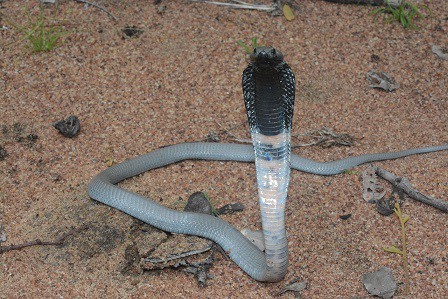
Maximum length: 240cm.
The most common spitting cobra in Africa, with Nigeria being the busiest spot of all. This nightmarish creature combines the ability to spit venom 57 times in 20 minutes, with the usual venom injected rapidly from front fangs.
Black-necked spitting cobras (Naja nigricollis) often exceed 2 metres, and are a rare snake which humanity has made more common rather than less. They naturally gravitate towards open areas rather than forests, and with heavy deforestation progressing annually in Nigeria, they’ve moved into these open areas and begun to terrorise farmers. The forest cobra is the exact opposite, shunning human civilisation (and therefore declining).
Black-necked spitting cobras have fast reactions, and aim directly for the eyes. A successful hit will blind you for 3 days, causing your eyeball to go numb. Their bite isn’t to be underestimated either, as this species has a highly anticoagulant venom. This cleaves directly through fibrinogen and cross-linked fibrin, the final clotting material of all wounds.
According to a 2009 study, the venom of this species also targets the heart. When injected into mice, swelling appeared on their heart tissue, and collagen protein fibers visibly degraded. Their heart tissue even changed colour, from deep red to a paler red.
Black-necked spitting cobras are most likely to prowl the Nigerian countryside during wet season (June-July), whereas during dry season (December-February), they become much more sluggish. They also eat significantly less during dry season. As younglings, their primary food source is the lizard Agama agama, before graduating to birds and small-scurrying mammals in adulthood.
| 2 | Smith’s African water snake |
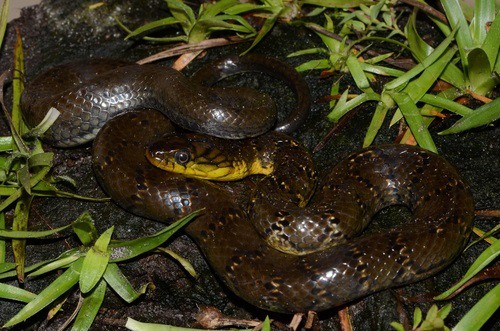
Maximum length: 160cm.
The Grayia genus of African watersnakes has 4 known members, and Smith’s watersnake is easily the most common. This is a non-venomous species of thick forests, particularly swampy forests with a dense undergrowth, covered with disguising shrubs and ferns.
Smith’s watersnakes (Grayia smythii) are semi-aquatic, and can be extremely common in certain swamps, where they prey exclusively on fish and amphibians. But you don’t have to worry about slipping and landing on your back in the mud. Smith’s watersnake wouldn’t dream of hurting anybody, and would be unable to even if a murderous urge suddenly struck.
This Nigerian snake reaches a maximum of 160cm, yet is low on the food chain. Smith’s watersnake’s many predators include herons, which scoop them out of the water with their long beaks, human fishermen, Nile monitors, and possibly forest cobras and black-necked spitting cobras.
This is a very common species, ranging from Uganda in the far east to Gambia in the far west. Smith’s watersnakes lay 8-14 eggs, which they hide in deep buttress roots, buried beneath leaf litter. In a 2001 study conducted 15km from Port Harcourt, Nigeria, amphibians comprised 75% of their diet, followed by 25% fish. Their single top prey was the western clawed frog (Xenopus tropicalis).
| 3 | Spotted night adder |
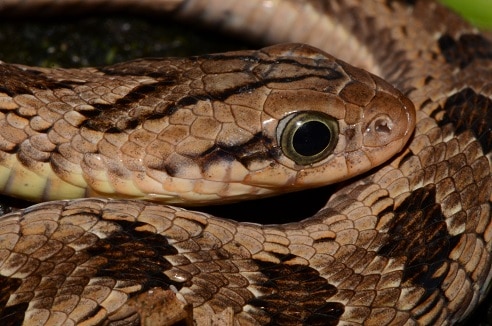
Maximum length: 70cm.
A common Nigerian snake with a moderately dangerous venom, which mainly causes swelling, fever, and pain. The spotted night adder (Causus maculatus) is one of Africa’s most adaptive venomous snakes, appearing in a huge range of habitats, from dense rainforests to open savannahs to dry Ethiopian canyons. They only avoid true deserts, requiring some moisture, as their main food source is amphibians.
Spotted night adders are spread far and wide, from Uganda to Nigeria to Sierra Leone. They’re easily recognisable, as they have an olive base, overlaid with widely spaced black dots. A few are missing these black dots, but there’s little variation in colour with this species overall.
Like other Causus adder members, the spotted night adder has round pupils rather than vertical, which is almost unheard of in vipers worldwide. This is also a wrestling snake, as males will sometimes intertwine and attempt to force each other to the ground.
According to a 2004 study, conducted in a rainforest patch along a river shore in Nigeria’s Akwa Ibom state, spotted night adders eat a diet consisting of 66.7% amphibians and 33.3% small mammals. Confirmed species include Hallowell’s toads, square-marked toads, and golden puddle frogs. Spotted night adders have a rare gift in nature: natural resistance to heart-stopping bufotoxins produced in these toads’ slimy skins.
| 4 | Ball python |
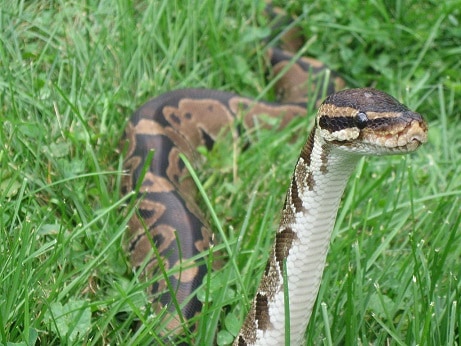
Maximum length: 183cm.
The most popular pet python worldwide. The ball python is relatively short, typically measuring 1 metre, but reaches high abundances in the Nigerian countryside. Ignoring any invasive species like the Burmese pythons which have conquered Florida, this is the westernmost python species worldwide, reaching the western tip of Senegal directly adjacent to the Atlantic ocean.
Ball pythons range from Gambia to Uganda, and Nigeria lies at the epicentre of this empire. Many Nigerians worship this python; the Igbo people even build coffins and conduct funerals for ball pythons when they die.
Ball pythons prey on a mixture of birds and mammals. Females tend to live in burrows, while males have stronger tree-climbing tendencies. Their name originates from their famous instinct to coil into a tight ball when threatened by predators. It’s estimated that 100,000 ball pythons are exported from Africa annually for the pet trade, yet the species is barely in decline.
Ball pythons lay just 10 eggs per average clutch, but these eggs are relatively large, at 6.0 by 4.0cm. The main purpose of their infamous ball is protecting their brains from attack, but a 2004 study from Lomé, Togo revealed how mothers use it to protect offspring. The study found that if mothers coiled around their egg clutch, the temperature was only slightly increased, but evaporative water loss was significantly reduced. The offspring of these “balled” eggs were larger, more energetic, faster swimmers, and grew more rapidly, compared to eggs that mothers didn’t coil around.
| 5 | Blanding’s catsnake |
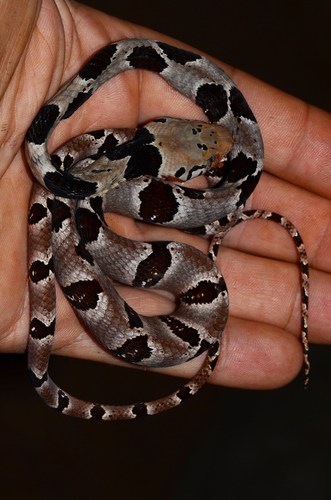
Maximum length: 2.8 metres.
A large branch-dwelling snake which regularly breaks through the 2 metre barrier. This is a tree-climbing species which is proven to reach towering heights, even up to 25 metres above ground.
Blanding’s catsnake (Toxicodyras blandingii) is a nocturnal species which is active from dusk till dawn. It appears all over southern Nigeria, and has a moderately dangerous albeit poorly researched venom. In one of the few bite reports on record, the victim suffered from cramps, strange sensitivities, and random aches and pains, and recovered within 2 days.
This Nigerian snake requires trees to survive, but is perfectly comfortable in tree clumps directly adjacent to human habitation, meaning that they’re not close to endangered. Their diet is varied, including dwarf chameleons and more mammals as an adult, including bats such as golden short-palated fruit bats and Angolan free-tailed bats.
Blanding’s catsnakes seem to be especially amazing climbers, even compared to other tree snakes. In 2010, an individual managed to grab a bat meal caught in a large mesh net, which was erected in a forest by strands of incredibly thin wire. The snake must have climbed either the mesh or the thin wire itself to acquire the bat, which was perched 2 metres above ground.
Blanding’s catsnake belongs to the same Toxicodryas genus as the common powdered catsnake (T. pulverulenta), but is easily the longer of the two, reaching 2.8 metres versus 1.25 metres.
| 6 | Roman’s carpet viper |
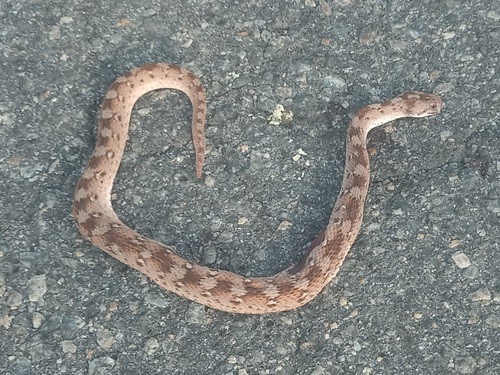
Maximum length: 71.5cm.
This potentially deadly venom bomb belongs to the same Echis genus as the infamous saw-scaled viper of India. Roman’s carpet viper is a very recent addition, as it was only made an official species in 2018, when it was split from the West African carpet viper (Echis ocellatus). It was distinguished by an especially high count of ventral (belly) scales, with 150-168 in females, and 146-156 in males. The number of scales around the eyes was also higher.
Roman’s carpet vipers are found mainly in central and northeast Nigeria, typically in dry, dusty areas. While research is scarce, they deal out plenty of bites each year. A study on antivenom effectiveness gathered hospital data from 2021 and 2022 in Nigerian hospitals, and managed to find 5467 Roman’s carpet viper victims. Symptoms included coagulopathy, AKA blood clotting chaos, and the antivenom was highly effective, causing a 93-94% reduction in mortality.
So far, the largest known Roman’s carpet viper was a male measuring 71.5cm, found in Central African Republic. In the initial 2018 discovery study, the largest male measured 61.5cm and the largest female 55.5cm.
| 7 | Saharan sand boa |
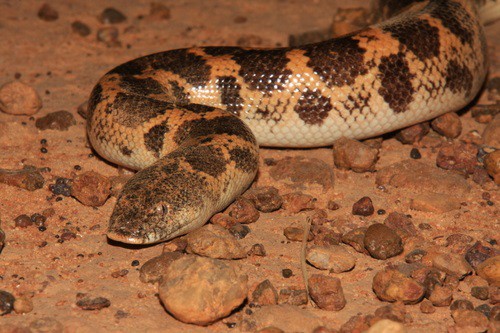
Maximum length: 80cm.
A species of drier areas, which is most common in northern Nigeria. The Saharan sand boa (Eryx muelleri) lives not in majestic sand dunes, but dry savannah. Occasionally, they appear at the transition zone between desert and dry savannahs, but never within fully-fledged sand deserts like the Arabian sand boa.
Saharan sand boas are completely harmless to humans. Within dry savannahs, they most commonly lurk in well vegetated spots rather than bare soil, possibly for disguise, or possibly because their prey is more common amid tangled bushes and dry grass.
This snake eats a mixture of lizards and mammals, shifting further towards mammals with age, as their mouths are simply too small early in life. The African five-lined skink is one confirmed reptile meal.
This Nigerian species has a small presence in the international pet market. Between 2007 and 2012, 571 were exported from Togo, which is barely a fraction of the relentless ball python conveyor belt. The Saharan sand boa species has virtually no variation in its appearance, being virtually identical across its entire central African range.
| 8 | West African carpet viper |
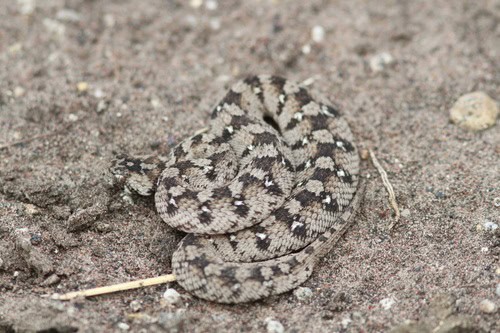
Maximum length: 65cm.
The other main Echis viper in Nigeria. The West African carpet viper (Echis ocellatus) was said in 2001 to account for 66% of venomous snakebites in Nigeria. Now that Roman’s carpet viper has been made an independent species, that proportion will be reduced, but this is still perhaps western Africa’s most dangerous serpent, alongside the black-necked spitting cobra.
This species is most common in western Nigeria, with Roman’s carpet viper dominating the east. There’s a strong lack of neurotoxic symptoms, but west African carpet pythons double down on virtually every other dark power: swelling, tissue necrosis, sudden haemorrhaging. In Ghana to the west, they cause 60% of snakebites, and 90% of deaths. Mortality rates for individual bites have been reported at 11-17%.
While preparing to attack, the West African carpet viper rubs its jagged scales together to create its signature “sawing” sound. This species derives a large portion of its diet from arthropods such as scorpions. This risky diet probably explains why its venom became so lethal, compared to the spotted night adder, which doesn’t need to disable its amphibian prey as rapidly.
| 9 | Rufous-beaked snake |
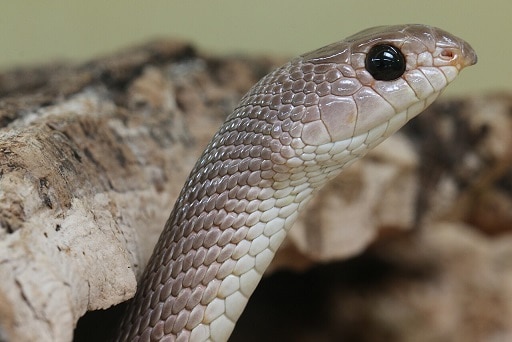
Maximum length: 158cm.
A pale, thin snake with a strange beak on its snout, which explains the name. The western rufous beaked snake (Rhamphiophis oxyrhynchus) is common in Nigeria, and tends to inhabit dry and moist savannah, open woodlands and grasslands.
Rufous-beaked snakes move by day, and travel relatively slowly, regularly taking shelter in termite mounds and animal burrows. Areas covered with constant bushes and thickets are a haven for this snake, and they’re excellent at staying disguised. Rufous-beaked snakes have virtually no patterns, neither from a distance nor up close.
This species is rear-fanged, and must chew victims repeatedly to inject venom, but that doesn’t make it harmless. One detailed report comes from a 2014 article, when a rufous-beaked snake snapped down on a 24 year old man’s finger and maintained a tight grip for 20 seconds. Within 20 minutes, the finger began to swell. Within hours, this covered the entire forearm, and the victim soon struggled to move his arm. By the next day, these symptoms had faded except for a mild, generalised pain in the man’s arm.
The venom of this species also contains neurotoxins, specifically the unique rufoxin, but these have yet to manifest in human beings. The main danger is an incredibly tight grip when they snap their fangs shut, combined with a benevolent determination of the victim not to hurt the snake by ripping its mouth off.
| 10 | Western forest file snake |
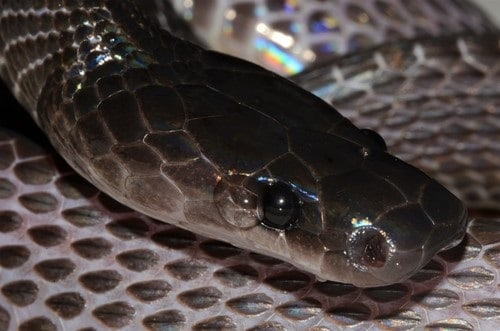
Maximum length: 120cm.
A snake of swampy rainforests, which sticks to the forest floor rather than climbing trees. Mehelya is a weird snake genus, as its members have large spaces between their scales, revealing the pale skin below. Yet the individual scales are sharp and jagged, thus creating the “file” name. These snakes also have a triangular shape when viewed in a cross section.
As for this species, the western forest file snake (Mehelya poensis) is common in central Africa, and Nigeria lies roughly at the epicentre of its range. This snake eats a variety of reptiles, as lizards, geckos and fellow snakes are all parts of its bewilderingly large menu, as are toads in the poisonous Bufo group.
The western forest file snake has a bizarrely shaped snout, which is shaped like a spade, and used for shifting aside loose soil. The swamp forests of Nigeria are home to a menagerie of snakes, but while Smith’s watersnake sticks to the swamps themselves, this species specialises in invading burrows, shifting aside loose debris to enlarge a path.
Western forest file snakes are no threat to humans, rarely biting even if picked up. This is one of 5 Mehelya filesnake species in sub-Saharan Africa.
| 11 | African rock python |
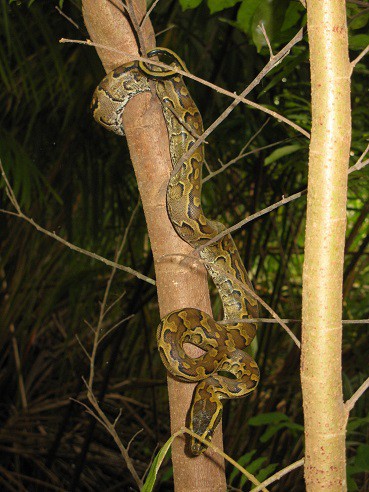
Maximum length: at least 6 metres.
The longest snake in Nigeria, and indeed, the largest snake in the whole of Africa. The African rock python (Python sebae) appears in the southern half of Nigeria, as well as a huge swathe of central Africa. It’s the second or third longest snake in the world, with unverified tales of 10 metre brutes from Ivory Coast, and 7 metre tales appearing regularly.
In terms of patterns, this species is difficult to distinguish from the ball python for a layman. But luckily, there’s only one ID feature you need – its crushing size. The ball python’s record length was 182cm, which the African rock python outstrips over 3 fold. Even a small adult will measure 2 metres.
African rock pythons are also much less common than ball pythons, covering a large area, but appearing only 1/10th as often in any given locality (according to one estimate). African rock pythons are particularly common immediately after rainfall, when they leave the safety of their underground burrows.
Across their range, African rock pythons are known to swallow impala, hyenas and small Nile crocodiles. In Nigeria, they sometimes lurk in suburban areas, where they swallow up rodents and domestic poultry. Their wild habitats are varied, including woodlands, fields, plains and game trails. One study found that those in suburban areas in Nigeria were smaller than rock pythons from the countryside.
| 12 | Forest cobra |
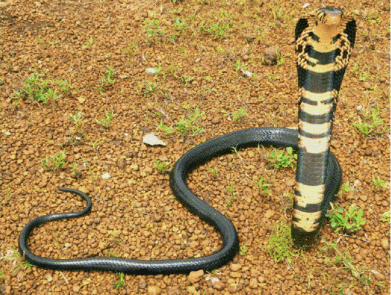
Maximum length: 320cm.
The other main cobra in Nigeria. The forest cobra (Naja melanoleuca) simultaneously gives and takes away, as it has two main differences in deadliness to the black-necked spitting cobra.
Firstly, the forest cobra has no ability to spit, no pressurised holes in its fang tips which unleash flying venom globules. Secondly though, this species is far more neurotoxic than its cousin. A bite from the forest cobra can unleash drooping eyelids, slurred speech, and blurred vision. More serious symptoms may include paralysis, inability to speak and respiratory failure.
The forest cobra is a common species of central Africa, and Nigeria is one of its heartlands. As the name suggests, this cobra is far more common in pristine forests compared to grassland, farmland or villages. Compared to the black-necked spitting cobra, it enters human areas far more rarely, thankfully lowering the rates of bites.
Forest cobras also have a different diet, as they prey heavily on fish, as well as the usual mammals. They’re one of the most aquatic cobras, paddling around in lakes, and also the longest true cobra (Naja genus) worldwide. The forest cobra is a fast, darting species which prefers active exploration to patient ambush.
| 13 | Calabar burrowing python |
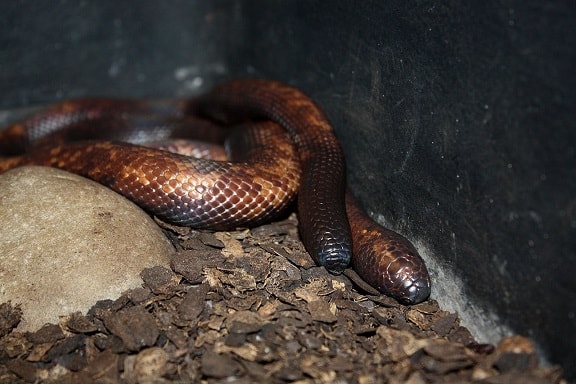
Maximum length: 103cm.
The final python in Nigeria. This species doesn’t belong to the true python genus of Python like our other two members. In fact, it’s debatable whether this snake is a python at all. Some consider this species to be a boa, more closely related to the rubber boas of the USA. What’s definite is that this southern Nigerian species is an evolutionary anomaly.
Calabar burrowing pythons are mainly found in hilly forest areas, including swamp forests and fully-fledged rainforests. They shun open grassland, and are easily recognisable due to their glistening chocolatey brown scales.
This species is unusual in many ways. Its hunting strategy involves raiding underground mammal dens, swallowing up nestling mice. Its defensive strategy involves pure deception, as this species lacks any form of aggressive weapon. When cornered, the Calabar burrowing python raises its tail into the air, revealing a snowy white patch, in order to distract from its head.
Finally, the Calabar burrowing python has the toughest skin of any snake alive. Scientists discovered this in a 2016 study, when they discovered an incredibly tightly interlinked series of collagen fibers, giving the snake a toughness equivalent to a rhino’s hide. The Calabar burrowing python far outstripped more dangerous snakes like rattlesnakes for sheer toughness. Like all boas/pythons, this species lacks even a mild venom.
I just learned that my ancestors were perdominantly from Nigeria.
So, finding this article was most helpful before I plan my first trip!