
| 1 | A pitviper’s greatest fear |
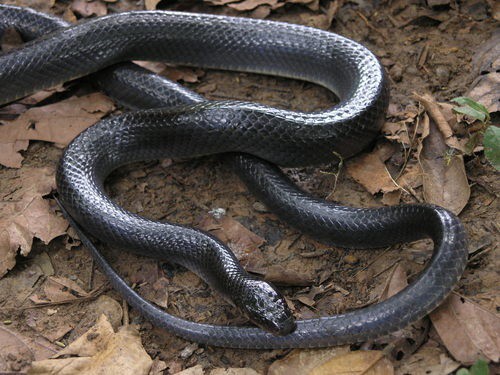
In southeast Asia, the reigning snake-eating snake is undoubtedly the king cobra, which sits atop the serpent pile, choosing to eat any fellow Thai snake it feels like. The equivalent in the western hemisphere, meanwhile, is the all-powerful mussurana, AKA Clelia clelia.
This is a powerful, muscular constrictor, which covers a vast swathe of Central and South America. Mussuranas begin their range in southern Mexico, cross through over a dozen countries including Brazil, then finally peter out in northern Argentina. Inbetween, they inhabit 6 out of 7 Central American countries, with the exception being El Salvador.
At an all-time record of 275.0cm, the mussurana is secretly one of the Americas’ longest snakes, easily long enough to force a terrified cocoa farmer to take a running leap. Clelia clelia doesn’t just eat snakes, but preferentially feeds on pitvipers, whose venom it is immune to. It possesses a mild venom of its own, but mainly subdues these lethal pitvipers via crushing constriction.
Some farmers even release mussuranas onto their own land, in order to combat the menacing pitvipers slowly closing in. Brazil’s main polyvalent antivenom is manufactured in Instituto Butantan, in São Paulo (southeast Brazil), and the grounds of the headquarters host a full statue of this species, in order to give thanks.
| 2 | Widespread but rare |
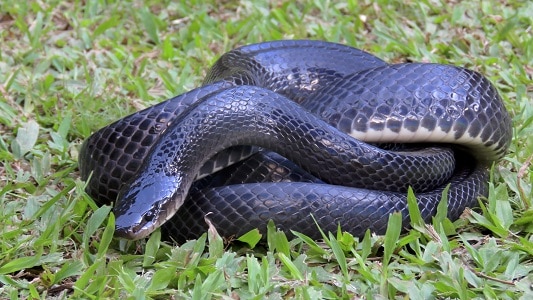
The mussurana is the bogeyman for all other snakes of South America, a creature they know is out there, and know they might one day meet. This species prefers to hide in sheltered evergreen forests, with a thick coating of leaf litter and underbrush, ensuring that shelter is always possible. It also appears in yards, meadows, agricultural fields and on hikers’ paths, but you’ll never find one in a desert or on an arid, rocky hillside. Clelia clelia always requires moisture, and fortunately, there’s plenty to come by in South America.
Mussuranas are largely nocturnal, but sometimes hunt during the day, usually immediately after heavy rains, when there’s plenty of puddles lying around. They mainly stick to the forest floor, but have strong climbing skills if necessary, reaching up to 1.7 metres high.
Though they control a huge territory across Central and South America, mussuranas are observed relatively rarely. Like the king cobra, they’re naturally sparse and spread out – you won’t find 10 huddling together under a log like the US ring-necked snake. This probably cranks up the fear even more for the local pitvipers, stimulating their nightmares to greater new heights by lurking in the shadows.
| 3 | Enjoys venomous snakes the most |
At least 17 snake species are confirmed in the mussurana’s diet, including…
Fer-de-lance – this terrifying snake inflicts 46% of snakebites in Costa Rica, and 70% in parts of Colombia. The fatality rate without antivenom is 9%.
Eyelash viper – a common viper in banana and cacao plantations. This is a branch-dweller, yet mussuranas can still eat them, proving their flexibility.
Puffing snake (Phrynonax poecilonotus) – an infamous bird-eater which slithers up branches and raids nests. Mildly venomous and common in Central America.
Boa constrictors – they’re confirmed to eat small adults of this globally famous snake.
Hudson’s coffee snake – a 40-50cm non-venomous noodle of Ecuador, which mussuranas probably slurp up in minutes, and won’t satisfy them for long.
South American bushmaster – a calmer venomous snake, but one measuring 3 metres (the world’s longest viper), with such a powerful pounce that it could probably knock you over. Typically contributes 4.5-7.5% of snakebites wherever it lives.
The mussurana has a particular love for pitvipers. While humans avoid fer-de-lances and bushmasters as much as possible, the mussurana seeks them out, and is excited to rub noses with them (although a few humans are like this too).
| 4 | Newborns red, adults black |
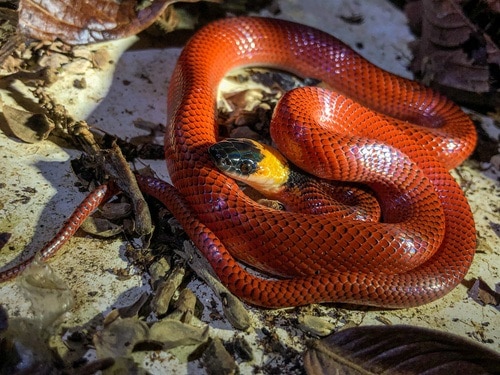
Aside from eating snakes, one of the mussurana’s most distinctive features is its dramatic colour change. As a newborn and juvenile, this species possesses a bright red body, followed by two black bands on the head and neck, and a snowy white or yellow band inbetween. Juveniles look like a completely different species, but after 3-4 years, they achieve their adult colours: a consistent blue-black, like an oil spill.
The change begins with a slightly black pigment at the free tip of each scale, both white and red simultaneously. This grows and grows, until eventually the entire body is black. The last colours to fade are usually the white/yellow neck collar, and traces are sometimes found in small adults.
According to this study on 105 mussuranas, the average length during the colour transition was 71.8cm. The study also found differences in the patterns by region. Those in the Amazon basin and Atlantic forest region had a first black band in a horseshoe shape, while from elsewhere, like Central America or the Pacific coast, the black band was straight.
The juvenile appearance has also created the myth of a blood snake, AKA víboras de sangre. According to locals, its venom is so lethal that every inch of your body surface will start bleeding uncontrollably. In reality, the venom is no stronger in juveniles than adults.
| 5 | Two hour pitviper battles |
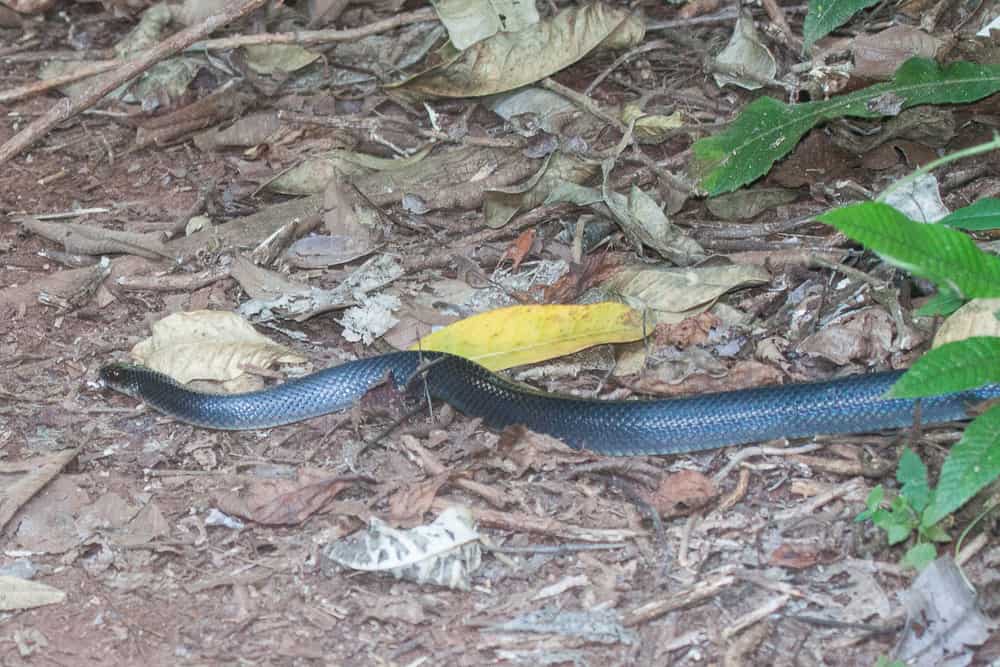
Mussuranas love snakes of all shapes and sizes, and they don’t care how long swallowing them takes. In 2005, scientists were observing a cacao plantation in western Ecuador. They stumbled across a mussurana measuring 123cm, which was coiled around a small rainforest hognose pitviper (Porthidium nasutum) measuring 20cm. The latter has a famous nose horn (making our horned snake list), and exceptional camouflage in forests.
The hognose pitviper made several jabbing bites, puncturing its predator’s skin, yet the mussurana didn’t weaken, whether through sheer determination or because it felt no pain. The mussurana moved its mouth from mid-body to head, then swallowed the pitviper headfirst, which was still alive in its body afterwards, with clear squirming visible. The whole event was over in 3 minutes.
But another observation happened in 2020, on an unpaved rural road in Bolivia. The combatants were now an adult mussurana versus an Andean lancehead (Bothrocophias andianus), a relatively uncommon venomous species of Peru and Bolivia. The mussurana bit its prize by the head, then suffocated it, before swallowing by the head. This time, the whole event took 2 hours, from initial attack to final ingestion.
| 6 | Toxin-resistant blood |
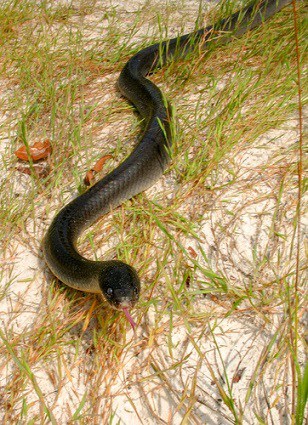
It’s obvious that mussuranas are resistant to pitviper venom. They can endure savage bites from their desperate prey and still not show any sign of concern, or even slowdown as they slither away into the depths of the forest afterwards. A 1990 study gathered nine newborn mussuranas, from two separate litters. Blood was extracted by cutting their tail, which was allowed to clot at room temperature for 2 hours, then frozen in storage for 2 months.
3 groups of mice were tested, and each blood sample was tested individually. There was also a control group of mice, which received no mussurana serum. All mice were injected with fer-de-lance venom, the most dangerous snake of Central America. Severe haemorrhaging is a hallmark of fer-de-lance bites, so severe that human victims can suffer a stroke.
2 hours later, the mice were sacrificed and examined. The results were as clear cut as possible. All mice injected with mussurana serum showed no sign of deformity or haemorrhaging, despite a hefty venom dosage, and were indistinguishable from healthy mice. Meanwhile, the mice receiving no serum showed extensive haemorrhaging.
The mussurana has protection from pitvipers in its very bloodstream, from birth to adulthood.
| 7 | Resistant to almost all venoms |
A 1982 study was more direct, gathering a number of mussuranas and injecting venoms from 13 different snakes into them. These included, but weren’t limited to: southern coral snakes, 7 Bothrops pitvipers, South American rattlesnakes and South American bushmasters. These varying species had a variety of different toxin profiles. The result: the mussurana was resistant to every single snake venom. All mussuranas survived, and not one experienced any visible local effects.
Their one chink in the armour may be coral snakes. While the study above was positive, a 1963 study found that Clelia clelia succumbed to southern coral snake (Micrurus frontalis) venom, 48 hours after being bitten, while easily deflecting the more traditional Neuwied’s pitviper. Coral snakes are much heavier in neurotoxins than their typical viper prey. They cause far fewer local symptoms, so it’s possible that the mussuranas above were affected, but managed to pull through. Then again, the scientists would have noticed any paralysis or laboured breathing too.
Coral snakes are the one remaining question mark. But the 1982 study even tested species that don’t live in South America, including the monocled cobra (Thailand) and forest cobra (central Africa). The toxins still bounced off Clelia clelia, despite not having evolved alongside them.
| 8 | They’re not coming for you |
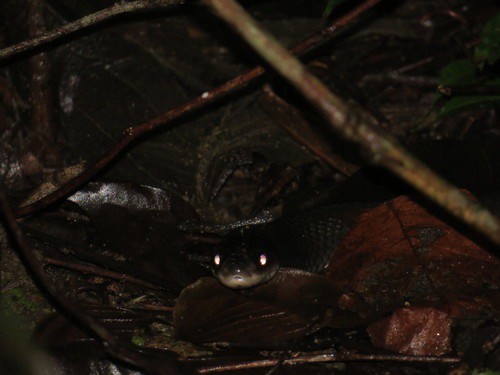
The mussurana has a mild venom, secreted through rear fangs, whose effect on humans or chemical makeup has never been tested. It’s a docile snake, and bites are rare. If picked up, this species will typically constrict your hand and release a foul snake smell, or it may not react at all, and gaze around at its forest amiably while in the palm of your hand, waiting patiently for you to put it down. Another occasional strategy is shielding its head in its own coils.
The most detailed venom information came from its cousin Clelia plumbea, formerly a subspecies, now independent, which inhabits southeast Brazil. A 4 year old girl was bitten by a 1.4 metre Clelia plumbea, and hospitalised 10 hours later. She experienced pronounced swelling and haemorrhaging, but had no systemic symptoms. She was given a Bothrops lancehead antivenom, and recovered fully after 3 days.
Among 19 mussuranas from Paraguay and Argentina, the shortest measured 42.1cm and the longest 222.0cm. The all-time record is 275cm. Clelia clelia has round pupils rather than a vertical, and the exception to its oily blue-blackness is a white belly.
| 9 | Capable of cannibalism |
In 2015, scientists scooped up a mussurana in northeast Honduras, measuring slightly under 2 metres, and placed it in a bag. After returning to their campsite, an unmistakable stench wafted over from the same bag. They peered in, and noticed that the mussurana had regurgitated its prey in a panic.
The scientists were interested, as they hoped to confirm some new prey species, but instead, they discovered a predator. The black adult mussurana had regurgitated a young mussurana, with its typical red colouring. In that moment, the mussurana was officially confirmed as a cannibal snake. Pitvipers, boas and cat-eyed snakes are all on the menu, and so are each other. All snakes are fair game. It works both ways, as mussuranas now have to look over their own shoulder too.
Also found in the bag was a lizard, the Middle American ameiva (Holcosus festivus), a newly discovered prey, and two unidentified mammals, probably mouse pups. The main mussurana was still alive, though bleeding from the mouth, and they promptly released it into the forest.
| 10 | Also eats lizards and mammals |
No systematic study of the mussurana’s diet has been performed, no gathering of 1000 snakes and checking their stomach contents. However, there’s endless individual records scattered around journals and social media. In 2013, scientists found that 20 such records consisted of snakes, 11 of lizards, 8 of mammals, and 1 a bird. This is a flexible snake too, which isn’t dependent on one prey type. Snake eggs have also been recorded as meals, in the Brazilian state of Pará.
Clelia clelia is able to lay up to 25 eggs, though the total is usually less. In 1981, a reptile expert successfully encouraged a Costa Rican female to give birth. She laid 10 eggs, which measured 5.5-6.6m long, and 3.1-3.17cm wide. All were healthy except one which was yellowish and deformed.
The eggs took a long time to hatch, 117-120 days in carefully incubated conditions. 2 of the eggs never hatched at all, but the mussuranas within were well formed. Of the 8 that hatched, the length of the newborns ranged from 42.0cm (a male) to 49.0cm (also male). The colour of the newborns had no variation, each possessing the classic red hatchling body, plus the vivid white and black neck bands.
Will, Mussuranae, consume, (Also), Fellow (Ophidious), Drymarchon/Lampropeltis, Sp. ?
The yellow-tailed indigo snake (Drymarchon corais) is confirmed in its diet. https://www.reptilesofecuador.com/clelia_clelia.html