
| 1 | One of the world’s most widespread snakes |
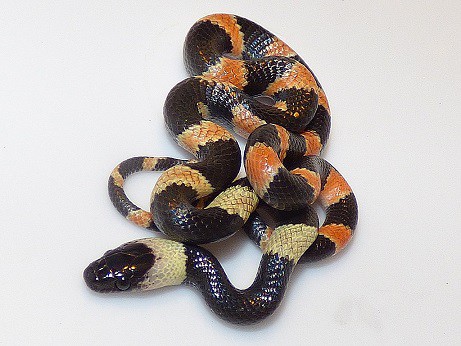
The forest flame snake (Oxyrhopus petolarius) is a completely harmless species of Central and South America, which only possesses a mild venom, and has never caused serious symptoms in humans on record. It’s a moderately sized species both in thickness and length, with an all-time record of 132.7cm, and a more typical length of 80-100cm.
In most ways, this species lacks any fancy features, with a generalist diet, and no unique offensive weapons or skills. Nevertheless, the forest flame snake does have a claim to fame: being one of the most widespread snakes, not just in the Western Hemisphere, but the entire world.
The forest flame snake outstrips the following species for territory covered: green anaconda, common lancehead, fer-de-lance, and even the boa constrictor. To the north, forest flame snakes stretch a decent way into Mexico, coming to a similar latitude to Mexico City. They then inhabit the majority of Central America, only skipping El Salvador, with decent colonies in Costa Rica and Guatemala alike.
In South America, forest flame snakes are almost ubiquitous in the northern half. There’s only two countries they don’t inhabit: Chile, which is to the west to the Andes mountains, and Uruguay, which lies too far south.
| 2 | All-powerful and unstoppable |
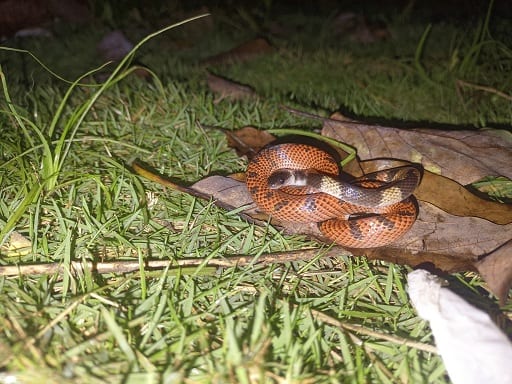
The forest flame snake would easily lose a one on one battle with a common lancehead or painted coral snake, yet it’s easily more common than both. Some species like common lanceheads are widespread, but disappear once the Amazon rainforest ends. Not the forest flame snake – this species appears all over the Amazon rainforest region, drier areas of eastern Brazil, and the Pantanal wetlands of southern Brazil.
There’s only one state of Brazil where forest flame snakes aren’t present: Rio Grande Do Sul, directly to the north of Uruguay. Forest flame snakes also appear on Trinidad and Tobago, and on both islands, unlike the common lancehead which only appears on the larger Trinidad. Forest flame snakes appear in Ecuador on both sides of the Andes mountains, which is rare, as the towering peaks (which reach over 6000 metres) split the country in two, and most species only appear either to the west or east, like the boa constrictor which appears in the east.
In Paraguay, forest flame snakes are sparser, but have several dots on the map. This lies almost at the southern extent of their range, but new locations are still being discovered, such as a sighting in Paraguay’s Itapúa province in 2024. This lies in extreme southeastern Paraguay, and shows that despite its empire being enormous already, scientists have yet to map it out fully.
| 3 | Appears in most habitats |
The main reason for the forest flame snake’s success is its immense habitat flexibility. The Oxyrhopus genus contains 15 members overall, also containing the yellow-headed flame snake and Tschudi’s false coral snake. These are generally restricted to pristine forests, but while forest flame snakes also prefer the moist leaves and gnarly trees of rainforests, they’re more than comfortable in other locations.
Forest flame snakes can be found in villages, grassy hillsides, coffee plantations and moist riversides alike. They move through these areas freely, with no hesitation, or concern over whether their camouflage might fail to activate.
One caveat with this species is that it’s generally a species of lowlands. On the map of Ecuador, for example, there’s a vast gap in their territory where the Andes mountains lie. In Costa Rica, a new altitude record for this species was set in 2006, but this was only 1334 metres. The highest mountains of Costa Rica reach well over 3000 metres, and are occupied by various snakes such as Talamancan palm pitvipers.
Nevertheless, as Brazil contains virtually no mountain ranges, the forest flame snake has an enormous playground to explore and completely dominate. The southeastern extent of this species lies in northeastern Argentina, in Misiones province. This is the only Argentine province they’re confirmed to inhabit.
| 4 | A flexible eater |
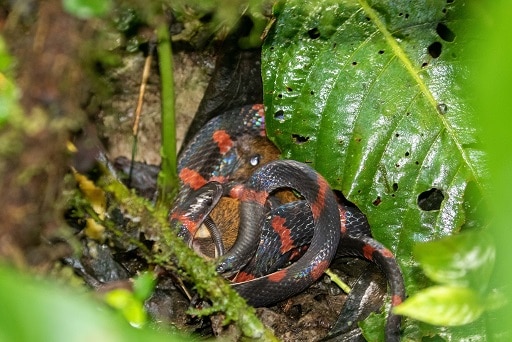
Forest flame snakes are immensely flexible in their dietary habits. They’re open to swallowing any animal kingdom object which will fit in their mouths, and one example happened in January 2022.
A forest flame snake was found in a house in Minas Gerais state in southeast Brazil, not far from a patch of Atlantic forest. The snake was inside a bird cage, positioned 160cm above ground, hinting at the worst already. The cage was home to several cockatiels, a popular type of pet parrot.
The snake had a mysterious bulge in its stomach. The owners placed it in a glass jar, and eventually, it regurgitated 6 eggs, which turned out to be cockatiel eggs. The eggs were completely intact, with no leakage of the nutritious inner contents.
While forest flame snakes typically appear on the ground, they still climb branches if drawn upwards by scent particles. This snake had acquired prey from a position of just over 1.5 metres off the ground. This was only the 2nd ever record of a forest flame snake eating eggs. The 1st was a western Amazon snake reported in the mid-80s which had several fragments of blue shells in its stomach, believed to have come from birds’ eggs.
| 5 | An occasional bat-snatcher |
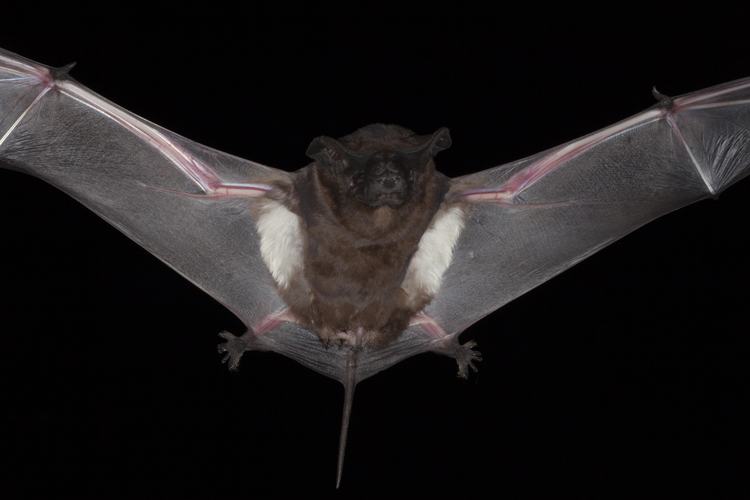
Another club which the forest flame snake carries a card for is the bat-eating club. No detailed diet study has ever been conducted on this species, but there’s a ton of more scattered observations, and one was made in 2012.
Scientists dug a preserved forest flame snake out of museum storage, measuring 82cm, which had been captured in Bahia state, Brazil. Inside was a 23cm bat, with its wings folded down. It was identified as a Sebia’s fruit-eating bat, a common species across South America and Central America. Judging by its angle, it had been swallowed tail first.
Reptiles seem to be the most common prey for the forest flame snake overall. In fact, its venom is particularly potent against Anolis lizards, like the green vine snake, which is powerful against reptiles but significantly weaker against mammals. Confirmed prey in the forest flame snake’s diet include striped worm lizards, Middle American ameivas, lava lizards, tropical house geckos and forest whiptails.
Sometimes, their meals have disastrous consequences, as one forest flame snake was discovered in 2011 attempting to swallow an Amazon lava lizard. Its mouth and neck seemed stretched to breaking point, and as it was moved to storage, the snake died in the struggle. The lizard measured 25.1cm, while the snake measured 64.2cm, but this lava lizard is a relatively thick-bodied species, which likely caused the snake to choke to death.
| 6 | Coral snake comparison |
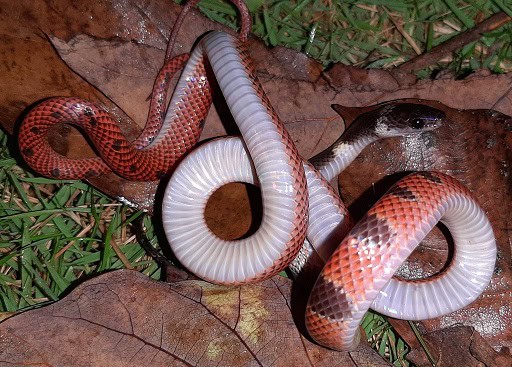
The forest flame snake has striking black and red bands, or sometimes black and white bands. These repeat at varying intervals, with the black sometimes covering more space, and the red sometimes being thicker. The number of bands also varies wildly, from less than 20 to over 50.
Though striking, recognising the forest flame snake might be tricky for an amateur enthusiast, for one reason: its neurotoxic coral snake neighbours. The Micrurus coral snake clan numbers 82 in the Americas, and all have a potentially lethal venom. South America is home to dozens, many of which overlap with the forest flame snake. The red, black and sometimes white bands can be very similar, making approaching this species a risky gamble, lest it turn out to be misidentified.
Though you might not get to see it, there’s one completely reliable ID feature with this species: its underside. The forest flame snake’s underside is virtually always free from patterns, except occasionally beneath the tail. It’s not just white, but a snowy, pristine white, with no red or black in sight.
Meanwhile, coral snakes are the exact opposite. The bands on their bodies continue through the belly uninterrupted, forming complete rings. No matter how black or red a forest flame snake, this pristine snowy belly is nearly always in place. The only trouble is getting a chance to see it. One tip is that the white belly sometimes extends to the chin.
| 7 | Ontogenetic colour variation |
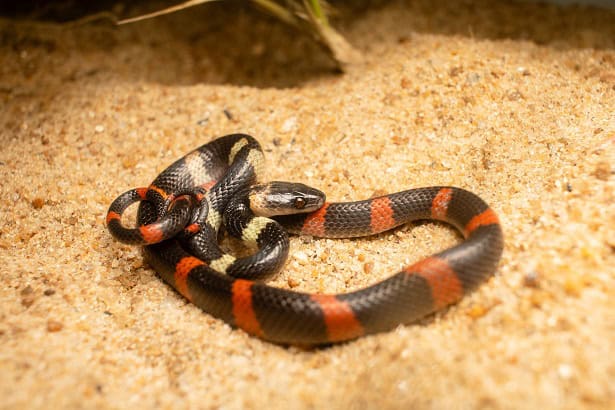
Ontogenetic colour variation is when a snake radically changes in appearance from youth to adulthood. Striking examples include the green tree python of Australia, which transitions from banana yellow to leafy green within 1-2 years. In South America, the feared mussurana begins life as bright red, before becoming midnight black in adulthood.
The forest flame snake also undergoes such a transition, though not quite as strikingly. At all stages of life, Oxyrhopus petolarius features black bands, but the colour between varies. In the first couple of years, the red bands are generally white instead, or sometimes orange. As they age, they gradually transition to red, forming the red-black picture of adulthood, and explaining why this species seems to have significant variation in many photographs.
This transition even creates the phenomenon of a halfway-house no man’s land serpent (see above). Forest flame snakes don’t transition overnight; their adult colours take a while to appear. Many images have been taken of forest flame snakes with red bands closer to their tail, but white bands still around the neck and chest.
It appears that the red transition begins at the tail, and gradually spreads to the head. The green tree python is completely different, as its yellow scales begin transitioning to green with no particular pattern, appearing all over its body simultaneously.
| 8 | Eyes, tongues and morphs |
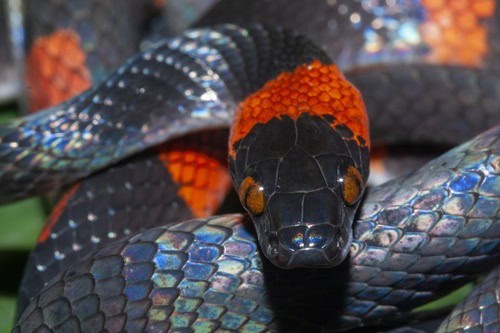
Forest flame snakes vary significantly between individuals, as well between ages. Red and black is standard in adulthood, but the amount of bands varies massively, as does their thickness. Occasionally, you can find rare silver individuals. This image shows a completely silvery forest flame snake in the rafters of a roof, coiled around and preparing to swallow a lava lizard. Note that the usual snowy white belly is still in place.
This image shows another silvery, almost steel morph. Occasionally, you can find individuals where the red bands cease to exist as well, resulting in a mostly black snake, making it very difficult to recognise.
Another ID sign of the forest flame snake is vertical pupils, and relatively large eyes. The eyes are typically greyish-brown, but these also vary, as some have bright yellow eyes. A small percentage have a rare feature among snakes: blood red eyes, with the usual vertical pupil. The tongue of this species is typically greyish-brown as well, with hints of purple.
| 9 | Offence and defence |
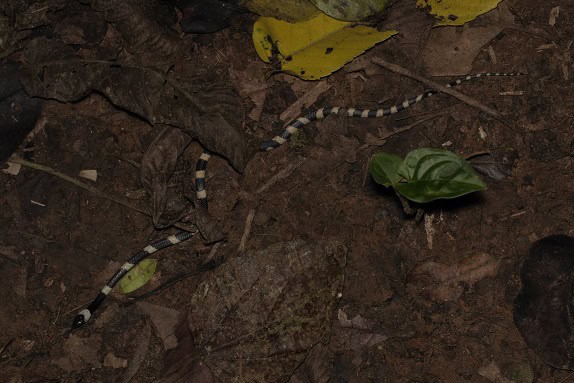
The forest flame snake possesses a mild venom, injected through its rear fangs, which must be manually chewed into the victim rather than rapidly injected. Though a few rear-fanged snakes have the ability to hurt humans, e.g. the western hognose snake of the US (which can swell a hand painfully), no bite symptoms have ever been reported in humans from this species.
Instead, the forest flame snake relies on a mixture of smaller, but equally effective survival techniques. The first is rapid flight. Forest flame snakes can vanish into rainforest undergrowth in a split second when threatened. Their Latin name references this, as Oxyrhopus contains a mixture of Oxy for flight and rhops for bush, referencing both their style of escape and their destination. Petolarius, meanwhile, references the Japanese deity of petola, who wore a pretty cloak, and hid in obscure areas of the forest where few could find her.
A rarer technique of the forest flame snake is kinking its neck like a viper, as though preparing to strike. This was only observed for the first time in September 2020.
| 10 | More survival skills |
The study above also observed a second forest flame snake, which had a few tricks of its own. The location was Caquetá department, Colombia, in the foothills of the Amazon rainforest, at an altitude of 349 metres. When the forest flame snake noticed the approaching scientists, its first move was to coil up tightly into a ball. Its head was contained in the centre of this serpent sphere, shielding it from attack.
Worldwide, this is common in the ball python of central Africa and rubber boa of the USA. Next, the forest flame snake began to fake death (thanatosis). It flipped over onto its back, and went limp as though completely lifeless, showing off the snowy white underside. It held this position for several minutes before raising its neck and beginning to flee.
Death-faking in the forest flame snake was also confirmed in 2020, in an observation made in Veraguas, Panama, at 110 metres in altitude. Researchers placed the snake in a grassy clearing and attempted to take its photo, at which point the snake tried to escape.
The scientists placed it back in the same position, but this time, the forest flame snake changed its strategy: it went completely limp, as though dead. It also flipped onto its back, as though all life had left its body. This lasted for 1 minute, at which point the forest flame snake flipped back over and attempted to flee again.
| 11 | Versus other members |
Finding the eggs of this species is a great challenge. Forest flame snakes don’t lay their eggs in specific hideouts like old birds’ nests or underground burrows, but amid random debris on the ground. Literally any patch of square 20cm on the forest floor could play host to this species’ eggs. Each clutch typically contains 2-15, with younglings hatching in around 3 months.
Being so widespread gives this species another record as well: being the most northerly of the 15 Oxyrhopus members. Another widespread species is the yellow-headed flame snake (Oxyrhopus occidentalis), which is found across the Amazon region, in Brazil, Ecuador and French Guiana, but with a more forest-restricted habitat, and almost no presence in Central America (eastern Panama only). This species is clearly different from the forest flame snake as an adult, as it has a yellow face, versus the mostly black face for the latter (occasionally with a white chin).
The most southerly Oxyrhopus member, meanwhile, is the Amazon false coral snake (Oxyrhopus rhombifer). This species appears in southern Brazil, Paraguay, Uruguay, and plunges deep into central Argentina.