
| 1 | European catsnake |
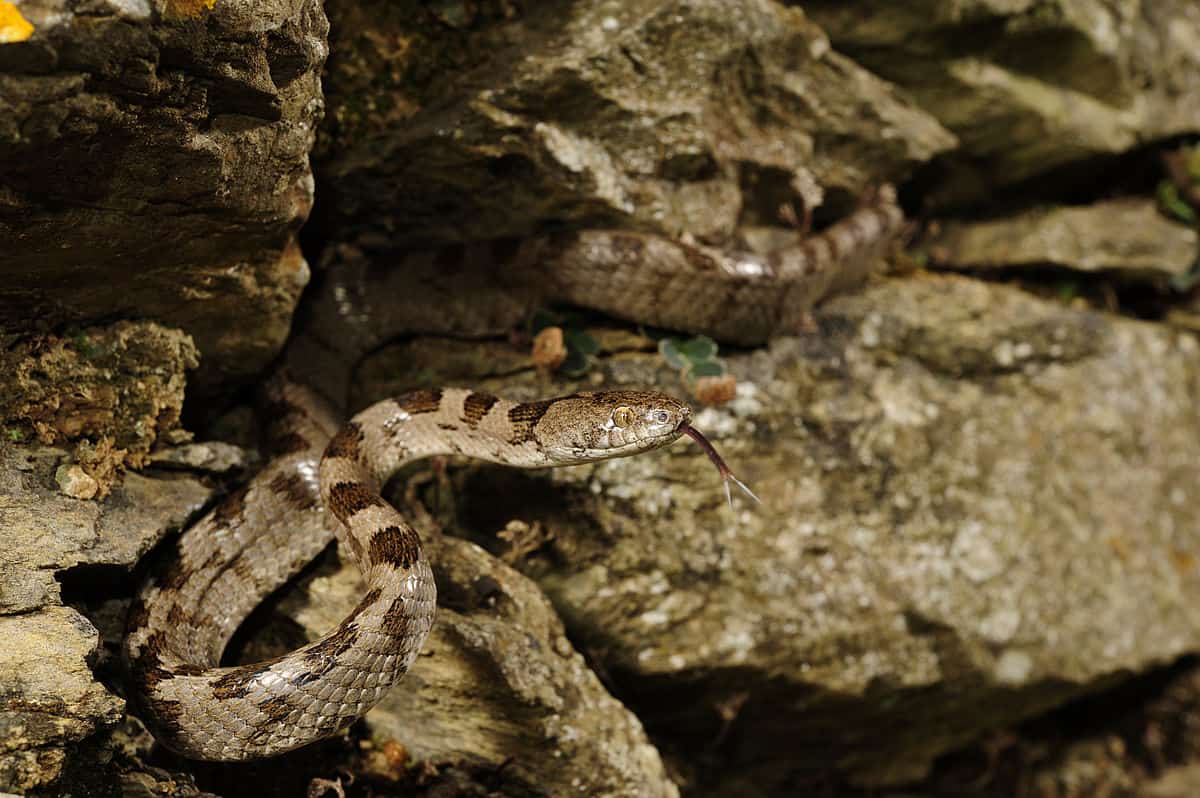
Maximum length: 130cm.
A mildly venomous species which is abundant all over southeast Europe, reaching as far as northern Iran. European catsnakes begin their territory in the extreme northeast of Italy (Trieste), and cover most of the Balkans. Their real heartlands are Greece and Turkey, where they’re most commonly found on dry, rocky slopes. In rocky canyons, they can swell to huge numbers in certain spots.
European catsnakes avoid excessive temperatures and prefer to take shelter by day. With their vertical pupils, they’re a classic nocturnal species. They make a strange whistling sound when cornered, which could emanate from a dark rock crack, leaving you completely confused (maybe terrified).
European catsnakes prey on reptiles such as wall lizards, and their colours are optimised for blending with rocks. Their grey blends perfectly with boulders and rubble, while the dark patches help to break up the vision of predators, matching the roughness of the terrain below.
Their patterns have a second purpose as well: mimicking the deadly nose-horned viper. This lethal species also inhabits rocky slopes in Greece, and the main difference is that in European catsnakes, the dark botches are separated, rather than one continuous zigzag. European catsnakes aren’t deadly, but if you bump into one on a rocky hillside, an actual villain might be nearby.
| 2 | Black-tailed rattlesnake |
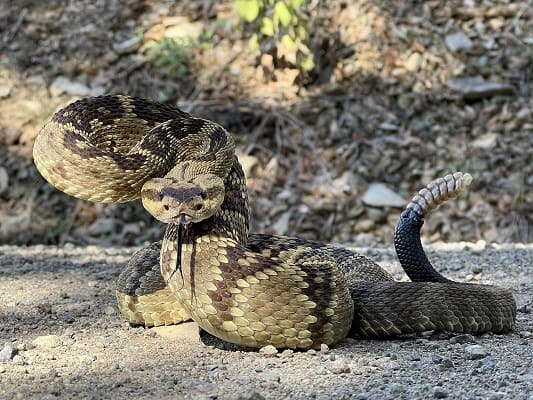
Maximum length: 152.4cm.
A species with a moderately deadly venom, including powerful haemorrhagic and cytotoxic powers in rats. Black-tailed rattlesnakes can rupture capillaries in the brain by dissolving laminin and type 4 collagen, yet they have zero confirmed human deaths to their name. This rattlesnake is found in Arizona and New Mexico, where rocky desert slopes are easily its favourite habitat.
For example, a 1995 study compared this species to tiger rattlesnakes and western diamondback rattlesnakes in the dry foothills of Tucson, Arizona. The former preferred rocky slopes and desert flats, the latter desert flats with plenty of creseote bushes.
Black-tailed rattlesnakes, meanwhile, easily had the strongest correlation with rocky slopes. 20% of western diamondback sightings were on rocky slopes, compared to 65% for the local black-tailed rattlesnakes. A separate study from Tonto National Monument found that they preferred especially steep rocky slopes. They use these both as hibernation sites and more casual resting places.
This species is is easily recognisable by its namesake black tail, which only ceases at the musical rattle segments. This is a relatively non-aggressive species, sometimes allowing humans to walk past without hissing or rattling. The one advantage of haunting rocky slopes (perhaps with hiking trails through them) is that black-tailed rattlesnakes rarely appear near buildings.
| 3 | Chihuahuan hook-nosed snake |
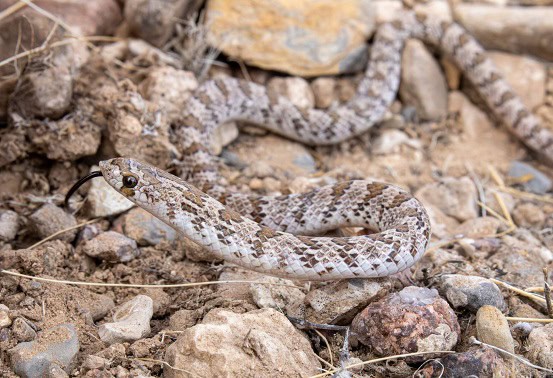
Maximum length: 38.4cm.
Rattlesnakes prowl the dusty deserts of the southern USA, that’s undeniable, but if you’re lucky, you may bump into a far friendlier creature: the Chihuahuan hooknose snake (Gyalopion canum). This species has a modified snout which allows it to burrow effortlessly into soft desert sands. While not the most widespread US species, it’s extremely common in southwest Texas, and also appears in New Mexico and southeast Arizona.
Enter a rocky desert slope in Big Bend National Park, and there’s a strong chance that the Chihuahuan hooknose snake will be there. There’s a far smaller chance that you’ll actually meet one, as this species tends to lurk under large rocks for long periods, with no interest in greeting humans. Its goal is to shelter from the beating sun, as well as overhead predators, which can exploit the lack of trees to see snake prey much more easily.
Chihuahuan hooknose snakes are also found in sandy environments, where they can easily dig using their spade-shaped snout. Most of their diet consists of a food source which the local gopher snakes or rattlesnakes ignore: spiders and centipedes. This species usually moves at a steady pace, but can explode into action for short bursts.
| 4 | Caspian cobra |
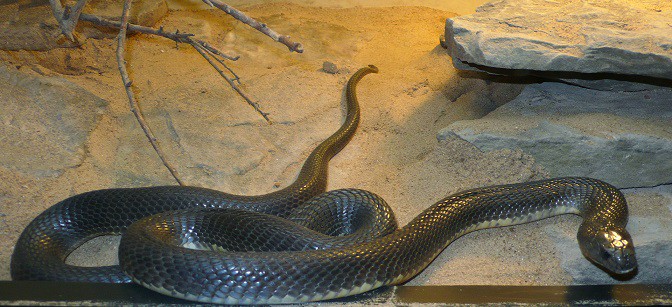
Maximum length: 175cm.
If you’re in Afghanistan and see a cloud of dust speeding down a rocky hillside, slowly gathering pace, then there’s only one explanation: the Caspian cobra. This infamously deadly cobra inhabits the dry regions of Pakistan, Afghanistan and northwest India. Cape cobras can appear in dusty villages and outside livestock fields, but are particularly common in remote canyons and arid hillsides strewn with boulders and rocks.
Caspian cobras (Naja oxiana) are fast-moving, and reach up to 175cm. Their venom may be the deadliest of any cobra, with the one redeeming feature being that they cannot spit. Their venom contains potent neurotoxins which trigger respiratory failure and progressive muscular paralysis, and even a toxin called Ribonuclease V1 that shreds RNA.
Cobras around the world have different habitats, as the cape cobra inhabits dry savannah and the Chinese cobra humid villages. The Caspian cobra might be the species most associated with rocky slopes, alongside the zebra spitting cobra of Namibia.
The only time Caspian cobras get shy is when taking shelter from the burning heat in mammal burrows. Otherwise, they slither down rocky slopes in full view of everyone, with zero concern about human beings watching them.
| 5 | Ring-headed dwarf snake |

Maximum length: 70cm.
This shy species could be lurking in almost any rock field in Turkey, completely out of sight. The ring-headed dwarf snake (Eirenis modestus) is about as harmless and non-threatening as snakes get. It has no way to hurt a human being, nor a predatory bird or pet dog. It seems well aware of its own weakness, as the ring-headed dwarf snake not only lives on rocky slopes, but spends virtually all day hiding under rocks, in a combination of seeking shelter and avoiding predators.
Ring-headed dwarf snakes are common, but hard to find. According to scientists, the most reliable way to find one is to walk around lifting up as many rocks as you can, hoping to flush them out. This species is about as thin as a pencil, and darts away rapidly when exposed. Its beige body and lack of any bright colours helps it to blend with its chosen rocky landscapes.
Ring-headed swarf snakes reach the far west of Turkey, and as far east as northern Iraq. Their diet includes beetles, locusts and crickets.
| 6 | Many-horned adder |

Maximum length: 75cm.
This venomous species not only lives on arid, rocky slopes, but seems to be transforming into a rock. The many-horned adder (Bitis cornuta) is a short African species measuring just 30-50cm on average. It’s instantly recognisable by its jagged horns, which aren’t singular, but spiral outwards in many prongs.
This species only has a moderately toxic venom, and bites are extremely rare, mainly because it lives in such remote areas. Rather than forests, many-horned adders are found in exclusively dry landscapes, in a narrow slice of southern Namibia and western South Africa. They don’t quite inhabit sand deserts, but areas one rung below in dryness.
If you meet a many-horned adder, then you’re probably in serious danger anyway, perhaps stumbling through a rocky desert in search of water, wondering when your guide will return. Many-horned adders blend superbly with both sandy soils and rock slabs, as their camouflage is positioned carefully to be just invisible in both.
Many-horned adders are nocturnal, with vertical pupils, and often coil up close to the shelter of large rocks, making them even harder to notice. This rock field snake won’t chase you down, but it will bite if you stray too close.
| 7 | Spotted whipsnake |
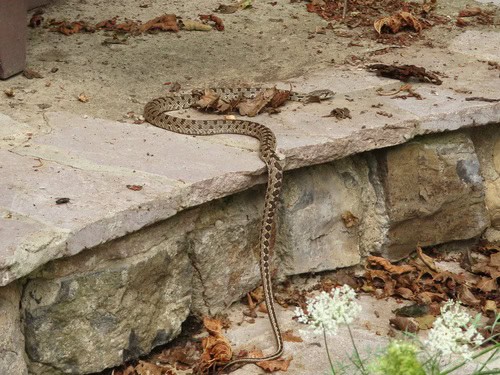
Maximum length: 150cm.
A 100cm species of eastern Turkey. This is a snake which would have watched on as Roman legions marched past 2000 years ago, trying to regain control of Armenia yet again. It would have witnessed the armies of the Ottoman empire and Persians as they dueled for supremacy, from its comfortable hillside perch. Millenia later, civilisations have come and gone, but the spotted whipsnake is still there, patrolling the rugged steppe and dry rocky hills of Turkey and Iran.
This is a fast-moving species which moves effortlessly over rocks, and also moves effortlessly into rocks when it needs to shelter. Spotted whipsnakes feed on reptiles such as toad-headed agamas, and are rarely found near towns, perhaps near remote villages. While no fatalities are known, their venom can cause swelling within 15 minutes, lasting up to 72 hours.
Spotted whipsnakes are allergic to thick forests, and much prefer rocky hillside slopes, even if there’s a chance they could dislodge a stone and trigger a calamitous rock slide which crushes them. They’re rarely found at below 1200 metres, and appear at up to 3600 metres in mountainous areas, making them one of Eurasia’s higher altitude species.
This species is recognisable by dark messy blotches which converge into orderly stripes on the tail. Unlike Eirenis modestus, the spotted whipsnake usually slithers openly through rocky plains, not bothering to hide under rocks.
| 8 | Durango mountain kingsnake |
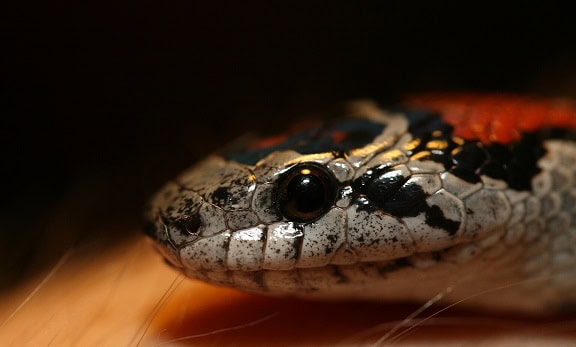
Maximum length: 115.6cm.
The California kingsnake is a common neighbour of people in the southwestern US, and sometimes flops down beside swimming pools. The Durango mountain kingsnake is the exact opposite, appearing on remote slopes in central Mexico, under a starry sky, far from humanity. This is a rare kingsnake, and a difficult one to find, as it loves to vanish into dark crevices when the weather gets too warm. This snake lives far from any major city, in its namesake Durango mountains.
Durango mountain kingsnakes (Lampropeltis greeri) would have excellent views to enjoy, if they cared to look at them. To find this species, you have to venture off the beaten track, by parking your car and climbing over boulders for 4 hours. Even then, there’s no guarantee they’ll come out to say hello.
Durango mountain kingsnakes (Lampropeltis greeri) inhabit rocky slopes, and especially rocky slopes within oak woodlands. They can sometimes be found basking on rock slabs, and their diet includes Sceloporus spiny lizards, which are probably gobbled up as they too seek warmth on rock slabs.
Despite their elusiveness, Durango mountain kingsnakes are especially easy to recognise if you do find them. They have an elegant silvery base overlaid with reddish blotches, each with a thick red outline. The chances that you’ll get to enjoy these startling patterns are very low.
| 9 | Rhombic skaapsteker |
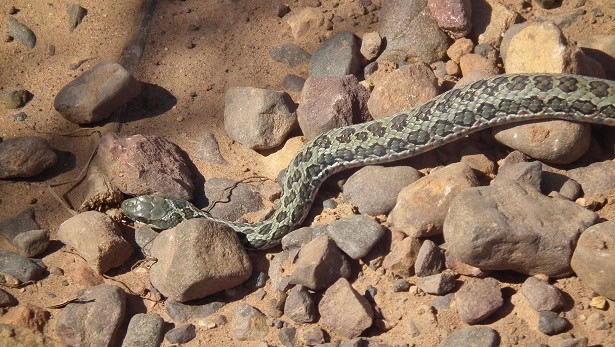
Maximum length: 150cm.
A South African species whose name translates to “sheep-stabber” in English. Whether this was based on an actual observation, we may never know, but this species is mostly harmless, and appears in a variety of habitats.
The rhombic skaapsteker can be found in grassland, savannahs, hilly slopes, arid semi-deserts and on crumbling rocky slopes alike. Its colours are grey-ish, enabling it to blend in with ease. Despite the merciless African sun, beating down on any creature that tries to eek out a living, the rhombic skaapsteker still moves by day. If spooked, it sometimes darts beneath a large rock for safety.
Rhombic skaapstekers are fast-moving, and their diet is just flexible as their habitats. They have a large amount of confirmed meals, including Angolan snake-eyed skinks, grey climbing mice and Angolan river frogs.
While rhombic skaapstekers aren’t reliant on rocky slopes like the European catsnake, they appear on them simply due to their flexibility, and ability to live almost anywhere. Rhombic skaapstekers are found in virtually all of South Africa, as well southwest Namibia.
| 10 | Saw-scaled viper |
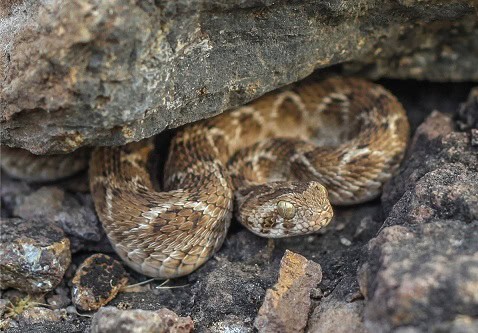
Maximum length: usually 50cm (occasionally 80cm).
In 2021, a British stonemason had ordered a shipment of rocks from India. When he opened the crate, he was greeted by one of the world’s deadliest snakes – the saw-scaled viper (Echis carinatus).
Saw-scaled vipers are severely dangerous, causing the 2nd most annual snakebites in India after the Russell’s viper. The initial symptoms include balloon-like swelling, which rapidly progresses to uncontrollable bleeding and kidney failure. Rather than than crop fields and rice paddies, this species favours drier areas, such as semi-deserts and rocky slopes. Its camouflage is optimised to blend with a mixture of sand and rocks.
By day, saw-scaled vipers hide in underground mammal burrows. By night, they hunt for scorpions and short-fingered geckos on their dry rocky terrains. When people stray too close, they grind their scales together to make a unique sawing noise (hence the name).
Saw-scaled vipers cannot even move properly on grass, they’re so adapted to rocks. They’re also found below piles of coconut husks, particularly in the dry northern half of Sri Lanka. This deadly species can be almost impossible to spot on a dry rocky slope – hence how one was scooped up and transported thousands of miles overseas to Britain (the snake thankfully survived).
| 11 | Ground snake |

Maximum length: 48.3cm.
A widespread non-venomous snake found in Nevada, Arizona, California and parts of Mexico. This harmless species measures 25-45cm, and appears on dry hillsides, arid shrubland and rocky slopes by long interstate highways. This is a likely snake to peer down at you from above as your car whooshes past on the way to Las Vegas.
Unlike the many-horned adder, this species has relatively weak camouflage on rocky slopes. The reason – the ground snake is one of the USA’s most variable snakes in colour. This snake has red-black morphs, black-white, pink-yellow, greyish, and more.
The amount of morphs then quadruples, as each color combo can have its own patterns: a vertically striped, banded, spotted, or non-patterned version. While the black and white form would blend decently, most ground snakes are very bright, even neon.
Ground snakes (Sonora semiannulata) mainly prey on scorpions, spiders and centipedes. They have several confirmed predators, as this image from Arizona shows one in the clutches of a hairy tarantula. Yet somehow, ground snakes remain extremely widespread. They must have a secret that keeps them safe in their rocky slopes, perhaps a supreme instinct for entering dark crevices, or piles of loose pebbles they can bury themselves under.
| 12 | Gopher snake |
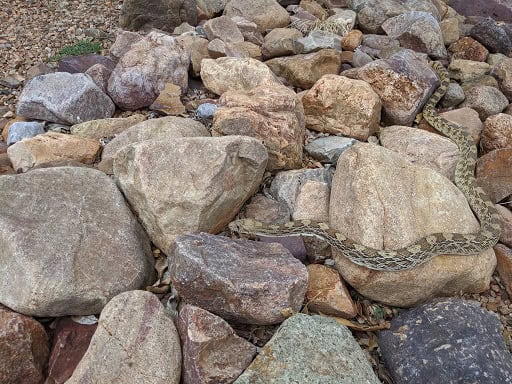
Maximum length: 266.7cm.
The gopher snake is an extremely flexible species of the western US, which only tends to avoid thick forests and true deserts. Any relatively open area is a potential habitat for the gopher snake – grasslands, farmlands, woodlands, parks, and definitely rocky slopes.
Gopher snakes don’t just pass through crumbling, rocky slopes, but exploit them. They often lay their eggs in dark gaps in talus slopes. Their hibernation sites include deep cracks at the bases of cliffs. The image above was taken in the extreme south of Arizona, in Cochise County, near the Mexican border. The subspecies is a Sonoran gopher snake (Pituophis catenifer affinis), which ranges from northern Mexico to Arizona and Texas, and consequently inhabits dry rocky slopes more than other subspecies.
Gopher snakes roam far and wide, and mainly prey on mammals, invading their underground burrows and pinning them to walls. If the tantalising scent of a pocket gopher burrow lures them over a hillside, towards a crumbling rocky slope, then they won’t retreat. They’ll simply continue on their path unthinkingly.
Their main threat in rock fields is overhead birds, which can see very clearly with the lack of trees. Gopher snakes are particularly popular prey for the red-tailed hawk (Buteo jamaicensis).
The gopher snake is the 4th most widespread snake of the USA. The most widespread is the common garter snake, which would never appear in such dry, rocky habitats, while the black racer has a slim chance, but far less than the gopher snake.
| 13 | Night snake |
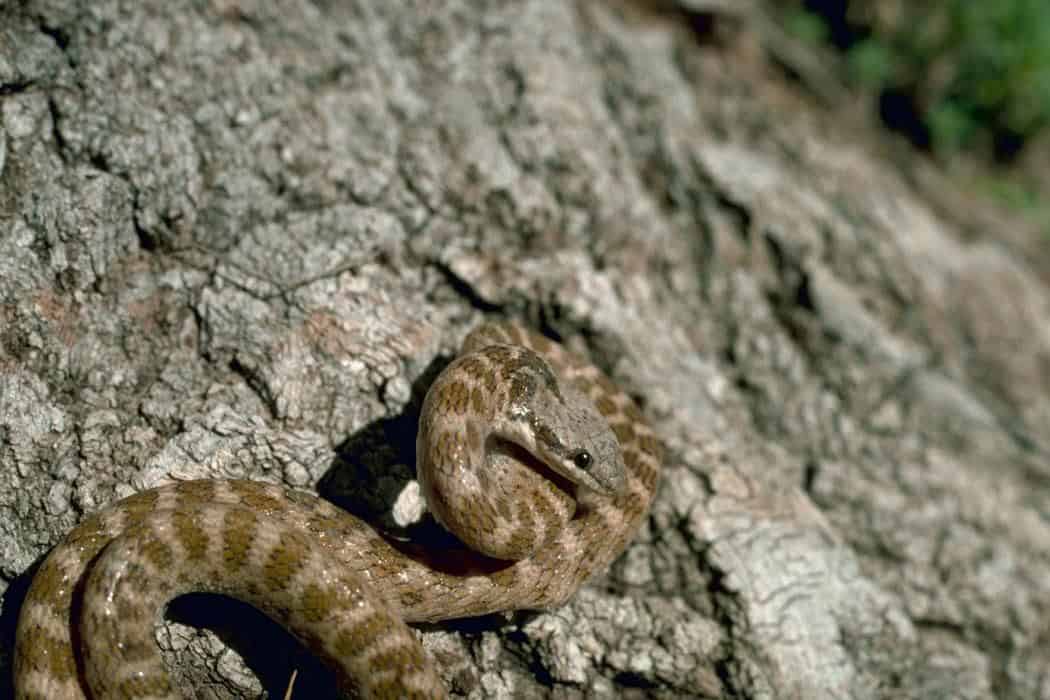
Maximum length: 64.2cm.
The night snake can spend its entire life in rock fields, slithering through an ever-shifting maze, and lurking in dark cracks in order to ambush lizards. This species is native to America’s Midwest, and mainly appears in dry rocky areas, never in people’s backgardens.
Night snakes are common in absolute wilderness, and can be found in cracks in completely random rocks. Finding one is an epic challenge, even if you extract the exact coordinates from a photographer who’s seen one.
Even if you stagger to their rock fields, and see absolutely nothing, it’s likely that a night snake is lurking just out of sight in a dark crack. It could be mere metres away, yet completely invisible. A gang of night snakes might be able to see you, but not you them, and that’s their preference.
This species has a mild venom, preys on lizards, and has especially sharp eyesight. It consumes no mammals whatsoever, and local reptiles such as Texas banded geckos have evolved to recognise its scent. Night snakes have vertical pupils, and reach as far north as British Columbia and as far south as Central Mexico.