
| 1 | 45 rattlers beneath one house |
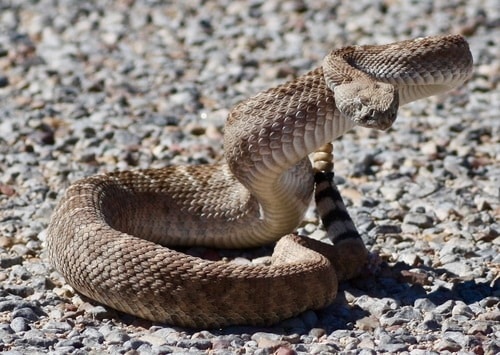
Abilene, Texas. It’s a town slap bang in the heart of western diamondback rattlesnake country, and few can live there for long without meeting them. The rattlers might be most common on hiking trails, but if you think your comfortable home is exempt, then think again.
This was exemplified by a case in 2019, when the owner attempted to fix a cable or TV issue underneath his house. He found a “few snakes”, and summoned a reptile handler to remove them. What followed was like a twisted treasure hunt, when you find one Roman coin, followed by one more, and just one more for an entire hour, until you suddenly have a whole handful. The big difference was that these were rattlesnakes instead.
The handlers spent hours working under the man’s house, eventually posting an 18 minute video of their handiwork on Facebook. They eventually found that 45 rattlesnakes were living on the man’s property, without him knowing.
The beige-black diamond patterns, combined with a sharply contrasting black and white tail, revealed that they were western diamondbacks. The house wasn’t an overgrown shack, or old and dilapidated like in the Texas Chainsaw Massacre; the company arrived to a neat house and a well-kept yard.
Removing the rattlesnakes was a tough challenge, due to the cramped space below the house. According to the company: “rattlesnakes don’t care how nice your house is or what kind car you drive – they care simply about survival“. Some of the rattlers reacted to being bothered by slithering away, but others bared their fangs aggressively.
| 2 | The three-eyed baby python |
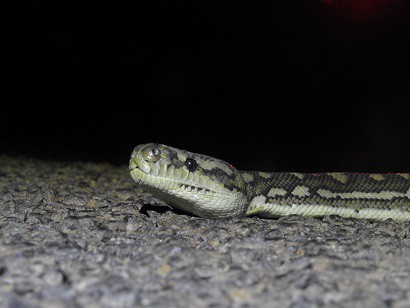
Two-headed snakes are fairly common in the snake world, but three-eyed snakes aren’t, and that’s what the Australian authorities found by a road in March 2019.
By a highway in northern Australia, they found a “peculiar” baby carpet python: two eyes in a relatively normal spot, but a third, angled eye on the human equivalent of the forehead. It was judged to be a natural mutation (thankfully not a radiation-fueled mutation) and was found near the town of Humpty Doo, 25 miles southeast of Darwin.
The species was a carpet python, a medium sized python which easily reaches 2 metres, though fails to match the 4.5 metre scrub python further north. Carpet pythons are skillful at climbing houses, and regularly live amid humans in towns and villages, without either harming each other. This 3-eyed carpet python was just a baby, and measured 40cm. It had apparently been struggling to eat due to its unusual face.
X-ray scans revealed that the snake’s head wasn’t two fused together, as sometimes occurs. The baby python had one skull with an additional eye socket, and three functioning eyes. How much light the snake was actually able to receive was a mystery. The snake was nicknamed Monty Python, but was sadly unable to survive into adulthood, and died in May 2019.
| 3 | Tourists stranded on snake island (Thailand) |
This story is a lesson in keeping your wits about you in bustling tourist areas of exotic countries. Emily Ince and a group of 17 fellow teenagers were holidaying in the Hua Hin beach resort of Thailand. On the beach, they encountered 3 men, who offered to take them for a snorkeling trip.
The group quickly agreed, and after coughing up $26, they jumped into the mens’ speedboat. Eventually, they reached an island. The boat stopped 30 feet away, and the men ordered the holidaymakers to swim to the shore.
When they crawled ashore, they found that the island was filled with snakes and jellyfish. The three men chucked them all a snorkel mask, which seemed to be from a discount shore, told them to watch out for the snakes, and blasted away in their speedboats.
The teenagers had been abandoned on the island. One was rapidly stung by a jellyfish, and they spent three hours without food or water, on an island apparently infamous for its snakes. They had clearly been tricked, and their future on Earth looked non-existent.
Eventually, they managed to signal to a fisherman, and a rescue effort began. The teenagers escaped the snake island, although they failed to get a refund from the 3 scam artists.
| 4 | King cobra lures man into sewers? |
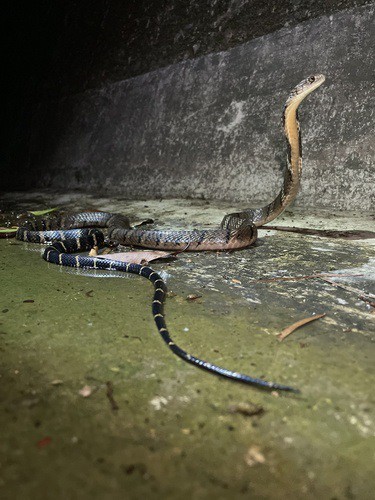
It’s long been rumored that alligators swim in New York’s sewers, and reticulated pythons are confirmed to swim around Singapore’s underground pipe networks. In 2019, snake handlers in southern Thailand fought a desperate battle with a king cobra which attempted to use the sewers as a refuge.
The snake measured 4 metres, and wranglers pulled it free several times, only for the king cobra to slither back in. It began in a housing estate in the southern province of Krabi, which was apparently once pure jungle. 7 snake handlers arrived, and footage showed one of them chasing the king cobra into a dark drain.
The king cobra is the world’s longest venomous snake, beating the black mamba into second, and delivers a correspondingly gargantuan quantity of venom. At one point, the handler was gripping the cobra by the tail, until it wriggled itself free and vanished again. He then huddled over and followed the snake into the tunnel. Luckily, this brought his head closer to the ground, allowing him to seize the cobra’s neck in one hand and tail in the other, lowering its maneuverability and ability to bite simultaneously.
The king cobra weighed 33 pounds, and was later released into the wild. It’s lucky that the handler seized the cobra so early in the sewer system – who knows what grisly fate would have befallen him had he entered the darkest, deepest tunnels. He may have stumbled across a secret underground colony of the largest snakes on Earth.
| 5 | Anaconda successfully crosses a road |
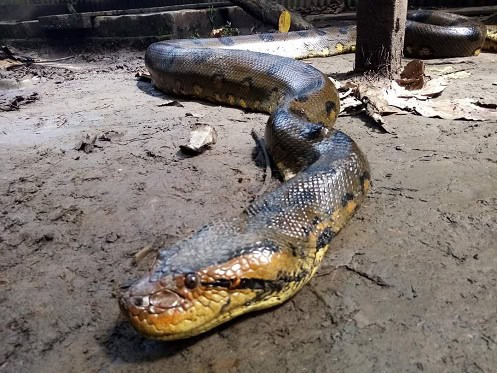
One video that went viral in 2019 was of a green anaconda blocking a busy road in Brazil. The anaconda begins the video in the first lane, with no thought for traffic whatsoever. The huge snake is slithering steadily forward, moving patiently, with no concern for the speeding cars and lorries that could easily end its life.
Several people record on their phones, while others watch in amazement. The green anaconda effortlessly climbs the concrete wall dividing the lanes of the highway, as though completely used to human obstacles.
At one point, the anaconda changes direction, and a car reverses with a slight note of panic. A couple of cars just manage to squeeze past in time. The whole time, the anaconda is guarded by several watchful protectors, who stand in the road to make sure that oncoming traffic doesn’t run it over (roadkill is an unfortunately common fate for snakes).
If you want to learn how anacondas move, then this is the best available video on the internet. It shows how anacondas bunch up their midsection into a couple of S shapes, by retracting their lower body, then thrust their upper body forward, suck in their lower body again, and repeat. People even got out of their cars to watch the spectacle unfold.
Miraculously, the video had a happy ending, as the green anaconda made it across the highway, and vanished into overgrown grass on the opposite side. As the video ends, just its tail is still visible.
| 6 | New species discovered in a stomach |
As usual, there were several new snake species discovered in 2019, but one of the strangest was found in the stomach of another snake. Even more unusually, it was only declared 40 years after its first discovery.
Cenaspis aenigma was named after the Latin words for “mysterious dinner” and was found in a coral snake’s stomach in the Mexican highlands in 1976. Instantly, the scientists thought it was a new species. Yet they hesitated until 2019, as they only had one specimen, and only a partially digested one. Scientist Campbell and his team searched the Mexican highlands for new individuals, but came up short, hinting that the snake had a very restricted geographic range.
Technology came to the rescue, as the scientists used computed X-ray tomography (CT) scans to analyse the original half-digested snake. They mapped its skull, organs and remaining skeletal structure. The truth was clear – this was a species never yet discovered. It was part of the huge Colubrid family, which includes cat snakes, gopher snakes, etc, but belonging to a unique genus. They deduced that Cenaspis aenigma was a burrowing snake, based on the shape of its skull, and relatively smooth scales, which burrowing snakes tend to have in order to prevent dirt from catching.
To this day, no live individuals of this dinner snake have been found. It’s still out there somewhere. Cenaspis aenigma is one of the remaining mysteries of the snake world. Who knows – it could be 100 years before another is found.
| 7 | The tuna and egg wars |
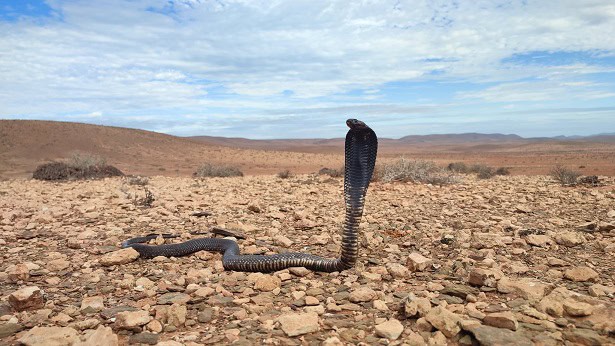
One wacky headline which somehow didn’t make much headway outside of Egypt was that the government was launching a war on venomous snakes using eggs and tuna. Snakes were causing chaos in the Nile Delta, with one victim being a farmer in Quesna, in Monufia Governorate, who died after being bitten while working in a field.
Therefore, Egypt’s agriculture, health, and environment ministries adopted the slogan “egg is the solution”. In coordination with the Ministry of Local Development, they purchased thousands of eggs and injected them with poison. These were placed in farmlands across the Nile Delta region.
Five thousand poisonous eggs were placed in the coastal Beheira Governorate alone. Snares were also used, and citizens were surprised to find eggs and tuna suddenly appearing everywhere.
The same tactics had been used in 2018, but to little success. One reptile expert doubted the methods; Dr Mohammed Ali said that snakes instinctively tended to stay away from poisonous objects. Also, only a limited number of species eat eggs preferentially, and few would eat a random pile of tuna. Egyptian cobras certainly don’t have a great love of eggs, and they’re the country’s main venomous species.
In any case, if you find a random egg and pile of tuna on your way to a pyramid while dismounting from your camel, don’t eat it.
| 8 | Sea snake super-adaptions |
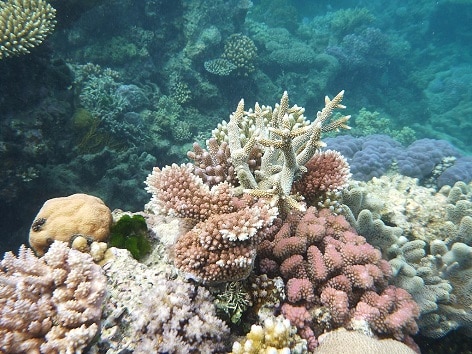
Sea snakes have many adaptions for surviving on the high seas, like drinking rainwater that collects in disks on the surface, and being able to hold their breath underwater for 2 hours.
A new discovery came in 2019, in the species Hydrophis cyanocinctus, AKA the annulated sea snake, which is found off the Australian coast. It found that the species has a high concentration of blood vessels positioned carefully on top of its head, which allow it to absorb oxygen from above, in the brief moments it surfaces from underwater.
These were widely dubbed snake “gills” by the media. The first indication was a strange hole in the species’ skull. This was reminiscent of the “pineal eye” found in some lizards which allows extra light absorption from above. So this was the scientists’ first thought, yet after buying live annulated sea snakes from a market in Vietnam, no evidence of a pineal eye was found.
Instead, they found that a large blood vessel ran through the hole. This soon branched into a complex network of veins and sinuses on the snake’s forehead and snout.
The blood vessels were highly exaggerated in size, and were unique in how they converged into a single large one connected to the brain. The conclusion was that this network was specially adapted to suck in oxygen from their environment, and redistribute it to the brain.
| 9 | Burmese pythons – the latest scheme |
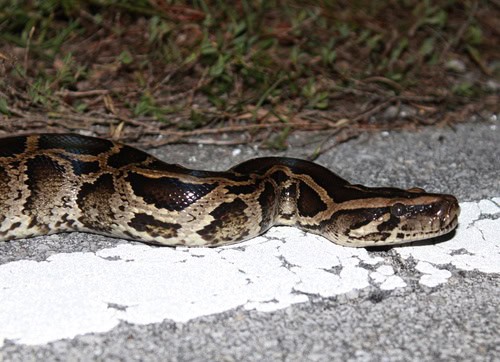
Invasive Burmese pythons were in full control of the Florida Everglades as of 2019, with at least 100,000 roaming the wilds, but that year, scientists invented a new eradication method so simple it was amazing nobody had thought of it before.
Like with many animals, male pythons are much more adventurous than females. While females aren’t lazy, covering hundreds of metres per year in their exploratory quests, males have the responsibility of sniffing out females using their pheromones, tracking them with their advanced olfactory system.
Therefore, in 2019, with Burmese pythons multiplying every year, scientists took a logical course of action, and decided to implant radiotransmitters into male pythons, in order to lead them to the females.
Combing the Everglades with a torch was failing, but this was surely foolproof. Their efforts paid off when a male led them to a 140 pound female python, whose bulging body contained 73 eggs.
This was the largest female python ever removed from Big Cypress National Preserve. It measured 5.2 metres, requiring 4 volunteers to hold it for a photograph. The problem with hunting Burmese pythons is their camouflage, combined with a tendency to stay stationary for hours, leading many people to walk right past their lurking places.
| 10 | Indian catsnake enters the UK |
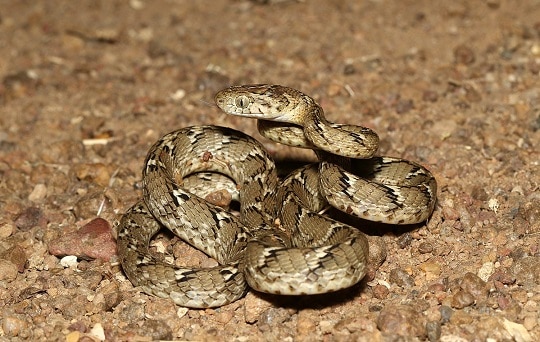
Snakes are able to survive absurd journeys, including eyelash vipers from Costa Rica which have ended up in banana aisles in German supermarkets. In 2019, a snake somehow survived travelling thousands of miles in the back of lorry travelling from India to the UK.
Staff at a freight company in Essex discovered the snake, and summoned the RSPCA, who said that it was probably an “Indian cat-eyed snake, or boiga, which is mildly venomous“. The species they’re referring to is Boiga trigonata, the Indian cat-eyed snake, which possesses venom but is incapable of killing humans, and is ubiquitous in India.
The snake was perfectly healthy, despite having travelled an estimated 4700 miles in the lorry. There was no access to food or water, and no temperature control, while driving across a huge stretch of Eurasia with all its climate fluctuations.
The snake was brought into the care of the RSPCA at its rescue centre in Brighton. It was planned to be rehomed later at a facility with the specialist knowledge to look after it properly.
Boiga catsnakes are excellent tree climbers, giving them plenty of opportunity to leap into a passing lorry, or fall into one accidentally while tight-roping across a branch to hunt a lizard. It’s equally possible that the catsnake took a nap in the lorry, seeing it as an equivalent to the rocky crevices they occasionally take shelter in.