
| 1 | The grass snake’s eastern cousin |
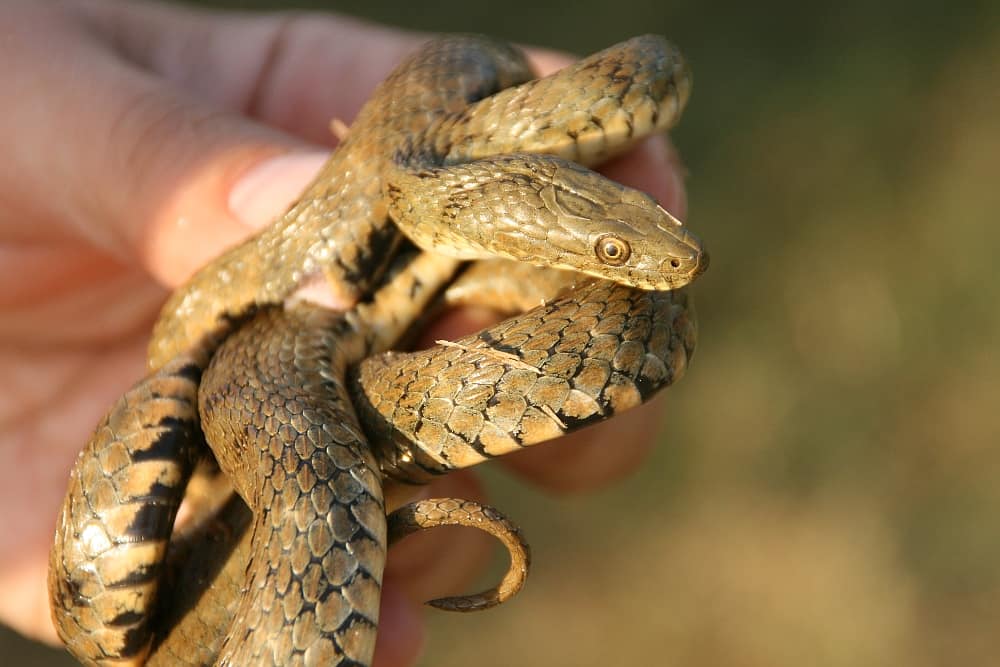
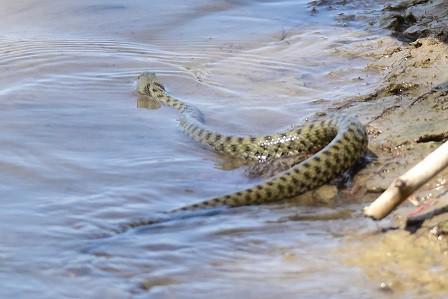
The dice snake (Natrix tessellata) is a semi-aquatic species of central and eastern Europe, which is usually found in large lakes or rivers. It’s a mildly venomous species, which has the power to envenomate and kill a fish, but poses little threat to humans. This species belongs to the same Natrix genus as the grass snake, Britain’s most common snake, but lives significantly further east overall.
The dice snake isn’t a famous species at all, as few people in the US or Australia have heard of it. Yet this is secretly one of the most widespread species of Eurasia, appearing in thousands of lakes and small streams.
The dice snake reaches as far west as central Germany, as well as Switzerland and northern Italy. To the south, it appears in Israel and even the Suez canal of Egypt. Its eastern ranges stretch to China, Turkmenistan and the wastelands of Kazakhstan.
Overall, the dice snake inhabits at least 41 countries, including hotter locations such as Iraq, Afghanistan, Iran, Jordan, Greece and Turkey. In certain lakes, this snake can reach vast numbers, swelling to thousands upon thousands of individuals. In some areas, this species overlaps with the grass snake, but the two have separate diets: dice snakes focus on fish, while grass snakes focus heavily on amphibians.
| 2 | Master of its lake domain |
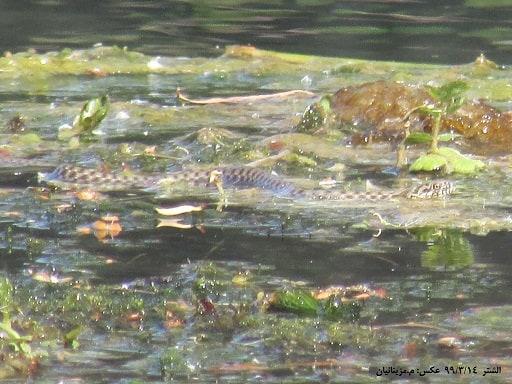
Unlike the grass snake, the dice snake performs nearly all of its hunting in the water, and 90% of its diet consists of fish overall. It often climbs branches overhanging water, and drops down when spooked, instantly diving into the depths in order to escape (like the brown watersnake of the southern US).
Dice snakes can remain submerged for hours at a time, surfacing only to take a 2 second breath. The time they do spend on land is usually for breeding, digesting food and shedding skin. One of their top locations is the Danube River, which flows through central and eastern Europe for 1770 miles.
Natrix tessellata isn’t completely aquatic, as it comes ashore to lay its eggs. Its favourite laying spots include the insides of rotting tree stumps, leaf litter or in damp soil, and a typical egg clutch contains 4-29. August-September is their usual month for hatching.
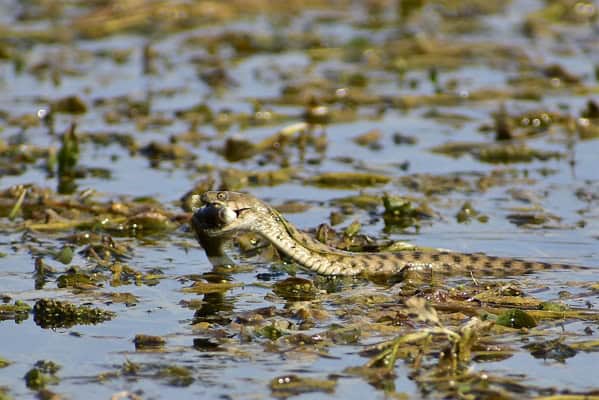
Dice snakes also come ashore to swallow particularly large fish, dragging their catch out of the stream while still in their jaws. This starves the fish of water, and ends the struggle far quicker.
| 3 | Variable colours |
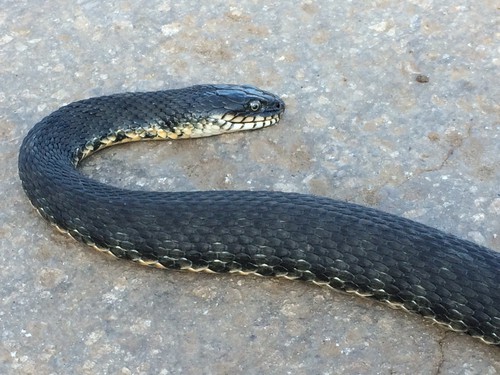
Dice snakes are well-adapted to their watery worlds, with immense diving and swimming skills, and another adaption involves their skull shape. Compared to the grass snake, this species has a narrower and more pointed head, decreasing water resistance and allowing it to motor forward effortlessly.
The grass snake already has the swimming skills of a speedboat, but the dice snake takes it a step further. This species has eyes and nostrils which are angled upwards, allowing it to breathe and analyse its surroundings while mostly submerged. The average length of the dice snake is 1-1.2 metres, with females being larger. The oldest individuals can exceed 1.3 metres.
Spotting a dice snake requires expertise, because its colour varies significantly. For example, those in the ancient ruins of Histria in Romania (one of its strongholds) are mainly olive-green, but dice snakes can also be blue-grey, greenish-grey, yellow-olive and reddish brown. Their belly colour also varies – whitish, yellowish, pinkish grey, and even bright red are all possibilities. Even black individuals are found sometimes, with a yellow belly.
| 4 | Wrestles but rarely bites |
You sit down one morning for a fishing session on the River Danube, and realise that you’re 1 metre away from a resting dice snake. What happens next? Firstly, dice snakes almost never attack – being bitten is a once in a blue moon level of rare.
When picked up, the dice snake normally thrashes and wrestles violently, in a valiant attempt to free itself, and releases a revolting and intolerable smell. It hisses loudly beforehand, and can widen its neck slightly in an intimidation display.
But an alternative strategy is playing dead. They do this less commonly than the grass snake, but dice snakes will often go completely limp in order to fool the aggressor. They’ll open their mouths lifelessly, and even fill their own mouths with blood. The larger the dice snake, the more likely it is to play dead – juveniles usually thrash instead.
For centuries, dice snakes were believed to have no venom, but like dozens of other snakes, they’ve been found recently to have a small Duvernoy’s gland. This backup venom pumper isn’t connected to the front fangs, but secretes a mild toxin into their saliva, which flows into the prey as they chew it (which takes many repeated chews to succeed). The venom is mostly neurotoxic, but no human being has ever fallen victim – it would be a fluke within a fluke.
| 5 | Snake Island, Ukraine – the origin story |
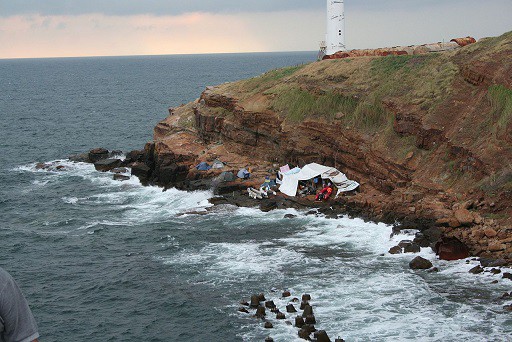
In February 2022, Russia launched a massive invasion of Ukraine, and one of the most heroic stories from the early days was Snake Island. As the hulking steel warship Moskva (which was sunk 2 months later) approached the island, demanding the soldiers’ surrender via loudspeaker, the Ukrainians simply told them to go away, except in far less polite terms.
Their resolve was immortalised in limited edition stamps, and in June 2022, the island was recaptured, with Ukrainians proclaiming victory and the Russians pretending that they’d withdrawn on purpose. Snake Island is an important strategical outpost in the Black Sea, but few asked the question: where did the name come from? The answer is that Snake Island is an ecological zone, swarming with one snake species in particular – the dice snake.
The island has not just a huge population, but a high amount of fully black melanistic snakes. The dice snakes here are theorised to be a subspecies (Natrix tessellata heinrothi) with minor scale differences, but scientists can’t make their minds up. Sadly, conservationists warned in 2011 that their numbers were dropping dramatically, 3 years after the island finally opened to tourists. Poachers were blamed.
| 6 | Capital: Histria ruins, Romania |
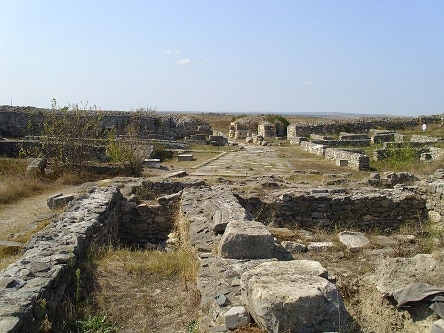
The dice snake is estimated to be the most populous snake in central Europe by headcount. In lakes with the perfect habitat, its numbers can swell to gigantic proportions, with thousands in a single water body, like a watery version of a crawling Egyptian tomb. Another of these hotspots lies in Histria, Romania. This is an outdoor archaeologist site, home to an ancient merchant town founded in 7th century BC.
Conquered by Romans, the town persisted until 700AD before it was abandoned. Then it was completely buried under sand and Earth, disappearing for centuries until excavations uncovered the first walls in the 20th century. Now it’s an open-air museum, and excavations continue during summer.
But in the winter, the ancient walls are home to hibernating snakes, including the Caspian whipsnake and grass snake. The dice snake far outstrips those two in population, and when awake, it spends its time in two lakes not far away.
The first is the shallow Lake Sinoa, 2 metres deep and lined with reeds. The second base is Lake Istria, which is connected to Sinoa by a channel starting 200 metres from the ruins. It sounds like a videogame level – a labyrinth of stone walls where snakes are around every corner.
| 7 | Hotspot 3 – Golem Grad |
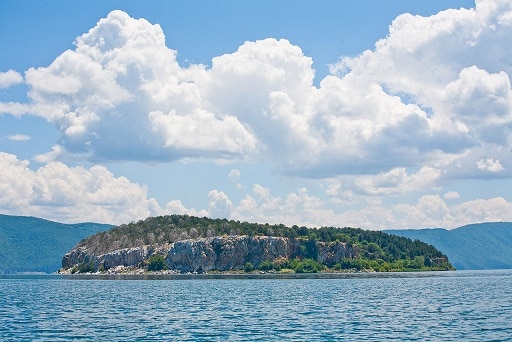
A second dice snake island can be found in Macedonia, called Golem Grad, located in Lake Pepsa. Macedonia is land-locked, and at 0.077 sq m, this is the country’s largest island. It’s covered with trees, pelicans, and rocks – and loads of dice snakes, plus a far smaller number of nose-horned vipers.
The dice snakes on Golem Grad peak during summer, when the rocks can be crawling with them. Tourists can sail over by boat, and its reputation as a snake pit often concerns them, not realising that the dice snakes are harmless.
Golem Grad translates to Big Fortress, and is also littered with ancient ruins. There’s 6 churches, including a still intact one devoted to St Peter, and another devoted to St. Demetrius. The oldest artefact may be a mosaic floor with Christian basilica dating back to 4th century AD. The snakes are believed by locals to guard the secret treasure of Tzar Samuel, who ruled Bulgaria from 997 to 1014 and waged war on Hungary.
Rather than being a uniform gene pool, the island has multiple colours of dice snake – spotted (58%), grey (29%) and black (13%). Over in Histria, they tend to be olive-green.
| 8 | A fish-eating snake |
The dice snake has the power to eat most food groups, but every molecule of its taste buds is attuned to eating fish, with a minor second course of frogs.
An Italian study examined 3 countryside streams, encompassing 1533 prey in total, and reached a verdict of 96.9% fish. A huge study covering multiple European countries found the following food groups: 80% fish, 10% amphibians, 2% mammals, 2% insects, 3% reptiles and 3% gastropods. The only contradictory survey came from central Turkey, where fish didn’t even reach 50%, because of hot summers drying out the water bodies.
The best study was conducted in a hilly area in central Italy, 60km northwest of Rome, in a stream known locally as Fosso Verginese. The stage was set: it was a zone where the dice snake and its cousin the grass snake lived side by side.
The first difference lay in habitat, as the grass snakes would often slither through the green fields, while the dice snakes stuck to the stream almost exclusively. As for their diet, the result was 97% fish consumed for the dice snake, but only 17% for male grass snakes (females reached 9%). The grass snakes ate 83% amphibians, particularly the common toad (Bufo bufo).
Three of the dice snake’s favourite fish species are the common bleak (Alburnus alburnus), common roach (Rutilus rutilus), and European chub (Squalius cephalus), which are all very common across Europe. Regardless of location, these fish always seem to pop up.
| 9 | Mindlessly grabs random fish |
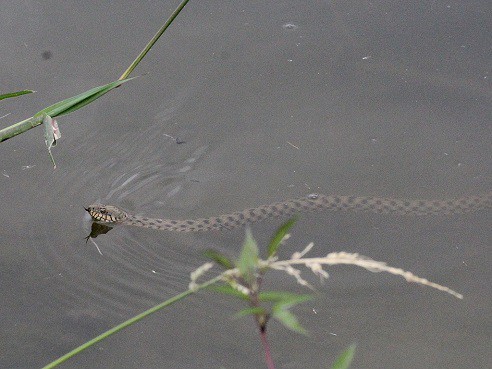
The dice snake has no power to coil itself around a fish and constrict, and its venom is weak and diluted and has to be forcibly chewed in. So it goes back to basics instead, and simply grabs its fish meal, rearranges it, and gulps it down alive. It accomplishes this with a sudden burst of speed, reaching 1 metre per second mid-charge, which is fast for an aquatic snake where water resistance is higher.
For dice snakes, the option of chemical hunting by flecking their tongue is closed off. Water makes picking up scent molecules extremely difficult, so the dice snake relies heavily on vision instead. The flicker of movement is what sets them off, as a dice snake can swim right past an immobile fish and fail to notice it.
Precisely how they hunt depends on whether they’ve eaten recently. A well-fed, luxurious dice snake will simply sit back and wait for a fish to swim by, but anything less, and the leaner, meaner snake will go on the prowl and hunt fish actively. The dice snake’s prowling speed while hunting is extremely low – just 0.1mps.
| 10 | The tricky part – rearranging |
One study observed 6 dice snakes captured in Romania. Fish-eating snakes generally swallow fish by the head, to prevent the fins from tearing their insides, and these dice snakes had a rate of 62% headfirst and 38% tail first. When they grabbed a fish by the head, they only took 14.61 seconds to swallow, from capture to finish. Grabbing and swallowing by the tail took just 18.49 seconds.
But when they grabbed the fish by the torso, it took 63.37 seconds to swallow it by the head, and 40.59 seconds by the tail. Rearranging from head to tail took 246.39 seconds, and vice versa was 201.19 seconds.
A dice snake’s ultimate plan is to go for the head, otherwise the slippery fish might wriggle free and escape, but doing so requires focus and ultra-precise timing. 13.25% of fish in the study managed to escape after capture.
That said, the dice snake was faster in every pathway than the false smooth snake of Spain (mildly venomous), which waits for its prey to die before swallowing, and sometimes take 70 minutes to fully ingest its meal.
| 11 | New colony discovered in Egypt |
Up close, dice snakes are easy to spot by their round, beady pupils. Round pupils aren’t uncommon whatsoever in snakes, but the dice snake’s are exceptionally round and even-looking, giving them a silly expression, not vicious whatsoever (an appearance that doesn’t lie for once). Like the grass snake, dice snakes have keeled scales, with each pointed at the end to remove all smoothness if you ever managed to stroke one
Even in the 21st century, new colonies of dice snakes are still being discovered. The species’ empire is so huge that we may be hundreds of years away from mapping it out completely.
In 2012, scientists discovered the dice snake in Port Said, on the Sinai Peninsula in Egypt. They spoke to farmers who were aware that the snake was harmless, but also local villagers who attacked them out of fear. The snakes had swum in through the freshwater Suez Canal, zooming along a secret passage to colonise an entire region.
Streams and rivers are the dice snake’s forte, and mountain streams are no exception: they’ve been spotted at 1800m in altitude in Italy, and 2800m in southeast Europe. Swimming up there must have taken centuries. Weird flukes continue to pop up, as in Iraqi Kurdistan, a 2-headed dice snake was discovered in 2021.