| 1 | Common death adder |
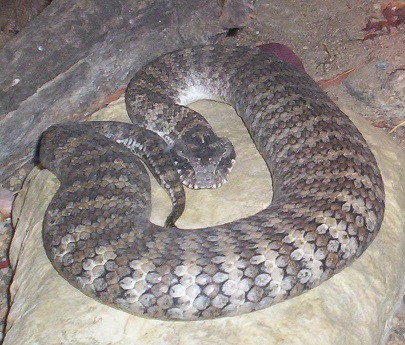
Maximum length: 100cm.
The thickest venomous snake in Australia by far. Like the eastern brown snake or yellow-faced whipsnake, the common death adder is an elapid, yet it dramatically outstrips those species for thickness. This species lives in woodlands and bushy thickets in eastern and southern Australia, and relies purely on ambush. Its body is incredibly thick, yet its murky grey and brown colours blend so effortlessly with the countryside that this adds nothing to its visibility.
Death adders never use constriction, although they more than possess the thickness for it. Instead, their massive body width is designed for knocking over their prey, in a massive rugby tackle, knocking a rabbit or mouse to the ground, knocking the breath out of their lungs, before finally sinking in their neurotoxic fangs. Death adders have a dangerously high venom yield, pumping out up to 270mg per bite.
That’s if they only have two fangs as well. In March 2025, the Australian Reptile Park of New South Wales announced that 7 years after its arrival, they had discovered a 3rd fang in the mouth of one of their resident death adders. This fang was more than capable of injecting neurotoxic venom, and the media dubbed the snake “the most dangerous death adder in the world“.
Fortunately, death adders rarely kill humans. Deaths have been recorded in 1901, 1930 and 1936, but none since the turn of the century.
| 2 | Blood python |
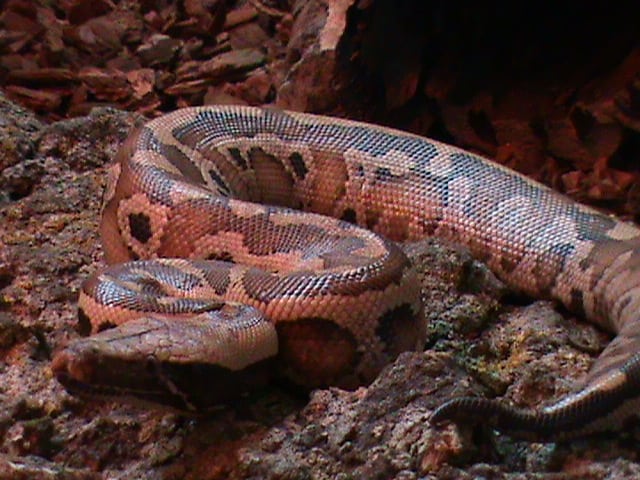
Maximum length: 2.6 metres.
The thickest constrictor in southeast Asia relative to its length. The blood python (Python brongersmai) inhabits Malaysia, Indonesia and southern Thailand, and is average in length for a python, with a wild record of 2.6 metres, versus the reticulated python’s 6.95 metres. Yet relative to its length, the blood python is a far thicker species.
The blood python is an expert constrictor, whose every sinew and fiber is designed for crushing small mammals. Yet its body is so crushingly thick that it might not need to – a single pounce might be enough to defeat its prey. A blood python can even cause a shocking thud in humans as it leaps against your legs.
Blood pythons have two hotspots in the wild. The first is swampy rainforests, where they rest along the overgrown swamp shores, doing absolutely nothing, except for one important thing – examining every single aspect of the surrounding forest.
Their second main location is a manmade one – palm oil plantations, which are a perfect manmade mimic of their natural locations. While the massive deforestation of Indonesia and Malaysia for palm oil has been largely detrimental to the environment, the blood python is one species to have coped well.
Places where you’ll never find a blood python include grassy fields, beaches and the suburbs of towns and cities. Unlike the reticulated python, blood pythons stay well away from inhabited areas, except the most remote villages.
| 3 | Gaboon adder |
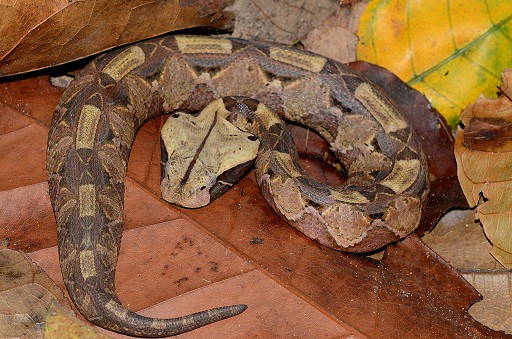
Maximum length: 175cm.
Africa is home to at least 600 snakes, and considering how poorly researched some areas are (e.g. the Congo Rainforest), we wouldn’t be surprised if there was over 1000 individual species. Of all those, the one snake that holds the most records is the gaboon adder.
This venomous viper has the longest fangs of any venomous snake, regularly exceeding 2 inches. Its camouflage is immense, blending effortlessly with leafy woodlands and coffee plantations. Finally, the gaboon adder is one of the most outrageously thick non-constrictors relative to its size in the world.
Like the death adder, and like its close African relative the puff adder, the gaboon adder (Bitis gabonica) is a thick tank of a snake, which waits patiently on the borders of forests for hours, even days. Its diet is believed to consist of nearly 100% mammals, including the likes of vlei rats and red velt rats. As an oblivious rat walks past, the gaboon adder will shift ever so slightly, to prevent its leaf-shaped scales from being recognised as fake leaves.
When the perfect moment presents itself, the gaboon adder will pounce, unleashing every ounce of its crushing bulk. The average mouse possesses little chance, unless it uses its nimble speed to dart out of the way (which often happens).
Gaboon adders are lethal, yet bite humans far less than their puff adder cousin. Deaths are confirmed, however, with one victim being a captive reptile keeper.
| 4 | Southern hognose snake |
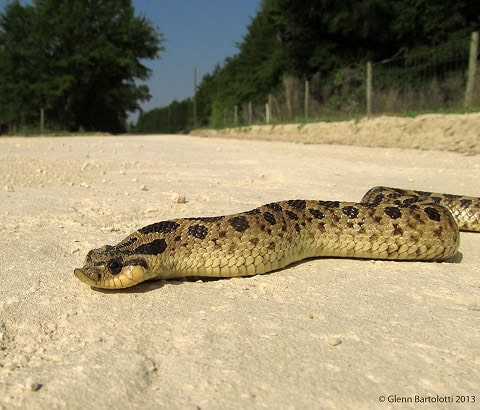
Maximum length: 61.0cm.
The southern hognose snake (Heterodon simus) is one of the rarest species of the USA, with less than 10,000 estimated to survive in the wild. This is the much rarer cousin of the eastern and western hognose snakes, and is mainly found in Florida, Georgia and the Carolinas.
Southern hognose snakes prefer a quiet life, well away from the hustle and bustle of humanity. They can’t stand suburbs with honking cars, and they definitely won’t appear in the greasy car park of a McDonald’s. Instead, you can find southern hognose snakes tucked away in peaceful longleaf pine forests and turkey oak woodlands. This species has a particular preference for loose, sandy soils, as these enable its strong burrowing skills. The southern hognose snake digs its own burrows, as well as occupying old mammal burrows.
This is a relatively short, yet thick-bodied species. The exact reason for this thickness is a mystery, as southern hognose snakes aren’t constrictors, preferring to subdue their prey with a mild venom. Southern hognose snakes prey on reptiles and amphibians, including the eastern spadefoot and brown forest skink.
Thankfully, this species is completely docile around humans, and no serious assaults have been reported. Southern hognose snakes might be thick, but if they launched at your leg, they’d still bounce off harmlessly.
| 5 | Green anaconda |
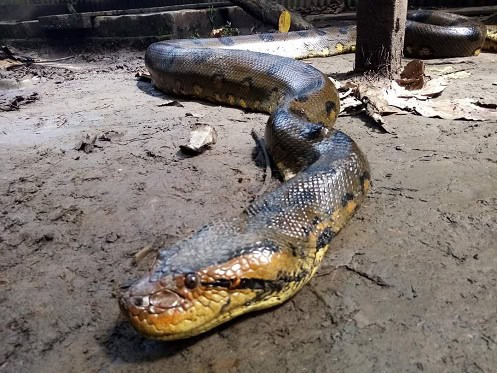
Maximum length: 5.21 metres (wild), 6.24m (captivity).
The reticulated python is the official longest snake species worldwide, with a maximum length of 6.95 metres (recorded on Borneo). Despite rumours of 11.5 metre monsters, the green anaconda ranks only 2nd or 3rd, with no officially confirmed wild records of over 6 metres.
Yet green anacondas still have two great advantages over their southeast Asian rival. Firstly, they have a movie named after them – Anaconda, released in 1997. Secondly, this species is significantly thicker than the reticulated python, and consequently, it ranks first when it comes to heaviest snakes worldwide, despite falling short for length.
Green anacondas are immensely powerful constrictors, exerting such force that they can squeeze a caiman to death, despite their crocodilian scales. They’re also confirmed to eat capybaras, white-tailed deer, wading birds, and whistling ducks, and they primarily hunt by lurking in shallow tributaries or marshes, leaping out when they notice prey walking past.
This infamously large species is found in a huge swathe of Amazonian Brazil, Venezuela, eastern Ecuador and Colombia. Green anacondas are extremely well disguised when lurking in shallow rivers or along shores, blending with the green reflections of the forests above. Yet out of the water, they’re far easier to notice.
The green anaconda is one of the more adventurous entrants on this list, as it’s commonly spotted crossing roads or weaving through villages. This usually happens after heavy rainfall, and when the green anaconda decides to go exploring, there’s no way that you can miss this thick brute of a snake.
| 6 | Bocourt’s watersnake |
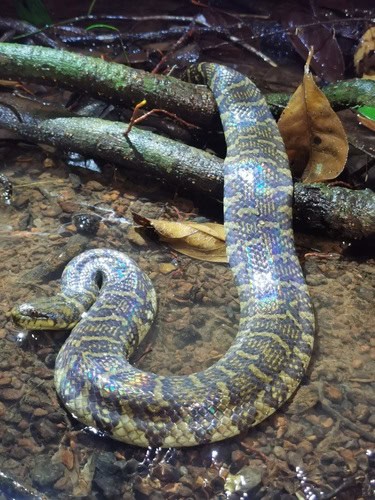
Maximum length: 110cm.
A unique snake, which is the sole member of the Subsessor genus worldwide. Bocourt’s mud snake (Subsessor bocourti) is related to various other water snakes in Thailand, yet has diverged far enough to occupy its own branch of the evolutionary tree. One of its unique characteristics is an especially thick body, as well as iridescent scales which glow under a bright light.
Bocourt’s watersnakes are found in Vietnam, Cambodia, Thailand, and just over the Thai border in Malaysia. They’re usually found resting on muddy river shores, patrolling for fish, their main prey. This species begins life as a more sharply contrasting black and yellow, but becomes duller with age, as the colours blend and blur together.
Bocourt’s mud snakes are undoubtedly thick and chunky. Yet like the blood python they occasionally coexist with, this doesn’t make spotting them any easier. Bocourt’s mud snake is an expert at covering itself in muck, absorbing into the wild shorelines it rests on.
Eagle eyes are required to spot this rare snake, although this doesn’t stop local fishermen. This species is part of a thriving trade in southeast Asia, with many villagers hunting and eating them as food. Others capture Bocourt’s watersnakes from rivers and sell them to large crocodile farms as feed.
This species preys mainly on fish. In one study, 5 fish were found in the stomach of one individual. As for its danger level, Bocourt’s mud snake has no detailed bite reports in humans, yet it has a larger venom gland than most other watersnakes in southeast Asia. Be cautious if you find this thick snake resting on a muddy riverbank.
| 7 | Eastern Russell’s viper |
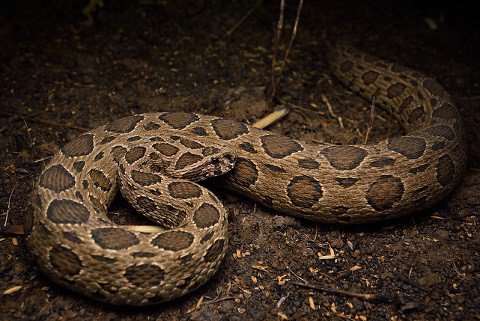
Maximum length: 127cm.
This massively thick species follows the path of the gaboon adder and death adder. It’s a non-constricting, yet horrendously venomous species, which relies on its camouflage to rest patiently in ambush posture, and springs out at small mammals with a massively powerful lunge when the time is right.
The eastern Russell’s viper (Daboia siamensis) is closely related to the Indian Russell’s viper, an immensely common and deadly species. The eastern form is much less common, and appears in Thailand, Cambodia, and southern China, as well as Java much further south. Its body is extremely thick, with a beige, orange or brown base colour. This is overlaid with rounded blotches, which each have a near black outline.
As the image above shows, this species has relatively clean patterns, rather than blurry and indistinct. Eastern Russell’s vipers often reach 1 metre, and combined with their thickness, these are all the ID signs you need.
Be wary of this snake – the Russell’s viper kills hundreds of Indians per year, and preliminary tests reveal that the eastern form is just as harsh on the kidneys as its cousin. Bite reports are rare, but this thick Thai viper seems to be one of the country’s most lethal, despite its low numbers.
| 8 | Arabian sand boa |
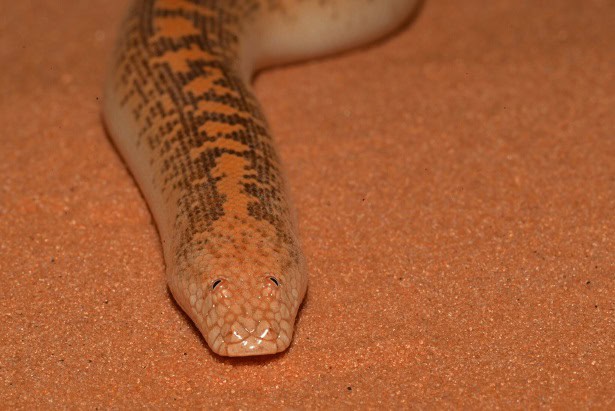
Maximum length: 40cm.
Constrictors are generally thicker than non-constrictors, that’s a consistent rule, yet there are some thin boas out there, particularly tree boas, which require a lighter weight in order to cross branches. The Eryx sand boa clan (13 members) is one which is generally thicker. This genus ranges from Nigeria to India, and has a strong tendency to dig in sandy soils.
The Arabian sand boa (Eryx jayakari) might be the best researched member of this thick-bodied group. With its stitched-on eyes and bizarre face, this is such a weird-looking snake that even supposedly impartial scientists were desperate to find out more.
It turns out that the Arabian sand boa has an unusual hunting style. Firstly, it digs deep into the soft sand dunes of Saudi Arabia, in the most isolated deserts imaginable. Secondly, it pokes just its eyes upwards – this is why its eyes look so odd, as they’re angled further up the head than usual. When a gerbil or sand gecko strays past, the Arabian sand boa leaps out and seizes its prey, shocking the small creature, which was only admiring the sunny desert views.
This non-venomous species lives all over the Arabian Peninsula, including Saudi Arabia, Oman, Kuwait and Qatar. Sightings are scarce over much of this deserted land, but only because humans are scarce.
One area where Arabian sand boas are sighted regularly is Dubai, and its bustling outskirts. On the iNaturalist map, this tourist city undoubtedly has the highest number of dots of anywhere. In 2019, diggers even unearthed an Arabian sand boa by accident while constructing the 2020 Dubai Expo.
| 9 | South American hognose snake |
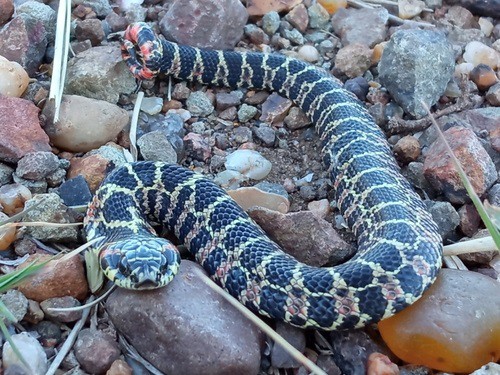
Maximum length: around 60cm.
The South American hognose snake (Xenodon dorbignyi) is a species of extreme southern Brazil, Argentina and Uruguay, which is most common in open grasslands. Like the southern hognose snake of the US, this is a thick-bodied snake, yet surprisingly, the two aren’t closely related.
The South American hognose snake is an example of convergent evolution: when two unrelated organisms develop surprisingly similar characteristics, due to occupying the same habitat niche, despite living halfway around the world from each other. Like its US hognose cousins, this species is also mildly venomous, also thick-bodied, and also has a specially modified snout which allows it to dig in soft soils. One of its strangest characteristics is a bright red tail which it flashes at birds, distracting them from its more valuable head.
South American hognose snakes prey on frogs and toads, and can also triangulate their heads to mimic a viper. They pose no threat to humans or large predators, which is why they’ve evolved so many other defensive strategies.
| 10 | Eastern diamondback rattlesnake |
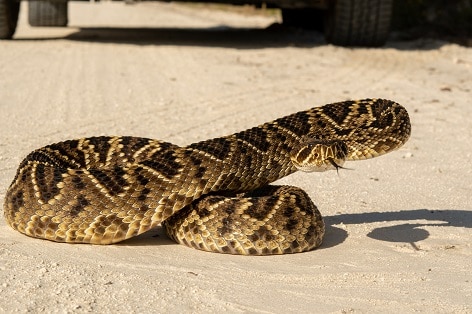
Maximum length: 251.5cm.
Length doesn’t necessarily equate to thickness in snakes. The black mamba exceeds 4 metres, yet is so thin that it must restrict itself to small meals, averaging at 5% of its own body weight. Meanwhile, the eastern diamondback rattlesnake combines length and thickness into one terrifying package.
This species inhabits Florida, Georgia, South Carolina and Alabama. It holds two records which its serpent rivals are greatly envious of. Firstly, it’s the longest rattlesnake worldwide, reaching a confirmed record of 251.5cm, versus the western diamondback’s 233.7cm.
Secondly, this is the heaviest snake in the USA. This is despite it not even being the longest US snake. The gopher snake outstrips the eastern diamondback for record length (266.7cm), yet the eastern diamondback packs more pounds, due to its thick body width.
Eastern diamondback rattlesnakes can look terrifying when blocking a road, as pictured above. They nearly always coil into the same strike posture when preparing to attack: a repeatedly coiled lower body, with a sharp kink at the neck, so that the face is directly pointing at the aggressor. Their bulky width only adds to the fear factor.
Like all rattlesnakes, this species never uses constriction, relying mainly on ambush tactics. Nobody can agree on precisely how aggressive the eastern diamondback rattlesnake is. The real answer might be an unpredictable personality.
| 11 | Dumeril’s boa |
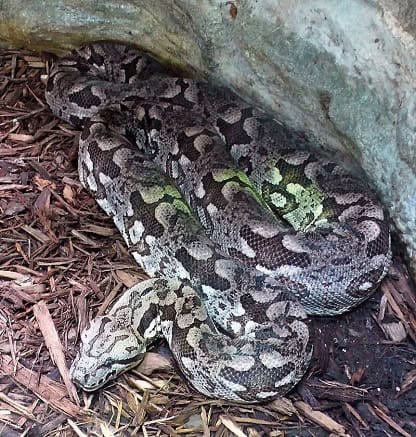
Maximum length: 259cm.
Among Madagascan snakes, two species stand out above all others for thickness, and both are the island’s main boas. The Madagascan ground boa controls the northern half of the island, and is slightly longer. Meanwhile, Dumeril’s boa (Acrantophis dumerili) controls the southern half of the island. There’s also an arboreal boa, the Madagascan tree boa, which belongs to a different genus to the other two.
As usual, the tree boa is the thinnest of the 3, using its lighter weight to cross carefully between branches. As for Dumeril’s boa, this species ventures onto branches as a juvenile, but rarely in adulthood, and the reason is its jumbo body width.
This species is far too thick and crushing to climb a tree. If the entire tree didn’t sway and fall over with a colossal crash, echoing for miles across the surrounding cocoa plantations and dry forests of Madagascar, then the branch itself would surely snap off.
Instead, Dumeril’s boa is a creature of the ground. This is mainly a species of dry woodland floors, which it effortlessly blends into using its beige and brown patterns. Dumeril’s boas prey on mammals, including lemurs, and their bodies are almost unbeaten for thickness among boas and pythons worldwide, with the exception of the blood python clan.
Dumeril’s boas regularly exceed 2 metres, and pose no threat to humans. They’re becoming sparser in the wild, due to overharvesting for the pet trade, but aren’t quite in a death spiral yet. Stepping on this snake is a real possibility, when you combine the immobile ambush nature, strong camouflage, and thick body which provides plenty of foot room.