
| 1 | Annulated cat-eyed snake |
Maximum length: 103.8cm.
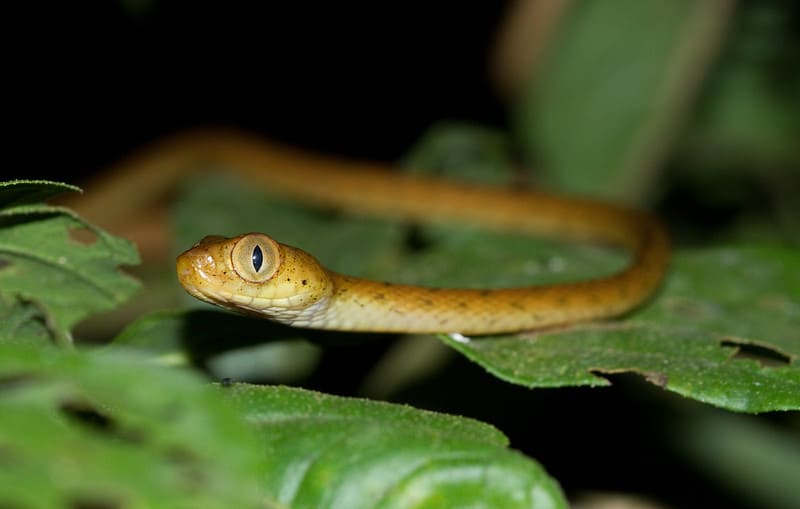
The annulated cat-eyed snake (Leptodeira annulata) is a super-widespread species, which inhabits Paraguay, Bolivia, Peru, Ecuador and most of Brazil, all the way to southern Mexico. This species is named for its vertical pupils, like a feline’s, but its eyes are also exceptionally large.
In some images, the eyes of Leptodeira annulata look almost as wide as its neck. Its pupils are large enough that a camera’s flash is easily visible in the resulting photo, while the irises are a dirty yellow.
Annulated cat-eyed snakes mainly live on tree branches, favouring tree clumps near wet areas, such as slow-moving streams, marshes, and seasonally flooded plains. There, they use their big, scanning eyes to hunt their main foodstuff – amphibians.
Annulated cat-eyed snakes are also nocturnal, making their bulbous eyes all the more useful for absorbing whatever insignificant light traces they can. Their colours vary, as some are pale orange, while others are a richer orange with a single thick black zigzag.
Annulated cat-eyed snakes aren’t completely harmless, as their rear fangs release a mild venom, which causes paralysis in their prey by damaging muscle fibers. They occasionally bite people, which usually just causes stinging and redness, but can occasionally swell an entire hand up.
| 2 | Large-eyed pitviper |
Maximum length: 74.1cm.
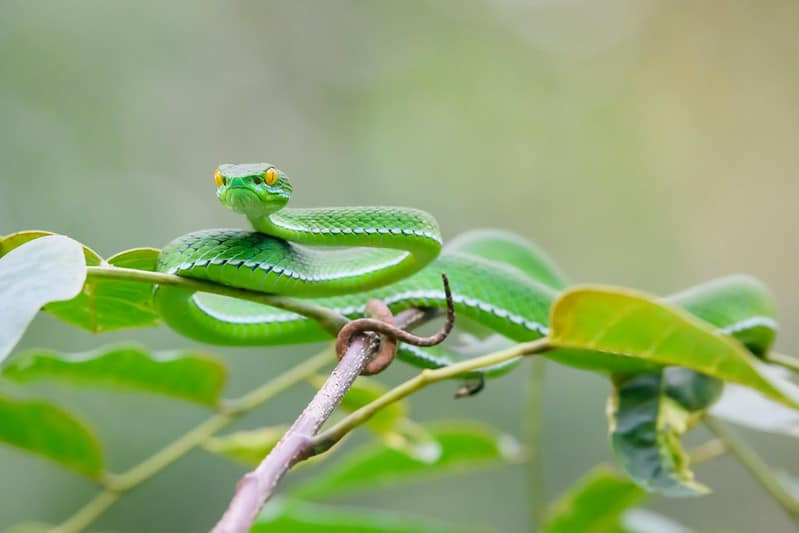
One of Bangkok’s most common venomous snakes. The large-eyed pitviper (Trimeresurus macrops) is found in much of Thailand, Cambodia, parts of Vietnam and southern Laos. Its survival skills include massively green colours to blend into a bush near a bus stop, and unusually large eyes, in order to scan its surroundings.
Trimeresurus is a large genus of pitvipers, which has at least 40 members in Asia, but the eyes are where Trimeresurus macrops stands out. These massive vision orbs have a slit-like vertical pupil, and even the Latin name of macrops refers to these large eyes.
Large-eyed pitvipers often co-exist with white-lipped pitvipers in Bangkok, but their larger eyes are one solid ID feature. The yellow colour of their eyes also contrasts sharply with the green below.
Large-eyed pitvipers are usually found in bushes or on low tree branches. Their bite is rarely fatal, but can cause necrosis and rotting flesh, leaving lifelong deformities. Collectively, the large-eyed and white-lipped pitvipers are responsible for 40% of all Thai snakebite hospitalisations. Don’t gaze into those wide, all-seeing eyes too much, or they may lull you into a trance which you never wake up from.
| 3 | Spotted dagger-tooth tree snake |
Maximum length: at least 180cm (probably more).
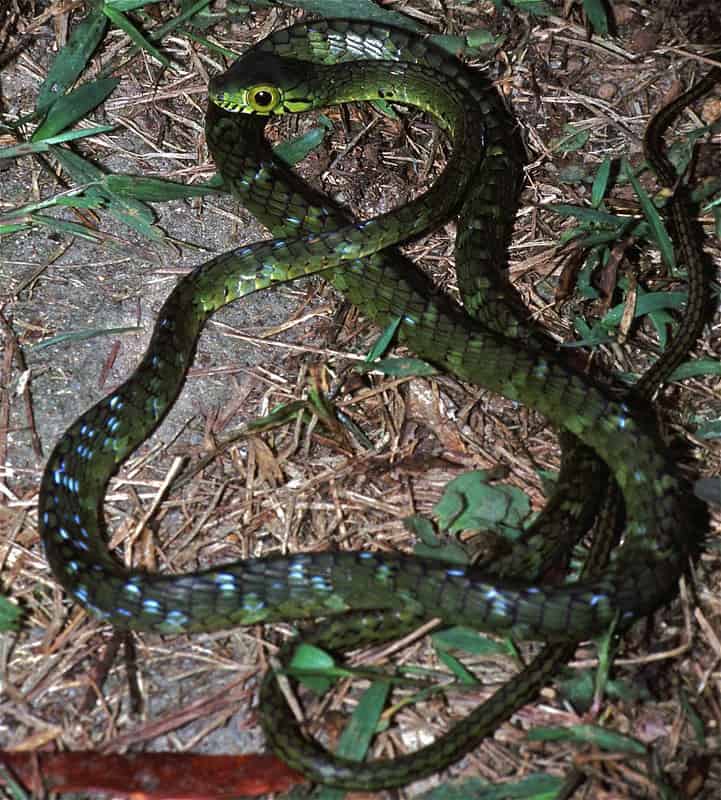
All the snakes on this list have huge eyes, but the impressive thing is how different they end up looking. The large-eyed pitviper looks menacing, but the spotted dagger-tooth tree snake (Rhamnophis batesii) just looks confused. It looks permanently dazed, as though somebody has smashed a cartoon hammer over its head.
Rhamnophis batesii is found in the jungles of central Africa, including Gabon, Equatorial Guinea and Cameroon. It’s usually found in trees, and derives most of its calories from amphibians.
This species measures 1.5-1.8 metres, and has smooth scales to touch. The eyes have a black pupil, while the iris is a light green the colour of swamp gunge. This snake also has incredible camouflage, as its green scales aren’t bright green like a Halloween decoration, but rich like jungle foliage, with many subtle shades. There’s even the occasional blue scale.
Nobody’s sure whether Rhamnophis batesii is dangerous, as it lacks traditional front fang venom glands, but it does possess a weaker rear-fanged venom, which it must chew into victims over several minutes. Some rear-fangers have turned out to be deadlier than once believed lately, including the western hognose snake of the USA. Therefore, scientists currently recommend caution with Rhamnophis batesii, in the unlikely event of meeting one.
| 4 | Cope’s parrot snake |
Maximum length: 155cm.
This rainforest species looks like it has amazing eyesight, although we still don’t know for sure. Cope’s parrot snake (Leptophis depressirostris) is found from Ecuador to Nicaragua, and especially in Costa Rica, and has a thin body designed for living on tree branches.
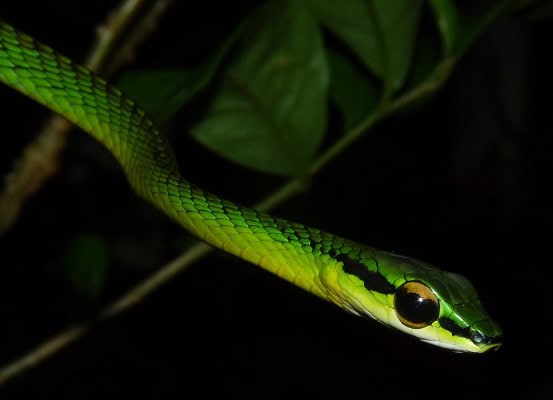
This species has even larger eyes than most parrot snakes. They almost pop out of its head like a frog’s eyes, particularly when viewed from head on. Like most parrot snakes, Leptophis depressirostris has a mild venom, which may contain anticoagulants and increase the pace of bleeding. This species doesn’t randomly attack humans, but can be aggressive if pushed, and rarely backs down from a fight.
This is a mainly green snake, but its eyes and face are covered with a thick black line. The parts of the eyes which aren’t covered are golden. Cope’s parrot snakes have round pupils, and given how huge their eyes are, these are easy to make out. When Cope’s parrot snakes die and are stored in alcohol, they slowly turn blue over time.
This big-eyed snake lives in both disturbed and undisturbed forests, and its diet consists of both frogs and reptiles such as stream anoles (Anolis oxylophus).
| 5 | Big-eyed ratsnake |
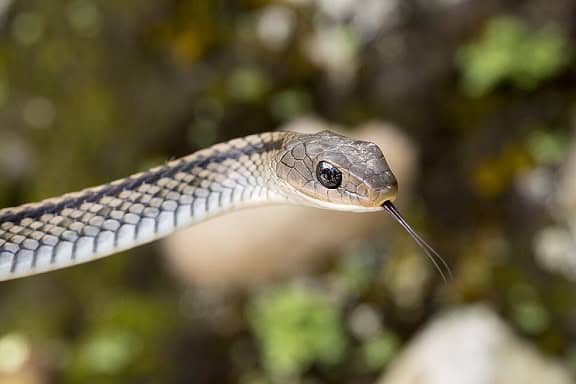
Maximum length: 256cm.
The big-eyed ratsnake (Ptyas dhumnades) is a close relative of the oriental ratsnake, one of Thailand’s most common snake species. This species is found in southern China and Taiwan instead, and another difference is its particularly massive eyes.
The eyes of this species look like dark black pits, which you could stare into and completely lose your soul. Surrounding the pupil is a thin ring of dirty yellow, and this is also a long species, regularly exceeding 2 metres, making the eyes particularly large compared to short species with similar proportions.
The big-eyed ratsnake isn’t dangerous to humans, lacking any venom whatsoever, but might scare people off with its twitchy and erratic behaviour when cornered. This large-eyed snake can move at extremely fast speeds. Some believe it to be the fastest snake in all of Asia; the Chinese name translates to “the knife that crosses the mountain”.
For once, this big-eyed snake isn’t primarily a tree snake, although it does sleep on branches at night. Ptyas dhumnades can roam anywhere from grasslands to farmlands to open forests, like its relative the oriental ratsnake.
| 6 | Amazon coastal house snake |
Maximum length: 58cm.
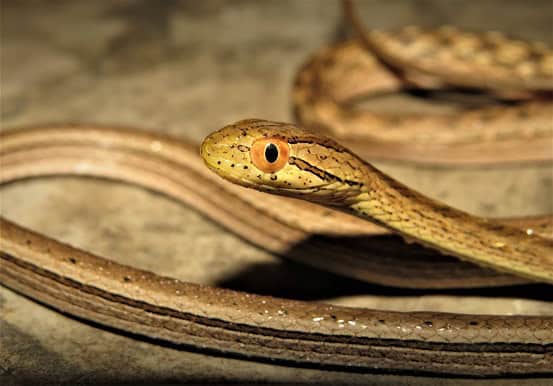
A little known snake which is nevertheless widespread across the Amazon. The Amazon coastal house snake (Thamnodynastes pallidus) lives in Peru, Bolivia, Colombia, Guyana and Venezuela, and is most commonly found staring at human explorers from a tree branch. People might miss this species as they walk past, but it certainly won’t miss you, as its eyes are enormous.
These eyes are a combo of yellow and black, with incredibly dark pupils bordered by a pale yellow line, with the iris being an earthier yellow. Its pupils are neither round nor vertical, but oval-shaped.
Thamnodynastes pallidus has such big eyes that they cover twice the diameter of the distance from its lip. The eyes range from 19.7 to 24.2% of the diameter of the head, and they also aid with camouflage, as the orange iris easily blends with this snake’s parched, beige body.
Amazon coastal house snakes have a diet heavy in frogs, including semi-lined tree frogs (Boana semilineata). They’re extremely thin and brown, and could probably be mistaken for dried-out foliage, if you weren’t looking carefully. This is yet another semi-arboreal snake – we’re starting to notice a correlation.
| 7 | Wall’s bronzeback |
Maximum length: 150cm.
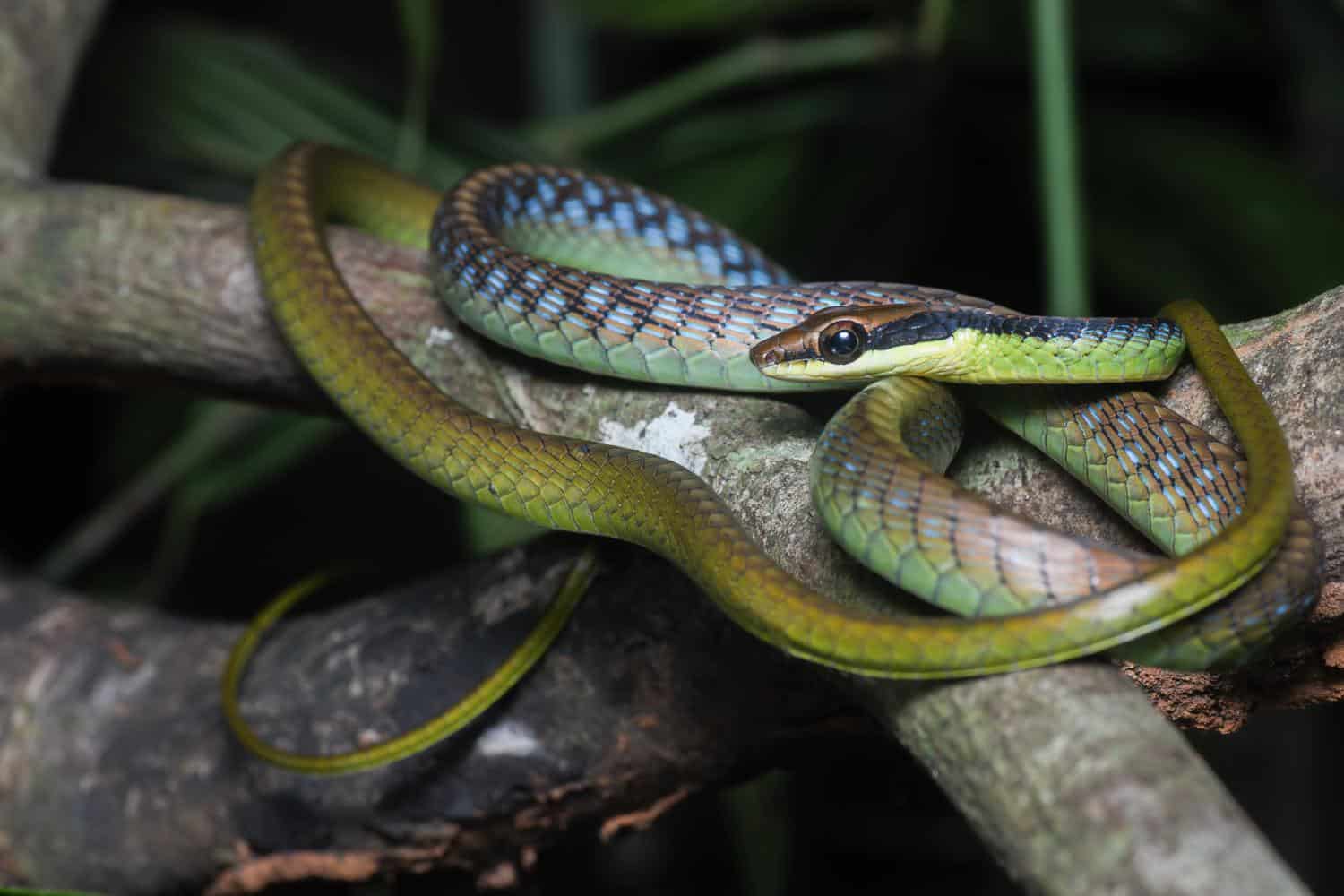
Wall’s bronzeback (Dendrelaphis cyanochloris) is a harmless snake found in eastern Bangladesh, Myanmar, most of Thailand, peninsular Malaysia and Singapore. It’s a rainforest snake, whose habitats have been dented by logging and agricultural takeover, yet is still flexible enough to survive.
This species has a cuteness quotient of around 8/10, mostly because of its huge eyes, which make up a great portion of its head. They almost pop out of its skull sideways, and have round pupils with a dull brown iris.
Wall’s bronzebacks have almost no weapons, except for bright skin beneath their scales, which they reveal to predators in times of stress. This snake is ultra-thin, and is overall a mixture of bright green and very dark blue. Wall’s bronzebacks are nearly always found on tree branches, and move extremely quickly, making catching one a challenging task.
This species coexists with the painted bronzeback, but that species has a paler, creamy underbelly, compared to the Wall’s bronzeback’s green.
| 8 | Malayan vine snake |
Maximum length: 110cm.
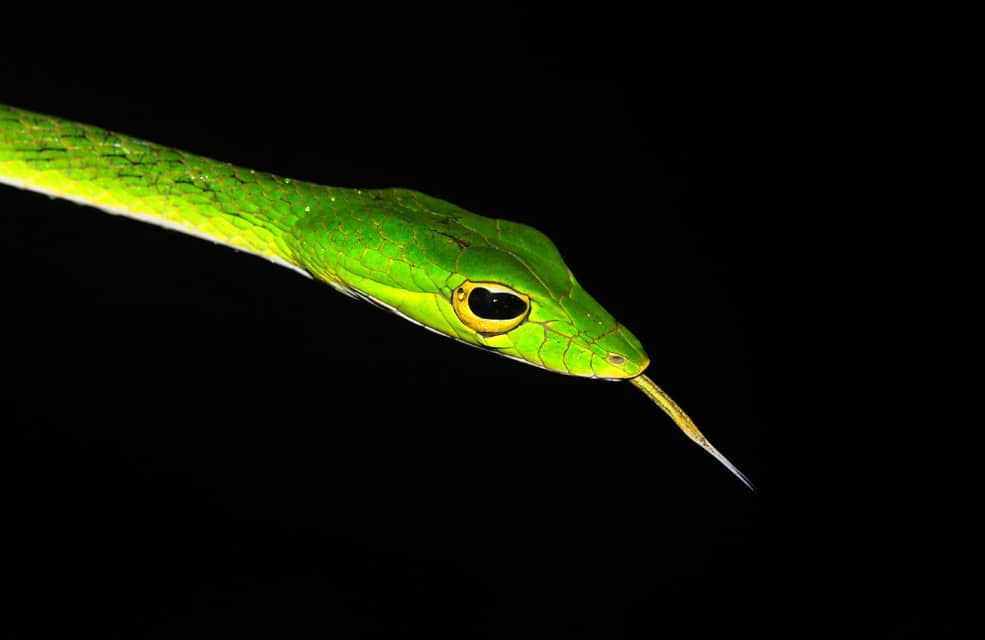
A common forest species of Java, Sumatra, peninsular Malaysia and Singapore. The Malayan vine snake is often confused with its close relative the Asian vine snake (Ahaetulla prasina). At first glance, the two are difficult to distinguish. They both have thin, vivid green bodies, which they use to swing from branches in disguise as vines. Even their tongues are a light green.
The Asian vine snake already has some of the freakiest snake eyes, with bizarrely shaped pupils which are neither circular nor vertical. Depending on the angle, these pupils look like keyholes or sideways carrots. Malayan vine snakes also possess these weird pupils, but the difference to their cousin is that their eyes are even larger. Hence their alternative name: the big-eyed green whipsnake.
The Malayan vine snake (Ahaetulla mycterizans) is far less researched than its cousin, mainly because it sticks to wild, untouched jungles rather than tree clusters near houses or parks. But it doesn’t take a 3 year research expedition in insect-infected jungles to ascertain one fact: that its eyes are huge.
Another difference is that Malayan vine snakes are shorter than their cousin, at a maximum of 110cm versus 2 metres. They also lack a thin yellow line on their flanks, while both snakes secrete a weak venom from their rear fangs.
| 9 | Malaysian spotted keelback |
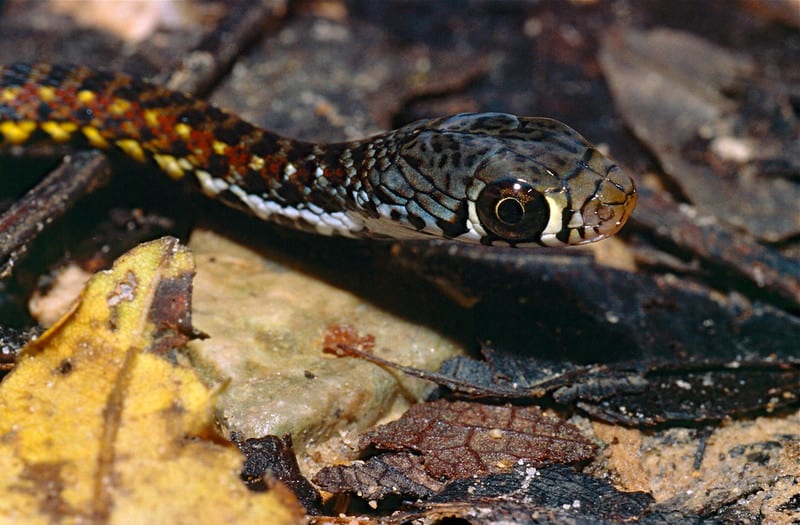
Maximum length: 100cm.
A mostly harmless southeast Asian snake, found in Borneo, Sumatra, peninsular Malaysia and Singapore. This species preys mainly on frogs, and is most common in shallow streams and swampy areas within forests.
The Malaysian spotted keelback (Xenochrophis maculatus) has a grey tongue, a white and dark grey neck, and two enormous eyes. Each pool-like eye is positioned exactly on one side of its head. While these fields of vision probably don’t cross over and create 3D depth perception (like in humans), they’re wide enough to cover virtually the entire jungle on each side, which is probably more advantageous to its lifestyle.
Malayan spotted keelbacks have round, black pupils, while their irises are medium brown. This is very a colourful species overall, as beyond the neck, a series of random red and yellow scales kicks in.
This big-eyed serpent managed to hide itself away for decades. Originally, Xenochrophis maculatus was believed to be completely missing from Thailand, only inhabiting Malaysia to the south. Then in April 2019, one was discovered in the extreme south of Thailand, in Narathiwat Province, a relatively unexplored jungle region. If only we had as massive eyes as they do.
| 10 | Boomslang |
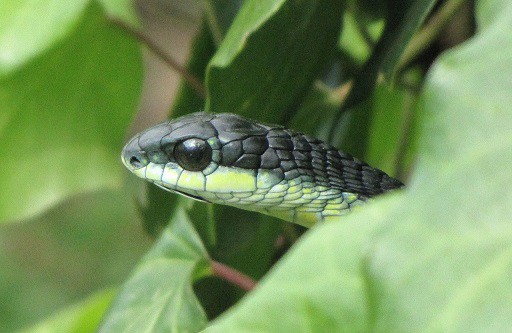
Maximum length: 210cm.
An infamously dangerous species, which inhabits at least a dozen countries of sub-Saharan Africa, including Zimbabwe, South Africa, Tanzania and Botswana.
There are two factors to consider in a boomslang encounter. The first is that this notoriously venomous snake (LD50 rating 0.07mg) is shy, and would much rather plunge out of a tree and disappear into the bushes than tolerate a human in the vicinity. The second is that with its massive eyes, there’s no chance of one not noticing you.
Boomslangs have such large eyes that they have binocular vision similarly to mammals, where the fields of vision cross over to generate 3D. Their large eyes are glassy and dark like a poisoned well, and blend well with their forested green scales.
At 1-1.2 metres, with a fairly thin width, boomslangs aren’t huge, but their eyes are immediately noticeable. One theory is that these eyes evolved in response to the chameleon’s camouflage, with one animal combatant trying to outwit another using an evolutionary arms race.
Think you can creep past a boomslang in the dark? No chance, but fortunately, this species is less aggressive than its reputation. Boomslangs cause surprisingly few deaths, with just 7 being recorded since 1954. One reason is a tiny venom yield of 1.6-8mg.