
| 1 | Northern Sahyadri keelback (India) |
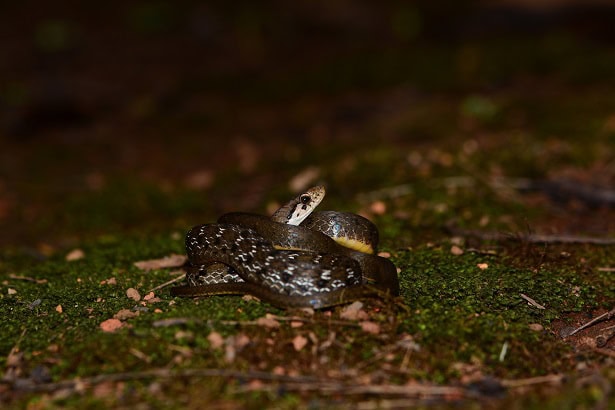
India has hundreds of snake species, and that’s only the ones we know about. 2023 saw yet another new discovery, in the form of the northern Sahyadri keelback, AKA Sahyadriophis uttaraghati.
This new species was found in the Western Ghats mountains of southwest India, specifically in the states of Maharashtra and Karnataka. The initial discovery revealed several details, as the first individual was found in a dry stream bed, hunting by day, attempting to grab frogs, as well as frog spawn.
The northern Sahyadri keelback is dark grey or dark olive in colour, interspersed with thin lines of black and white. Its underside is more memorable, as the upper half is white, which gradually transitions to a yellow/cream underbelly as the tail approaches.
As you’d expect, few photos exist so far, but one set captures an individual coiling into a tight ball, possibly in order to hide its head, protecting its brain from predators. This species is assumed to be harmless to humans.
In the same 2023 paper which announced this species, an entirely new snake genus was created – Sahyadriophis. The new group contained 2 snakes – the new species, and the Nilgiri keelback (Sahyadriophis beddomei). The latter is also found in the Western Ghats mountains, but is much more widespread, and was previously placed in the large Hebius keelback genus.
The Western Ghats is a particular haven for new species discoveries, due to its various ranges of sub-hills. For example, the Anamalai wood snake was discovered in 2020, and is endemic to the Anamalai Hills subregion, separated from the mountains to the north by the Palghat Gap.
| 2 | Desert whipsnake |
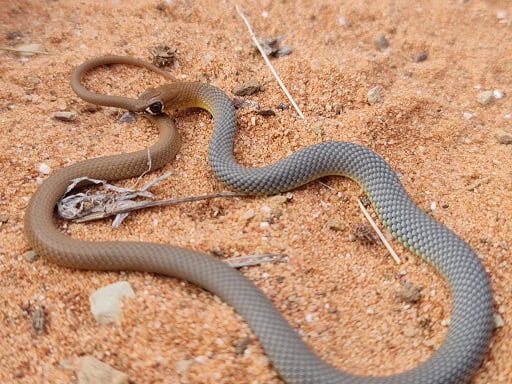
The yellow-faced whipsnake (Demansia psammophis) is one of the most common (and fastest) snakes in eastern Australia, and was first discovered in 1837. You’d have to live in a cave not to be aware of this species, yet one fellow Demansia species took until 2023 to be discovered – the desert whipsnake (Demansia cyanochasma). Like other members, this species is moderately venomous, but rarely attacks humans, tending to flee at the first sign of trouble.
Desert whipsnakes are known from Northern Territory, South Australia, and western Queensland, and are easily recognisable by a rich blue upper body. Compared to their relative the reticulated whipsnake, which also has a bluish body, they’re distinguished by less of a black edge to each scale. Genetic analysis was also conducted, which confirmed the independence of the central whipsnake.
The Latin name referenced the colour, as cyanochasma translates to “blue gap”, referencing the wide blue space between the copper head and lower body. Other snakes with similar names include the blue bronzeback of Thailand, AKA Dendrelaphis cyanochloris.
The desert whipsnake is active during the day, like other Demansia members. It’s confirmed to reach at least 90cm, and has round pupils rather than vertical.
| 3 | Tiger slug-eating snake |
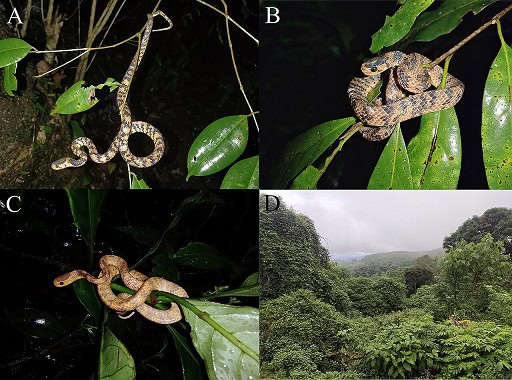
This new member of the large Pareas slug-eating genus (31 members) was discovered in southeast China, at an altitude of 1950 metres, near a small forest stream. Several members are already known from the region, including Hampton’s slug-eating snake. The tiger slug-eating snake (Pareas tigerinus) differed by its repeating dark vertical bars, which clearly resembled a tiger’s. In the original individual, these numbered 59 on the body, and 22 on the tail.
3 individuals were found in the original discovery. The first was a female, the designated holotype, the original representative of the species, which measured 54.3cm. The second was a male, which kept the vertical bars, but was significantly darker. The third, meanwhile, was another female, which was far paler, so this new species seemed to have natural variation.
Virtually all Pareas members prey on slugs and snails, but the scientists were surprised to find the tiger slug-eating snake coexisting with another species: Pareas xuelinensis. The scientists speculated that Pareas tigerinus had more terrestrial tendencies, while its neighbour stuck more closely to tree branches, perhaps reducing their competition. Whether their diets differed wasn’t known yet.
| 4 | Obscure cobra (Naja obscura) |
It’s one thing finding a tiny new slug-eating snake, hiding in an obscure forested hill range in southern China, but finding a new cobra is much rarer. That occurred in 2023, in the coastal reaches of northern Egypt. The snake was Naja obscura, tentatively called the dusky cobra or obscure cobra.
Initially, this cobra was thought to be a melanistic variant of the Egyptian cobra, which is ordinarily brownish-yellow. However, several features marked it as distinct, mainly related to the scalation of the face.
The first was very clear: the obscure cobra completely lacked any subocular scales, the small scales immediately below the eyes, Instead, the supralabials (above the lip) were so large that they touched the eye. This scalation differed wildly from the Egyptian cobra’s.
Local reptile dealers in Egypt had understood for years that Naja obscura was a distinct species, including traders in Matrouh and Abu Rawash, so in reality, the discovery wasn’t new at all. The habitats of Naja osbcura include banana plantations, crop fields, sparse vegetation and orchards.
There’s still a slight question mark over this species, as genetic testing hasn’t yet been conducted, but the scalation differentiation makes it likely. While we may have a full map of Africa, there’s still endless nooks and crannies whose snake populations aren’t fully understood.
| 5 | Limestone eyelash pitviper |
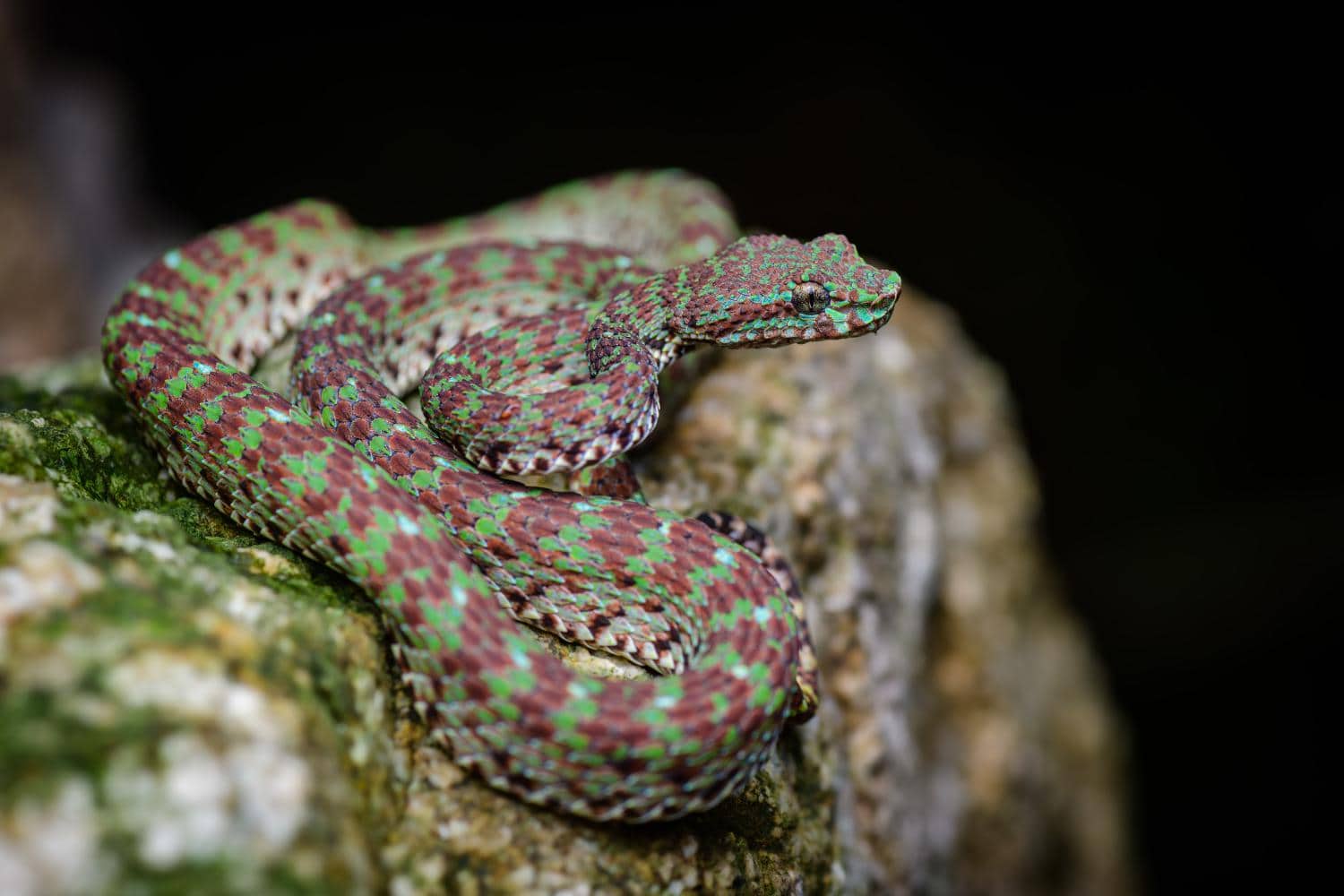
New pitvipers are being discovered constantly in southeast Asia, and one of the newest was the limestone eyelash viper (Trimeresurus ciliaris), currently known only from far southern Thailand. This species is believed to be related to the beautiful pitviper, AKA Trimeresurus venustus, but was separated by its vivid green and purple patterns. Genetic testing revealed a divergence from T. venustus of 12.5%, and that the limestone eyelash viper formed its own clade within the Trimeresurus genus.
This species is found only in karst limestone regions, mainly in forests, in the Nakawan Range spanning the border of Thailand and peninsular Malaysia. The study authors made their observations in Trang and Satun provinces in far southern Thailand, and since then, more observations have been made in Perlis state, Malaysia just over the Thai border.
The first ever limestone eyelash viper (Trimeresurus ciliaris) was observed in Tha Le Ban National Park, in a forest with numerous large rocks strewn around. One individual was found on a large limestone rock 5 metres above the ground, in a vertical position. Compared to other Trimereurus pitvipers, this species seems less fond of branches; it uses large boulders to gain a vantage point instead.
So far, nothing is known of the limestone eyelash pitviper’s venom potency. This species has been found alongside two fellow snakes: the beauty ratsnake and Wagler’s pitviper.
| 6 | Levant ratsnake |
Western Eurasia has several ratsnakes of the Elaphe clan, which are all non-venomous constrictors. These include the four-lined snake of Italy and Greece, the eastern four-lined snake of Bulgaria, and the rarer Urartian ratsnake of Turkey.
These were known to be independent species, yet to the south, there was an isolated ratsnake pocket, found in the high altitude Mount Hermon area. This straddles the borders of Lebanon, Syria, and the Israeli-controlled Golan Heights, and is even home to a Middle Eastern ski resort. The ratsnakes here were separated from those further north by 400km, yet their status was unknown.
In 2023, the truth was finally revealed, as the Mt Hermon ratsnakes were found to be an independent species, estimated to have diverged from those further north 3.9-5.1 million years ago. They were darker in colour than those further north, contrasting against a yellowish underbelly.
Sightings of the new snake were scarce, due to tourism, land use change, and even military activity. The species was dubbed the Levant ratsnake, or Elaphe druzei, and had an average length of 1 metre.
| 7 | Canopy snail-eating snake |
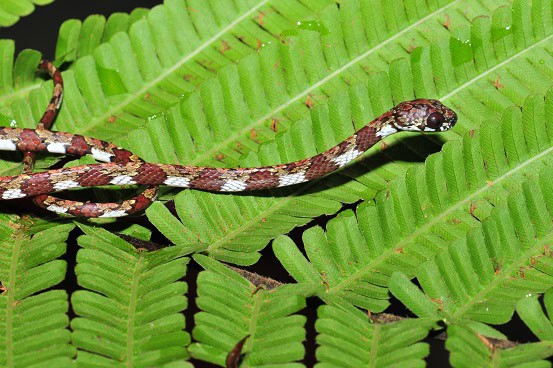
2023 was a great year for snail-eating snakes, as the Americas saw 6 new discoveries. In a single study, 5 new species were announced, including DiCaprio’s snail-eating snake, named after Leonardo DiCaprio.
Another of these was the canopy snail-eating snake, AKA Sibon canopy, pictured above. The species had large eyes (like most Sibon members), and repeatedly alternating white and brown patches, each with a slight black outline. Between this lay neon patches of slimy green, like pieces of swamp were clinging to its scales.
The new species was discovered in the forests of central and western Panama, making it one of the rarest snail-eaters. Unlike the massively widespread cloudy snail eater it overlaps with, which inhabits every Central American nation, the canopy snail eater was endemic to just one country, although one individual was found not far from the Costa Rican border. The species was also found to be threatened by illegal mining operations.
Only a handful of canopy snail eaters have been discovered, yet the species is known to be variable, as a few have had blood red eyes, one of the more disturbing yet rare features in snakes. Sibon canopy has been found resting on vegetation 0.5 to 3 metres high, and has been observed eating a snail, but there’s also evidence that they eat worms.
| 8 | Hidden snail-eating snake |

2023 saw new discoveries in all 3 major groups of snail-eaters: Pareas in southeast Asia, Sibon in Central America, and the vast Dispas genus of the Americas, which has over 50 members. One of these was the hidden snail-eating snake, AKA Dipsas aparatiritos, whose days of hiding finally ended when it was discovered in the Atlantic forests of Panama.
The first Dipsas aparatiritos was discovered on an old logging trail, in an area frequented by amphibian conservationists. The snake was found resting on a tree branch 75cm high, and further individuals were found 30-200cm high.
Compared to Sibon snail eaters, this species has somewhat cleaner patterns, ranging from chocolatey brown to a muddier brown, overlaid with thick bands, and easily distinguishable eyes. The new species was found to be particularly common near streams within forests, rather than near ponds.
The largest confirmed hidden snail-eater individual so far measured 72.5cm. Despite being so new, this species already has a detailed diet study, and the result was clear. Among 50 prey items found in Dipsas aparatiritos, just 1 consisted of snail remains, and the other 49 earthworm remains. This new species is inaccurately named, with an unusual diet for its Dipsas clan.
| 9 | Harrison Ford’s slender snake |
Annoyed that his younger rival Leonardo DiCaprio managed to snag his own snail-eating snake, Harrison Ford fought back, and took ownership of a new snake discovered in Peru.
This new snake, also known as Tachymenoides harrisonfordi, was part of the tiny Tachymenoides gneus native to Peru, which has just 3 members (including the new addition). Tachymenoides is extremely poorly researched, and the new species was found in Otishi National Park, a protected area in Peru rich with forests and waterfalls. Just one individual was discovered – a 40.7cm snake found in puna grassland.
The snake was yellowish-brown in colour, overlaid with black stripes and blotches. The snake had subtle scale count alternations, and this was enough to identity it as a new species, separate from Boulenger’s slender snake (T. affinis), found further northwest in Peru. Harrison Ford’s slender snake was found at an altitude of 3248 metres, and seeing as no frogs whatsoever were found in the vicinity, it was believed to prey on a local reptile: Proctoporus titans. This was also first discovered in 2023.
Surprisingly, Leonardo DiCaprio pulled ahead again in 2024, as he had a new Himalayan snake named after him called Anguiculus dicaprioi, which was copper in colour. One thing was never confirmed – whether the actors were ever told about their respective snakes, or indeed cared.
| 10 | Hunan odd-scaled snake |
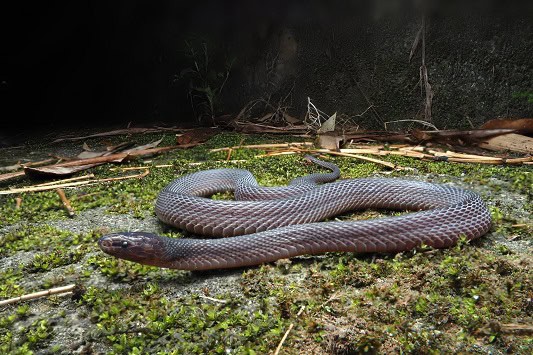
Achalinus is a large, poorly researched genus of snakes numbering 26 worldwide, which includes the Boulenger’s odd-scaled snake of Hong Hong, and black odd-scaled snake of Taiwan. 2023 saw the discovery of an all-new species: the Hunan odd-scaled snake (Achalinus hunanensis), found in southern China. It was declared in 2023, but the first ever individuals were collected in 2013, when 2 snakes were collected in Hunan province.
The first individual was found in an evergreen broadleaf forest at high altitudes, near a stream with shrubs on either side. Its diet wasn’t observed, but the surrounding area was heavy in earthworms.
The new species was extremely unmemorable, with virtually no colour other than black. Even its eyes were jet black and blended into the rest of its scales. Like all Achalinus members, it was believed to be non-venomous.
Nevertheless, genetic analysis revealed the Hunan odd-scaled snake to be an entirely new species. Its closest relative was found to be the Ningshan odd-scaled snake, from which it diverged 0.48 million years ago. The two species were firmly separated by the Three Gorges and Yangtse River, with no intermingling.
| 11 | Tudor’s coffee snake |
A high altitude species of Ecuador, which has no ability to harm human beings. South America is full of coffee snakes of the Ninia genus, and Tudor’s coffee snake dwells at altitudes of 1190 to 1676 metres.
Compared to its Ninia members, this species has the usual black body, but a thick, snowy white neck collar, as well as a white chest. Tudor’s coffee snake is found exclusively in Ecuador, and only in a narrow portion, specifically northwestern Ecuador on the slopes of the western Andes. So far, it has been found in three provinces: Cotopaxi, Imbabura, and Pichincha.
Tudor’s coffee snake (Ninia guytudori) is found in pristine, untouched forests, as well as coffee plantations adjacent to forests, and dirt roads nearby. The species appeared to be nocturnal, moving along beds of leaf litter under darkness. By day, individuals were found hiding in rotting logs, and when threatened, they flattened their head and tail.
So far, this is the rarest coffee snake discovered in Ecuador. Other species include the Teresita’s coffee snake of Ecuador’s northwestern lowlands, and Schmidt’s coffee snake of the southwestern lowlands.