
| 1 | The USA’s less famous water snake |
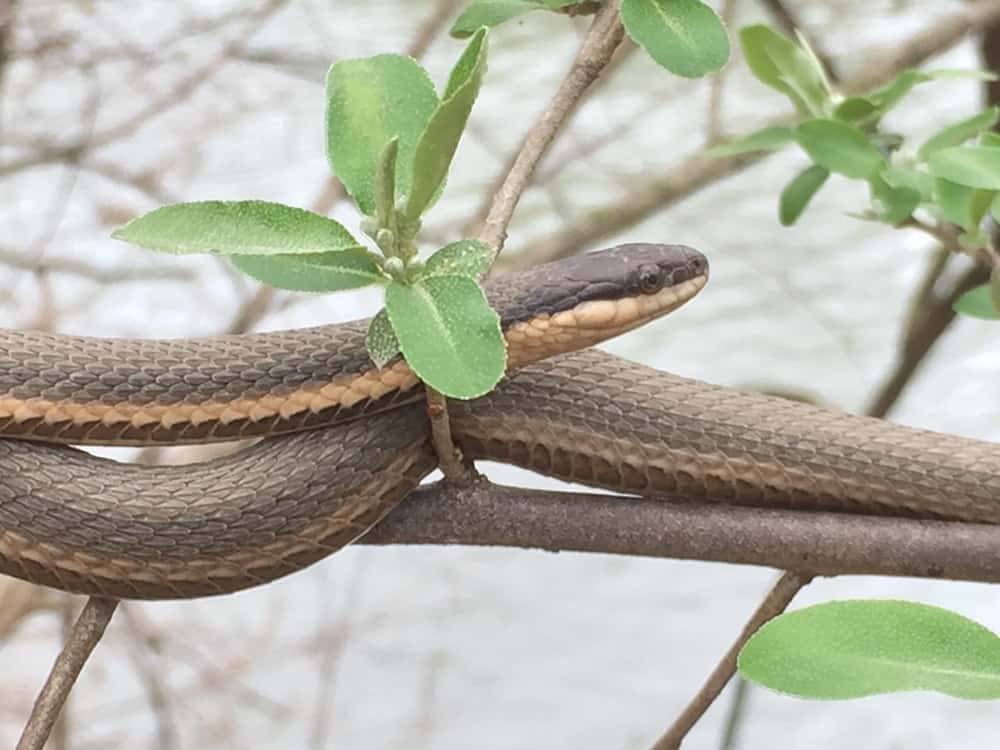
The US is full of semi-aquatic snakes, including 15-20 garter snakes, and the 10 members of the Nerodia watersnake clan (e.g. the northern watersnake). Most of these are well known, but less famous is the Regina genus, which has 4 members. The most widespread of these is the queen snake (Regina septemvittata), which inhabits 22 states of the US east.
The queen snake is non-venomous, and captures its prey using manual pursuit and grappling. It’s a fairly short species, with a record length of 92.2cm, and an average of just 60cm. One of its closest relatives is the striped crayfish snake, which inhabits virtually all of Florida, but only just crosses into southern Georgia.
The queen snake, by contrast, appears further north, reaching as far northeast as New York and Delaware. It stretches down to Florida, but only reaches the panhandle. Its westernmost point lies in extreme eastern Oklahoma, and it also crosses the border into Canada, where it’s increasingly endangered.
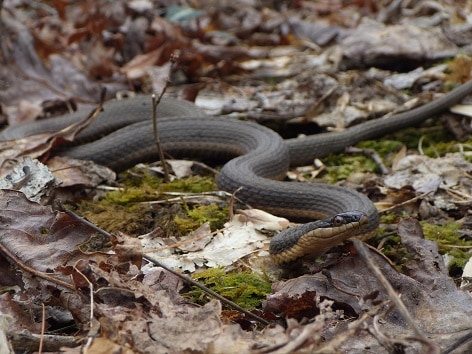
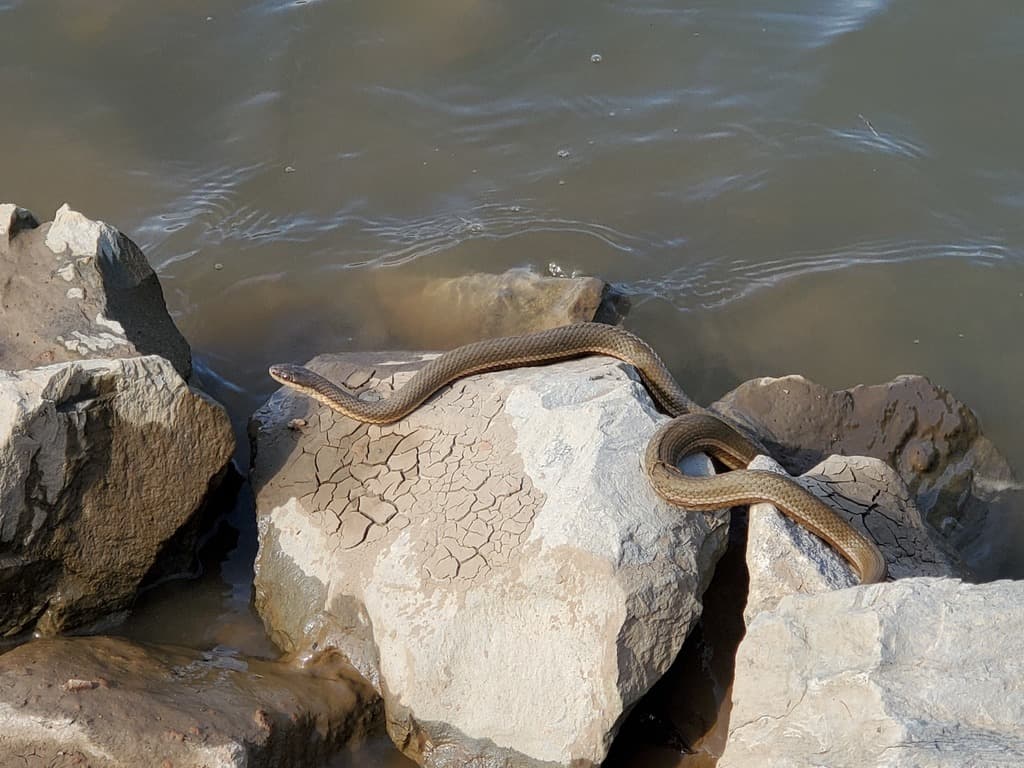
Despite a large range, queen snakes are very difficult to track down. They’re almost never found in towns, and they have no bright colours, with a consistent grey colour which allows them to blend perfectly with their favourite habitat: rocky streams.
| 2 | Restricted to rocky streams |
Unlike the northern watersnake, which inhabits virtually all water bodies in the eastern US, the queen snake has some of the narrowest habitat requirements of any semi-aquatic US snake. Firstly, this species rarely leaves its streams, and when it does, it never moves more than 6 metres away (usually 3).
Secondly, queen snakes don’t appear in any old river: they require streams with a rocky, gravelly bottom, to allow them to take shelter. Queen snakes always require a water current, favouring moderate to fast-flowing streams, which must be present year-round rather than a temporary runoff stream activated by rainfall.
Unlike other aquatic snakes, queen snakes rarely appear in ponds or stagnant, misty swamps. One of their close relatives is the Graham’s watersnake (Regina grahamii). Except for subtle scale counts, the main difference between the two is that Graham’s watersnake is adapted to living in swamps instead.
Queen snakes also face tight temperature controls. According to a study from Ohio, this species cannot cope with streams cooler than 18.3 degrees Celsius for the majority of the active season.
| 3 | Never appears in towns |
Queen snakes only appear in rural rivers, almost never beneath a bridge in the centre of town. They can have a narrow range even within one river, hanging around along a narrow stretch covering just 3-5 metres of shoreline.
There’s a few secret signs to watch for, as a study in Ontario found that queen snakes were commonly found near willow and cottonwood trees. Herbaceous, marshy meadows were popular locations, but they avoided shorelines shaded by heavy canopies.
Queen snakes generally like rivershores with moderate forest cover, which are open enough to allow several hours of sunlight per day. They prefer water which is clear, rather than murky and silty. They also favour still pools on the edges of flowing rivers, possibly for hunting and resting. Rocks are all-important for queen snakes, as they prefer rivers not with constant muddy flats, but a rugged rocky shoreline, with a particular preference for limestone.
You won’t spot the queen snake on an epic expedition to find a new hibernation den either. Their winter dens are normally located mere metres from their summer streams. These dens include natural rock niches, crevices in walls and dams, and old bridge abutments.
| 4 | No threat to mankind |
The queen snake is very alert, yet timid and shy. It almost never bites, whether picked up, falling into a fishing boat from a tree, or accidentally stepped on. The queen snake will wrestle and thrash violently in the palm of your hand, but its teeth will never make contact with your skin. The worst weapon it possesses is a foul odour.
One theory is that this species’ head is too sleek and thin, lacking the crushing jawbones to inflict real harm. Meanwhile, its neighbour the northern watersnake has a robustly structured head, and is one of the more vicious non-venomous snakes.
Queen snakes are very quick to drop off branches when approached, diving into the safety of water below. Despite being timid, they’re perceptive of their surroundings, and know exactly what’s happening in all directions around them. Water is their safe zone, as they move faster in water than on land regardless of temperature.
| 5 | ID: check the belly |
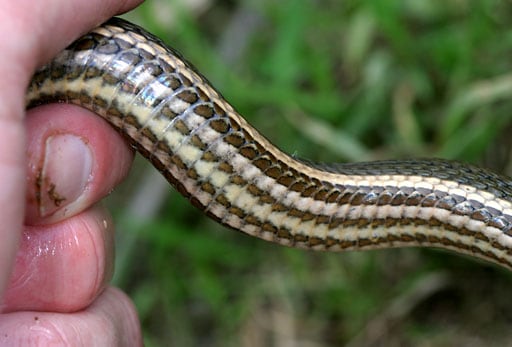
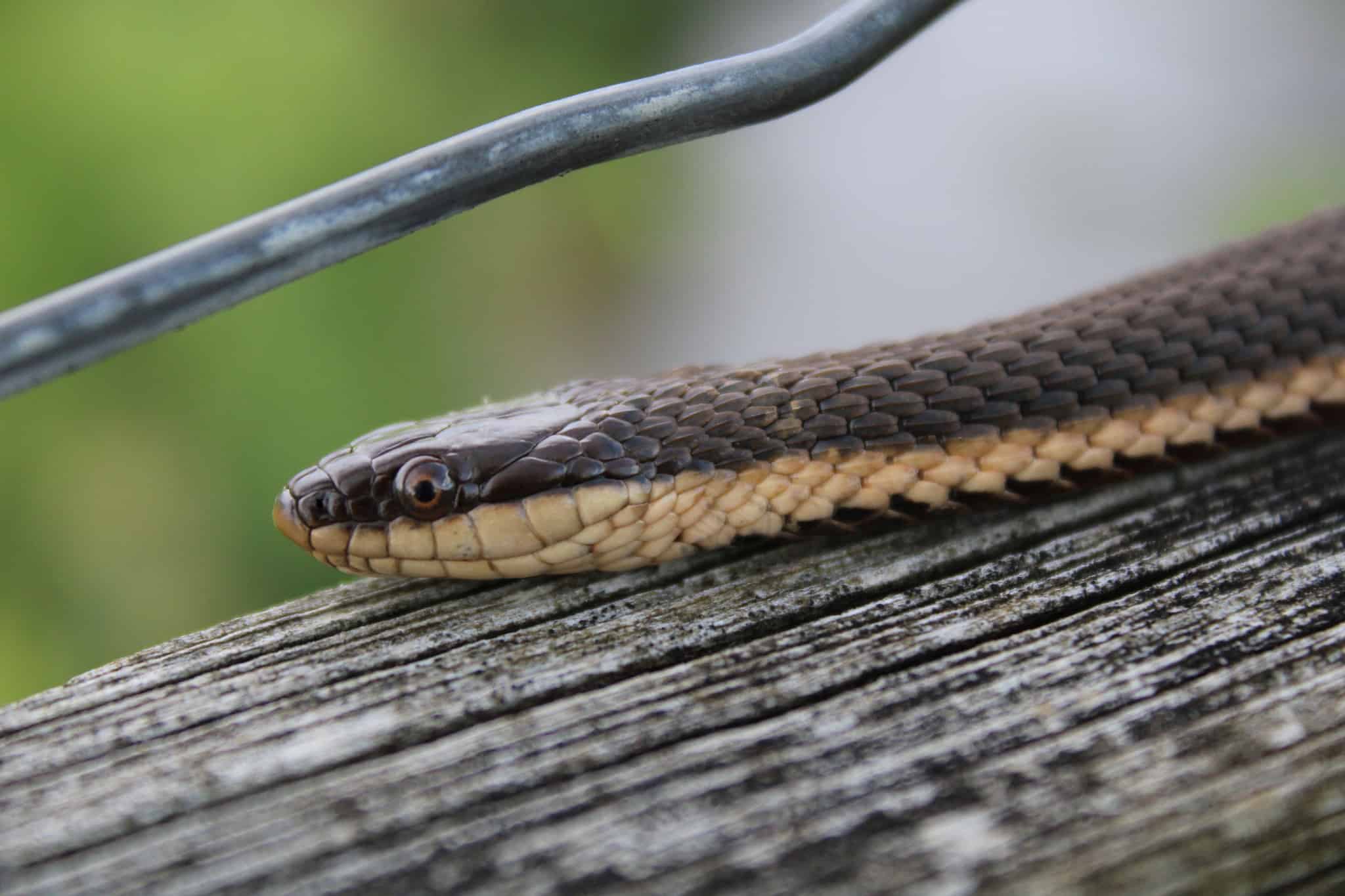
Queen snakes are primarily black contrasting against yellow, with only minor colour variation across their empire. Some have confused them with garter snakes due to the thin, parallel stripes running down their body.
However, the underside is different with the queen snake: covered with 4 vertical stripes, versus a consistently coloured belly for the garter snake. The Latin name Regina septemvittata translates to 7-striped queen. This belly is a particularly effective ID sign, as many snakes have a tapestry of patterns on their back, but one solid colour on their underside. The queen snake, if anything, is more patterned on its belly (ventral surface) than its main body. The main colour of the belly is pale yellow or cream, contrasting sharply against the much darker body.
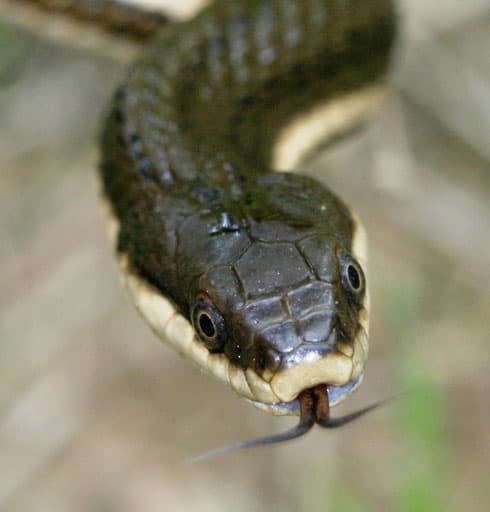
This is a fairly short snake, at an average of 60cm, with the largest ever recorded a mere 92cm. The queen snake has round black pupils, with a brown iris, and its tongue is a dark reddish-brown. Its head is small, not particularly bulky.
As queen snakes age, the 7 stripes may fade away. Younglings generally have more noticeable stripes on their back. Newborns measure 18-20cm, and grow by 75% or 15cm in their first year. The queen snake has rough (keeled) rather than smooth scales to touch.
| 6 | Diet: over 95% crayfish |
The queen snake is as narrow in its diet as in its habitat. Other prey have been recorded occasionally, like dragon fly nymphs and a snail, but the queen snake derives almost all of its calories from crayfish.
A study in western New York analysed 45 queen snakes, and found that crayfish comprised 99.4% of total meals consumed. In Kentucky, a dissection of 120 queen snakes revealed a crayfish count of 98.6%. The vast majority of these were one species: Orconectes juvenilis, AKA the Kentucky river crayfish. In New York, 94% consisted of Orconectes obscurus, the obscure crayfish.
The striped crayfish snake of Florida goes for adult crayfish with tough shells. It has sharp, saw-like teeth for gripping and swallowing them. The queen snake avoids these tough meals, instead going for easy crayfish in the middle of moult. With such fine taste buds, queen snakes are a nightmare to keep in captivity – force-feeding them mice is impossible.
| 7 | Rock hollow ambushes |
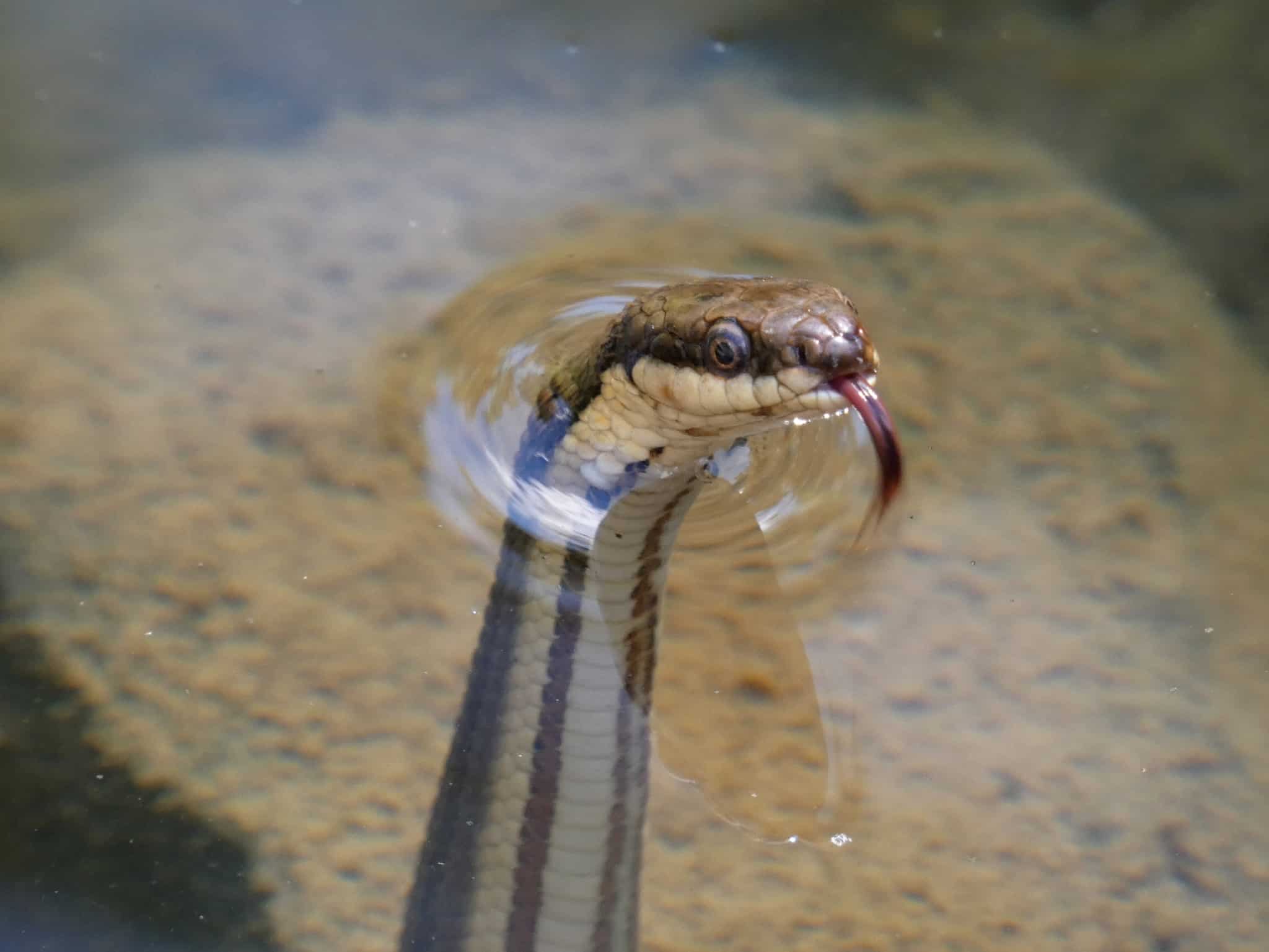
Summer is peak feeding season for queen snakes. In colder weather, they still rely on crayfish (94.1% in one study), but a lower amount of queen snakes have food in their bellies. This is probably because the crayfish themselves disappear during cold weather.
Queen snakes are pretty lazy hunters, and will normally swim to submerged rock shelters where they know that freshly molted crayfish hang out. There, they’ll wait patiently in ambush, hidden in a shadowy hollow.
Occasionally though, crayfish turn the tables, and dine on young queen snakes, with the hunted becoming the hunter. They don’t roll over when pursued by queen snakes either, and will fight back in aggressive duels.
Queen snakes sometimes swallow dead crayfish, and have been spotted lurking in small riverside pools with only their heads protruding above the surface. Queen snakes hunt at specific hours, mainly at 8-10am, and then an afternoon session lasting from 4-6pm. This is a diurnal snake rather than nocturnal, but midday is the least likely time to encounter them.
| 8 | Super-attuned to crayfish scents |
Ecdysone is a steroidal prohormone which controls the moulting process in numerous arthropods, including crabs and crayfish. Queen snakes not only spot crayfish with their shells and spikes, but can detect this chemical diffusing through the water, like a bear smelling an elk carcass from 20 miles away. It’s like a male rattlesnake sniffing out the pheromones of a breeding female, to an ultra-specific species level, but converted to hunting purposes instead.
A study compared the queen snake to the northern watersnake, which has a far wider diet. When exposed to ecdysone, the northern watersnake didn’t respond, with no inquisitive tongue flecking. But the queen snake became far more interested, and when a crayfish extract was shown to them without the ecdysone, it had no effect. The queen snake swallowed the crayfish in 5 out of 7 trials with the ecdysone, but none without. Its tongue flecking doubled when exposed to the chemical.
The queen snake is an ultra-specialised predator, although there were some concerns raised: that manmade pollutants could mimic ecdysone and throw off the snake’s sensors.
| 9 | Neighbour: northern watersnake |
Put two maps side by side, and you’ll see that the queen snake shares a large range with the northern watersnake. The two often live in the same rivers, sometimes side by side. Like its neighbour, the queen snake sometimes climbs up branches overhanging rivers to rest for a while. The two species might even rest on the exact same branch. When winter comes, queen snakes have no problem with snuggling into the same rocky crevices as northern watersnakes, without snapping or biting.
The queen snake is also a student of the school of death-feigning. In a 2017 encounter, two young queen snakes flipped over onto their backs and remained motionless for 10 minutes. Their grey bellies blended into the cold riverside rock perfectly. Scientists captured the images here.
Of 4000 snakes worldwide, the queen snake’s closest relative is Regina grahamii, AKA Graham’s watersnake. There are many similarities, as both prefer newly molted crayfish over adults with hard carapaces, and both respond eagerly to the ecdysone crayfish chemical.
However, Graham’s watersnake has more flexible habitats, also including swamps, moist meadows, and roadside ditches. It’s more tolerant of human areas, and lives further southwest, occupying central US states like Arkansas, Louisiana and Nebraska, to as far south as Texas.
| 10 | Edging towards extinction? |
Queen snakes aren’t at imminent risk of vanishing, but their range is being pushed back on all sides. Their narrow habitat requirements make them vulnerable to housing developments and pollution, and the canalization of wild streams, but their narrow diet of crayfish is the weakest link. Crayfish are vulnerable to factory chemical spillages, including the heavy metal mercury, and when they disappear, so do the local queen snakes.
In New Jersey, queen snakes haven’t been officially recorded since 1977, although anecdotal sightings from reptile enthusiasts are still trickling in. In Canada, they once extended eastwards to Toronto, but the last sighting was in 1858 (this was the only sighting ever). They still survive in Ontario, but this coincides with Canada’s most heavily populated region.
Some of the most reliable Canadian hotspots are the Thames River, Maitland River and Grand River, but they haven’t been sighted in Bayfield River since the late 1970s. The Canadian queen snake realm is fully separated from the US territories further south, with no link up.
The queen snake is believed to be extirpated in Missouri, due to the construction of dams. It still survives in New York state, but no other northeastern states (officially anyway).
Update: the queen snake was officially rediscovered in New Jersey in 2024. Maybe there’s hope for Missouri as well.
| 11 | Mysterious mass gatherings |
Queen snakes sometimes gather together for unexplained reasons. In 1947, a Mr Neil spotted a group of “dozens upon dozens” gathered together in a creek in Georgia in November. Neil believed this to be the entire river’s population, as they were usually quite scarce there.
In 1944, a Mr Wood spotted a gang of 47 resting together, on saplings overhanging the Miami River of Ohio. The greatest record happened on September 22nd 1946, when three determined scientists scoured a 100 metre stretch of creek in Ohio, and came up with 125 queen snakes in an hour.
These gatherings happen in autumn, and may be connected to hibernation. It’s possible that the queen snakes were resting together on a small stretch of riverbank, and a burst of unusually hot weather triggered them all to return to action at once. Or maybe, this was their final conference before heading off for the winter. Other weird sightings include an Ohio queen snake resting peacefully on top of ice in January.