
| 1 | Malabar pitviper |
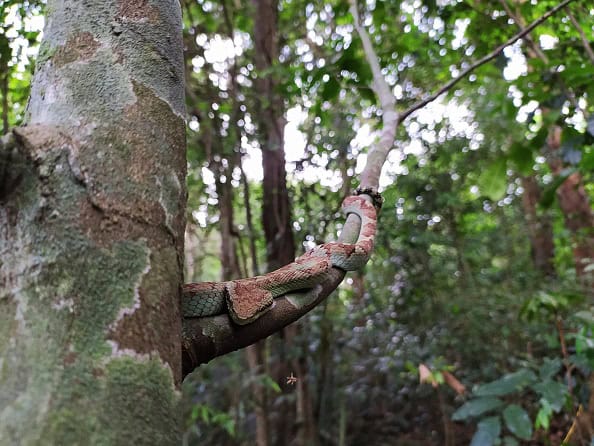
Maximum length: 89cm.
A dangerous pitviper of India’s southwest, though one which has a moderately intense venom only, causing swelling and haemorrhaging rather than neurotoxic paralysis. The Malabar pitviper is purely a forest species, appearing in moist, humid rainforests receiving a constant battering of rainfall. Its diet consists heavily of treefrogs, and it often becomes prey for the king cobra.
The Malabar pitviper spends at least 90% of its time in trees, but it doesn’t simply jump up several metres at once. The Malabar pitviper must climb if it wants to get to its high branch perch, and it does so effortlessly, instantly identifying the easiest route up a tree, despite lacking much in the way of brainpower. It’s all down to natural, ingrained climbing instincts with this snake, rather than inspecting a tree and making detailed plans.
Malabar pitvipers know the best routes up trees automatically, and once they initiate their plan, they execute it flawlessly. Other skills include resting on the same branch for days or even weeks, and dangling down from branches with a prehensile tail.
| 2 | Indian python |
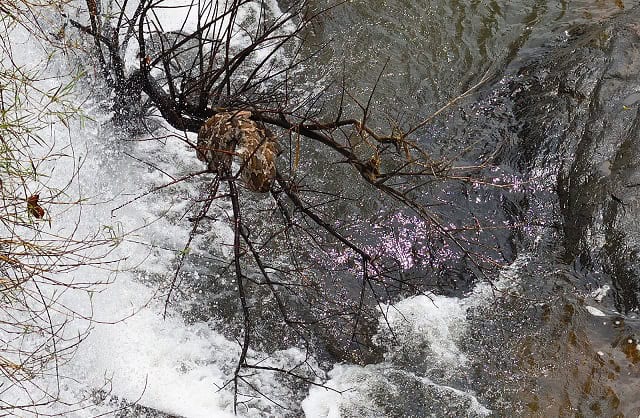
Maximum length: 4.6 metres.
The most common python in India, inhabiting the vast majority of the country, as well as all of Sri Lanka. The Indian python avoids extremely dry areas, but appears in moderately parched woodlands and lush green hillsides alike. This species mainly sticks to the ground, yet still possesses fantastic tree-climbing skills.
The Indian python could live out its entire life without climbing a tree if it wished. Yet it often ascends thin branches anyway, just to investigate the feeding opportunities higher up. It’s likely that they find a bird’s nest sometimes, or return to the ground with great disappointment in other cases.
One thing this species does seem to be missing is any sense of fear or restraint. The Indian python has no issue with clinging to incredibly thin, swaying branches over a raging torrent, as proven by the image above. Pythons are solid swimmers, like most snakes, but they might not be able to withstand gallons of rapidly flowing water, unlike a checkered keelback, which is much more adapted to moving water. The Indian python must have the fear section of its brain missing altogether.
| 3 | Indian vine snake |
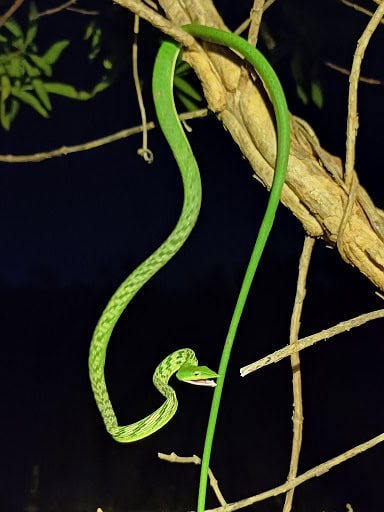
Maximum length: 1.8 metres.
A mildly venomous species whose venom hasn’t been examined in great detail, but is likely incapable of causing more than a swollen hand. Unlike the Indian python, this is a committed tree-dweller, appearing at levels from 1 metre to 10 metres to maybe more, and occasionally on the ground itself.
Indian vine snakes (Ahaetulla oxyrhynca) climb trees without even thinking, and their thin body is one classic tree-climbing feature. But another is an exceptionally long tail. In this species, the tail comprises an exceptional 40% of total body length. For example, one individual analysed measured 154.5cm overall, with a tail measuring 62.5cm.
Indian vine snakes are abundant all over southern India, and are present but less abundant in central regions of India, before disappearing in the north. India is the only country they inhabit, with no presence in Bangladesh, Sri Lanka, Nepal or Pakistan. This species is far from the only vine snake in India, as the Western Ghats mountains in the southwest are full of species, like Gunther’s vine snake, the Travancore vine snake, etc. But it’s probably the most common overall.
| 4 | Common catsnake |
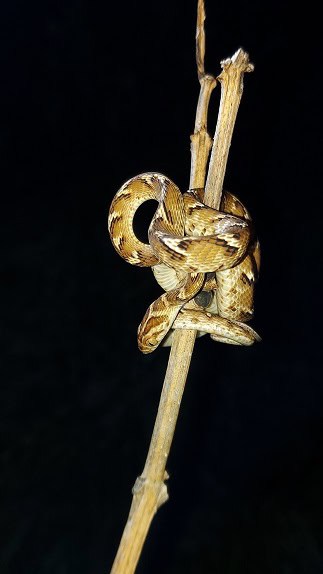
Maximum length: 130cm.
The most common Boiga catsnake species in India, out of over 40 members worldwide. The common catsnake (Boiga trigonata) has a large question mark over its head when it comes to venom, as several other Boiga members have recently turned out to possess unique neurotoxins, which are capable of causing numbness and disorientation in victims. One fact which isn’t debated is the common catsnake’s amazing tree-climbing skills.
A common catsnake could be spotted moving steadily up a tree trunk, or clinging to high branches like a statue, plotting its next serpent move. The camouflage of this species isn’t amazing in the leafy canopies, making them easy to spot. However, it’s stronger on the thick trunks of trees, or the bark below, with a brown tone on the body and a paler underside.
Unlike the average bronzeback, common catsnakes tend to climb more slowly, but their success rate is just as high. This is a careful, methodical climber, preferring not to risk its nightly hunting session with a punishing fall. Common catsnakes prey heavily on lizards, and appear in almost every region of India, except for high elevation mountains and the harsh Thar Desert in the northwest.
| 5 | Common bronzeback |
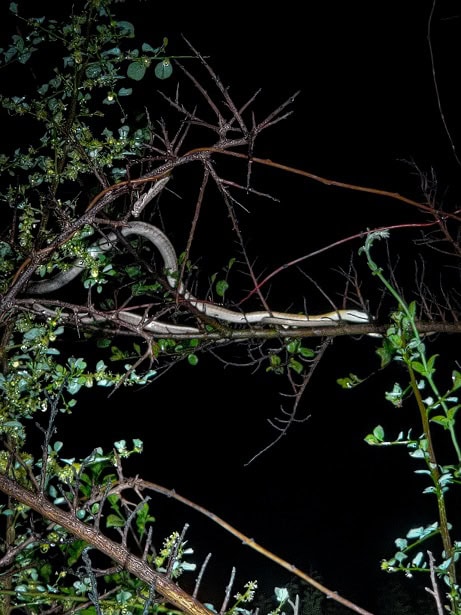
Maximum length: 169cm.
If you see a thin-bodied, whip-like snake escaping up a tree so fast that it almost seems to be floating upwards in mid-air, then the odds are high that it’s the common bronzeback (Dendrelaphis tristis). This mildly venomous species preys on frogs and reptiles and appears in around 90% of India, from Kerala state in the Western Ghats region to Uttarakhand in the Himalayan foothills.
The bronzeback genus has 50-55 members in total, none of which pose a threat to humans. The common bronzeback is similarly harmless, and has an extremely thin body, with a long tail averaging at 30-33% of its total body length. That’s less than the Indian vine snake, but significantly longer than the average boa, giving it superior balance and agility. Common bronzebacks don’t just climb trees with ease, but cross precipitous gaps between branches that don’t quite overlap.
The bronzeback genus is one of the more consistently tree-climbing groups of southeast Asia. The most southeasterly species is the green tree snake of Australia, but the common bronzeback is the most westerly, even crossing the border into Pakistan in narrow areas. This species also appears in most of Sri Lanka.
| 6 | Anamalai pitviper |
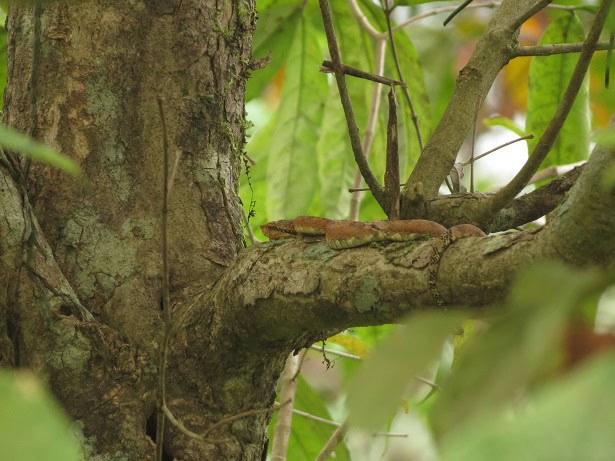
Maximum length: 91cm.
A close relative of the Malabar pitviper, inhabiting the same Western Ghats mountain range of southwest India, but with a more southerly distribution overall. This species also feeds on amphibians, rests on branches for days, and has virtually no confirmed humans deaths to its name.
Another characteristic of the Anamalai pitviper is living exclusively in forests, and it comes equipped with all the necessary skills to do so. You don’t have to witness this species climbing to know that it ascends trees effortlessly. The sight of one resting on a thick tree arm 10 metres above ground is all the evidence you need, and another skill is fantastic camouflage, blending into constellations of leaves, moss growing on trunks and bare bark with equal success.
This species is only mildly aggressive, and won’t react with alarm and defensiveness if a human enters its forest. If you see the sight above, then you’re almost completely safe to walk beneath the thick branch, assuming your hair isn’t brushing against it. Anamalai pitvipers are the exact opposite of the Indian cobra. The latter is an active forager, exploring its countryside in an agitated and nervous state, but the Anamalai pitviper’s entire hunting strategy rests on staying still.
As long as you know where this species is, you’re safe, as its entire goal is to not react until prey strays past. The only risk is spotting an Anamalai pitviper, breathing a sigh of relief, and not realising that its hidden female partner is directly in your path.
| 7 | Vellore bridal snake |
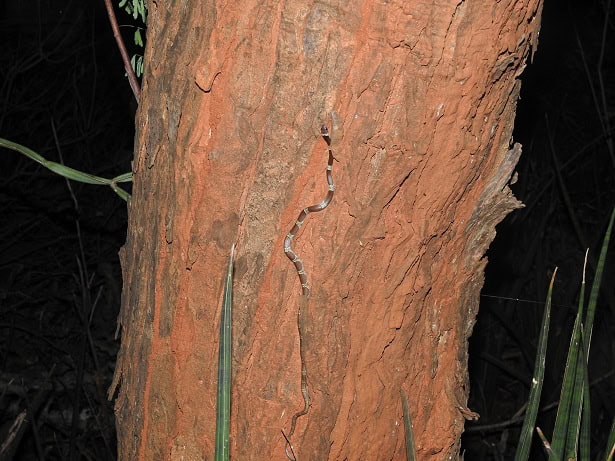
Maximum length: 57.4cm.
A common species in southern India and Sri Lanka, with sparse sightings in central India. The Vellore wolf snake (Lycodon nympha) is far from a tree snake, but climbs them easily nevertheless. Its diet consists of reptile eggs, which it cracks open messily, eating parts of the shell as well as the nutritious insides.
This species has patterns of repeatedly alternating white and black, with the black sometimes being chocolatey brown. The areas between these bands are generally clean in colour, rather than speckled and disorderly like the more common Indian wolf snake. Vellore wolf snakes have particularly large eyes, and the top of their head is brown, with the chin and underside of the head being white.
The Vellore wolf snake is less adapted for tree-climbing than the average vine snake, but it grinds its way patiently up a tree trunk all the same. Vellore blind snakes are efficient at exploiting fissures and irregularities in gnarly tree trunks, plotting a course upwards slowly but surely. They might struggle on a smooth tree trunk stripped of its bark, but any roughness and unevenness and they’re ready for action. Even brick walls are no obstacle to this species.
| 8 | Oriental ratsnake |
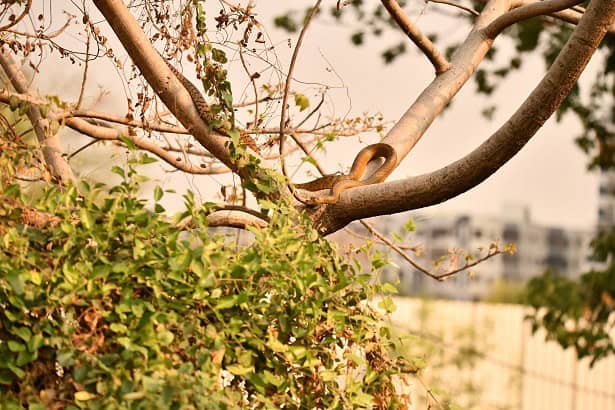
Maximum length: 3.7 metres.
A non-venomous species, but a highly adventurous and flexible one. The oriental ratsnake (Ptyas mucosa) appears all over India, and spreads to Bangladesh, Thailand, Cambodia and Vietnam, making it one of southeast Asia’s most widespread snakes.
The oriental ratsnake is fast-moving, and has no hesitation whatsoever. More than any other Indian snake, this species can explore anywhere, eat anything, and get into the most bizarre situations, such as plummeting into a stone well after tight-roping towards a birds’ nest, and accidentally swallowing a tablecloth in a town marketplace. Compared to many of its wacky escapades, climbing trees is no issue at all, and the oriental ratsnake often ascends high into trees, for reasons known only to them.
This species is far from a tree snake, unlike most Boiga catsnakes or Dendrelaphis bronzebacks. The oriental ratsnake is generally a ground species, yet its adventures often bring it high into tree canopies anyway. The snake above seems to have an excellent view over a gate or fence, and is clearly close to human habitation, perhaps a car park or large square.
Comfort in urban areas is another characteristic of the oriental ratsnake. In fact, this is one of the most abundant snakes in India overall, alongside the checkered keelback (which tends to appear closer to water).
| 9 | Spot-tailed pitviper |
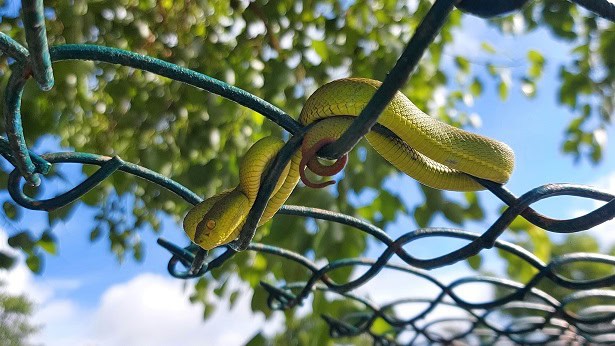
Maximum length: 104.5cm.
A species found exclusively in northeast India, meaning that it has no overlap with the Malabar pitviper, Anamalai pitviper, or other staples of India’s southwest. The spot-tailed pitviper (Trimeresurus erythrurus) has taken its place on tree branches in the northeast, waiting silently but completely alertly on the arms of trees. This species is found in West Bengal, Tripura, Assam, and Meghalaya states, as well as much of Bangladesh nearby. It isn’t the most widespread pitviper ever, but can be abundant in certain regions.
Though Trimeresurus erythrurus spent millions of years adapting to trees and bushes, its climbing skills seem to have translated well to manmade objects, such as metallic fences. Its innate sense of balance and agility allows it to ascend the interlocking gaps with ease, before arriving at a comfortable, patient rest.
Local Indian villagers might be horrified at the sight of this species climbing objects near their property. But despite a dangerous cytotoxic venom, Trimeresurus erythrurus will almost certainly ignore you as long as you give it space. The tricky part can be identifying this menacing pitviper in the first place, particularly in a bush or particularly leafy tree.
| 10 | Collared catsnake |
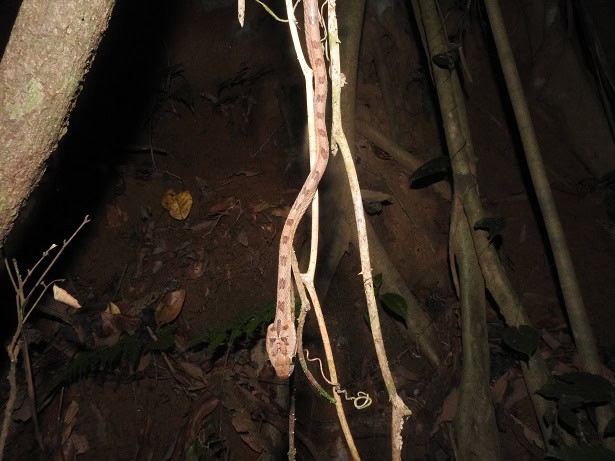
Maximum length: 120cm.
Another Boiga catsnake member, but more concentrated in the southwest rather than the entire country. Collared catsnakes (Boiga nuchalis) appear in Kerala and Karnataka states, where they’re locally common. The way to find this species is to look up, as the collared catsnake is a skillful tree climbing snake, like the rest of its family.
Collared catsnakes are in possession of a venom, though the exact intensity is a mystery. Their diet includes fellow reptiles, and their eyes are particularly large and bulging, which enables them to capture every detail of the surrounding forest from the trees they inhabit.
Collared catsnakes are proficient in climbing not just tree trunks, but thin, spindly branches extending many metres out like fingers, or old detached bits of wood leaning against their parent trees. As long as there’s some sort of connections between fragile pieces of wood, this snake can ascend metres into the air. In fact, a connection might not even be necessary, as Boiga nuchalis is able to cross precipitous mid-air gaps as well. The only skill this species lacks is a sudden mid-air jump, as produced by the painted bronzeback of Thailand.
| 11 | Common bamboo pitviper |
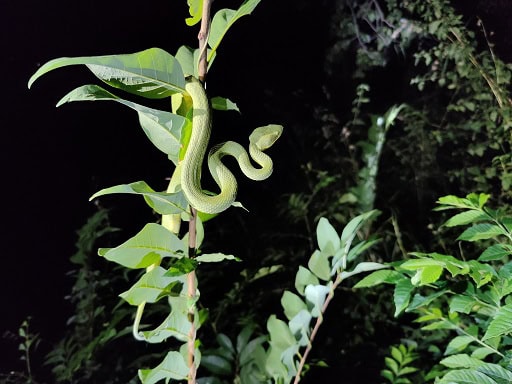
Maximum length: 113cm.
A venomous species of India, which falls far short of the “big 4” species, e.g. the Indian cobra and Russell’s viper. The common bamboo pitviper is a consistently green species which lives in consistently green environments, such as bushes or overlapping leafy branches. This species even derives the majority of its calories from trees, specifically tree frogs, which make up a large share of its meals.
This species is spread across a huge swathe of India, but tends to have certain hotspots. These include western Maharashtra state, including the countryside surrounding Mumbai, southern areas near Bengaluru, and central India near Hyderabad.
There are few detailed case reports for human victims, but lab experiments using the LD50 scale have revealed only a moderately intense venom, similarly intense to the Malabar pitviper, and significantly weaker than that of the hump-nosed pitviper (southeast India). No specific antivenom is available for this species. Given its excellent leafy green camouflage, bites are surprisingly rare, but one fact is undeniable: this species is an excellent climber, navigating thick tree trunks and thin branches alike. Common bamboo pitvipers appear on the ground occasionally, but looking upwards or slightly upwards is the best way to spot them.