
| 1 | Snake charmer gets his revenge |
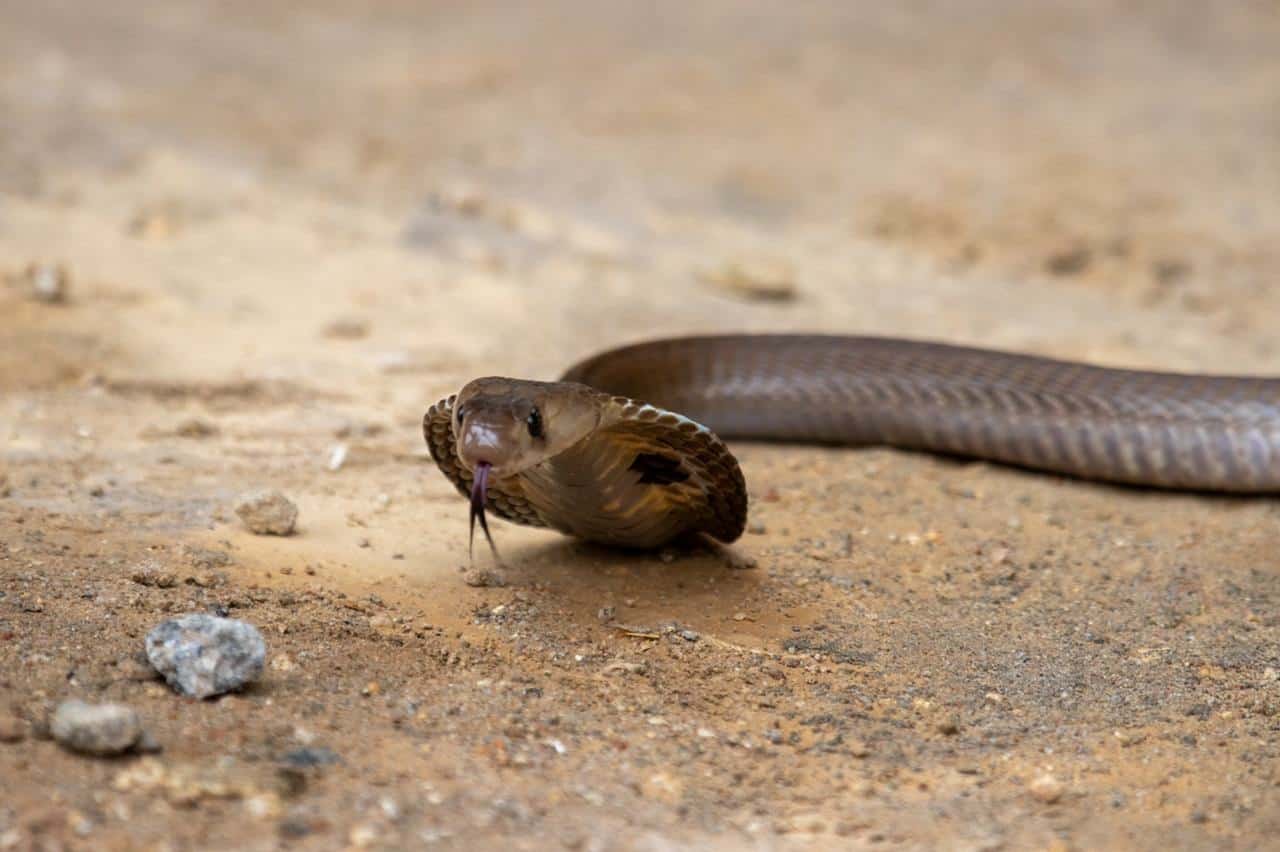
In November 2011, the Indian government learned why you should never annoy a snake charmer: they have lots of snakes at their disposal. The dispute centred over a plot of land, which a charmer called Hakkul claimed to have been allocated for snake conservation. He had even petitioned the president, and senior officials had allowed him to keep the land, only for corrupt local officials to keep delaying.
This angered Hakkul, and one Tuesday he marched to a Basti district revenue office with a group of supporters. The office was full at the time, bustling with nearly 100 clerks and officials, plus visitors. Mr Hakkul walked in, and emptied his sack of snakes straight onto the floor.
Many were venomous, and the result was chaos. Snakes were soon slithering up the walls and over chairs. Some brought sheets to cover the snakes, while others stood by flashing photos.
Angry officials grabbed sticks and approached Hakkul to beat him. However, in the melee of hissing and slithering, Hakkul and his friends managed to escape. One thing can’t be denied – he fulfilled his goal of raising awareness, as the story even reached the BBC.
| 2 | Boy breaks up with python |
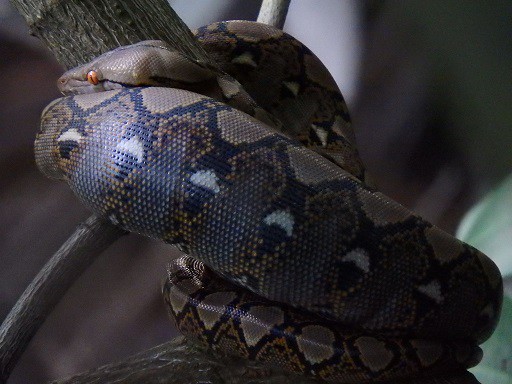
2011 saw the abrupt ending to a heartwarming love story between boy and snake. It started when Sambath was 3 months old, and his parents spotted a small snake curled up under his sleeping mat. They took it as a sign of good luck, and from that moment, Chamroeun the python rarely left his side.
Sambath would ride on his python’s back like a horse, cuddle her and pet her. Sambath’s father would arrive home and greet the python like an extra child each day. The python would eat several chickens per fortnight, and eventually grew to be 5 metres. It took 4 men to carry her from Sambath’s room.
Eventually, the tale of boy and snake spread across Cambodia, making them minor celebrities. It reached Sky News and other western outlets in 2006, and the boy’s parents consulted an oracle, who had an insight that the two had been siblings in a past life. People travelled from across Cambodia to receive a good look blessing from the python.
The bliss abruptly ended in August 2011, when 12 year old Sambath entered his room at 9am, and Chamroeun the python immediately bit his leg. His mother rushed in and tried to break the python’s tail. She failed, but the python soon opened its mouth, allowing the boy to escape.
The scene was a bloody one, but Sambath thankfully recovered in hospital. Chamroeun the python, however, was escorted out and placed in a zoo (video). The dream was over, although Sambath still planned to visit his “sibling”.
| 3 | Burmese python eats deer |
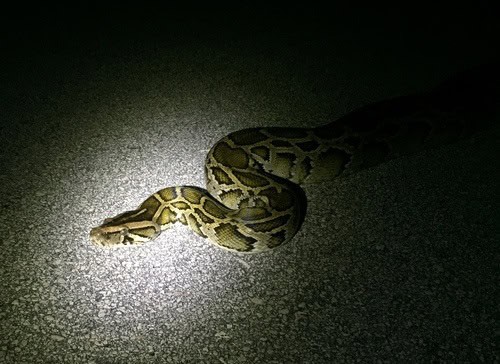
Long ago, there was a time when Florida wasn’t home to 5 metre pythons roaming the wilderness at will. Those times are now gone, thanks to the colossal Burmese python, which is probably the world’s 5th largest snake. This species is native to Myanmar and Thailand, and has successfully established colonies in the Florida everglades.
The theory is that pet owners didn’t expect their pythons to get so huge, and dumped them in the wilderness in a panic. Another theory was that the ferocious Hurricane Andrew caused a mass breakout from a breeding facility in 1992. Either way, November 2011 saw a fresh headline when conservationists were spraying invasive plants on an island 20 miles from Everglades National Park. Instead, they stumbled across a massive Burmese python.
The snake was monstrous, a 4.77 metre brute with a grotesque protrusion at its mid-section. The researchers dispatched the python with a humane shotgun blast to the head, as per protocol. The huge bulge turned out to be a 76 pound deer, swallowed whole, with no obvious discomfort.
This was the earliest a Burmese python had ever been caught after eating such a large animal. “It’s pretty clearly one of the biggest snakes we’ve seen,” said Scott Hardin, exotic species coordinator. However, this python wasn’t the outright largest. In 2023, a record breaking Burmese python measuring 5.79 metres was captured on a road in Big Cypress National Preserve.
| 4 | The snake house |

In Rexburg, Idaho, there was a house that all the locals knew about. They called it the Snake House, as its foundations lay upon the winter hibernacula of several hundred garter snakes.
Several previous owners had fled the elegant-looking house, with its white roof and green lawn. The latest buyers were Ben Sessions and his wife Amber. Rumours of the snakes soon reached their ears, but estate agents assured them that the stories were made up.
The Sessions purchased the house for under $180,000, even signing a contract stating that they were aware of the snake rumours. It took just days for the trouble to begin. The pregnant Amber Sessions began to bump into snakes in the garage, living room and kitchen. There were snakes everywhere they stood, and the smell from their musky defensive odour became unbearable. Even the water supply had the aroma, forcing them to eat out regularly.
They developed a routine, waking up early in the morning, to bash the snakes to death. On one day they managed 43, but it was no good – the foundations of the house themselves were infested. The snakes owned the house, not the couple. Legal documents meant nothing to them.
Finally, the Sessions had had enough and moved out, and Ben was diagnosed with snake-related PTSD. Amber dubbed their former home “Satan’s lair”. The bank didn’t give up, asking for $114,900 for the next owners, before dropping the price to $109,000.
| 5 | Snakes on a train – Vietnam |

In August 2011, a Vietnamese railway made a scheduled stop at Quảng Ngãi railway station. A guard and conductor were performing routine checks, making sure that passengers were carrying tickets, when they discovered 4 jam-packed bags of king cobras stashed under a seat.
The bag was see-through, allowing passengers to see the serpents in all their glory. The snakes’ mouths had been cruelly sewn shut, and some were later weighed at just over 2 pounds. Vietnam has strict laws on transporting wild cobras, but snake soup is a popular delicacy in southeast Asia, creating an irresistible incentive for smugglers.
News of the discovery soon spread through the train, from person to person. The mere mention of “snake” was enough to set people off. Hundreds of passengers fled the carriage in terror, and amid the chaos, the smuggler managed to slip away.
The bags weighed 45kg in total, and the cobras were released into the wild. According to one passenger: “Some of the snakes were very big, and looked terrifying. Most people ran away. But some people went to look at them and the cobras rose up“.
| 6 | Mega-snake meets giant croc |
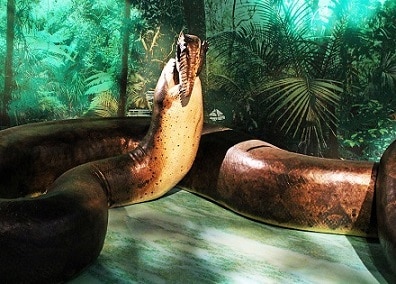
The titanoboa is the largest known snake ever to have slithered the Earth, measuring at least 14 metres, and ruling over the Amazon with an iron fist (or tongue). In 2011, scientists confirmed its coexistence with another giga-reptile – a 20 foot prehistoric crocodile known as Acherontisuchus guajiraensis.
This super-croc had a thin jaw with many tiny rows of teeth, hinting that it specialised in eating fish. It was adapted to freshwater habitats, such as wide rivers in the central Amazon rainforest. Its fossils dated to 60 million years ago, overlapping with titanoboa nicely.
Most importantly, the fossil announced in September 2011 was found in the same fossil deposit as titanoboa – Cerrejón coal mine in Colombia.
The two mega-reptiles were neighbours, and scientists’ minds immediately turned to the epic battles that could have taken place. They theorised that the giga-croc could have been a meal for titanoboa, albeit a risky one, with its dagger-like teeth and iron clamp jaws. Internet sketch artists in their bedrooms joined the team effort, producing vivid mock ups of the giant reptiles snapping at each other.
| 7 | Queensland flood danger |
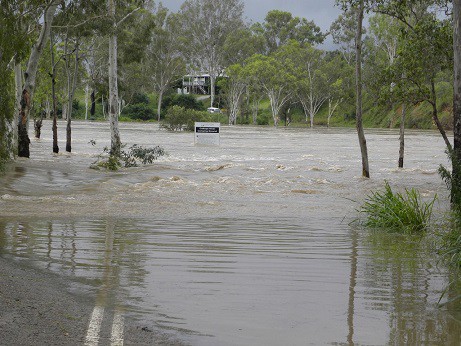
January 2011 saw some of the worst floods on record in Queensland, Australia. Entire towns were submerged with only upper storeys of buildings poking out, forcing helicopters to rescue people from roofs.
Another risk was the possibility of an overwhelming snake invasion. The authorities warned that some of Australia’s most venomous species would likely use the increased water as a highway to visit wherever they felt like. Both eastern brown snakes and coastal taipans are excellent swimmers, and would be trying to seek out higher, drier ground to escape the watery conditions.
There were also fears of hungry saltwater crocodiles expanding their borders. Jumping into an Australian river is a poor idea at the best of times, but now the river was the entire countryside.
The mayor of the worst affected city, Rockhampton, said that snake sightings were already rising, with surprise serpents floating around near innocent people attempting to evacuate. The local authorities even loaded up on antivenom for their emergency supplies, alongside fresh food and clean water.
There was one glimmer of salvation – that the heavy rains had reduced temperatures, possibly reducing the snakes’ metabolic rate and making them calmer.
| 8 | Boa bites breast implant |
This news story may not have been news at all, as nobody could agree on its truthfulness. The scene was a photoshoot by model Orit Fox, in Tel Aviv. Her prop was a beige-black boa constrictor, which she draped alluringly round her legs, neck and waist. Soon, the model was licking her new boa friend seductively.
But the boa constrictor didn’t like this, and decided to sink its teeth into the model’s chest. It was probably shocked to find that instead of flesh, its teeth landed in the hard silicone of a breast implant.
Fox leapt back in pain and screamed, while an assistant pulled the boa off after a few seconds. Fox merely received a tetanus jab in hospital, but the boa faded fast. It was suffering from silicone poisoning, and tragically died.
The photoshoot definitely happened, but the boa’s untimely death has never been proven. Some insisted that it was true, because they had read it on the internet, but experts pointed out that a boa constrictor’s rounded teeth are designed for gripping prey, and are too small to penetrate a silicone implant. They argued that a boa constrictor would never absorb silicone through its teeth anyway. Who knows?
| 9 | Patch for snake venom |
At this very moment, there are futuristic new remedies for snakebite in development, with only a trickle of news leaking out from secretive labs. One announcement in 2011 was an ointment, which victims could simply rub onto the bite site.
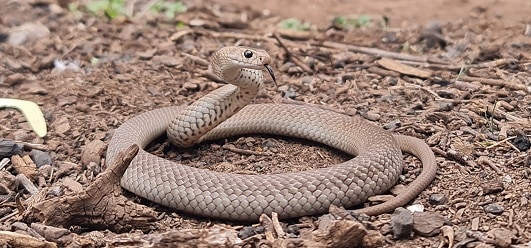
Many snakes like the Australian eastern brown snake possess toxins which are too large to enter the bloodstream. Instead, they pass into the lymphatic vessels, which run alongside the blood vessels and enter the wider arteries near the heart.
The lymphatic vessels are powered by thousands of tiny smooth muscle contractions, which the body normally controls using nitric oxide. However, snake venoms often possess bonus toxins which block nitric oxide, thus increasing the contractions, and accelerating the dispersal of the deadly ingredients.
Scientists created an ointment consisting of glycerol trinitrate, which restores nitric oxide. They gave several volunteers a non-toxic venom mimic, which was easily trackable in the body. With the ointment rubbed onto the injection site 1 minute later, the fake venom’s advance was slowed 3 fold. Rodents, meanwhile, were given eastern brown snake venom for real, and took 50% longer to die from respiratory failure.
The ointment was a work in progress, but the scientists believed that a mindlessly easy, rub on antivenom could happen one day. Some time in the future, any Australian could carry this ointment in their jacket pocket.
| 10 | Snakes on a train – Boston |

Another snake on a train tale, but this time lasting for weeks rather than hours. Penelope was Melissa Moorhouse’s beloved Dumeril’s boa, a 1.5-2 metre species originating from Madagascar which kills its prey via constriction. Pets are permitted on Boston’s trains, and on January 6th 2011, Melissa took the boa aboard, draped around her neck. Somehow, she let her eyes wander, and the next moment, Penelope the boa was gone.
MBTA employees helped her search the subway carriage, stopping the train for several minutes. At the Braintree terminus, they performed a more exhaustive search. But it was no use – nobody caught a single glimpse of scales or a flecking tongue. Melissa walked home empty handed.
For weeks, no sightings came in. Then on February 10th, nearly 5 weeks later, a passenger reported a snake slithering around the same carriage.
The train was stopped, but while the sighting came in at 10am, it wasn’t until 8pm that Penelope was finally caught and delivered to her owner. “I’m overwhelmed,’’ said Melissa. “I’m extremely happy to have her back”. Boas can go weeks without eating, and if the train had a mice infestation, then Penelope would have had an even sweeter deal.