
| 1 | Burmese python (Florida) |
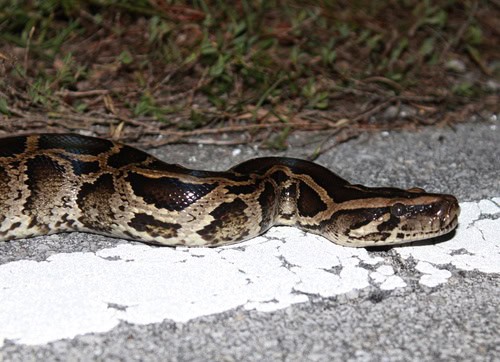
Maximum length: 579cm.
The Burmese python is easily the most infamous invasive snake in Florida, and probably the world. This species is native to southeast Asia, with its heartlands lying in marshy, humid areas of Thailand and Myanmar. However, sightings in the Everglades of southern Florida began to pop up in the 1970s. They accelerated in the mid-1990s, until the 2000s arrived, and southern Florida was almost overrun.
The USA has no native large constrictors, but it’s now estimated that Florida hosts well over 100,000 Burmese pythons, and possibly up to 1 million. The Burmese python has no presence in central or northern Florida, such as near Orlando. Instead, its heartlands are the Everglades, including the vast, untouched Everglades National Park.
Native mammals have no instinctive fear of large snakes, and since the Burmese python arrived, numbers of bobcats have fallen by 87.5%. Numbers of raccoons have fallen by 99.3%, while opossums have decreased by 98.9%. Burmese pythons are occasionally feasted on by large alligators, but not often enough to cause a serious pushback from Mother Nature.
Instead, it has been left to humans to do the culling, and the results have been mixed. One suggestion was to engineer a virus in a lab, but this was deemed to be too imprecise. Another idea was to organise an annual hunt, with bounty hunters flying in from around the USA. One restaurant even suggested cooking them in pizza, until it was found that mercury levels in the meat were dangerously high.
The best results have arrived only recently, with a simple yet ingenious solution: installing trackers into males, and following them as they hunt for females. The large, egg-bearing females are killed, while the male is released to find more females. The Burmese python invasion is far from over, but in 2025, it was announced that 23,000 have been removed and killed since 2000.
| 2 | Brown tree snake (Guam) |
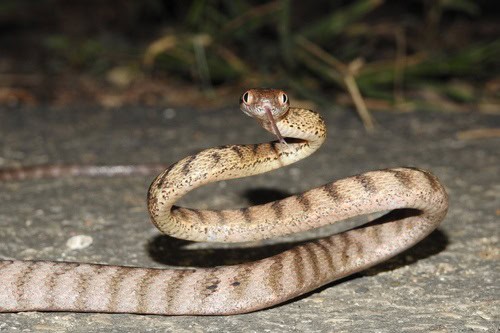
Maximum length: 3 metres.
Another snake which has decimated the wildlife of its newly conquered land. The brown tree snake (Boiga irregularis) is native to northern Australia, and some Melanesian islands to the north. In the 1940s, it was accidentally introduced to Guam, the US overseas territory which is home to a large military base. Naturally, Guam has no native snakes at all, and the brown tree snake soon multiplied to vast numbers.
It was in the 1970s when Boiga irregularis really began to make its impact felt. This species preys heavily on birds, and local populations endemic to Guam began to plummet. The local Guam flycatchers began to disappear, and the Guam kingfisher was last seen in 1986.
As of 2026, it’s estimated that Guam is home to 1 million brown tree snakes, with a staggering density of 13,000-30,000 per square mile. 10 out of 12 native birds to Guam are extinct, and the remaining two are severely reduced. These birds have never been exposed to snakes, and unlike in northern Australia, have no defensive tactics against them. Since their introduction, the brown tree snakes have fed to their hearts’ content, ballooning in number, and even ballooning in size, reaching extreme lengths of 3 metres due to the easy availability of calories.
The invasion has had strange consequences for Guam. One is a deathly silence in the islands’ forests, caused by the reduction in birds. Another is thick spiders’ webs clinging to every tree, as the predators of the spiders are now gone. Powercuts have become common as well, as the brown tree snake is a skillful climber which regularly ascends electricity pylons just for the sake of it.
Eradication schemes have mostly failed so far, even compared to with the Burmese python. Plans to drop in poison mice were carried out in 2013 and 2020, but the brown tree snakes are believed to have ignored them. Killing by hand is more reliable, but unable to even dent the massive invasive colony which has taken hold.
| 3 | Common wolf snake (Christmas Island) |
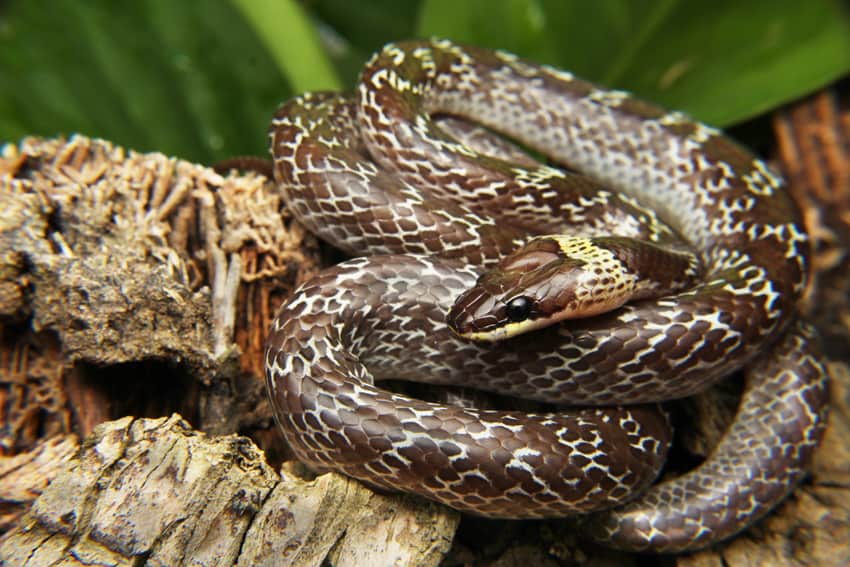
Maximum length: 76cm.
In the Pacific Ocean, 190 miles south of Java, Indonesia, a very similar story has unfolded, but to much less attention than the previous stories. The location is Christmas Island, and the antagonist is the common wolf snake (Lycodon capunius), one of the most widespread non-venomous snakes in southeast Asia, ranging from Thailand to Indonesia.
Christmas Island has one native snake – the Christmas Island blind snake (Ramphotyphlops exocoeti), which poses no threat to the island’s native lizards. The common wolf snake is believed to have arrived in the mid-1980s, as the first official sighting was made in Flying Fish Cove in 1987.
Since then, this species has completely taken over. The common wolf snake has set up a nice overseas outpost for itself, a stronghold where no other serpent can boss it around, but this has been to the detriment of Christmas Island’s native lizards. Like with Guam’s birds, these have dramatically declined, with species such as the Christmas Island forest skink becoming completely extinct.
Another lizard to be completely annihilated was the blue-tailed shinning skink, which was originally the most common reptile on Christmas Island. This species had a bright blue tail which it purposefully detached in order to distract predators, before later regrowing it. This species is now completely extinct on Christmas Island, and was saved only by a captive breeding program in Australia, which used 66 individuals captured on Christmas Island before the situation become completely unsalvageable.
As of 2026, the common wolf snake remains in full control of Christmas Island. Even the blind snake has declined in number. One endemic reptile remains fairly common – the Christmas Island forest gecko.
| 4 | Aesculapian snake (UK) |
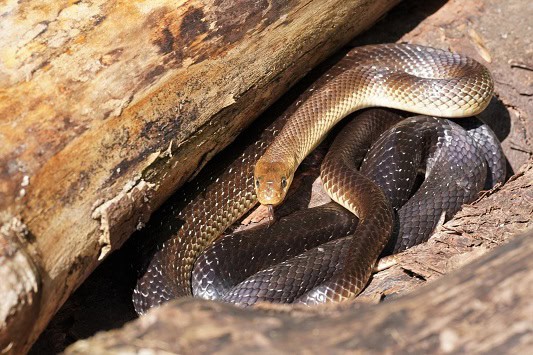
Maximum length: 225cm.
The Aesculapian snake is a non-venomous constrictor which ranks as the second longest snake in Europe, after the four-lined snake. It’s a tree-dwelling snake which is particularly common in Italy, and spreads down the Balkan nations all the way to Greece. This species is missing from the UK – or at least it was, until sometime over the last 50 years.
Nobody knows precisely when it happened, but the Aesculapian snake has somehow set up a well-documented invasive colony on the streets of London itself. The area is relatively narrow, but the snakes here are numerous in number. The area is Regent’s Canal, near the famous Camden Market. Dog-walkers or people wandering back from the shops have been coming face to face with curious serpents for years, before posting panicked testimonials on social media. This has resulted in several viral scare stories, such as in 2014, when headlines screamed that killer snakes were roaming London attempting to eat your child.
None of that was true, as the Aesculapian snake is a completely harmless species. It’s believed that the colony is having no negative ecological consequences, as the species mainly preys on mammals, and the Regent’s Canal colony mainly preys on rodents, including rats, which aren’t native to the UK themselves.
There’s a real chance of a random snake poking a head out of a dark concrete crack and shocking you in inner city London. The UK’s native snakes are the grass snake, adder and the much rarer smooth snake, but none of these are likely to appear within London, except perhaps in a grassy park near a small lake (the grass snake).
There’s one final twist in this tale – the Aesculapian snake was once native to the UK, during the warmer period immediately after the last ice age. As demonstrated by fossil records, the species only vanished in the UK a few thousand years ago, as temperatures cooled slightly again. The Aesculapian snake might be invasive, but it is only recolonising the lost northern sections of its previous empire.
| 5 | Horseshoe whipsnake (Balearic Islands) |
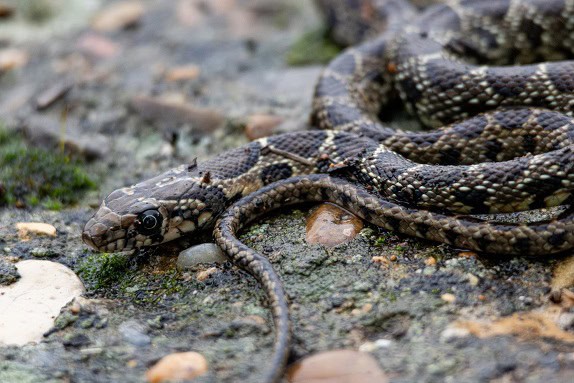
Maximum length: 185cm.
One of our invasive snakes so far has been a boat stowaway (brown tree snake), while several have been escaped pets (Burmese python, beauty ratsnake). Our next snake managed to invade its newly conquered land by hiding in the hollow interior of an olive tree. The snake we’re referring to is the horseshoe whipsnake (Hemorrhois hippocrepis), the most destructive invasive species to emerge from Spain.
The horseshoe whipsnake is a non-venomous constrictor which ranks as one of Spain’s most common, and is easy to observe, due to a love of open spaces, diurnal nature, and unusually high tolerance for hot conditions. Another tendency is to take shelter inside hollow tree trunks, before getting uprooted and shipped off to the Balearic Islands, specifically Ibiza and Mallorca.
Those islands have seen a large trend over recent decades for ornamental olive trees, not for farming, but to decorate gardens outside pristine white villas. Most of these are sourced from plantations on the Spanish mainland, and taken to the islands by boat. With them comes a secret stowaway, shipping off to an entirely new land, of plentiful lizards to eat, which have no way to deal with them…
Like those on Christmas Island, the lizards on Ibiza and Mallorca face no native snake predators. The horseshoe whipsnake derives a large portion of its meals from lizards, including 56% of its calories on Ibiza according to one study. The result has been a catastrophic decline in native species, specifically the Ibiza wall lizard, which has almost completely disappeared in many areas of the island.
The first horseshoe whipsnake was recorded on Ibiza in 2003, and in 2004 on Mallorca. All efforts to eradicate them have failed so far, but there’s one glimmer of hope – the local lizards appear to be adapting. When Ibiza wall lizards from Ibiza itself were exposed to horseshoe whipsnakes, they showed signs of alarm, while those from the tiny islet of Sal Rossa (where horseshoe whipsnakes haven’t arrived) showed no concern at all. This time, it may be the lizards themselves who outwit their new serpent foe.
| 6 | California kingsnake (Canary Islands) |
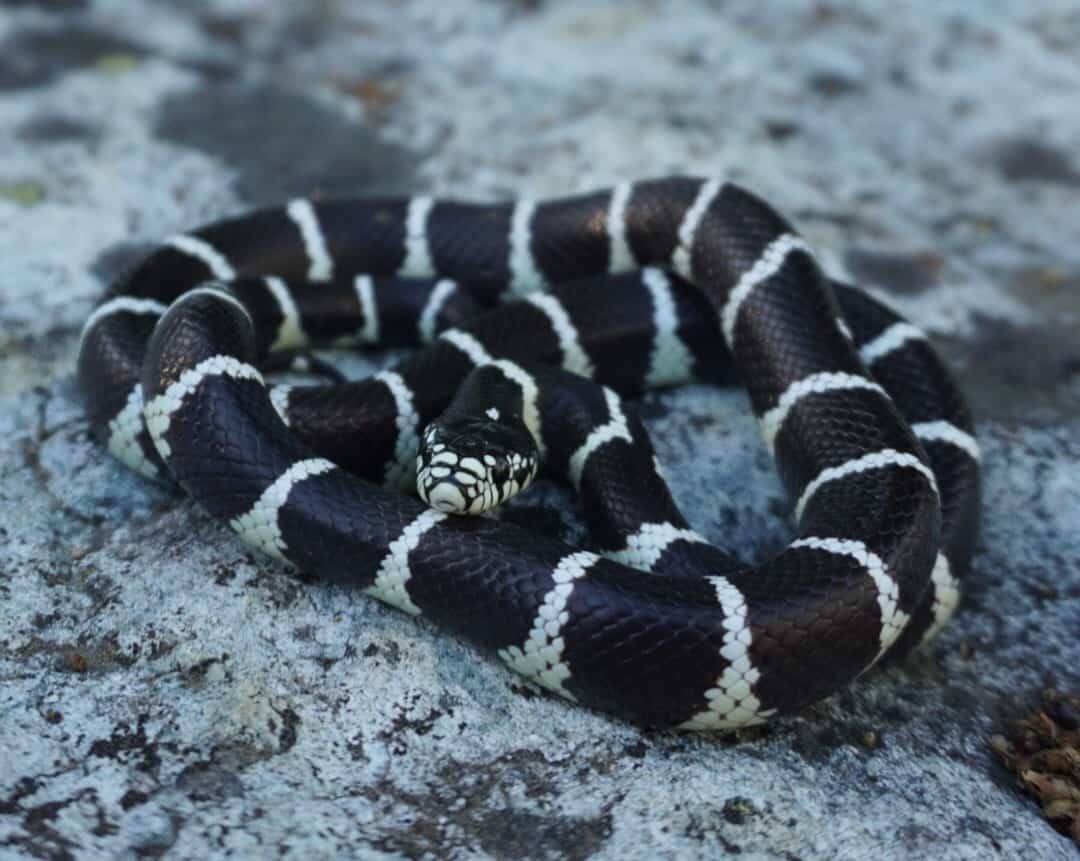
Maximum length: 2 metres.
The Canary Islands lie off the southwest coast of Morocco, and are beloved among tourists for their sunny beaches and seeming lack of any winter season. Another advantage was the total lack of snakes – until 1998. That was the year the California kingsnake (Lampropeltis californiae) docked in Gran Canaria, and began an expansion which has continued unabated ever since.
The California kingsnake is a common species in the southwestern US (California, Nevada, Arizona), as well as the Baja California peninsula of Mexico. It has a flexible diet, including mammals, fellow snakes and lizards alike, and poses no threat to human beings.
The same can’t be said for Gran Canaria’s local wildlife, as in 2021, a detailed survey revealed catastrophic effects on three native reptiles. In areas invaded by California kingsnakes, numbers of the Gran Canaria giant lizard plummeted by 99%. The local Gran Canaria skinks plummeted by 80%, while numbers of Boettger’s geckos fell by 50%.
Eradication efforts are now underway, with 17,615 individuals being removed since 2009. Yet California kingsnakes continue to appear from nowhere in rural areas of Gran Canaria, with their usual calm, unconcerned facial expressions. Even local citizens are worried about stepping out their front doors, despite the species’ complete lack of venom.
Precisely how the California kingsnake arrived in Gran Canaria is a mystery, though escaped pets may be partially involved. The main leaders of the eradication project are the Post-Life Lampropeltis group, who had established 506 traps on the island as of 2024. The Guiniguada Ravine on Gran Canaria is said to be a particular hotspot.
| 7 | Beauty ratsnake (Belgian railway tracks) |
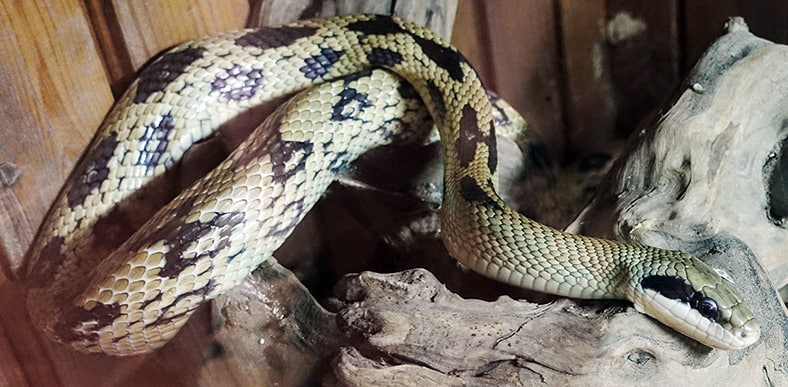
Maximum length: 280cm.
Belgium is home to a handful of native snakes, such as the venomous adder and harmless grass snake. Recently though, another snake has arrived in the country, which not only was never native to Belgium, but lives thousands of miles away, in southern China, Laos and Thailand. That species is the beauty ratsnake (Elaphe taeniura), a harmless constrictor with an elegant physical appearance.
This species is popular in the pet trade, due to its easy husbandry. At some point, a wave of captives must have escaped, because a thriving colony of beauty ratsnakes now exists in the northeast Belgian city of Hasselt. The location is a series of railway tracks, and tellingly, a reptile shop was once found in the city not far away.
The first ever sighting was made on October 26th, 2006. Occasional sightings continued in the years ahead, until the number suddenly jumped in 2015, and remained at that higher level thereafter. Dozens of live snakes were observed, as well as 3 dead snakes, a clutch of 6 eggs, and 3 shed skins. The beauty ratsnakes are spread over 208km², but the vast majority were concentrated in a 2km² zone around the railways.
The snakes seem to hibernate for a similar time to normal, as the latest observed sighting so far has been October 8th, and the earliest March 12th. Various snakes already congregate around railway tracks in Belgium, such as the adder, as they tend to create a microhabitat more suitable for snakes. Railway tracks create open spaces, and hence more sun, gaps in concrete embankments where snakes can lurk, and a plentiful food source in the form of rodents.
So far, this invasion hasn’t gained much publicity, and there’s no evidence of negative effects on the ecosystem. Nevertheless, scientists in a 2021 report advocated for “a rapid response as the most appropriate risk management strategy”.
Ibiza and Formenterra together the Pitiusas Islands, we are trying to actually deal with three snakes. Also the ladder snake and the Montpelier snake.
How can we catch the Montpelier snake? It seems to not be interested in our 6-10,000 snake traps.
I believe we have a million units of invasive snakes maybe more. Ibiza is 541sqkms in size.
Tim
Invasive Snake Trapping Logistics
+34 696 197 372
I wish I could help, but even the keenest scientific minds have struggled to eradicate other invasive snakes such as those on Guam.