
| 1 | India’s main mud master |
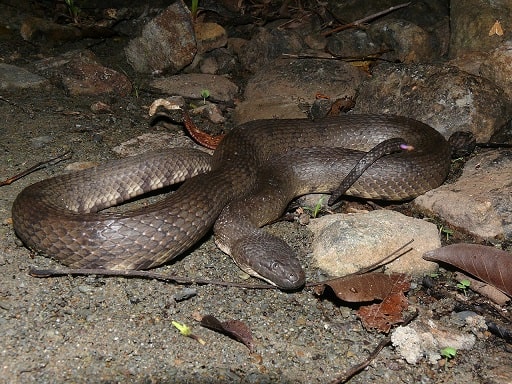
The dog-faced watersnake (Cerberus rynchops) is a mildly venomous species found in southeast Asia, which has never killed a human being, and lacks an aggressive personality as well. It’s a common species in India, Bangladesh, and Myanmar, where it sticks heavily to coastal regions, never straying to more than a few miles inland.
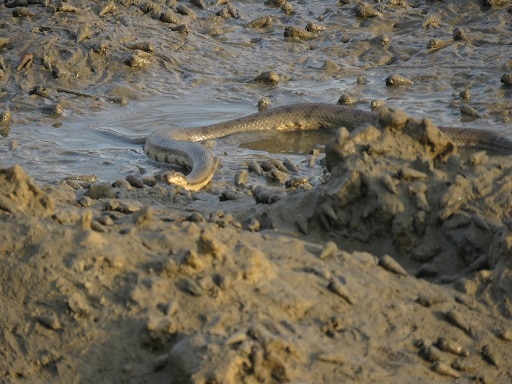
Some snakes specialise in leaves, while others specialise in dark mammal burrows. The dog-faced watersnake, meanwhile, has a different speciality: it’s the undisputed master of mud. This species’ main domain is coastal mud flats, including areas not far from human towns and cities.
Dog-faced watersnakes are particularly common in estuaries, the muddier the better. Rather than flat featureless beaches, they’re abundant in areas with a variety of muddy pools and tidal streams, intermingled with aquatic vegetation where they can disguise themselves, with one particular favourite being beds of mangrove roots. Dog-faced watersnakes even roll around in mud for camouflage purposes, deliberately covering themselves from head to tail in order to blend in.
Shelter is very important for this species, as dog-faced watersnakes face many predators in the wild. They’re vulnerable to predatory birds such as white-bellied sea eagles, and even fall victim to fellow snakes such as the king cobra (see this video).
Dog-faced watersnakes pose no threat to humans, unless their venom is dramatically more potent than anyone realises. Fishermen often bump into this species while wading through muddy shores or after accidentally collecting them in nets, yet no serious cases of bites have ever been reported.
| 2 | Thousands of miles of coastline |
Dog-faced watersnakes are barely heard of in the west, but they probably should be, as this species is secretly one of the most widespread snakes in all of southeast Asia.
To the west, this species reaches as far as southern Pakistan. The dog-faced watersnake then covers the entire coastline of India, from westerly realms such as near Mumbai, to the southern tip near Sri Lanka (plus Sri Lanka itself), to the entire eastern side of India. It then covers the entire Bangladeshi coast, and all of Myanmar, before disappearing in the middle-western section of Thailand.
Even here, the dog-faced watersnake is replaced with a near identical species: Schneider’s dog-faced watersnake (Cerberus schneiderii), which shares an almost identical appearance and habits, but is genetically distinct enough to be separate. This species then continues through peninsular Malaysia, Singapore, most of Indonesia, and virtually all the Philippines.
The dog-faced watersnake has an extremely narrow territory, not narrow as in small, but literally narrow on a map. As it never strays inland, its territory simply follows the Asian coastline, meaning that if you drew this species’ range on a map, it would probably be snake-shaped itself. This coastal empire stretches for thousands of miles, with only occasional interruptions by major towns and cities. Even in these urban areas, dog-faced watersnakes can still show up occasionally.
Because they stick to coastlines so closely, dog-faced watersnakes are extremely easy to find. European explorers have known about them since 1799, when they were first described by naturalist Johann Schneider.
| 3 | Dog-faced adaptions |
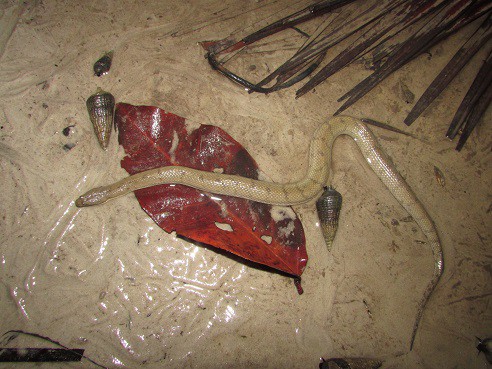
Dog-faced watersnakes aren’t truly aquatic in nature, but are instead a halfway-house species, with several of the adaptions wielded by real sea snakes.
The first is a salt gland, located below the upper lip, which absorbs and expels salinity from their bodies. This salt gland is less efficient than in fully aquatic snakes, expelling less salt per minute, but is still powerful enough to allow them to live along coasts, while pitvipers watch on enviously. Dog-faced watersnakes also have coastal-adapted skin, which has lower rates of oxygen loss to the atmosphere, and lower water permeability than land-based snakes, again reducing the infiltration of seawater.
Another aquatic feature is their nostrils, which are positioned high on their heads in order to allow breathing while underwater. These nostrils are partially responsible for their titular dog-faced appearance. It’s unlikely that you’d put one on a lead by accident, but this snake has a rounded snout, and round black eyes which fulfil the adorable pet image.
Their colour is also an adaption, as their murky tones are optimised for blending into mud. The dog-faced watersnake is a consistent dark brown to near black, with no noticeable patterns along its back.
| 4 | The world’s first jumping snake |
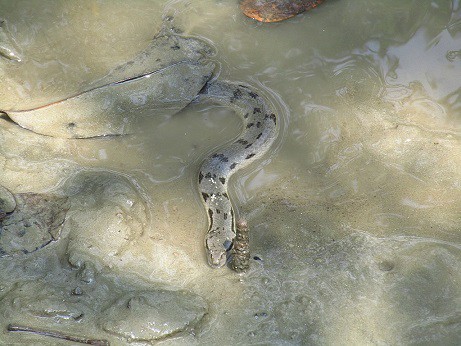
The dog-faced watersnake has one of weirdest skills of any snake: jumping. The first to discover this power was the camera crew of the BBC’s 2008 series Life In Cold Blood, filming along a muddy tidal flat in Singapore. Amazed viewers watched as a dog-faced watersnake sprung forward without even coiling its body, skipping over several feet of mud. Jumping isn’t a regular thing for the species, but in the most treacherous, unstable tidal muds, the dog-faced watersnake can leap in a way that defies the laws of biology.
Even its normal movements are unusual, as the dog-faced watersnake is a rare snake species to sidewind, moving directly sideways rather than forward. It’s rarer still by sidewinding to gain stability on mud, rather than sand. The majority of sidewinding snakes worldwide are desert-dwellers, like the Saharan horned viper.
Cerberus rynchops throws its body forward in advance of the head, brings its head and tail level, then rinses and repeats. This leaves recognisable impressions in the mud in its wake, like the J-shaped imprints of a sidewinder rattlesnake. With the dog-faced watersnake, these often take the form of two parallel tracks.
| 5 | Hijacks the laws of physics |
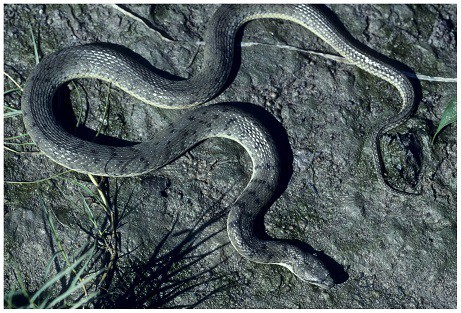
Dog-faced watersnakes have large bulbous eyes, but their eyesight is far from the best among snakes. They live in a murky, silty world, where fish are reduced to blurry objects and rocky walls only become apparent when everything suddenly darkens. Dog-faced watersnakes eat fish exclusively, and studies have found that they cannot identify prey using sight alone. Even if a motionless fish was centimetres from them, the snake would still be unable to make the catch.
Combining with the mud to ruin all visibility, this is a nocturnal snake, which hunts at night-time exclusively. However, experiments have been performed in well-lit tanks, and the dog-faced watersnake still failed to grab a fish using sight when visibility was excellent. Its eyesight is inherently poor, rather than simply caused by murky conditions.
Instead, dog-faced watersnakes tune into the laws of physics, sensing movements in water currents, realising that a fish is coming. They can anticipate the paths of fish based on slight water flow differences, in a way that a human being never could.
| 6 | Eats fish exclusively |
The dog-faced watersnake has a particular taste for two families of fish: the ricefish and the mollies. In a huge study at Sungei Buloh Wetland Reserve in Singapore, covering 1845 prey in total, these made up 54.1% and 35.4% of animals consumed by headcount.
13 other fish families were found in the dog-faced watersnakes’ bellies, but none exceeded 2% of overall prey. Mollies are larger than ricefish, and consequently, they made up by far the highest weight of prey, at 66.48% of the total.
Dog-faced watersnakes also have a tendency to swallow up multiple prey at once. They can swallow up to 4 ricefish, or maybe mix and match species such as 2 mollies, a halfbeak, a mullet and a cichlid. The same study found that female dog-faced watersnakes ate an average of 4.72 fish per meal, and males 4.3. One snake had swallowed 42 tiny ricefish and 4 mollies.
Cerberus rynchops is a mildly venomous species. No symptoms have been observed in humans, but as it chews fish, their pupils sometimes dilate, with a dark mark spreading steadily from the bite site.
One fish was released by a dog-faced watersnake and swam around until it died 16.5 minutes later. With particularly large fish such as cichlids, dog-faced watersnakes normally leave the water and rest on muddy shores to commence swallowing.
| 7 | Portion size control |
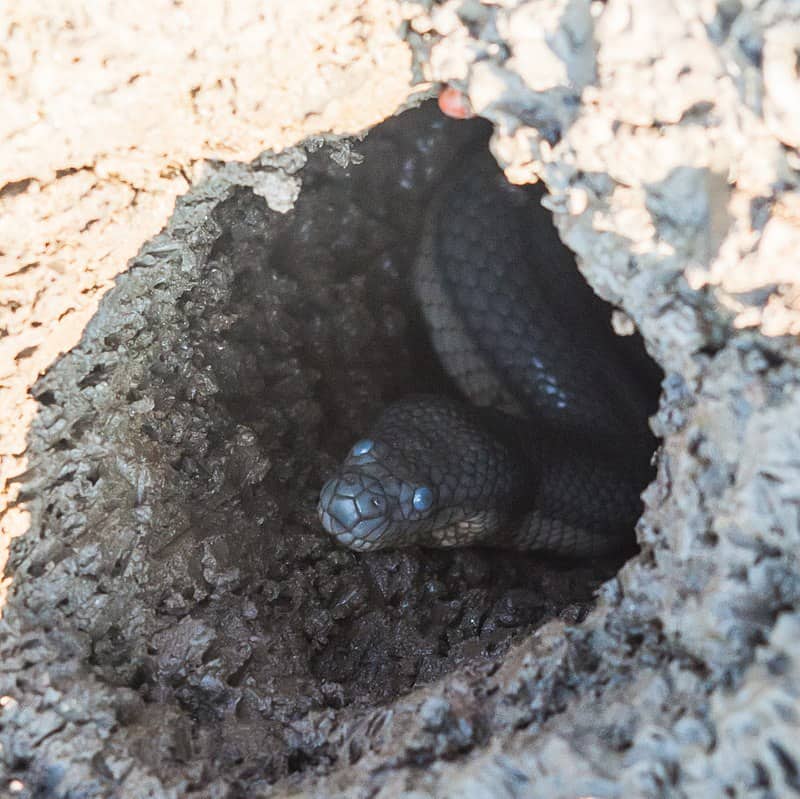
Dog-faced watersnakes are so sensitive to vibrations that they sometimes attack ripples caused by waterdrops. They’re smart in some ways, as they rarely eat prey anywhere close to their own body weight.
In the Singapore study, the largest prey was a Mayan cichlid weighing 16.48 grams, which was swallowed by a dog-faced watersnake weighing 147.36g. The largest prey relative to body size was another Mayan cichlid, weighing 10.25g versus 48.71mg. That was only 21% of the snake’s own size, which doesn’t approach the lunatic meals of an African rock python (which include crocodiles).
The one thing Cerberus rynchops struggles to suss out is the diameter of the fish it eats. It doesn’t matter how light a fish is; if its head is round, then it can be impossible to get down.
One snake with a head diameter of 1.8cm tried to swallow a Mayan cichlid with a diameter of 6.8cm. It spent 30 minutes in a valiant struggle before finally giving up, which was probably for the best.
| 8 | The 270 degree neck twist |
Dog-faced watersnakes can hunt surface-dwelling fish, middle-dwellers and bottom-dwellers all the same, and use varying hunting strategies for each. One is to prowl along the muddy tidal flats, examining pools and probing their heads into burrows to search for gobies and snapping shrimps.
Another is to simply wait on the muddy shores of a pool, waiting for mollies and ricefish to fleck their fins above the water’s surface. They’ll also enter the fray themselves, diving underwater and swimming along the bottoms of pools with their mouths open.
The dog-faced watersnake has some intricate manoeuvres for capturing fish. Sometimes, it’s as simple as standing in a school of fish and opening and closing its mouth. But when actually grabbing fish, dog-faced watersnakes always perform a sudden snap of their neck, which tilts their head back at a sickening 270 degree angle.
Furthermore, they keep the fish in a very casual, loose grip with their jaws. With their head bent at an extreme angle, they pin the struggling fish to their neck, so that if it thrashes its way to freedom, its jaws are free to instantly recapture it.
| 9 | Calm and docile |
Dog-faced watersnakes have a very calm personality. They reluctantly bite if harassed by humans, chewing on a finger repeatedly, but will show no reaction if you wander past them. This has helped them to gain a foothold in the reptile enthusiast market recently, although their love of fish means that the usual pinkie mice are rejected.
Dog-faced watersnakes aren’t close to endangered, with a “least concern” IUCN tag, but their mangrove habitats are often swallowed up by humanity’s sprawl. Former muddy paradises for this species have been turned into garbage dumps, tourist developments, or polluted mires, causing the snake to vanish without a trace.
The day may come, but dog-faced watersnakes aren’t close to being kings of their muddy ecosystems. They’re eaten by mangrove mud crabs, and their Australian relative, Cerberus australis, was once found in the stomach of a tiger shark.
| 10 | The dog-faced lifestyle |
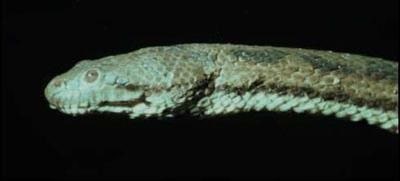
Dog-faced watersnakes are comfortable in their muddy universe, and rarely feel the need to seek out a new one. They stay not just in the same muddy tidal flat, but the exact same muddy pool for months on end.
In a study on 1087 dog-faced watersnakes, 20% were found less than 10 metres away from their original spot 8 months later. If they do seek out a new pool, it tends to be 100-200 metres away, but once they’ve grown tired of that muddy pool, they commonly return to the original one. This snake is intelligent enough to guide itself home using familiar scents and landmarks.
Cerberus rynchops is unusual in that males and females move the same distance in metres per day. In most snakes, males are more adventurous, due to their quest for mates. It’s possible that dog-faced watersnakes are so abundant on muddy tidal flats that males barely have to travel any distance to find their serpent soulmate.
Dog-faced watersnakes travel long distances occasionally – one travelled 851 metres to a new pool – but they’re mostly a sedentary, comfy snake.
| 11 | The dog-faced family |
Originally, the dog-faced watersnake (Cerberus rynchops) was believed to be the only Cerberus member, stretching from India to Australia. The first change happened when the Australian colonies were divided into their own, called Cerberus australis. This rules over Australia’s north coast, from West Australia to the Cape York peninsula of Queensland.
Cerberus rynchops was then divided into 4 subspecies, but by 2012, DNA analysis had revealed the truth once and for all. The 4 non-Australian species are…
Cerberus rynchops – the coasts of India, Bangladesh, Myanmar and Thailand as far south as Phuket, plus the Andaman and Nicobar Islands.
Cerberus schneiderii – most of Thailand, Malaysia, Indonesia, and the Philippines.
Cerberus microlepis – extremely rare, found solely in Lake Buhi in the Philippines.
Cerberus dunsoni – almost as rare, found solely in Palau in Micronesia.
None of the 5 species exist in the same place. Most are hard to distinguish except via subtle scale counts, although Cerberus dunsoni has a black belly and more rounded head scales. Today, the 5-member Cerberus genus is agreed upon by scientists, but the Australian Cerberus australis is more genetically isolated, while the other 4 are closer relatives.