
| 1 | Indian cobra |
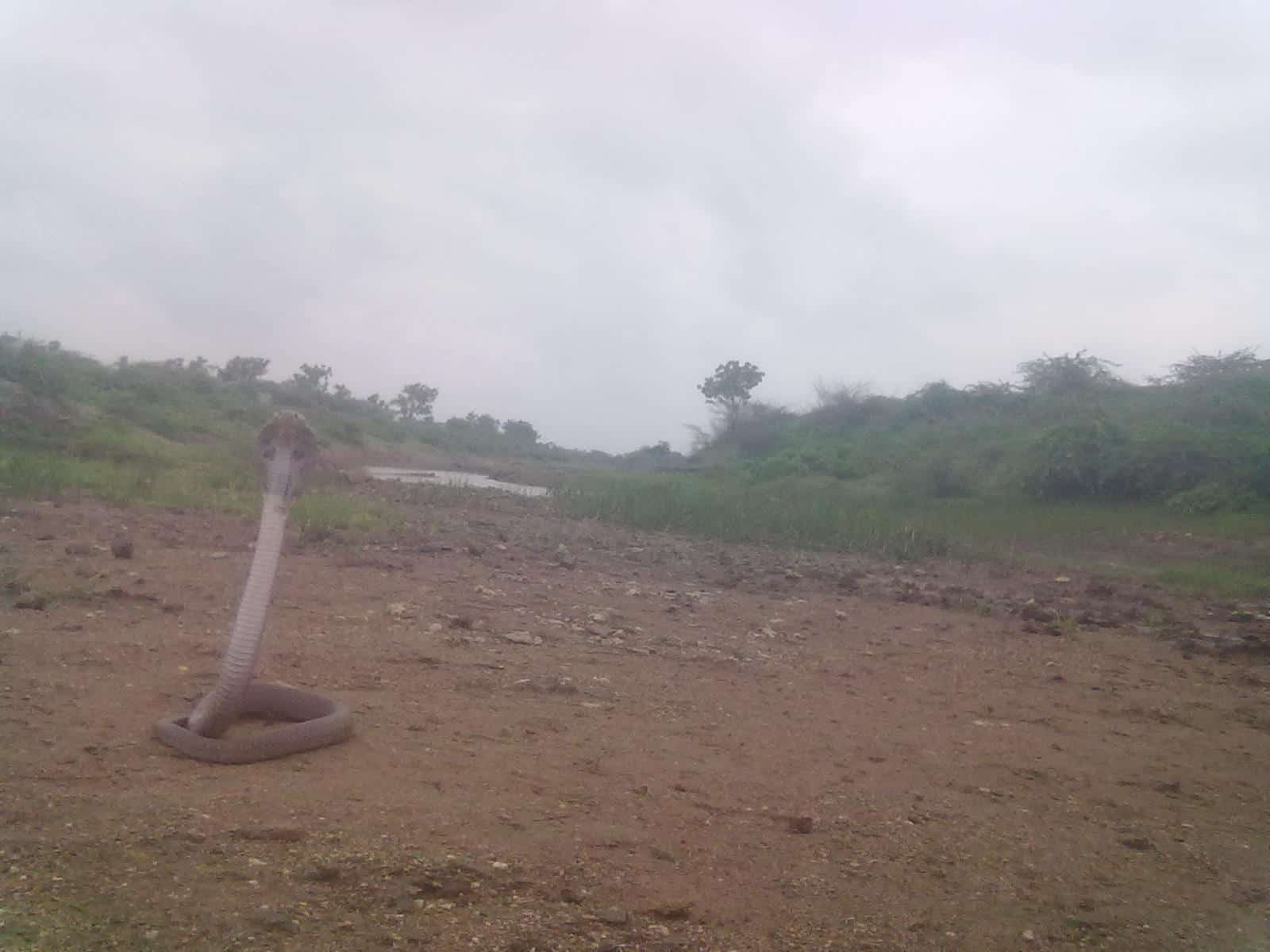
Maximum length: 220cm.
India is overflowing with venomous snakes, with several dozen, yet the Indian cobra (Naja naja) is the species which covers the most territory within the country. It also happens to be extremely common within that territory, invading farmland, parks and villages without bothering to check whether any humans are home first.
Indian cobras are found in the vast majority of the Indian subcontinent, except for the harshest deserts, densest jungles and highest mountains. There’s a couple of other cobras in India – the Caspian cobra and monocled cobra – but those are only found in the far northwest and northeast respectively. Instead, it’s the Indian cobra which is overwhelmingly the most likely species for you to bump into (as the king cobra tends to hide away in forests).
Indian cobras are fast-moving and energetic. If they feel threatened, they may flee, but they may attack, after producing their classic neck flare. In central India, this is the only cobra you’ll meet, but the classic ID sign is two round markings on the back of the head – hence the alternative name of spectacled cobra.
| 2 | Indian krait |
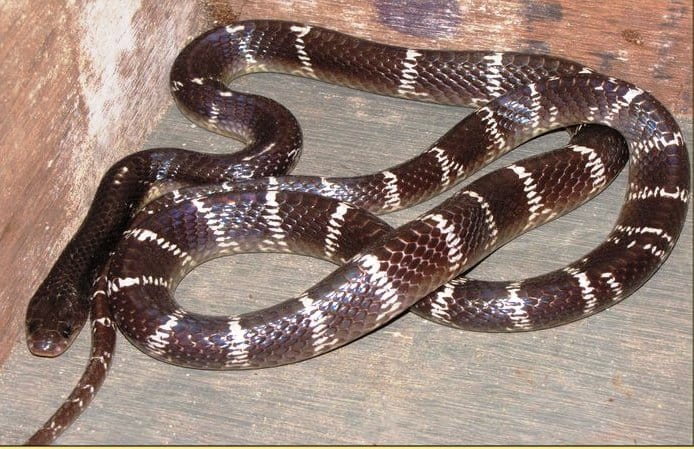
Maximum length: 175cm.
A much slower-moving species than the Indian cobra, but just as deadly. This species is recognisable by its black or chocolatey brown body overlaid with thin white stripes, a pattern which is copied by several mimics, such as the harmless Indian wolf snake.
Common kraits appear in almost all regions of India, but like the Indian cobra, skip the driest deserts and thickest jungles. They have a disturbing tendency to enter human dwellings, often while the occupant sleeps at night. Like the Indian cobra, common kraits typically kill their victims via paralysing neurotoxins which lead to respiratory failure, as opposed to kidney failure or brain haemorrhage.
The Indian krait should never be touched in any circumstances. As a heavily nocturnal species, this snake is sluggish by day, and much safer, but should still be treated with respect. At night, it becomes more aggressive, and should never be approached at all. India is also home to the sind krait (Bungarus sindanus) in the west, but this species is easily the most common.
| 3 | Russell’s viper |
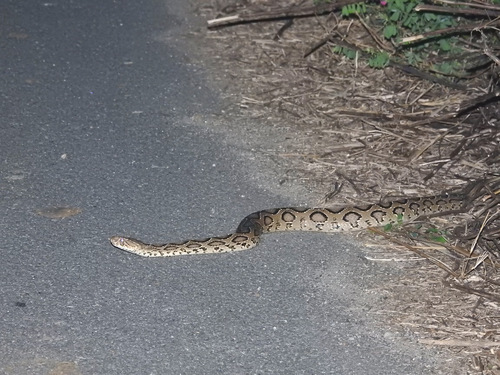
Maximum length: 185cm.
When it comes to raw fatality count, this species may top the tables, not just within India, but the entire world. The Russell’s viper is one of 4 species in India dubbed the “big 4” – those whose deadliness, aggression and territory covered far outstrip the rest.
While Russell’s vipers are slightly less widespread than Indian cobras, two factors conspire to make them even deadlier: 1) their tendency to lurk on bushy farmland, and 2) their immobile ambush hunting strategies. These combine to make stepping on them incredibly easy, or even brushing your foot lightly against one, which may trigger no reaction, but just as commonly triggers an aggressive lunging strike.
The vast majority of Russell’s viper deaths are due to kidney failure, as this species lacks the neurotoxins of an Indian cobra. What it does possess is a high venom yield, and endless cytotoxins and haemotoxins. Russell’s vipers even cause pituitary gland damage, causing victims to undergo “reverse puberty”.
The one beneficial aspect of Russell’s vipers is their diet, which consists heavily of rodents, and therefore gives farmers a nice economic boost – assuming they can avoid their fangs and not suffer an amputated limb.
| 4 | Saw-scaled viper |
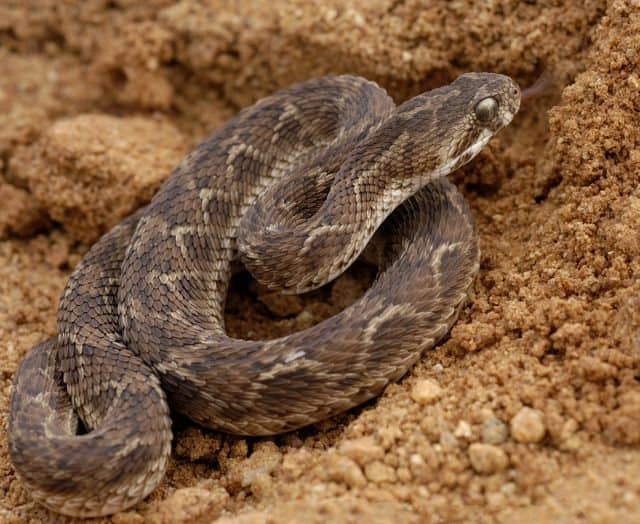
Maximum length: 50cm (80cm in certain locales).
The final member of the big 4, and another potentially deadly species. This species is the most tolerant of dry conditions of India’s big 4, and even appears in dry desert areas in the northwest, in the Thar Desert of Rajasthan (bordering Pakistan). Russell’s vipers and common kraits never appear in these areas, and the adaptions of the saw-scaled viper include sidewinding, enabling it to move over unstable desert surfaces.
The caveat is that saw-scaled vipers are less tolerant of moist or wet conditions than the Russell’s viper, but this species is still fairly flexible, and appears in dry grassy fields, dusty villages and perhaps on the edges of crop fields. Piles of coconut husks are a particular hotspot for this menacing snake.
Saw-scaled vipers are nocturnal, and often lurk in burrows by day (never poke your arm into one). Their venom is specialised against scorpions (a favourite prey), but is still powerful against mammals, and typically triggers kidney failure in victims.
In one study from a hospital in Maharashtra state, central India, this species contributed the single most bites, at 274 bites out of 663 (41.3%). However, bites were slightly less severe than for the Russell’s viper, Indian cobra and common krait.
| 5 | Common bamboo pitviper |
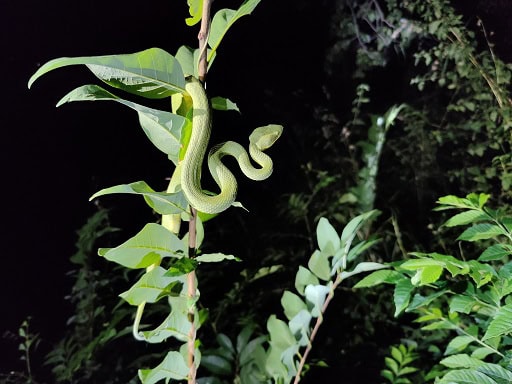
Maximum length: 113cm.
The common bamboo pitviper (Craspedocephalus gramineus) is the greenest venomous snake found across the vast majority of India, and the most commonly found lurking on tree branches. While the big 4 far outstrip the rest in terms of territory covered, this species is easily 5th, appearing across a large area of central and southern India, including hilly areas as well as lowlands. Hotspots include the outskirts of Mumbai and West Bengal in the far northeast.
This species causes far fewer bites than the species above, but nevertheless, a 2023 study concluded that “bamboo (Craspedocephalus gramineus) pit vipers can potentially inflict severe envenoming“. The venom was less severe than that of a hump-nosed pitviper (see below), but equal to that of the Malabar pitviper.
Common bamboo pitvipers are recognisable by a leafy green body contrasting against a yellow belly. The body sometimes has thin black markings, while the body length is never over 120cm. Then there’s a strongly triangular head, vertical pupils, and a constant home of tree branches rather than the rocky ground or grassy hillsides.
| 6 | Banded krait |
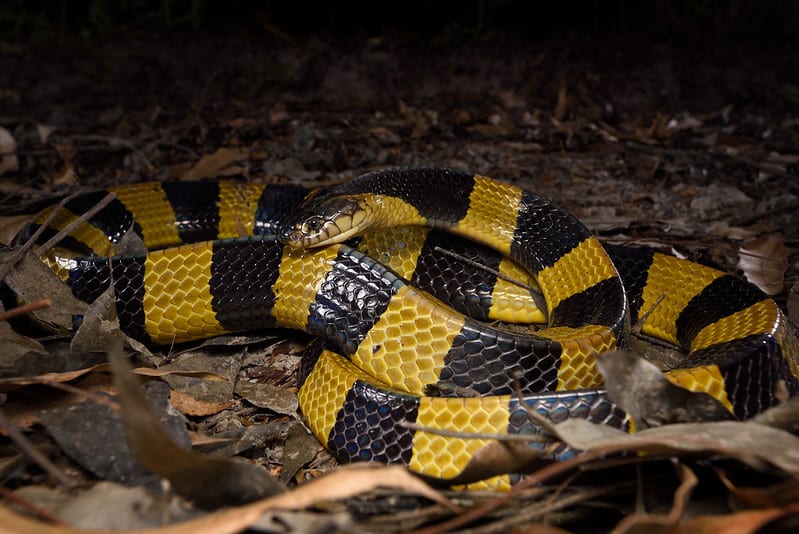
Maximum length: 212.5cm.
The banded krait belongs to the same Bungarus krait genus as the common krait, but nobody could ever confuse them, as this species has striking black and yellow patterns, like painted road traffic markings. This is the 6th most widespread venomous snake in India overall, and it’s one to never underestimate, with powerfully neurotoxic venom capable of disabling lung inflation and deflation just like its more common cousin.
Banded kraits focus on the northeast and east of India, skipping the north and northwest. They generally appear in moderate to moist areas rather than parched plains, and are nocturnal rather than diurnal.
In southwest India, banded kraits are rarer, but have secretive colonies in the humid, damp Western Ghats mountain range (e.g. Kerala state). Only a handful of official sightings have been made here, and it’s possible that more locations will be discovered in the future.
This species causes a few bites annually; a study from Kerala state (SW India) found 2 bites from January 2012 to October 2016, compared to 538 for the Russell’s viper. Nevertheless, its venom is more than capable of killing. Its diet consists of fellow snakes and reptiles.
| 7 | Hump-nosed pitviper |
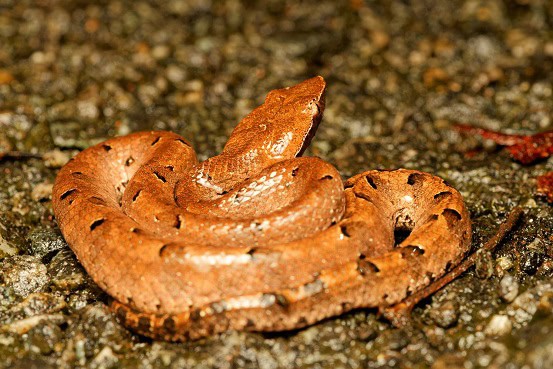
Maximum length: 50cm.
The hump-nosed pitviper is a ground-dwelling species found mainly in southwest India, in the damp, hilly Western Ghats mountain range, as well as Sri Lanka to the south. Hump-nosed pitvipers are never green, and they rarely dwell on branches, despite almost always appearing in forests. Instead, they specialise in leafy forest floors, blending in easily using their glistening golden scales.
Hump-nosed pitvipers are small, never exceeding 50cm. Yet their venom appears to be deadlier than once believed, with the ability to cause kidney failure and potentially death. One hangout of this species is cashew plantations, where they lurk in a leaf litter ecosystem, hiding among the fallen leaves and waiting for lizards darting between the layers slightly lower.
Farmers often meet this species, and king cobras occasionally eat them. Hump-nosed pitvipers are named for their upturned snout, and have two cousins on Sri Lanka: the lowlands hump-nosed pitviper and Sri Lankan hump-nosed pitviper. However, this is the only species in India. Despite only appearing in the southwest, the hump-nosed pitviper is extremely common wherever it does live.
| 7 | Malabar pitviper |
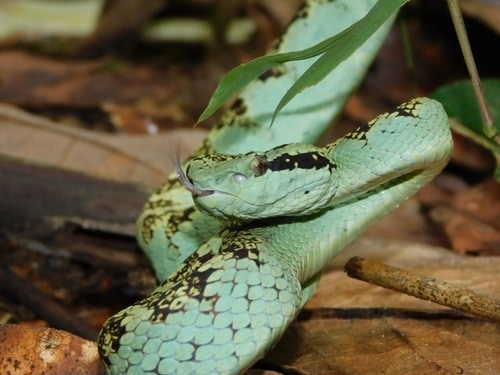
Maximum length: 89cm.
The other main pitviper of India’s Western Ghats mountains. This species often lives in the exact same forests as the hump-nosed pitviper, sharing space with its venomous viper brethren. Yet the two have strong differences which allow them to coexist, the main one being a completely different habitat: Malabar pitvipers spend most of their lives on tree branches, while hump-nosed pitvipers stick to the ground.
Malabar pitvipers can stay on the same tree branch for days or weeks without moving. Their diet consists almost completely of amphibians, including Malabar gliding frogs (one of their favourite meals), which they wait for patiently and quietly, making no movement which could betray their presence other than a gently flecking tongue.
Malabar pitvipers are immensely variable in colour. Minty green, brown, orange and tree bark grey are all possibilities. They have vertical pupils and a triangular head, and move slowly and patiently rather than zipping around. This species does stray to the ground on occasion, and when it does, it’s highly vulnerable to one predator: the king cobra, which adores the taste of this species.
Like the hump-nosed pitviper, Malabar pitvipers only appear in southwestern India, but are highly abundant in their hilly mountain forests.
| 9 | King cobra |
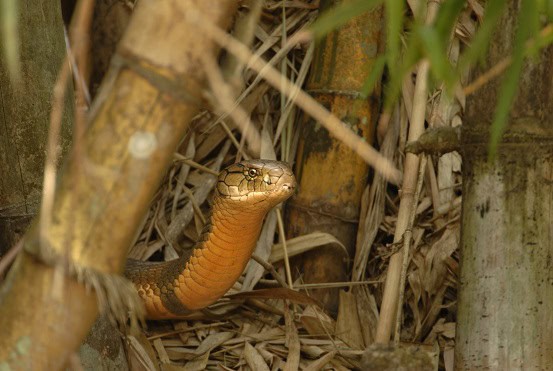
Maximum length: 5.85 metres.
The king cobra is the official largest venomous snake in the world, but is far less widespread in India than the more flexible Indian cobra. While Indian cobras appear in farmland, towns and grassy fields alike, king cobras prefer to hide away in untouched forests, occasionally venturing out to villages nearby.
King cobras aren’t widespread in India, and are divided into two pockets. The first is northeast India, including the states beyond Bangladesh such as Manipur and Assam, plus West Bengal and Odisha. There’s also a thin line of territory running along the Himalayan foothills near Nepal.
The second pocket lies in the pristine, ecologically rich Western Ghats mountains of the southwest, and between lies hundreds of miles of territory where they don’t exist. These two pockets actually consist of two distinct species, which diverged millions of years ago, but are very similar in appearance, diet and lifestyle.
King cobras prey heavily on Malabar pitvipers, often knocking them out of trees deliberately, and can track their scents through humid forests with ease. Their venom is potent in humans, potentially lethal, and king cobras often fasten their jaws to a human arm and deliberately pump extra dosages in. Fortunately, their shy habits mean that encounters with humans are far rarer than with Indian cobras.
| 10 | Black coral snake |
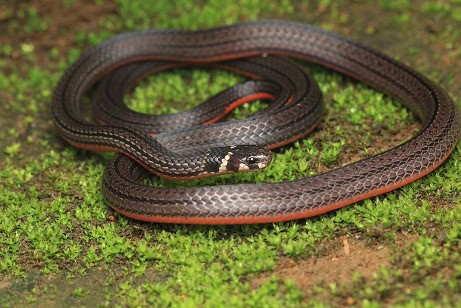
Maximum length: 115cm.
Another species found in the southwest only, in the damp Western Ghats mountains, an overflowing paradise of exotic creatures found nowhere else, most harmless, a few utterly lethal. The black coral snake falls into the latter category, as while its venom has never been researched in depth, its relatives worldwide are severely dangerous. These include the Malaysian blue coral snake, which once killed a Singapore man within 5 minutes.
Black coral snakes (Calliophis nigrescens) are widespread, appearing in virtually the entire Western Ghats mountain range, including in Kerala, Karanataka, Goa and Maharastra states. They also exist just to the east of Mumbai, at the northern extent of their territory.
This species is poorly researched in general, though its diet is known to include fellow snakes. It leads a shy, semi-burrowing lifestyle, spending its days buried beneath leaf littler, soil and forest mulch. Many encounters with humans occur when it strays to roads, and ends up as roadkill.
If you do find a black coral snake, it’s easy to recognise, with shiny grey and vivid red colours, but take this warning, and only admire its colours from a distance, or they might be the last thing you’ll ever see.
| 11 | Monocled cobra |
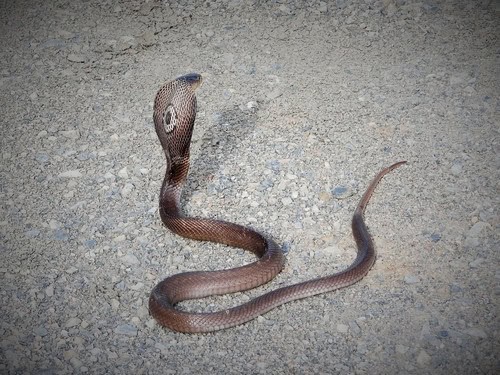
Maximum length: 230cm.
Another cobra found in India, but only in the northeast. This species is far, far less widespread across the country than the Indian cobra, but is abundant in Assam, Manipur and Tripura states, as well as the Himalayan foothills of far northern India.
Monocled cobras have a single round marking on the back of their hood, thus explaining their name. The bulk of their range lies in Thailand and Myanmar, and just spills into India, with Indian cobras controlling most of the country. However, this species is still extremely deadly, and most probably fatal if antivenom isn’t administered. Fatalities occur due to respiratory failure rather than kidney failure, and dizziness and sudden fatigue are also possibilities.
More disturbingly, the monocled cobra has the ability to spit. It isn’t a true spitter, and lacks specialised holes in its fang tips, but can throw its head upwards at a sharp angle, while releasing a globule of venom, which produces a spitting effect similar to true spitters like the red spitting cobra (Kenya, Ethiopia).
If you’re lucky, the monocled cobra will just flee into the bushes. If you’re luckier, you won’t meet one at all.
| 12 | Spot-tailed pitviper |
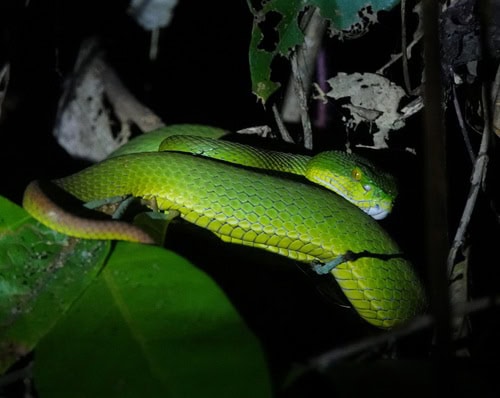
Maximum length: 104.5cm.
Another venomous snake mainly found in northeast India. This species is the main-branch dwelling pitviper in northeast India, e.g. Manipur and Assam states, plus a small area of West Bengal.
The red-tailed pitviper (Trimeresurus erythrurus) stays still on tree branches and strikes anyone that dares to stray too close. It ventures to the ground occasionally, but spends the majority of its life on bushes or trees 1-2 metres high, as well as on manmade objects like chain-link fences, which it climbs readily.
The venom of this species is well researched, and its symptoms are mainly local rather than neurotoxic: necrosis, severe swelling, and blistering, plus defibrination of the bloodstream (potentially resulting in free bleeding). Its diet includes frogs and mice, and it’s particularly common in Himalayan foothill forests at elevations of 1000-2000 metres. While not common across India, it’s abundant in the northeast where it does appear.
This species is most likely to be confused with the common bamboo pitviper, but the two species have very little area of overlap (possibly in West Bengal). However, here’s a few differences anyway: 1) an orange eye in this species versus green for the bamboo pitviper, 2) fewer or no black markings in this species, and 3) the red tail, with the bamboo pitviper’s tail being simply green. The split between the bright underside and green body is also more striking in the common bamboo pitviper.