
| 1 | Forest cobra |
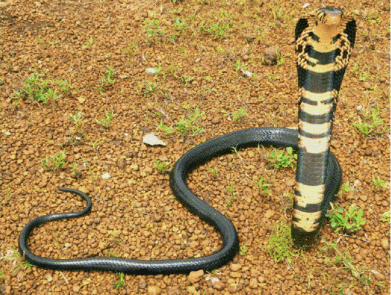
Maximum length: 320cm.
In the average British forest, the biggest risk is slipping in your wellies and getting mud all over your new jeans. African townsfolk have a different problem: the cunning forest cobra. This is a species of western and central Africa, with a powerful venom that mixes neurotoxins and cytotoxins.
Forest cobras (Naja melanoleuca) exceed all other true cobras in length, measuring up to 3.2 metres. While they don’t encounter humans often, they won’t hesitate to rear up and lunge at anyone they decide is an intruder. Enter their forest domain and nobody is exempt, from local kids and beekeepers, to Western scientists and even Boko Haram soldiers.
Forest cobras aren’t always contained within forests (this island is full of them), but they’re easily their headquarters. This is a fast, active species, which covers a lot of ground each day. Like any cobra, forest cobras make multiple, sharp stabbing lunges at anybody they deem to be an aggressor.
In all countries where they live, forest cobras overlap with several other cobras. In Nigeria, they coexist with black-necked spitting cobras, as well as the occasional Egyptian cobra. But those two species are much more common in villages and towns, whereas forest cobras shy away from humanity, and are always the most common species in forests (hence the name).
| 2 | Boddaert’s tropical racer |
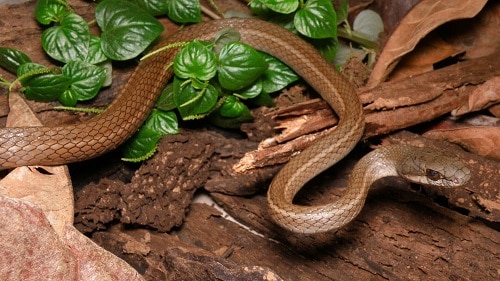
Maximum length: 150.5cm.
A snake which dwells in forests both local and remote. Boddaert’s tropical racer (Mastigodryas boddaerti) reaches lengths of at least 1.5 metres, and primarily feeds on lizards. This is another snake that can reach large numbers, particularly in the deeper, darker inner sections of forests. Rather than a lazy ambusher, this is a fast, often manically active species.
Boddaert’s tropical racer is a snake which forages directly, charging after prey on its branches and subduing them with a chewing of mild venom. 74% of its diet consists of reptiles (14% mammals), and it hunts mainly by day.
Boddaert’s forest racers are particularly common in Trinidad, as well as Colombia and French Guiana. They’re a decent way up the food chain, but still face threats from the likes of the mussurana, an infamous snake-eating snake.
It can be hard to tell that Boddaert’s tropical racers are around until you’re some way down a forest trail. By the time you realise you’re in their home forest, it might be too late to turn back. Fortunately, this snake is completely harmless, and won’t ambush you in large numbers. Boddaert’s tropical racers sometimes bite, but this is usually a last resort, after fleeing, thrashing, vibrating their tail, and even detaching their tail.
| 3 | Scarlet snake |
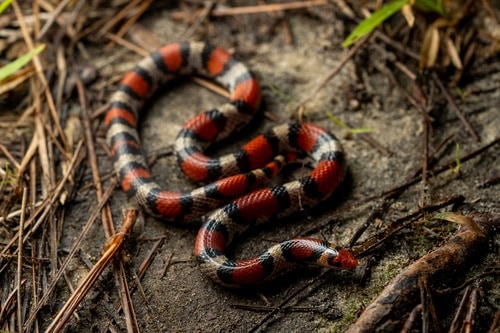
Maximum length: 82.3cm.
This non-venomous forest dweller could easily live close to your home in Florida or Georgia. The scarlet snake is a shy species which mainly lives in burrows dug out of soft soil. It’s very difficult to find, as some reptile enthusiasts spend years searching for this shy forest snake, only to fail miserably.
Scarlet snakes inhabit a variety of forest types, including damp hardwoods, sparse flatwoods, and coniferous forests. You can look for this snake under every rotting tree log and pile of leaves and still find none, even after 100 cumulative hours of searching. Meanwhile, a dog walker who follows the same woodland path every day will probably meet the scarlet snake once or twice by accident, with no idea what they’re actually looking at.
Scarlet snakes mostly feed on lizards, and have a taste for turtle eggs, which they pierce with a specially shaped tooth. Their forests can be located alongside a road, or bordered by a dog-walking park. As long as a decent clump is still standing, scarlet snakes can cling on.
If you’re lucky, this species could be a 1 minute walk from your house. Grabbing a towel and sitting cross-legged on the forest floor for several hours is probably the best way to find them.
| 4 | Large-eyed pitviper |
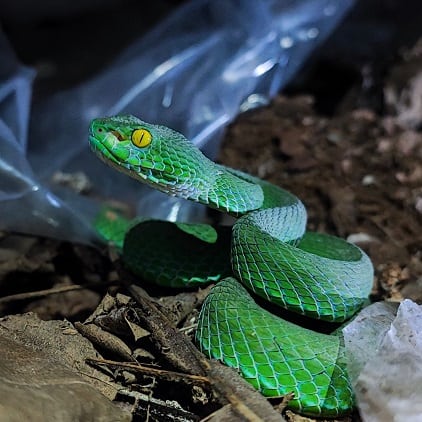
Maximum length: 74.1cm.
A 50-70cm snake of Thailand, with a cytotoxic, skin-shredding venom. Large-eyed pitvipers belong to the vast Trimeresurus pitviper genus, which are almost all extremely green, with a few subtle differences. The classic sign with this species is large eyes, a red tail, and a fainter white lip line than others.
Large-eyed pitvipers (Trimeresurus macrops) like forests, but also cope well with human disturbed areas. With this snake, the priority is to remember an instinct that humans naturally forget: look up! Large-eyed pitvipers are rarely found on the forest floor, preferring branch perches 1-3 metres above ground, which they rest on for most of the day, glaring at passersby menacingly.
Many don’t notice this species, but others spot the snake, and freeze so solid, petrified, that the snake seizes its chance. In Thailand, even the simplest walk through the forest can end with a pitviper falling on your head, just as it can end with a heartwarming Bambi encounter.
The extreme greenness is designed specifically to keep this pitviper clan invisible in forests. Large-eyed pitvipers can even appear in forest clumps in inner city Bangkok – this is no remote mountain snake.
| 5 | Grenada tree boa |
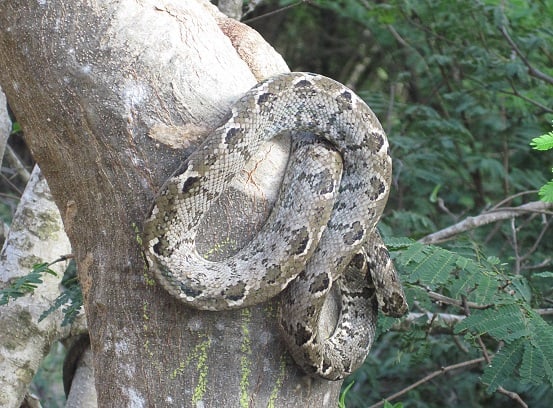
Maximum length: 188cm.
Found exclusively on Grenada and nearby islands, this is a tree-loving snake which belongs to the same Corallus genus as the emerald tree boa. The difference is that Grenada tree boas actually prefer disturbed forests near villages, rather than remote, untouched rainforests.
In adulthood, Grenada tree boas mainly use ambush tactics, but they’re not shy in the slightest. They prefer to rest casually on tree branches 2-5 metres high, waiting patiently for rodents. Grenada tree boas are unbelievably easy to find – just park your car in a village and walk for about 30 seconds into the local woods. It’s estimated that they’re more common now than in pre-Columbus times (late 1400s), because of the growth of settlements.
Grenada tree boas are particularly addicted to rodents, which flock to feed on juicy fruit. Consequently, a spacious wood next to a busy fruit plantation is their absolute favourite spot.
Grenada tree boas can be extremely abundant, as researchers have found 30 in one hour close to Beausejour and Pearls. They’re so common that most superstition has worn off, with locals realising that the woods hosting them are perfectly safe, if slightly unnerving.
| 6 | Black-headed snake |
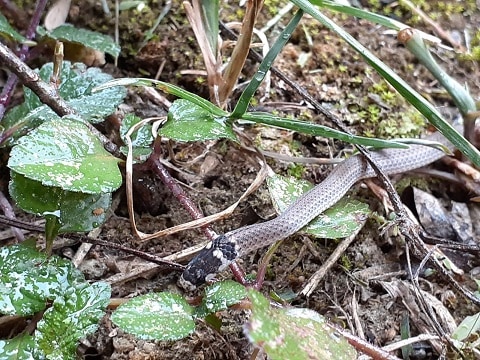
Maximum length: 43.5cm.
A widespread snake in South America, which ranges from Costa Rica all the way to Argentina. Black-headed snakes eat a diet of centipedes, and out of all harmless snakes in Brazil, they might be the most widespread. This is a patient forest species, which is largely underground-dwelling, and lurks under rotting logs and leaves when it does reach the surface.
Black-headed snakes (Tantilla melanocephala) are mildly venomous, and take 2-7 minutes to rearrange a centipede before finally swallowing, which is always headfirst. Black-headed snakes also face battles of their own, becoming stuck in the webs of greedy brown widows, and being swooped down upon by burrowing owls. All this can be happening a couple of hundred metres from the family kitchen, where parents and kids sit eating chicken for dinner.
This snake sticks to the ground rather than clinging to branches. It’s pretty hard to miss, due to the jet black colours which cover most of its head. This species belongs to the huge Tantilla genus (68 members), of which it’s easily the most common member.
| 7 | Mamushi |
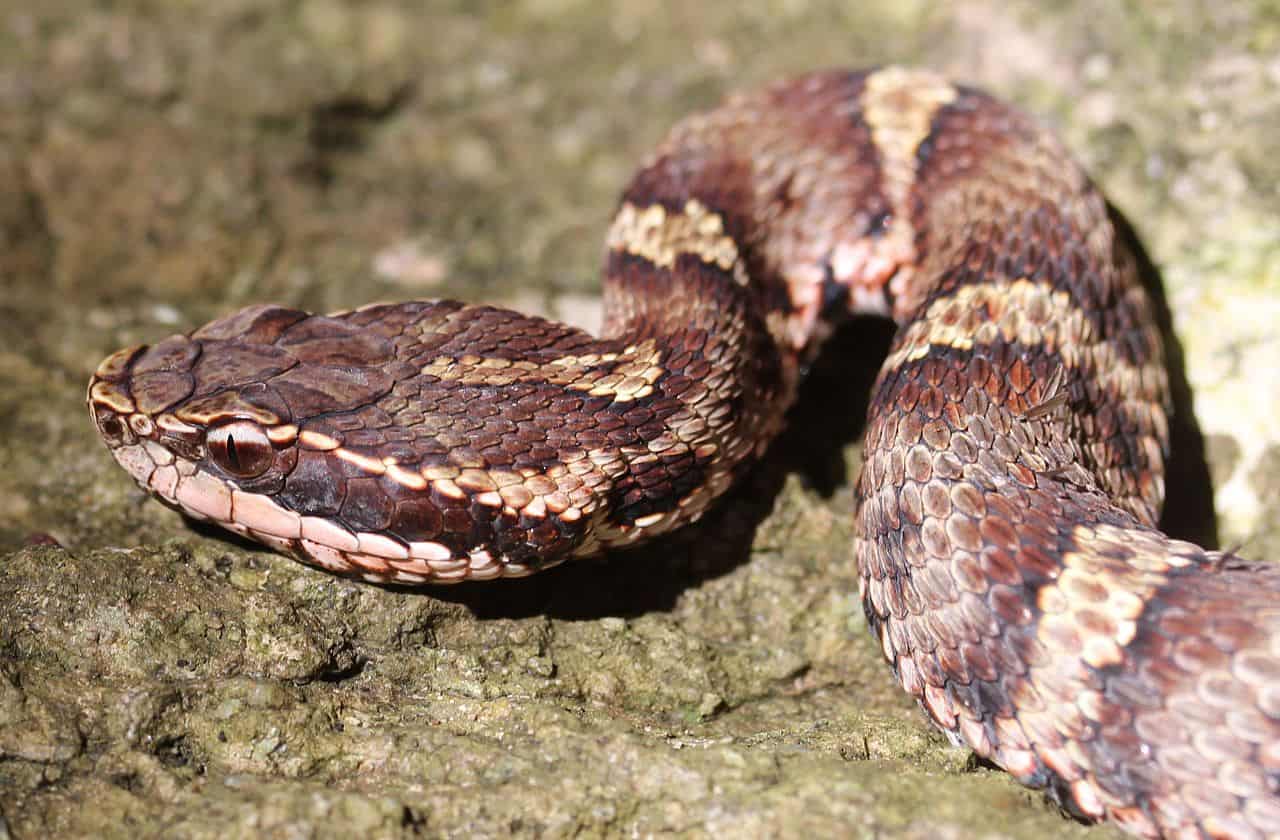
Maximum length: 91cm.
The mamushi is the main venomous snake of Japanese forests, including those directly next to village paths. This is the snake parents constantly warn their children about when playing in the local woods. Its venom is a cocktail of nastiness, with a mixture of neurotoxins, haemotoxins and cytotoxins. Its bite is rarely fatal, but can cause flesh to liquify near the bite wound.
If a mamushi was offered any location in the world to live, it would still choose a mild forest with a thick bed of leaves. It rests beneath large piles of those leaves, creating virtually impenetrable camouflage. This is central to its entire hunting strategy, as when a small rodent walks past, the mamushi leaps from these leaf beds in a surprising display of speed.
The worst thing is that mamushis don’t move much, causing people to step on them accidentally. Great fear surrounds this snake in Japanese villages, as it only takes one snakebite for a forest to acquire an evil reputation. Even a slight rustling in the bushes is assumed to be a vicious pitviper, sending gangs of teenagers fleeing, who have usually sneaked in for a bet, against their parents wishes.
The legends grow over time, until one day, the forest is a place of pure fear, not fun and enjoyment. That said, there are many local forests in Japan where the mamushi really is lurking and waiting.
| 8 | Painted bronzeback |
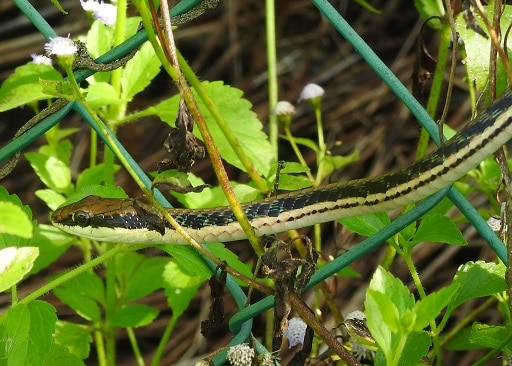
Maximum length: 125cm.
One of Thailand’s most common species overall. This is a mildly venomous frog hunter which effortlessly leaps between trees, and weaves along the thinnest possible branches.
The painted bronzeback (Dendrelaphis pictus) is an incredibly likely species to meet in a local forest, whether near a police station, rice field, or simple village hut. Compared to other bronzebacks (Thailand has 11), this species is particularly comfortable in environments altered by mankind, making it a likely species to appear in disturbed forests near houses, as well as deep ones.
ID signs of the painted bronzeback include a brownish-green body, sharply contrasting against a pale cream belly, and a red tongue. It has hopeful round eyes, with round pupils, rather than vertical pitviper pupils.
The painted bronzeback isn’t a species of one remote valley or obscure southern county; it appears across virtually all of Thailand. If you’re in a hotel near Bangkok and venture into a forest for fun, this is a highly likely species to meet. Then again, you might stay far away from any forests, with all their hissing serpents, and we can’t blame you. You might not even need a forest to find this species, it’s so comfortable in human habitats.
| 9 | Clark’s ground snake |
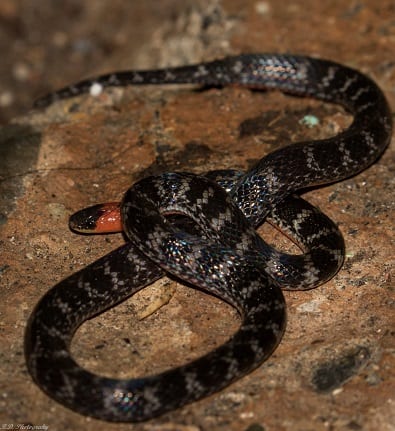
Maximum length: 39.6cm.
Another fossorial snake which is difficult to find. Like the scarlet snake, a dedicated herpetologist could spend an entire year planning an expedition to find this species and fail miserably.
Clark’s ground snake (Atractus clarki) is found only in western Colombia and northwest Ecuador, and has several classic underground adaptions, such as beady eyes and smooth scales to prevent dirt from building up. Its diet mainly consists of earthworms, and consequently, it’s always found in areas of forests with soft floors to excavate. Clark’s ground snakes inhabit untouched, pristine forests, but also old forest remnants, amid a patchwork of fields and rural houses.
The barriers to spotting this snake are immeasurable. Step 1 is to realise that Clark’s ground snake even exists, by reading an obscure corner of Wikipedia. Step 2 is to enter the forest at precisely the right hour, when they’re exploring the surface and not lurking in their underground lairs.
Next, you have to lay your eyes on the tiny, 30x30cm forest patch where this species is lying. Finally, you need the visual acuity to distinguish Clark’s ground snake from nearby fallen twigs.
If you live by a forest in Colombia, your front porch could be 100 metres from a Clark’s ground snake colony, yet you might never meet one, or realise that they’re there.
| 10 | Radiated ratsnake |
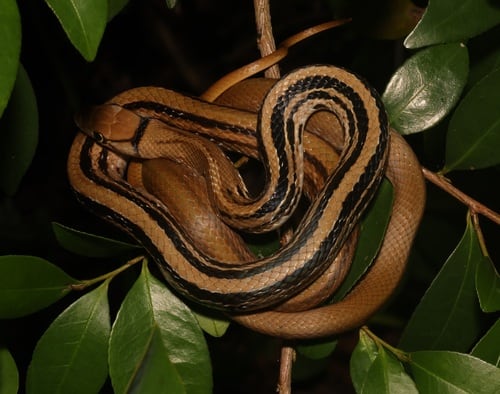
Maximum length: 230cm.
The radiated ratsnake (Coelognathus radiatus) is a constricting serpent of southeast Asia, which lacks any form of venom and regularly reaches 200cm long. This species can live in remote forest corners accompanied only by a lost hiker, but is equally common in forests bordering towns, particularly those adjacent to village rice paddies.
The radiated ratsnake is a fast-moving species, a classic one to make rustling sounds through the bushes and cause people to rotate on the spot in panic. This is a day-faring species, which is very simple to find, as it isn’t shy in the slightest.
Radiated ratsnakes dislike people entering their personal space, and have a defensive personality. Despite their lack of venom, reptile handlers would still rather approach them with steel snake tongs.
With the radiated ratsnake, there’s no need to drive to the deepest, most treacherous forest imaginable, park your car, and spend 3 days trudging around the Thai forest from hell. There’s a good chance that this species lives in a local forest backing onto your backgarden or holiday hotel. The only worry is being ambushed by its serpent mates, such as the Malayan pitviper in Thailand, or even a 5 metre king cobra.