
| 1 | Rhombic night adder |
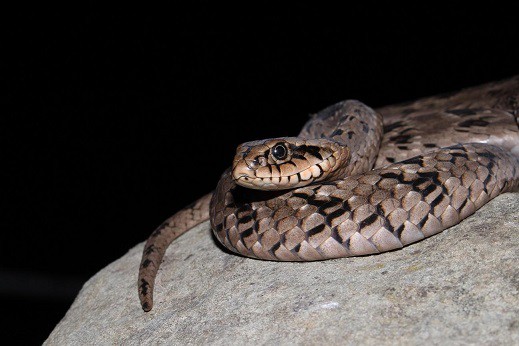
Maximum length: 93cm.
A moderately venomous species found across a swathe of eastern Africa. Common night adders (Causus rhombeatus) range from South Africa to as far north as Ethiopia, and Zimbabwe doesn’t escape their wrath. This snake has a false name, as while they’re able to hunt at night, they’re more active during the day.
Common night adders don’t have particularly memorable patterns, with grey and black intermingling. Their colours are quite similar to the harmless common egg eater (Dasypeltis scabra). But they can easily be identified by a black V-shaped marking on the head, with the point ending between the eyes. Uncommonly for a viper, this species has round pupils rather than vertical.
Though venomous, aggressive and eager to bite victims, common night adders have no confirmed deaths to their name. Their venom is mostly cytotoxic, causing swelling and possibly mild necrosis. This is a heavily toad-eating snake, and hence tends to appear in damper regions of Zimbabwe.
This species only measures 30-60cm. Even the longest of all time was only 93cm (discovered in eastern Zimbabwe). However, this isn’t a license to underestimate them. Rhombic night adders can move surprisingly quickly, advancing 3 feet in one second from their stationary position on a rock. This is the longest and stockiest of the Causus viper genus, with a bulky head and large tail.
| 2 | Common purple glossed snake |
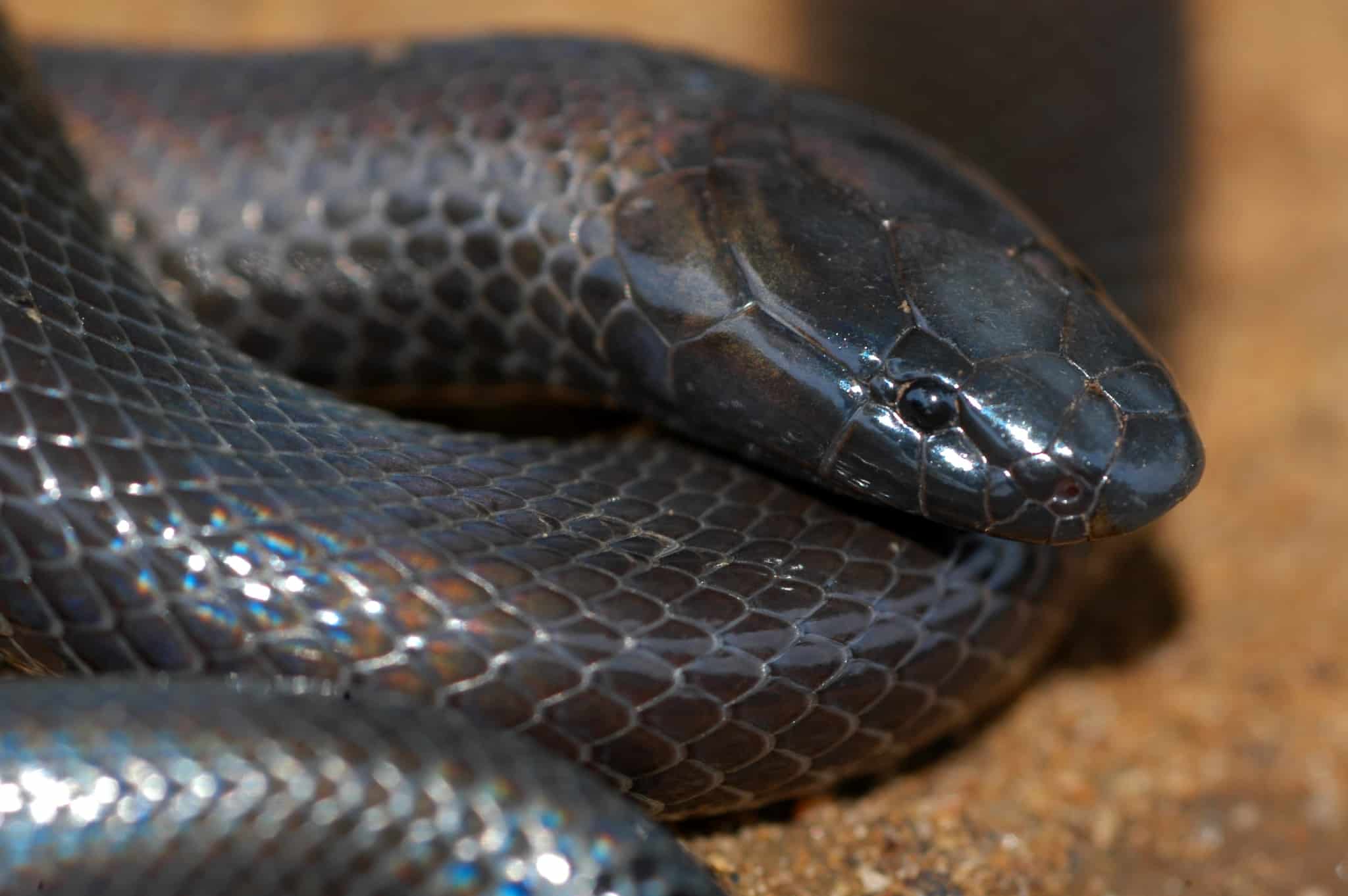
Maximum length: 111.1cm.
The common purple glossed snake (Amblyodipsas polylepis) is a fossorial burrower which usually only appears after heavy rains, sometimes under leaf litter near farms or a mango tree. This snake isn’t the fastest or most venomous in Zimbabwe, but it might be one of the shiniest. It also has an iridescent sheen, reflecting back the colours of the rainbow, like the sunbeam snake of Thailand.
Purple-glossed snakes are confirmed to be venomous, but the exact properties of this venom are barely understood. It’s assumed to be mild, perhaps capable of causing swelling.
This snake rarely bites or lunges wildly. Instead, purple glossed snakes prefer to entrance their enemies. They hide their head and move their tail, which looks virtually identical, in a rhythmical pattern so that predators get distracted and attack the wrong body part. This isn’t a problem for us, as most humans aren’t hellbent on destroying a snake’s brain, but running far away before the snake can bite them.
Purple glossed snakes mainly prey on another underground family: the worm lizards, legless reptiles which resemble snakes themselves. Species confirmed in their diet include Monopeltis luandae, Anchieta’s worm lizard, and Zygaspis violacea.
| 3 | Boomslang |
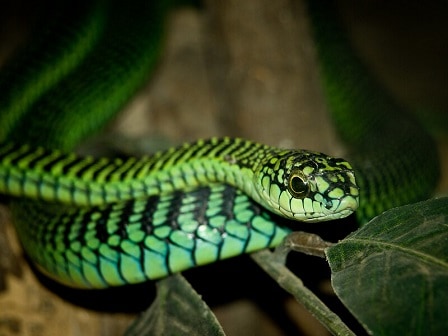
Maximum length: 2.1 metres.
Like the black mamba, the boomslang is a name which sends a shudder of fear down many people’s spines. This species is a bogeyman for local villagers in Zimbabwe, as well as other countries in its vast African range: South Africa, Botswana, Uganda, Nigeria, DRC, etc.
The boomslang (Dispholidus typus) is a dangerously venomous species which lives on trees, but isn’t completely reliant on them. Rather than rainforests, boomslangs are generally found in mixed areas of grassland and woodland, or perhaps villages with many tree clumps. They’re even found on roads occasionally, although when they are in trees, their camouflage is exceptional.
The boomslang is one of Zimbabwe’s most dangerous species. Its danger is only slightly overstated, as this species has a strongly haemorrhagic venom, which causes blood to burst from old cuts, the nose, and other areas.
Its diet is also unusual, as boomslangs prey heavily on chameleons. Confirmed prey include the cape dwarf chameleon and flap-necked chameleon. Their hunting method involves scanning distant branches with their large eyes, searching for any movement, and then crossing layers of branches in the canopy to reach their target. Male boomslangs are generally leafy green, while females are mixture of brown and green.
| 4 | Olive grass snake |
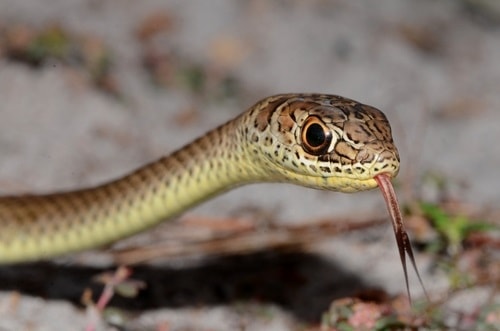
Maximum length: 180cm.
A member of the vast, 33-strong Psammophis genus, which is abundant in central and northern Zimbabwe, through to Kenya. Like the rest, this is a fast-moving snake which is strongly reliant on eyesight rather than smell. Olive grass snakes (Psammophis mossambicus) reach a decent size of up to 1.8 metres, and live in moist grasslands. When not zipping around investigating their surroundings, they rest in termite mounds, small mammal holes, and fallen logs.
This snake may lack venom, but it has one weird skill of note. Like the Montpellier snake of Spain, Psammophis mossambicus is one of a handful of snakes worldwide to rub itself with a mysterious nasal secretion, covering every inch of its scales and giving them a nice shine. The purpose is unknown – there’s apparently no connection to mating, and preventing moisture loss in the harsh sun is one theory.
According to this 2006 study, olive grass snakes are far more common in areas without large African herbivores, including cattle. Their absence allows rodents to increase, giving the olive grass snake a mealtime bonanza. One of their favourite food sources is Mearns’s pouched mouse, which also likes soft, moist grasslands.
Unlike the cross-marked grass snake, a distant offshoot, the olive grass snake is nestled in the centre of the Psammophis family tree. Its closest relative is the olive grass racer (Psammophis phillipsi) of west Africa, followed by the short-snouted grass snake (P. brevirostris) and leopard grass snake (P. leopardinus).
| 5 | Eastern bark snake |
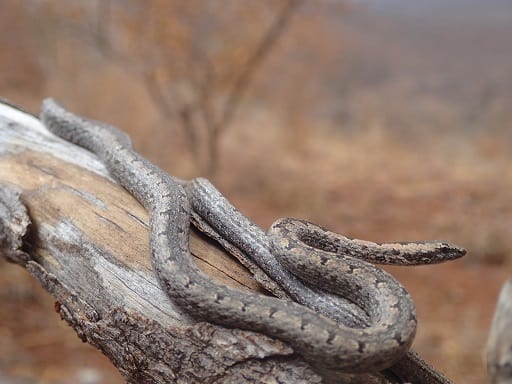
Maximum length: 50cm.
This species is called the eastern bark snake because that’s exactly what it looks like. It looks like God was out of ideas for his next creature and cast a spell on a nearby twig instead.
Eastern bark snakes (Hemirhagerrhis nototaenia) occur in most of Zimbabwe, as well as Mozambique and northeast South Africa. They’re sometimes found lying on branches, but particularly favour cracks in tree stumps where their bark camouflage allows them to completely vanish. This is a slightly venomous snake, which poses little threat to humans.
Eastern bark snakes prefer habitats at neither extreme, neither too wet nor too dry. They’re mainly found in dry savannahs, moist savannahs, and lowland forests. Lurking between tree cracks is actually an ambush strategy, where they blend in, wait patiently, and pounce savagely at lizards walking past. These lizards probably think in their last seconds (unless they manage to dodge) that the tree is coming to life and pulling them in.
Eastern twig snakes are confirmed to hunt cape dwarf geckos (Lygodactylus capensis), and sometimes lure them in by waving an orange-tipped tail in a caterpillar motion. In one observation, the curious gecko was edging closer to the tree crack, until the bark snake accidentally moved its head ever so slightly, alerting the gecko and sending it fleeing.
| 6 | Black-headed centipede eater |
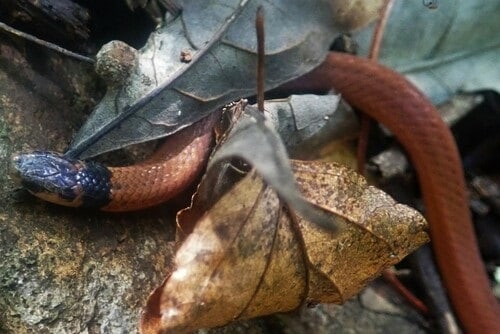
Maximum length: 41cm.
This species is recognisable by its black head contrasting against a uniformly red body. Black-headed centipede eaters (Aparallactus capensis) live in southern Zimbabwe through to South Africa, and make their bases in old termite mounds, where they can plot their next escapade in peace.
After seizing a centipede, they chew on their bodies for prolonged periods to inject a mild venom, ensuring that enough tiny droplets make their way inside. Gradually, the centipede becomes paralysed, and the snake can swallow its prey, which is always performed headfirst. Black-headed centipede eaters average at 30cm and are rarely aggressive towards humans.
For years, centipedes were the only food Aparallactus capensis was ever witnessed eating. Scientists wanted to test this reputation, so they examined 62 old black-headed centipede eaters stored in museums. They extracted 21 food items in total, and each one was a centipede, confirming what everyone suspected.
They concluded: “if cape centipede eaters do eat non-centipede prey, they do so very infrequently“. Most prey items belonged to the order Scolopendromorpha, the most aggressive and venomous centipedes of all.
| 7 | Spotted bush snake |
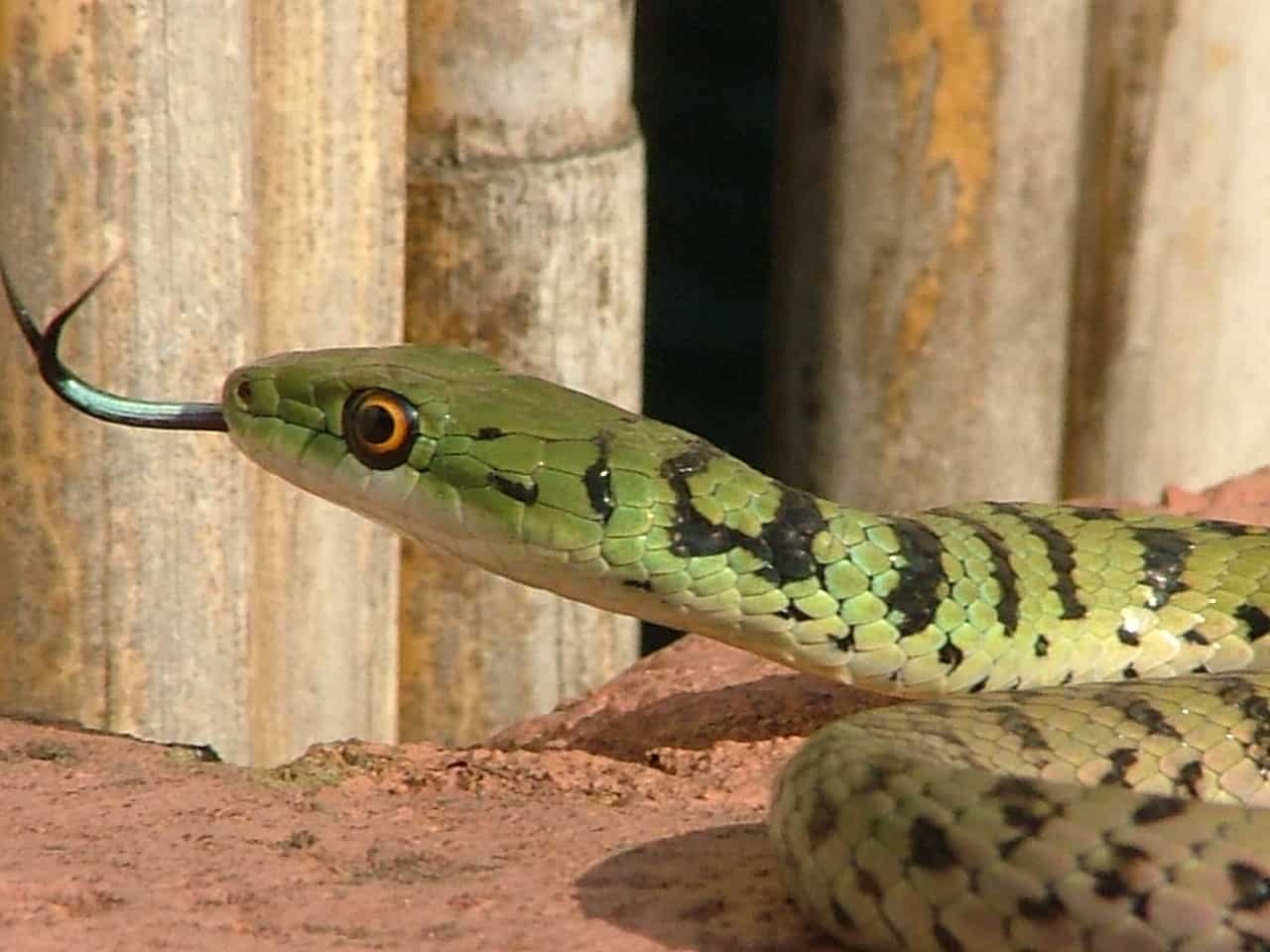
Maximum length: 140.5cm.
One of Africa’s most widespread snakes. This is a nervous and alert snake with superb climbing abilities. Spotted tree snakes can appear in trees, attic rafters, and on brick walls alike. They have large eyes, which aren’t just cosmetic, but provide them with excellent vision.
Spotted bush snakes (Philothamnus semivariegatus) aren’t territorial, and many individuals will sometimes gather in the same tree. They’re found across most of Zimbabwe, and indeed 60-70% of sub-Saharan Africa.
This species is a juicy green, with round pupils surrounded by an orange iris. Spotted bush snakes look similar to boomslangs or even black mambas, but can be distinguished by multiple black dots on their upper body. These black dots are particularly large as hatchlings, before gradually shrinking in adulthood.
Though constantly photographed on branches, spotted bush snakes aren’t diehard forest-dwellers. They prefer mixed areas with various tree clumps, such as savannahs, or cultivated human areas on the outskirts of forests. Their nemesis in the wild is the rock monitor, an absolute tank of a reptile, which eats them alive, swallowing by the tail.
| 8 | Black file snake |
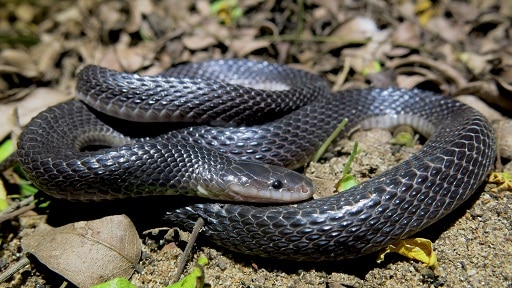
Maximum length: 65m.
A very difficult snake to identify. There’s several other black, glossy and shiny snakes in the southern African region, including in Zimbabwe. These include the dangerously venomous stiletto snake, and underground dwellers such as black thread snakes. Only an expert can distinguish these lookalike serpents, but black file snakes have small white cracks visible between each black scale.
The black file snake (Gracililima nyassae) measures up to 65cm, and is isolated on the evolutionary tree, being the only member of the Gracililima genus. This species ranges from eastern South Africa to southern Kenya, with plenty of sightings in Zimbabwe and Tanzania. It travels in strange, jerky movements when nervous, and if picked up, it does virtually nothing, staying still and occasionally raising its head up.
Black file snakes primarily consume lizards, but occasionally other snakes, including the eastern shovel snout. They live in dry forests, but also the heart of the savannah, with a whole set of iconic African creatures. You could spot one from a Safari vehicle if your eyes were sharp enough, but most people will be distracted and drawn to majestic giraffes or cobras instead.
Even then, black file snakes usually stick to the protective line of vegetation, giving them a corridor of shelter, and making them very tricky to spot. This Zimbabwean snake would rather not be noticed if possible.
| 9 | Snouted night adder |
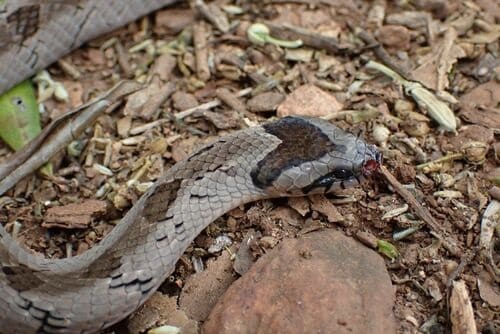
Maximum length: 42cm.
A smaller, slenderer cousin of the rhombic night adder. This species sticks to savannahs both dry and moist, and reaches 1800 metres in altitude.
Snouted night adders (Causus defilippii) can be separated from their cousin by an upturned snout, as the name suggests. While slightly less widespread, they’re still found in most of Zimbabwe, as well as Mozambique and northeastern South Africa. Snouted night adders are easy to find as well, as they love to bask in the sun while resting on rock slabs. This is a tiny viper species, as the maximum length ever was just 42cm.
Snouted night adders have a similar venom to spotted night adders. Symptoms include rapidly-induced swelling, fever and intense pain. But with a smaller length of 20-35cm, they inject correspondingly less venom, and the effects are milder overall. Most swelling subsides after 2-3 days.
Skills of this snake include hunting during both day and night. Like its common cousin, this is a toad-loving snake. Rather than many small toads, snouted night adders prefer to eat one large toad per meal, including the likes of square-marked toads (Bufo regularis). They also feed on frogs such as African puddle frogs (Phrynobatrachus genus) and African striped frogs (Spelaeophryne methneri).
| 10 | East African egg eater |
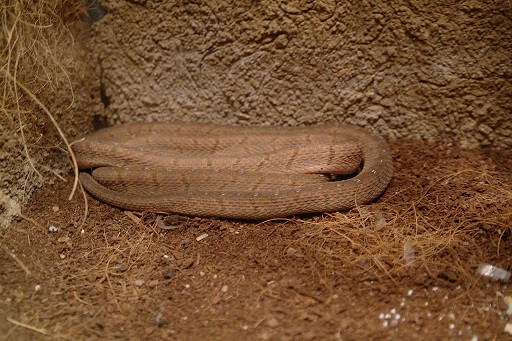
Maximum length: 90cm.
Another member of the Dasypeltis egg-eating genus (which has 18 members). This non-venomous species inhabits the extreme east of South Africa, before continuing northwards through Mozambique, into a sizeable portion of eastern Zimbabwe.
Eastern egg eaters are incredibly skilled at finding bird eggs. They’re so effective at sussing out their hidden locations that it’s like they’re tracking a beeping homing device. They swallow these eggs whole, and crack the shells open from within using specially modified vertebrae. This egg-shattering spine has been evolved by several completely unrelated snakes worldwide, also including the Japanese ratsnake.
Eastern egg eater snakes (Dasypeltis medici) live in moist savannahs and evergreen forests, top locations for birds to lay their eggs. Yellow-streaked bulbul eggs are one confirmed meal.
Though non-venomous, this species is far from timid. When threatened, east African egg eaters will immediately swivel into an S-shaped coil. This species makes a double warning sound. They not only hiss sharply, but make an odd whistling sound as they inhale air to prepare for that hiss. They already have an expandable throat in place for their diet, and when threatened, they inflate this throat grotesquely to make themselves appear deceptively large.
The more closely a threat (such as a human) approaches, the tighter the coils will become. All this is a ruse though, as east African egg eaters don’t even have teeth. They also rub their own scales together sometimes, creating a rasping sound.
| 11 | Striped skaapsteker |
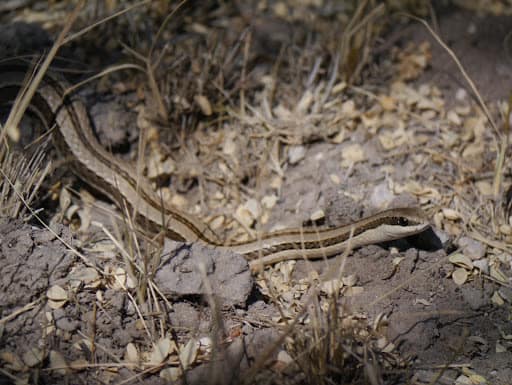
Maximum length: 93cm.
A sleek snake with a long tail, and a thin, whippy body. This is a rapid-moving species which doesn’t seem to have an off button. Striped skaapstekers (Psammophylax tritaeniatus) inhabit virtually all of Zimbabwe, preferring open areas such as savannahs and grasslands as opposed to forests.
This species eat more mammals than other skaapsteker members, and is particularly comfortable in towns and villages. Residents might lift up a pile of rubbish while whistling a tune, only to have a lurking skaapteker dart away beneath their feet.
Striped skaaptekers are confirmed to be venomous, although the exact potency is unresearched. Their venom is believed to be mild, but their rhombic skaapsteker cousin can unleash swelling and throbbing pain. Luckily, striped skaapstekers are reluctant to bite anyway. They could easily wield their speed for evil if they wished, but they much prefer to escape at high speeds.
Striped skaaptekers overlap partially with the rhombic skaapsteker in their territory, but are hard to confuse: the striped version has beige-black stripes, while the rhombic skaapsteker is overlaid with black dots.
The manic speed of striped skaapstekers almost certainly evolved to dodge predators, such as snake eagles and monitor lizards. Even the fastest snakes are sometimes caught, so they haven’t truly mastered the art of hyperactivity yet. Therefore, there’s still room for snakes to keep accelerating in the millions of years ahead, and the striped skaapsteker might be the one to get faster.
| 12 | Boulenger’s garter snake |
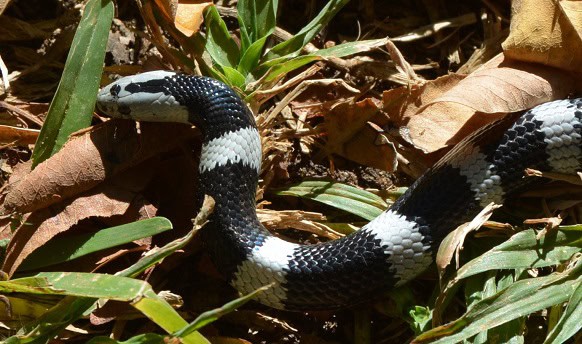
Maximum length: 77cm.
A species of southeastern Africa. Boulenger’s garter snake (Elapsoidea boulengeri) inhabits Mozambique, Botswana, Zambia and Malawi, with Zimbabwe lying right in the middle of its territory.
Boulenger’s garter snakes are venomous, but rarely attack humans. Their venom is relatively mild, combining cytotoxins and neurotoxins, leading to stiff and swollen limbs, and perhaps temporarily blurred vision and nausea. Their diet consists of amphibians such as rain frogs, plus lizards and fellow snakes.
This species’ most famous feature isn’t its appearance, or diet, but its movements. When cornered, Boulenger’s garter snakes have some of the craziest, most erratic movements of any snake. They’ll suddenly hop forward, backwards, 90 degrees to the left, landing on the ground or a random branch, in a manner which looks like very few snakes on Earth.
These bizarre movements were the subject of a viral video in 2023, and the only way to truly understand is by watching it. Boulenger’s garter snakes only move like this when cornered, not all the time, as it would expend far too much energy.
This species often takes shelter underground or in old, vacant termite mounds. Boulenger’s garter snakes also undergo an ontogenetic colour transformation. As newborns, they’re adorned with thick white bands, around 10-17 of them. With age, these gradually thin and fade, until the oldest adults are left as a uniform black colour.