
| 1 | Spotted rock snake |
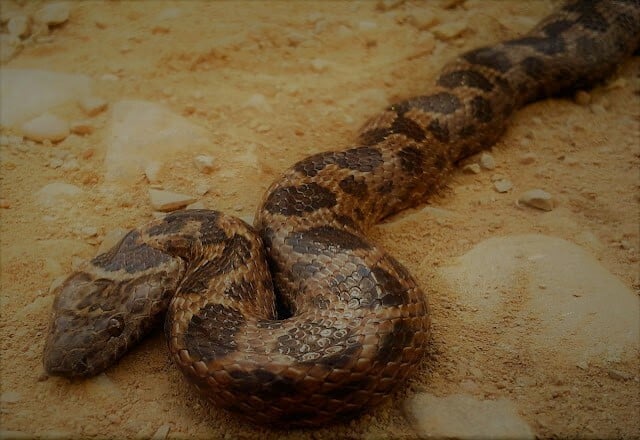
Maximum length: 72cm.
This harmless species inhabits a large swathe of South Africa, skipping only the northern border areas near Botswana. The spotted rock snake (Lamprophis guttatus) is non-venomous, and rarely exceeds 60cm.
As the name suggests, this species is a creature of rock fields. Spotted rock snakes can be found on gravelly hillsides, crumbling scree slopes, and in dark, shadowy crevices. They can even be found poking their heads out of cracks in large boulders. This species can be common in certain spots, yet is always difficult to find due to its secretive manner.
Spotted rock snakes are faced with various choices in their rock field habitats. They must choose whether to move stealthily through a dark crack, travel over rocks and leave themselves vulnerable to birds, or simply remain still and hope that lizards come to them. The opportunities for death are large in these rocky biomes, but so are the opportunities for meals. Their diet consists mainly of other reptiles that live in these rock fields. Specific prey include Karoo girdled lizards, Waterberg dragon lizards, common crag lizards, and southern rock agamas.
Spotted rock snakes rarely bite, but if they feel threatened, they’ll hiss loudly and coil tightly as though preparing to lunge. This species is nocturnal, which only adds to its secretive nature.
| 2 | Dusky-bellied water snake |
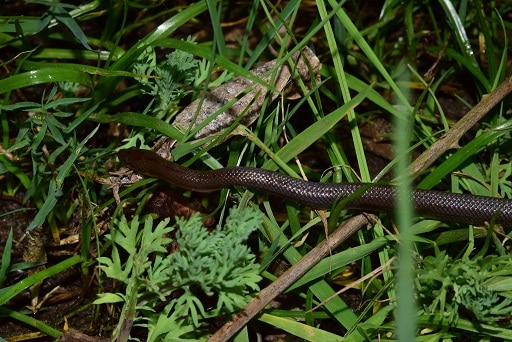
Maximum length: 114cm.
One of South Africa’s most aquatic snakes. The dusky-bellied water snake (Lycodonomorphus laevissimus) is found in inland water bodies, and preys primarily on tadpoles and frogs. This species has multiple hunting tactics, as it usually drags its prey to the pond edge to complete swallowing, but sometimes skips that unnecessary step and swallows its prey whole while underwater.
Dusky-bellied water snakes average at 30-60cm, but some are far longer, pushing to a record of 114cm. Though aquatic, they generally prefer more shaded streams beneath the safety of tree canopies, as well as ponds. This snake is completely non-venomous, yet is confident in its biting abilities, which it will use readily if picked up.
Dusky-bellied watersnakes particularly love to lurk amid rocks below the water surface. They have one of the classic underwater adaptions of the snake kingdom – eyes unusually high on the sides of their head, to allow skyward vision. These eyes have a round black centre, surrounded by a vivid orange line.
With a sleek black body, sometimes brown, dusky-bellied water snakes can be difficult to identify. These water-adapted eyes are the best hope for a simple ID. Another sign is a yellow belly, which is cleanly separated from the darker back. This is an egg-laying species, which pumps out 4-17 per batch on average.
| 3 | Rhombic skaapsteker |
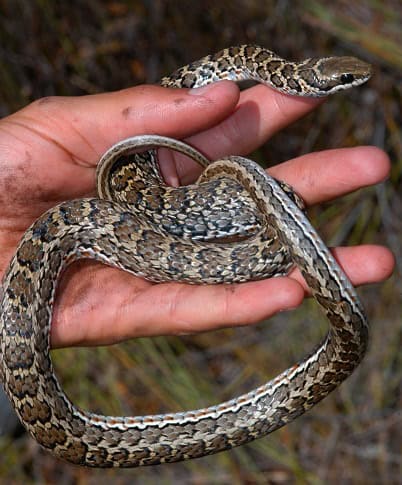
Maximum length: 150cm.
The rhombic staapsteker (Psammophylax rhombeatus) is one of South Africa’s more common species, as it appears in high densities in southern and eastern areas, including near Cape Town and Johannesburg. This is an extremely fast and nimble snake, which darts around the savannah as though fast forwarded with a remote controller. Rhombic skaapstekers inhabit moist savannahs, bushland and grassland alike. They hide within bushes if bothered, and are one of the few African snakes to protect their eggs.
Rhombic skaapstekers are mildly venomous, but not dangerous. After experiments where fowl died rapidly, scientists speculated in 1921 that the rhombic skaapsteker could be as dangerous as the infamous boomslang. However, its venom is actually fairly weak, and must be chewed in for roughly 30 seconds to take effect.
For example, one photographer found a rhombic skaapsteker coiled around an egg clutch, and attempted to remove it for a photograph. The skaapsteker sank its fangs in and chewed for 45 seconds, as it was extremely difficult to dislodge. A few hours later, the man’s hand swelled moderately, with mild throbbing pain, and his partner said that heat was radiating from it.
‘Skaapsteker” is an Afrikaans word that translates to “sheep stabber”, from an old belief that they had sheep-murdering tendencies. Years ago, many ranchers and farmers killed them on sight, but it’s believed that cape cobras were actually behind the livestock losses. Perhaps this was a sneaky scheme to shift the blame onto their serpent rival.
| 4 | Southern brown egg eater |
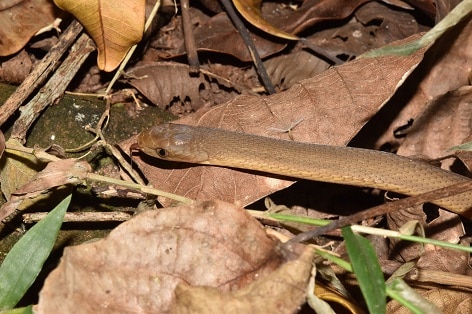
Maximum length: 120cm.
This egg-hungry snake lives in eastern areas of South Africa, especially along the coast, such as near the city of Durban. The southern brown egg eater (Dasypeltis inornata) belongs to the 17 member Dasypeltis genus, and is one of the more common versions. The inornata part of its Latin name references the lack of interesting patterns, which is similar to the dull-looking Puerto Rican boa (Chilabothrus inornatus) of the Caribbean.
Southern brown egg eaters are mainly found in moist areas rather than bone dry savannah. Egg-eating is their main goal in life, and every one of their characteristics is geared towards fulfilling this. They’re strong branch climbers, allowing them to access nests.
Most importantly, southern brown egg eaters have extended shelves on their vertebra which allow them to crack through hard egg shells. Their strategy is to swallow eggs whole, causing their necks to become grossly distended as a virtual bowling ball moves down their throat. They then contract their middle section, shattering the egg, before regurgitating the shell remains in a neat package.
Bird keepers fear this snake, as it can swallow several eggs in one session. Even birds themselves caw with fear when they see Dasypeltis inornata approaching.
Southern brown egg eaters are toffee-coloured with oval shaped pupils, and an orange iris. They have pink tongues, and a strong tendency to invade people’s houses. They’re completely non-venomous, but bold and adventurous in temperament. Southern brown egg eaters have no time for fear, as this would interfere with their neverending egg quests. This species averages at 75cm.
| 5 | Cross-marked grass snake |
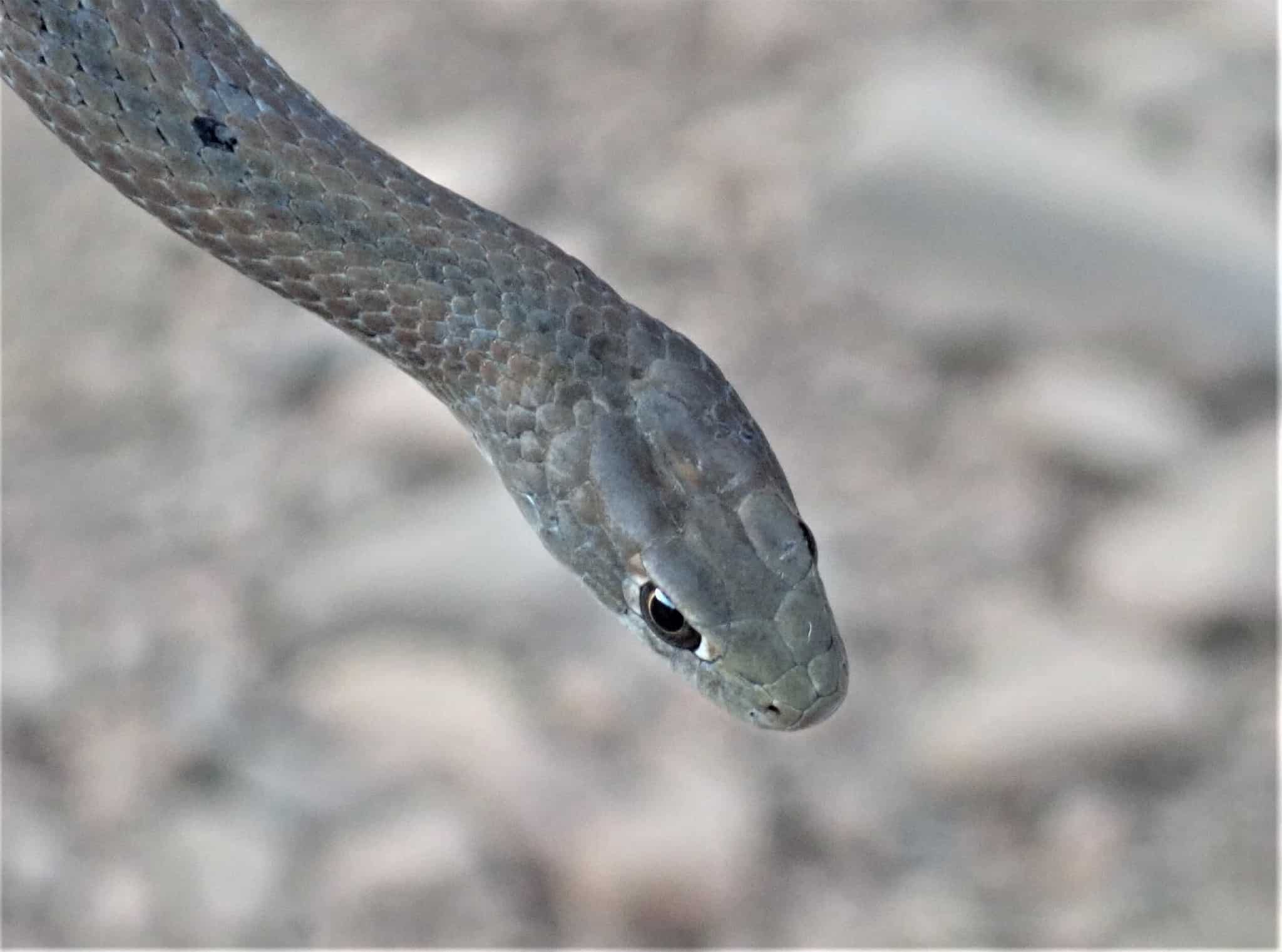
Maximum length: 82.2cm.
This slightly venomous species is fairly common in South Africa, appearing in moist savannah, montane forest, and grasslands. The cross-marked grass snake (Psammophis crucifer) is one of South Africa’s most reptile-addicted snake species. A 2010 study found that 93% of food items in its stomach were reptiles, with a sample consisting of 73 females and 70 males. Three of its confirmed meals are the variable skink, cape three-lined skink, and spotted thick-toed gecko.
Cross-marked grass snakes are mildly venomous, and probably capable of causing stinging or a slight swelling at the worst. When frightened, they curl up into a ball of coils and hide their head in the centre, protecting their pea-sized brain. This species reaches 82cm in the longest individuals, with females exceeding males.
The Psammophis snake genus is vast, with 33 members worldwide. Many are barely distinguishable, but along with the 2 Eurasian species, the cross-marked grass snake was the earliest lineage to diverge from the pack. Genetically, this snake is further away from the Psammophis core than the rest.
Cross-marked grass snakes are recognisable by vertical stripes running down their entire body in parallel formation. These are grey and brown, but the signature ID sign is a white scale in front of each eye. This species lays 4-13 eggs on average.
| 6 | Common slug eater |
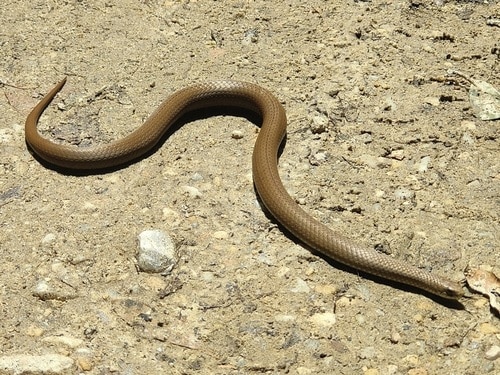
Maximum length: 45.2cm.
This non-venomous snake has found its own niche within South Africa’s crowded ecosystem. Rather than swallowing dassies or rock rats, which many snakes compete for, they focus on a less popular food source: slugs. Common slug eaters (Duberria lutrix) measure 30cm on average, and this makes small slimy creatures a natural choice. They also eat snails, and their favourite spot to rest is amidst long grass tufts, making them hard to spot.
Common slug eaters can be found in virtually the entire eastern half of South Africa, and are particularly abundant in the country’s southeast. To find the common slug eater, you must follow the dampness. They appear in savannahs, but always those with higher annual rainfall totals. No moisture equals no slugs, and this species is addicted to them. The fact that slugs are so slow makes their job much easier.
Afrikaans call this harmless snake Tabakrolletjie, due to a strange defensive method. When confronted, Duberria lutrix coils into a tight spiral with its head at the centre, so that it resembles a roll of tobacco.
The common slug eater currently has 5 subspecies, but research is lacking, and it’s believed that some are probably independent species. South Africa is a big place, and there’s plenty of hidden corners where undiscovered creatures can lurk.
| 7 | Aurora house snake |
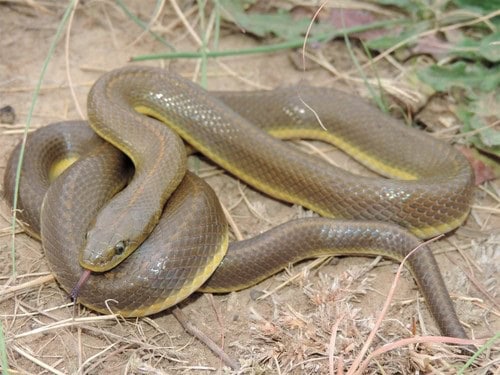
Maximum length: 90cm.
A flashy snake with variable colours. There’s always a bright yellow or orange stripe down this species’ spine, but some individuals are plainer while others are adorned with bright dots. The aurora house snake (Lamprophis aurora) measures 60cm on average, and sticks to moister areas such as nature reserves, with one hotspot being Walter Sisulu National Botanical Garden, near Johannesburg. Information is scarce, but nestling rodents and small mice are confirmed as regular prey.
Unlike a cape cobra, aurora house snakes are extremely peaceful. They’re not only non-venomous, but hardly ever bite even if picked up. This is one of many snakes which lives quietly in South Africa and goes about its business, to no interest to the rest of the world.
The Aurora house snake sees many things in its life. It has insider knowledge of which hyena clans are about to battle, which savannah the elephant herd is heading to next, and which village a cobra is about to terrorise. If they could speak, they could tell us many tales, yet they have no desire to disclose this inside information.
Aurora house snakes are common not just in savannahs, but major cities such as Johannesburg and Cape Town. Overall, they’re concentrated most heavily in southern and eastern South Africa, skipping the parched northeast and central north.
| 8 | Red adder |
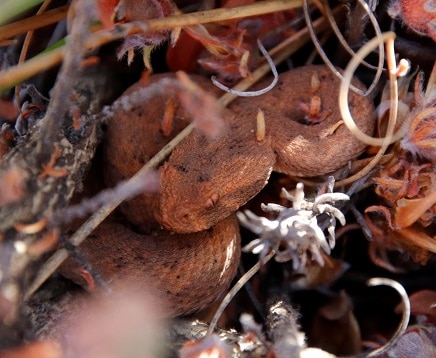
Maximum length: 43.4cm.
This is the adder equivalent of a red deer or red squirrel, except a lot less cuddly. The reasons for this redness are unknown. It could be furious anger, or it could be a red-tinged venom coursing through every inch of its body.
Either way, the red adder (Bitis rubida) is found exclusively in southern regions of South Africa, with a relatively narrow range. It averages at just 20-30cm, yet despite this small size, its venom is lethal, with a bevy of post-synaptic and pre-synaptic neurotoxins. These bind to and block acetylcholine receptors in muscle cells, similarly to a black mamba’s neurotoxins, except slightly weaker.
Like its Bitis adder cousins, the red adder is an inactive species which is usually found lurking stealthily under rocks or shrubs. Its main habitats are rocky gravel plains on mountain slopes, and its most active time periods are early morning and late afternoon, taking a siesta at midday. To find this snake, you must venture to rough, jagged terrain, not humid forests.
Red adders vary significantly throughout their range. Some are full blooming red, while others have the beige and black colours more typical of adders. There’s even xanthic individuals, where the genes for yellow pigments go into overdrive. This is one of the rarest of the Bitis adder genus, with the most common being the puff adder (found all over sub-Saharan Africa).
| 9 | Black thread snake |
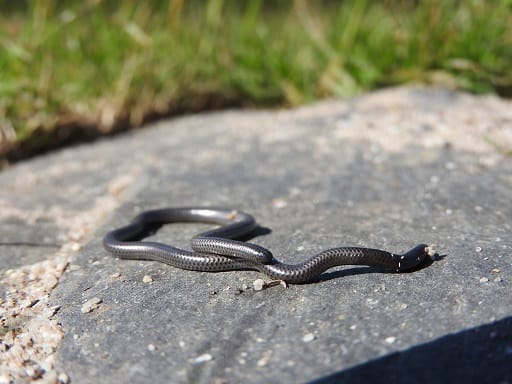
Maximum length: 20cm.
This tiny species occupies about 20% of South Africa, sticking mainly to the southern coast. Black thread snakes measure only 12-15cm, with a maximum of 20cm, and are often confused with earthworms. This is particularly true given that this is an underground snake, which spends the vast majority of its life burrowing through soil.
Black thread snakes (Leptotyphlops nigricans) are completely non-venomous, mostly blind, and stay below the surface virtually all day. The best time to witness them is immediately after heavy rains, when they poke their heads out of their holes curiously and explore the surface for a while.
In winter, they sometimes hit the surface in waves and huddle together en masse, beneath rocks and logs or within old termite mounds. Both soft soils and sand are acceptable for black thread snakes, as coastal dunes are one habitat where they’re common.
The Leptotypholops thread snake genus has over 20 members in Africa, and these are exceedingly difficult to tell apart. Each member is small, black and shiny, with the black thread snake being no exception. Only herpetologists have the expert knowledge to make IDs, using subtle scale differences.
| 10 | Short-snouted grass snake |
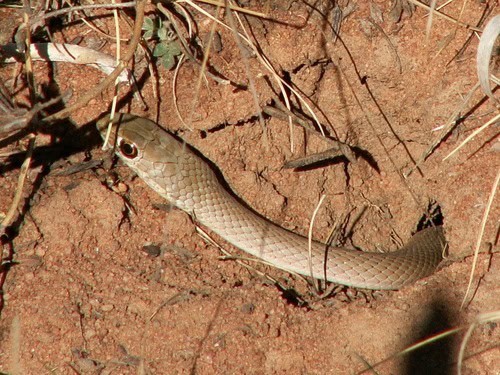
Maximum length: 120cm.
This species is found in eastern and northeastern South Africa, particularly in moist areas. The short-snouted grass snake (Psammophis brevirostris) moves by day, and averages at 40-60cm. This species has no deadly venom, but is extremely agile. Short-shouted grass snakes use speed in everything they do: rapid escape when cornered, or a rapid bite if someone dares to pick them up.
This species eats a few mammals, but prefers skink lizards, with one confirmed being the variable skink (Trachylepis variegata). If cornered with no chance to flee, this snake coils up and hisses loudly. This makes them somewhat unique, as hissing is relatively rare within their 33-strong Psammophis genus.
The Saharan sand snake (Psammohpis aegyptius) is one member which does hiss, and the short-snouted grass snake is another. They achieve this with a gulp of air, which visibly inflates their chest area, before releasing it through hissing sound channels. While Saharan sand snakes inflate their throats when hissing, this species inflates the chest.
Short-snouted grass snakes can be feisty in captivity. A captive keeper once sprayed a cage with water, and the short-snouted grass snake began drinking it eagerly, licking up droplets from the glass cage and branches within. However, the snake hated to be sprayed with the water hose directly, and began hissing loudly. Short-snouted grass snakes can turn aggressive even after changing their water bowl, though they pose no serious threat to humans.