
| 1 | Oriental ratsnake |
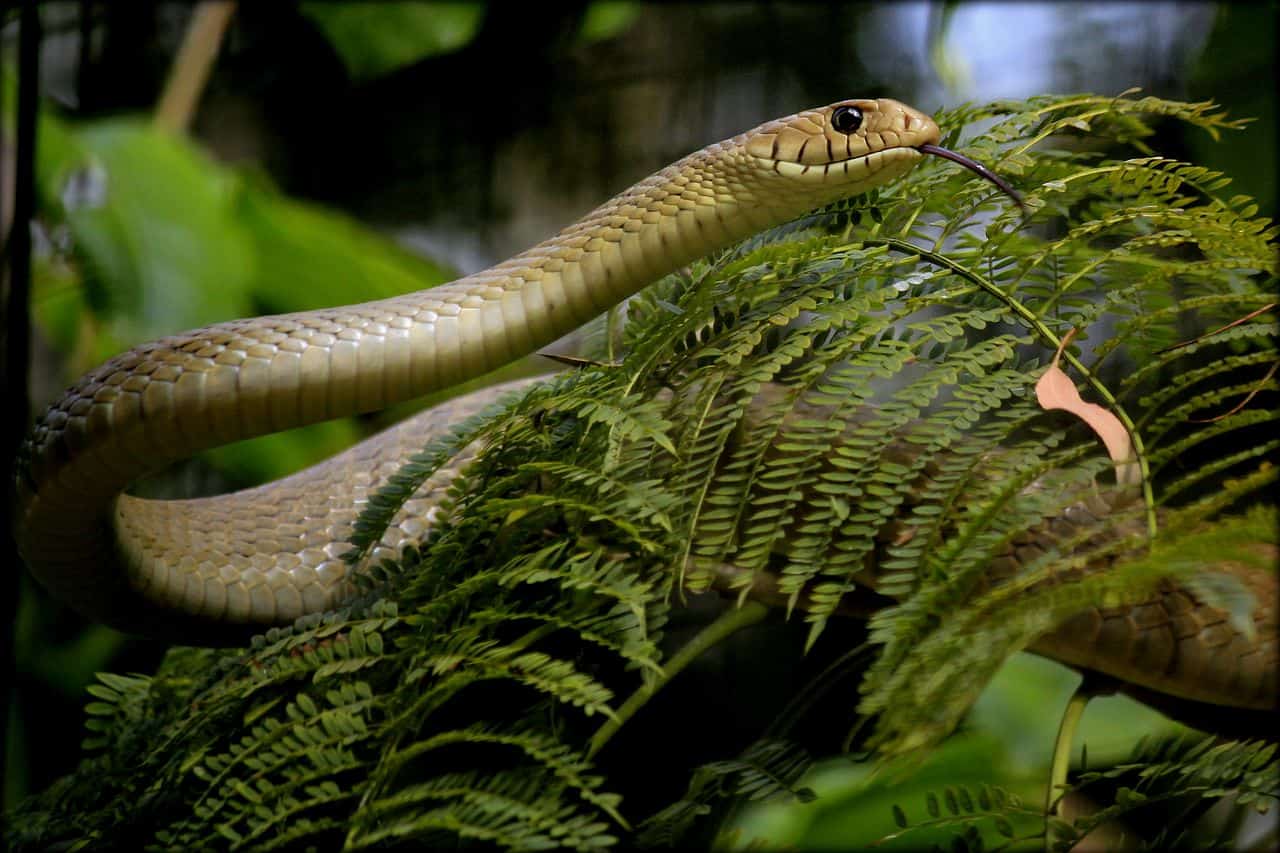
Maximum length: 3.7 metres.
The most abundant large snake in Hong Kong, and the third longest native snake after the king cobra (maximum 5.85 metres) and Burmese python (5.79 metres). The oriental ratsnake reaches a brutish 370cm in the largest individuals, with an average of 150-195cm. This species isn’t bothered even slightly by the heavily urbanised nature of Hong Kong, appearing in streets, gardens and even on the roofs of tall buildings.
Oriental ratsnakes (Ptyas mucosa) are non-venomous, and will normally flee if approached by humans. However, if cornered with no room to escape, they may stand their ground, spread their neck to mimic a cobra, and deliver a painful bite. As they move mainly during the day, oriental ratsnakes are regularly encountered by ordinary Hong Kong citizens.
Oriental ratsnakes are a common presence on Hong Kong’s many jogging trails, and often weave through water culverts searching for frogs, their main prey. They also eat a helping of mammals, and birds such as house sparrows, but amphibians constitute over 50% of their prey, with one favourite in Hong Kong being the Asian common toad (Bufo melanostictus).
This species also holds a less welcome record. Snake soup and meat is a booming industry in southeast Asia, especially in China, and in 2011, scientists obtained 16 snake meat samples from shops around Hong Kong. The verdict: oriental ratsnakes were the most common ingredient, with Javan spitting cobras coming second (despite their venom).
| 2 | Greater green snake |
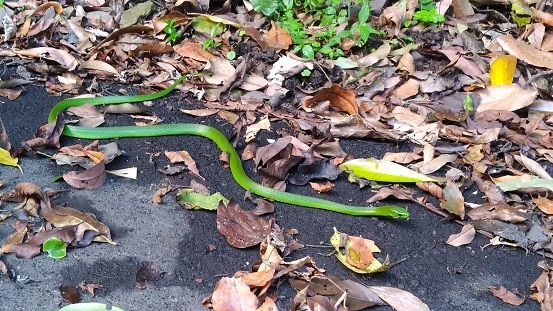
Maximum length: 130cm.
This species belongs to the same Ptyas genus as the oriental ratsnake, yet with its leafy green scales, there’s no chance of confusing the two. In fact, the greater green snake (Ptyas major) has a problem its cousin doesn’t: being mistaken for the dangerous bamboo pitviper and whacked to death. In reality, this snake is non-venomous, and generally flees into the bushes if frightened, where it can blend in using its superb camouflage.
Greater green snakes are thin rather than thick, and eat a diet of earthworms. Consequently, they can be found anywhere in Hong Kong with soft soils: less likely in a water culvert, but more likely in a meadow, a riverbank, or the grassy ground of a playpark.
Greater green snakes are encountered commonly in Hong Kong, but pose no threat to humans. They bite people occasionally, but are incapable of doing much damage due to their small mouths. During daytime, they’re usually found on the ground, while at night, they seek refuge on high branches. This snake has round pupils, with a brown-orange iris.
The greater green snake averages at 70-90cm, pushing to a maximum of 130cm. This species is widespread in southeast China, and also reaches northern Laos and Vietnam, but isn’t found in Thailand.
| 3 | White-browed keelback |
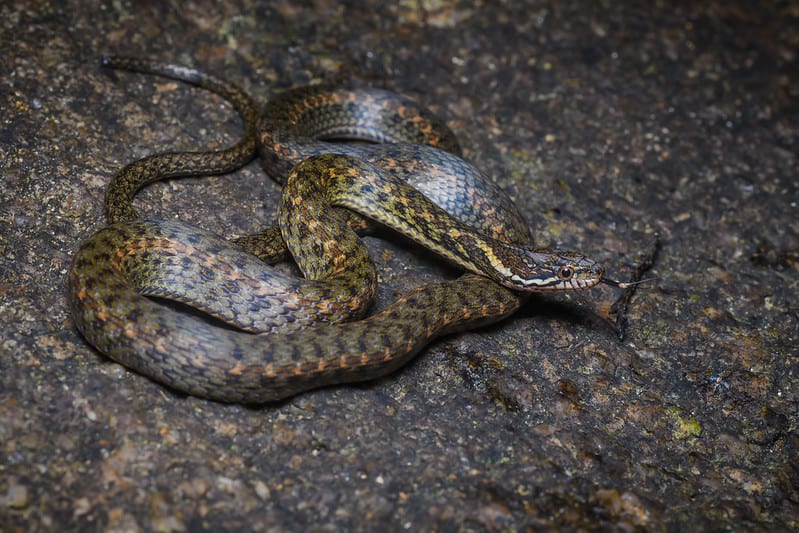
Maximum length: 88cm.
A much rarer species of Hong Kong snake. The white-browed keelback is not only heavily nocturnal, but avoids inhabited areas. This species is most common near water bodies within forests, such as small rocky streams, and has superb camouflage abilities.
White-browed keelbacks (Hebius boulengeri) are simple to recognise due to one ID sign: a snowy white stripe extending backwards from each eye. They have round pupils with a bronze iris, and a mostly black tongue, but with a white centre. Their main body is typically a greenish-black, with a honey-brown stripe extending along each flank.
This species poses no threat to humans, but is rarely encountered and may possess secret skills. One individual was observed with a mysterious white dribble of liquid on its neck, which could easily be poisonous (like the tiger keelback of Japan).
When frightened, white browed keelbacks generally coil into a small ball to protect their brain. When startled, they dart quickly into leafy cover, while if picked up, they usually coil harmlessly around your finger.
White-browed keelbacks have never been observed to bite, and most Hong Kong citizens don’t even know they exist. This species has been recorded eating small amphibians, in rocky stream habitats. Note of confusion: this species is occasionally referred to as Boulenger’s keelback, which is also a separate Sri Lankan species (Fowlea asperrima).
| 4 | Radiated ratsnake |
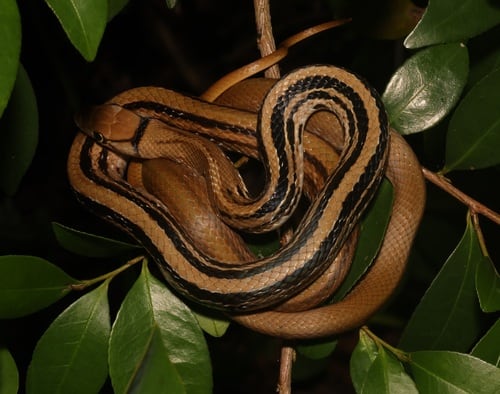
Maximum length: 230cm.
Another common yet (mostly) harmless species. The radiated ratsnake (Coelognathus radiatus) appears in every region of Hong Kong, and has the signature feature of extreme speed. This species can disappear into bushy undergrowth in the blink of an eye, and also possesses an aggressive temperament. This snake prefers to flee rather than fight, but will strike furiously and deliver slashing bites to your arm if cornered against a wall.
Radiated ratsnakes can be terrifying if witnessed up close. They bare their mouths like a lunatic and puff their neck up, and with their relatively large eyes, they succeed at intimidation more than most non-venomous snakes. Like the oriental ratsnake, this is a multi-skilled species which can swim across rivers, climb trees, and slither confidently down pavements.
Radiated ratsnakes move by day, and have beige patterns overlaid with long black stripes, and the occasional white line between scales. They reach a maximum of 230cm, and are usually found in open grassy areas. They tend to avoid dense forests and misty hills, meaning that they’re regularly encountered by ordinary Hong Kong citizens, usually without incident.
| 5 | Diamond-backed watersnake |
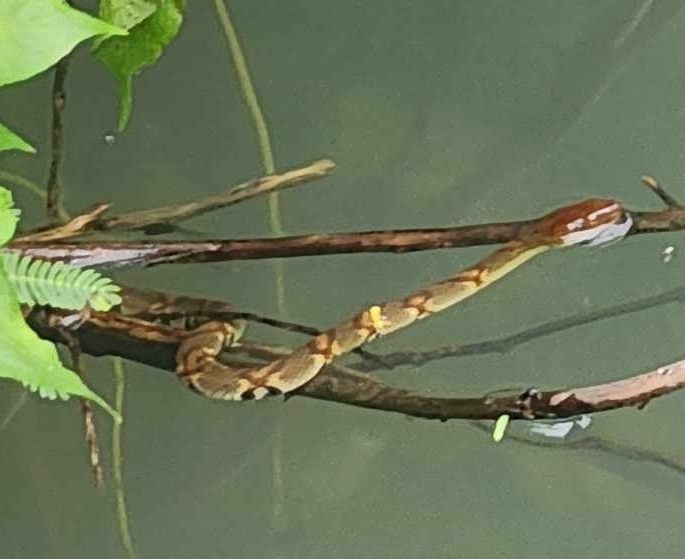
Maximum length: 142cm.
This harmless snake prefers to hang out in rivers, away from the hustle and bustle of Hong Kong’s busy streets. The diamond-backed watersnake (Trimerodytes aequifasciatus) isn’t rare, but will never appear outside a fruit shop or a block of flats.
Rather than ponds, diamondback watersnakes stick to deep bodies of fresh water, such as small lakes or slow-moving tributaries. They’re also decent climbers, and their favourite place to ascend is a branch directly overhanging water, which allows them to leap down when their danger sensors pick up a slight flicker of activity.
This snake varies in appearance, but is usually grey, with brown patterns similar to hourglasses, each with a creamy core. Diamond-backed watersnakes measure up to 142cm, and have a thick body, making them one of Asia’s larger snakes that nobody ever talks about. Hong Kong is one of their main strongholds, but they’re also found in southeast China, northern Vietnam, and northern Laos.
Diamond-backed watersnakes pose no threat to humans. Their teeth are no joke, but they’re strangely reluctant to use them. Like the brown watersnake of the southern US, they’d much rather dive headfirst into the water below for safety. This snake mainly preys on fish, with the occasional amphibian.
| 6 | Anderson’s stream snake |
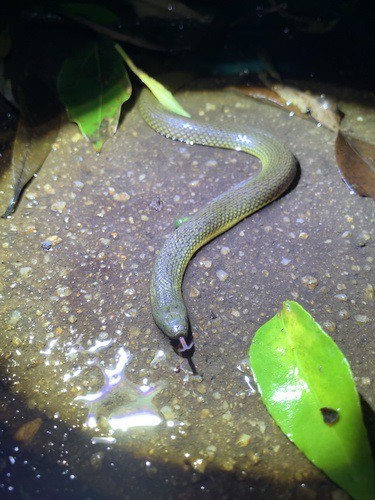
Maximum length: 50cm.
A nocturnal snake, which is common all over Hong Kong. This is a harmless, 30cm average species, which easily blends into muddy river banks using its muddy grey colours.
Anderson’s stream snakes (Opisthotropis andersonii) are completely non-aggressive, and have no desire to harm a human. Though a freak occurrence can’t be ruled out, they rarely bite even if picked up, nor do they squirm frantically.
Anderson’s stream snakes particularly favour shallow, rocky rivers, where they can swell to large numbers if conditions are optimal. Their bodies are perfectly adapted to this habitat, with a narrow head that they force between rocks in order to seize shrimp, one of their favourite prey.
As well as fish, Anderson’s stream snakes also have a liking for earthworms. Immediately after heavy rains, they’ll suddenly appear in force on trails bordering rivers, waiting for slimy snacks to appear.
Anderson’s stream snakes have few noticeable patterns, and have a grey-green body with a whitish underbelly. A rocky, slow-moving stream is their absolute favourite habitat, and luckily, there are no dangerously venomous snakes in Hong Kong which they resemble, so you won’t be lulled into a death trap, thinking you’re safe. Opisthotropis is an obscure snake genus, with no famous species, yet it has 25 members across southeast Asia.
| 7 | Taiwan kukri snake |
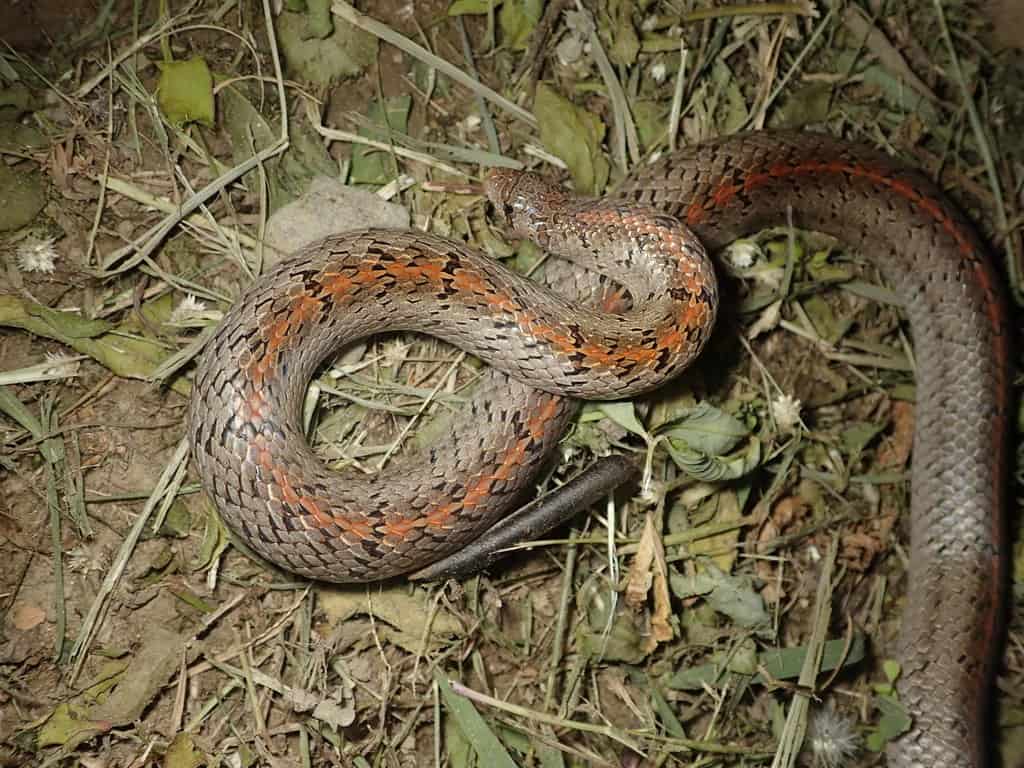
Maximum length: 95cm.
A non-venomous snake measuring 40-60cm, with no power to kill humans. This species inhabits southeast China, northern Laos and northern Vietnam, with Hong Kong and Taiwan being its main hotspots.
Taiwan kukri snakes (Oligodon formosanus) live in forests, yet stick primarily to the ground. They never appear in the bustling streets of Hong Kong, but are a regular sight in nature trails through forests. They vary significantly in appearance, as they’re normally some variation on brown, but with multiple unique morphs. Taiwan kukri snakes can be brown with an orange vertebral stripe, brown with a reddish tint, or light and dark brown in many intermingling shades.
Taiwan kukri snakes are perfectly harmless, as long as you don’t pick them up. This snake reaches an average of 50cm, yet is much more troublesome than the diamond-backed watersnake (over 1 metre). One special feature is sharpened front teeth, which are designed for hacking through calcified reptile eggs, but double up as handy defensive tools.
This species can deliver several slashing bites to a human arm in rapid succession, making picking one up most unwise. If left alone, this species usually flees into the bushes. If you wish to meet the Taiwan kukri snake, then dusk or early morning is the best time.
| 8 | Chinese slug snake |
Maximum length: 68cm.
A slow-moving snake which is constantly scanning the forest for slugs to swallow up. Chinese slug snakes (Pareas chinensis) are not only excellent branch climbers, but curl around them continuously as they slither, like a twisting piece of spaghetti. They’re incapable of hurting humans, as they lack venom or even a sharp pair of teeth. They never bite, and their main strategy when flustered is to remain completely still, clinging to their tree branch.
Chinese slug snakes are encountered only occasionally by ordinary Hong Kong citizens, as they’re mainly found in forests, near misty streams. They feed on snails and slugs exclusively, without even the occasional mouse or gecko snack. See this video for footage of one in motion.
Compared to the common slug snake (Pareas carinatus) of Thailand, this version has a higher amount of black bands. Chinese slug snakes have large eyes, with a rich orange colour. They not only have black bands, but a smattering of black dots like a pepper shaker explosion.
The weirdest physical feature of this snake is being translucent when held up to the light. There’s no chance of confusing the Chinese slug snake for another snake nearby. Its relative the white-spotted slug snake also lives on Hong Kong, but this could never be misidentified, as it has a completely different colour scheme.
| 9 | Futsing wolf snake |
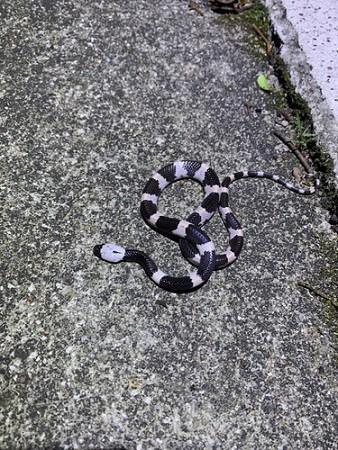
Maximum length: at least 80cm.
A species which isn’t rare in Hong Kong, but sticks to woods and forests well away from urban areas. The Futsing wolf snake is non-venomous and reaches 80cm in the largest individuals. There’s endless wolf snakes in southeast Asia, but Lycodon futsingensis is recognisable by the white patch atop its head. Its face is extremely black, while the rest is black alternating sharply against white.
If you see this snake in Hong Kong, then don’t approach! Futsing wolf snakes are perfectly harmless, and will normally flee for the bushes if humans wander past chatting. The reason to be cautious is a close resemblance to the deadly many-banded krait (Bungarus multicinctus), which also inhabits Hong Kong. The white and black bands are extremely difficult to distinguish for a beginner. It may not be a Futsing wolf snake you’re seeing at all. If in any doubt, stand well back.
This species normally moves slowly and carefully, not wanting to miss any scent particle clues. However, it’s able to dart away rapidly if startled.
Futsing wolf snakes mainly stick to the ground in forests, rather than climbing branches. A leafy forest floor is their favourite location of all. The white patches vary with this snake, as they can sometimes be darker, closer to gold in tone instead.
| 10 | Banded stream snake |
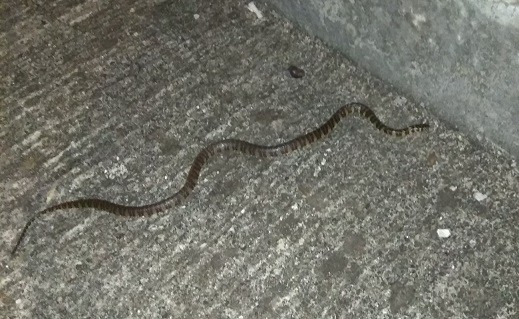
Maximum length: 105cm.
A relative of the diamond-backed watersnake. This version (Trimerodytes balteata) is easy to distinguish thanks to its vividly contrasting black and orange bands. On the belly, the orange suddenly vanishes, and gives way to alternating black and white patterns.
The banded watersnake is a nimble dweller of freshwater habitats in Hong Kong, such as slow-moving rivers and wetlands. It rarely leaves these reassuring water bodies, except after heavy downpours. Hence, it is rarely seen by citizens of Hong Kong. Banded watersnakes are skilful in their watery realms, as they can probe into muddy shores, and even sift through submerged root systems to find the fish prey they’re specialised for.
You’d probably only meet Trimerodytes balteata if you fell face first into a marsh, and even then, they’re mostly harmless. Banded watersnakes will only bite if harassed, and the worst they do is produce a foul snake smell.
Banded watersnakes reach 40-60cm, and have round pupils with virtually black eyes. They sometimes stray to land and rest on moist rocks amid a nest of leaves. Up close, this is actually one of the most detailed snakes around, as there’s a constant speckle of neon orange covering their body, in the form of endless tiny dots and lines.
| 11 | Boulenger’s odd-scaled snake |
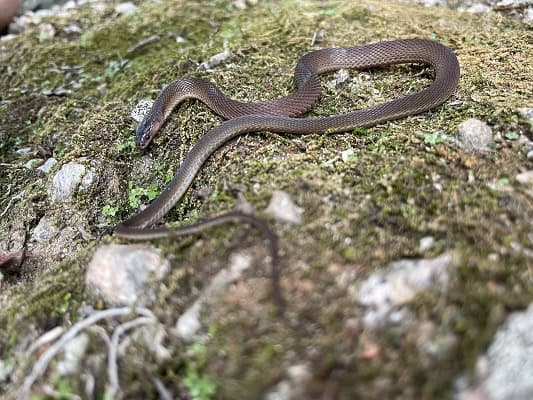
Maximum length: 45cm.
A nocturnal species which derives most of its calories from earthworms and slugs. Boulenger’s odd-scaled snakes (Achalinus rufescens) are found in southern China plus a small area of northern Vietnam. They don’t quite reach Taiwan, but Hong Kong has the highest quantity of sightings of anywhere.
This species is found mainly on forest floors covered with dense leafbeds, often close to small streams. They sometimes appear in water culverts close to human areas as well. The reason is their earthworm prey, which correlate closely with moist areas.
Boulenger’s odd-scaled snakes are completely harmless. They have no dangerous venom, nor sharp fangs. The only weapon they have is the occasional mock lunge performed at humans who curiously pick them up. Boulenger’s odd-scaled snakes aren’t particularly well researched, but one weird sighting involved a swarm of ants, which was crawling over one snake’s back, possibly feasting on it.
This species has a wide variation in colour, as some are grey or brown like above, while others are a bright lemon yellow. The consistent feature is that Achalinus rufescens never has any memorable patterns from a distance. The main pattern is a slight black edge to each scale, which becomes more visible when up close. There’s also a secretly iridescent top of the head, which shimmers with all the colours of the rainbow when exposed to bright light.
| 12 | Common wolf snake |
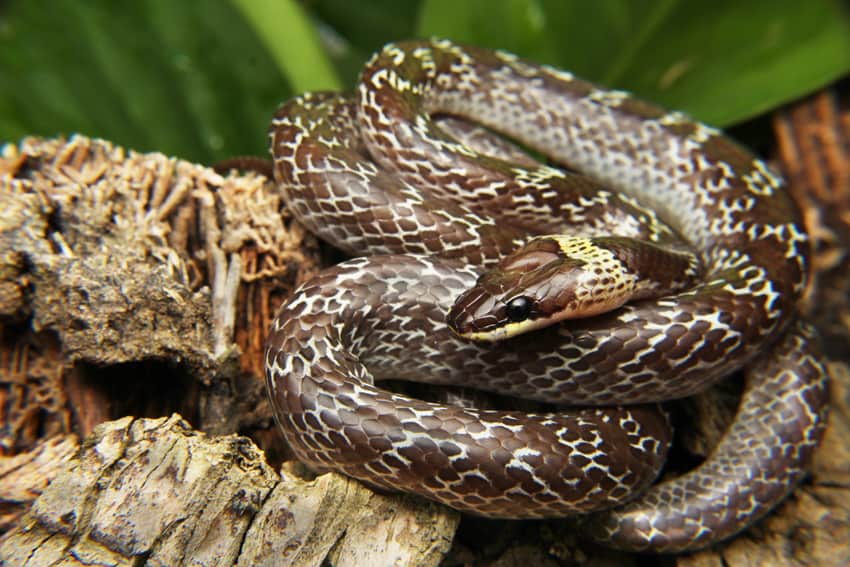
Maximum length: 76cm.
The common wolf snake (Lycodon capucinus) is one of the most massively widespread species in southeast Asia. Hong Kong lies roughly at the northern extent of its range, but there’s just as many sightings here as anywhere else.
The common wolf snake is a non-venomous species, which is capable of drawing blood if picked up by a human, but still rarely resorts to attack. Common wolf snakes prey primarily on lizards, including geckos and skinks, and their enlarged front teeth are believed to be for holding them in their mouths, preventing them from escaping.
Common wolf snakes are nearly always found on the ground, although there are no hard rules, as they’re strong tree climbers if necessary. They can also be found coiled up in small pipes and relaxing. They can appear in various habitats, including forests and fields, but also paved walkways next to metal railings. This isn’t a difficult species to encounter, and they’re fairly easy to recognise, with sharply contrasting brown and white, arranged in messy patterns.
Common wolf snakes also appear in Thailand, Vietnam, Cambodia, etc. To the south, they may reach as far as Indonesian New Guinea. Despite a total lack of venom, this is an extremely successful snake species.
| 13 | Bicoloured stream snake |
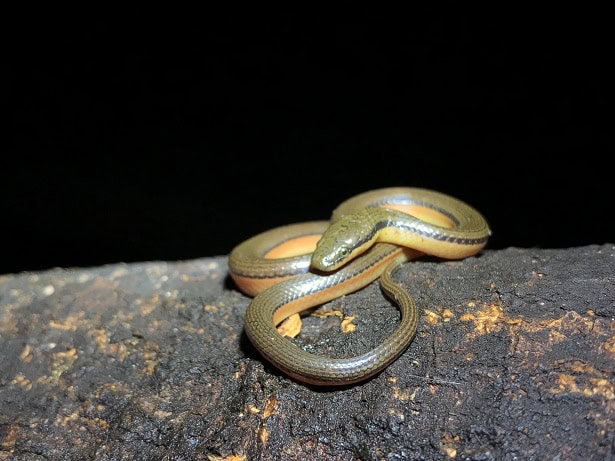
Maximum length: 50cm.
A far less widespread species. Unlike the common wolf snake, the bicoloured stream snake (Opisthotropis lateralis) is found only in far northern Vietnam and areas of southern China adjacent to and including Hong Kong.
This species live up to its name, as it’s a dweller of gently flowing forest streams, and has a sharply divided colour pattern. From above, it’s a swampy green, not bright and neon like a green pitviper, but with a definite murkiness that enables it to blend with overgrown water bodies. From below, its colour is much brighter, allowing it to blend with the sky when viewed from below, confusing potential predators. This split colour pattern is similar to various other water snakes, including the yellow-bellied sea snake of the Pacific Ocean, and plain-bellied watersnake of the USA.
Bicoloured stream snakes have large eyes with round pupils. Between the two colours, there’s a black stripe which passes through each eye. Their diet mainly consists of small fish such as crabs and shrimp, and they’re completely harmless to humans.