
| 1 | Brazilian false coral snake |
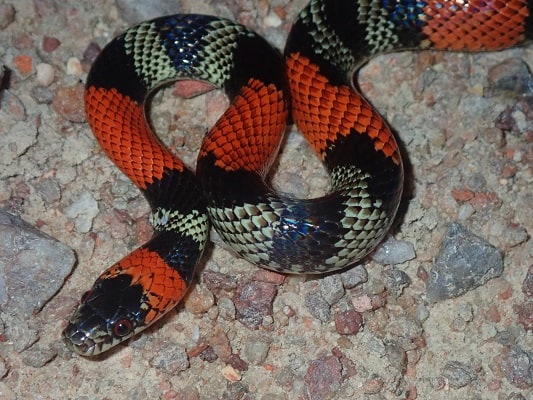
Maximum length: 103cm.
A common coral snake mimic of eastern Brazil, which has thrived by fooling predators into thinking it’s severely venomous. In reality, this species lacks any serious venom, and defends itself instead by producing a vile snake smell.
The Brazilian false coral (Oxyrhopus trigeminus) is common near Rio de Janeiro and the Brazilian capital of Brasília, as well as in the extreme easterly state of Paraíba. This is a nocturnal snake, which sticks to the ground, rarely climbing trees. Its habitats include open cerrado and sandy restinga forests, and it averages at 40-60cm long.
Eastern Brazil has several coral snake species, but the closest match for Oxyrhopus trigeminus is the ribbon coral snake (Micrurus lemniscatus). Both have wider red bands, followed by three thinner black bands and a white band inbetween. A strong difference is that the false coral snake has large, protuberant eyes, which have a red iris – the ribbon coral snake’s eyes are tiny (see here).
Another reason this mimic is so common is that while mammals dominate its diet, it’s a very flexible eater. A study from southeastern Brazil found a diet of 46.7% rodents, 33.3% lizards and 20% birds. Snakes are also confirmed prey, specifically the brown vine snake.
| 2 | False tree coral |
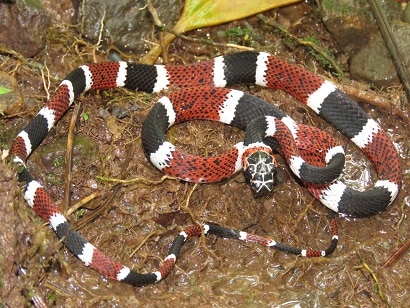
Maximum length: 176.2cm.
A moderately venomous species of Costa Rica, Panama, Colombia and northwest Ecuador. The false tree coral (Rhinobothryum bovallii) lives alongside several deadly species, including the Costa Rican coral snake and Allen’s coral snake.
This species is mainly found at low altitudes, usually below 1000 metres, and very rarely above 1500 metres. Like its coral snake neighbours, it favours untouched primary forests, particularly lowland tropical forest and premontane forest.
The more fragmented a forest becomes by agriculture, the more the false tree coral will disappear. There are no gotcha ID signs, but the best one is probably its head, which has a cracked black pattern, with snowy white showing underneath. Costa Ricans colloquially dub this snake “Cabeza de Tortuga” (turtle head) because of these cracked patterns.
This is a relatively large coral snake mimic. At one stage, the record length was 130.2cm, until 1997, when a 176.2cm individual captured in Limón Province, Costa Rica demolished this completely. While its effects on humans are mysterious, Rhinobothryum bovallii possesses a venom of its own, which is strongly targeted towards green iguanas, paralysing them irreversibly, while barely affecting small mammals.
False tree corals have a strong geographical dividing line, as they’re found only to the west of the Andes, in Colombia and Ecuador, before moving into the Central American nations of Panama and Costa Rica. They’re one of just two Rhinobothryum members, the other being the Amazon banded snake, which lives exclusively to the east of the Andes (including in Brazil).
| 3 | São Paulo false coral snake |
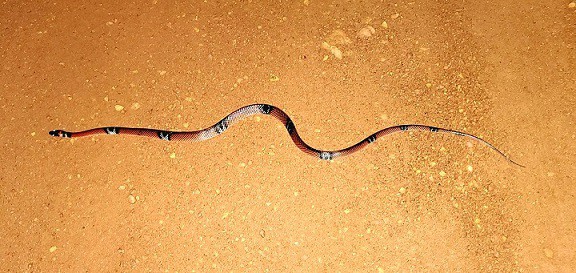
Maximum length: 78cm.
A relatively small coral snake mimic, ranging from 25-78cm. São Paulo false coral snakes (Simophis rhinostoma) live mainly in southeastern Brazil, along the Atlantic coast, as well as eastern Paraguay. They avoid thick forests, and prefer open cerrado savannahs and grasslands, plus secondary forests degraded by mankind.
Species this mimic coexists with include the painted coral snake (Micrurus corallinus) and decorated coral snake, and the wide red spacing followed by tightly bunched black-white has a close resemblance to both.
This species poses no threat to humans. São Paulo false coral snakes have short, feeble teeth, and while they bite if picked up, they’re incapable of causing serious damage.
When cornered, this coral snake mimic has various strategies: fleeing, freezing, thrashing, raising its tail menacingly, flattening its body, an S-coil, false strikes, actual strikes and biting. It has a huge repertoire of defensive tricks – all except venom itself.
One study examined 12 Simophis rhinostoma gathered in their namesake state of São Paulo, Brazil. 5 had identifiable prey in their stomach, and all were frogs, with the top species being Cuvier’s weeping frog. Insect remains were also found, but no rodents or lizards.
| 4 | Broadhead ground snake |
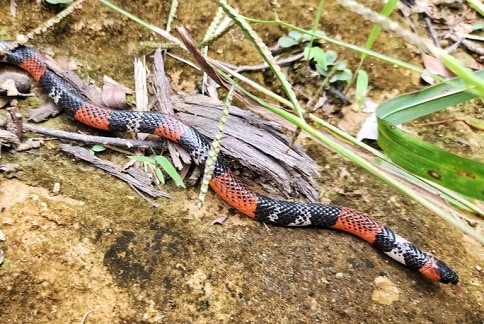
Maximum length: 61.8cm.
This coral snake mimic is found across a huge swathe of central and northwest Brazil, crossing into Peru and Bolivia as well. This is a forest snake through and through, appearing in primary lowland rainforest and riverside gallery forests, occasionally straying to roads inbetween, or slithering around recently deforested areas and wondering what caused all the devastation.
Broadhead ground snakes have various names, including wedgetail earth snake and broadhead arrow earthsnake, as well as their Latin title of Atractus latifrons. They also have various morphs, each mimicking a certain coral snake species.
The first morph is bicolored, featuring black overlaid with thin white stripes (picture). According to a 2022 study, this likely evolved to mimic the white-banded coral snake (Micrurus albicinctus).
Meanwhile, the tricolored morph pictured above probably evolved to mimic the ribbon coral snake (Micrurus lemniscatus). Then there’s a third morph with extremely wide red bands (see here), which is likely mimicking Avery’s coral snake.
Broadhead ground snakes mainly stick to the floors of forests, burrowing themselves into soft soils. They feed on insects and earthworms, and average at 50cm. Despite its huge range, this species is encountered by humans only rarely.
| 5 | Aesculapian false coral snake |
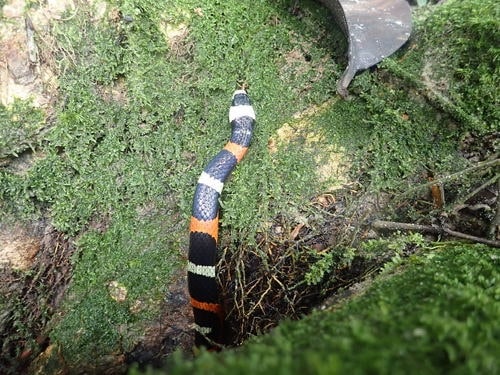
Maximum length: 103.6cm.
A member of the huge Erythrolamprus genus, which currently has 55 members. This species averages at 65-80cm, and has a giant range, covering almost the entirety of Brazil, as well as Peru, Bolivia and northern Argentina.
Aesculapian false coral snakes (Erythrolamprus aesculapii) have a mixture of red, white and black scales, but vary constantly in the exact placement, depending on which coral snake they need to mimic. This is a forest species which is normally spotted by people on forest trails, or occasionally roads adjacent to forests. Its diet includes fellow snakes, like the grey ground snake (Atractus occipitoalbus) and Panama spotted night snake.
Unlike many mimics, this species has its own dangerous venom, which isn’t to be underestimated. This is a rear-ranged snake, which is forced to chew venom into its prey manually. According to hospital data from Butantan, Brazil, 1965 bites from rear-fanged snakes were recorded from 1959 to 1999. The Aesculapian false coral snake accounted for 10 cases, or 0.5%.
In 2016, a 24 year old man suffered a bite from an Aesculapian false coral snake measuring 69cm. After 5 minutes, his finger began swelling painfully, and after 1 hour, his entire hand was swollen, with the bite mark bleeding heavily.
After another four hours, a painful blister appeared, and the swelling reached the elbow. The next day saw his entire arm swell up, and another agonising blister form. That said, this victim was chewed on the finger for a full minute before he removed the snake. This setting of this bite tale was São Paulo state, southeastern Brazil.
| 6 | Variegated false coral snake |
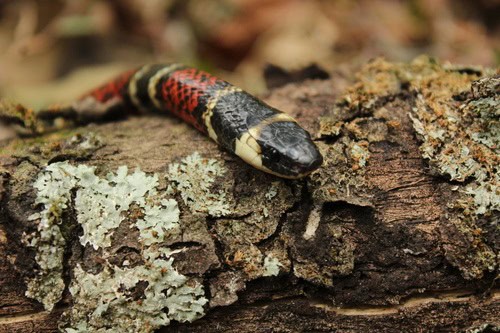
Maximum length: 70cm.
A Central American coral snake mimic, which begins in Costa Rica, and continues all the way to northeastern Mexico, without quite reaching the US border. This mimic coexists with several real coral snakes, including the variable coral snake, Brown’s coral snake, and Texas coral snake (which also lives in Mexico).
The variegated false coral snake (Pliocercus elapoides) is variable in colour, though not as strongly as the broadhead ground snake. This species isn’t found in open grassland, but a variety of forest types, from wet forests to dry forests to cloud forests, and also coffee plantations. While not heavily researched, most sightings of prey so far have been salamanders, including the coffee grove salamander (Aquiloeurycea cafetalera).
This snake has round eyes and smooth scales to touch, with a head distinct from the neck. The variegated false coral snake may also have the nastiest venom of this list. In 1979, a 23 year old herpetologist was gripping this snake, preparing to inject it with a syringe, when it suddenly snapped down onto his finger.
The bite lasted for less than a second, yet just 3 minute later, the entire finger was swollen, and 10 minutes later, the entire hand was swollen. The solution: run far away if you see red-yellow-black colours in Mexico, as it’ll save you in either scenario.
| 7 | False coral snake – E. bizona |
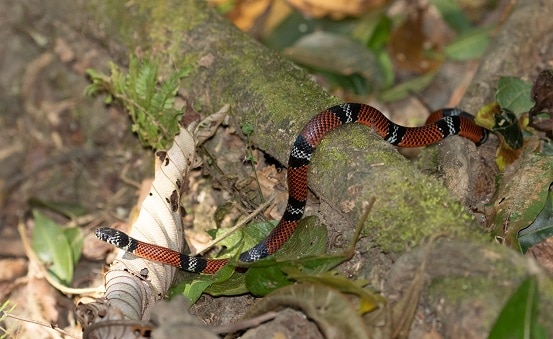
Maximum length: 120.8cm.
A coral snake mimic of Costa Rica, Panama and Colombia. Erythrolamprus bizona mainly inhabits evergreen and semi-deciduous forests, and is relatively common throughout its territory.
With white, black and red bands adorned with subtle dark spots, only an expert could recognise this snake’s deceptive nature at first glance. A white marbled face, alternating between white and black, is one of the best ID signs. This species possesses its own venom as well, with dangerous neurotoxic and proteolytic properties.
This species even mimics the diet of true coral snakes: other snakes. So far, Erythrolamprus bizona has been spotted eating at least 5 snake species:
- Northern cat-eyed snake (Leptodeira septentrionalis).
- Freminville’s scorpion-eating snake (Stenorrhina freminvillei).
- Degenhardt’s scorpion-eating snake (Stenorrhina degenhardtii).
- Hallowell’s coffee snake (Ninia atrata).
- Black-headed snake (Tantilla melanocephala).
The dreaded cane toad is another of its confirmed prey. This species is packed with deadly bufotoxin, meaning that E. bizona may have natural resistance. The unusual thing is that Erythrolamprus bizona swallows its prey tail first, whereas headfirst is the serpent standard.
Erythrolamprus bizona appears in various locations, ranging from 0 to 2630 metres above sea level. While its average length is 50-80cm, the longest of all time (so far) measured 120.8cm. This wasn’t a live individual, but found in an old collection in the Florida Museum of Natural History.
Females are slightly longer in this species, as the previous records were 108.0cm for a female found in Cartago, Costa Rica, and 99.9cm for a male found in Antioquia, Colombia.
| 8 | Filetail ground snake |
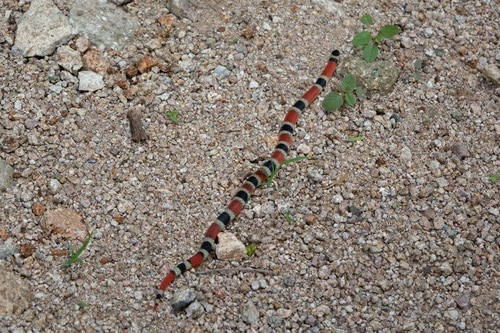
Maximum length: 44.7cm.
An obscure snake which has a small range in western Mexico. Filetail ground snakes (Sonora aemula) are found to the west of the Sierra Madre Occidental mountain range, usually in tropical dry forests.
This species is native to the following states: Chihuahua, Sonora and Sinaloa. The main coral snake it overlaps with is the West Mexican coral snake (Micrurus distans), and its patterns are a close match. Both have wide red bands, followed by thinner bands in a white-black-white sequence.
This species closely resembles other Sonora genus members (such as the Western ground snake), but has rough spines along its tail, which give it the jagged “file” title. Research is severely lacking, but according to a 2008 study, its diet consists mainly of insects, particularly crickets and locusts. This makes sense given its small size of 30-40cm.
The mean size of an egg clutch was 4.6, and there was no size difference between the genders. Until 15 years ago, this species was known as Procinura aemula, and many old research papers are still filed under that name.
| 9 | Scarlet snake |
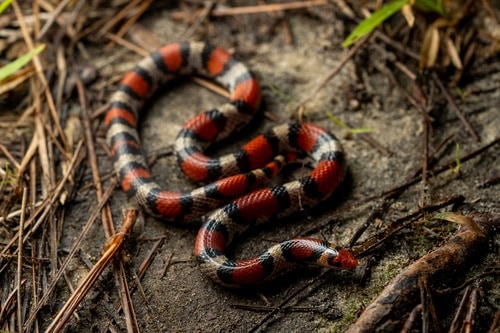
Maximum length: 82.3cm.
No article about coral snake mimics would be complete without the scarlet snake of Florida. This is the species which inspired the classic nursery rhyme: “red touches black, venom lack, red touches yellow, kill a fellow“, and its endless variations.
In the southeastern US, this rhyme is completely accurate. The resident killer is the eastern coral snake, whose bands go red-yellow-black-yellow-red-yellow and so on. The scarlet snake, meanwhile, is a completely harmless species with no venom. It does have a severely enlarged front tooth, but this is for hacking through turtle egg shells, and licking the yolk out.
Scarlet snakes are found in similar habitats to eastern coral snakes, including damp hardwood and coniferous forests, adding to the confusion. Scarlet snakes rarely bite even if picked up, preferring to release a vile serpent odour, forcing you to drop them in disgust. This species inhabits all of Florida (except the Keys), and occurs as far north as Philadelphia, hugging the eastern seaboard.
Some scientists believe that coral snake mimics aren’t really mimics at all. They believe that instead, a similar set of habitat circumstances forced the colourful bands to evolve independently, possibly involving moonlight and camouflage against fallen branches.
The simple argument against this is Africa. Across the entire continent, there are no true coral snakes, and likewise, harmless snakes with red-yellow-black bands are severely lacking in Africa compared to elsewhere.
| 10 | Imposter flame snake |
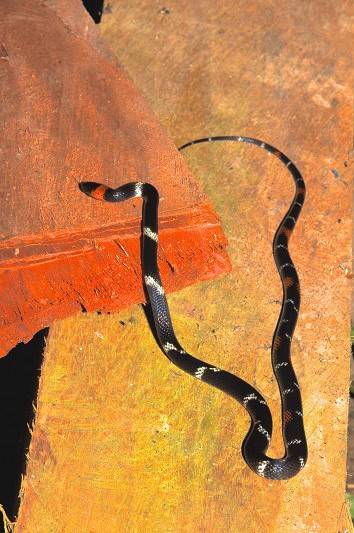
Maximum length: 101.8cm.
A species of the Amazon rainforest, but a relatively flexible one which can appear in plantations and degraded forests as well. The imposter coral snake (Oxyrhopus vanidicus) has a black body overlaid with white bands spaced at fairly consistent intervals, and additional bands which are red in some individuals and yellow in others.
You can find this mimic species in eastern Ecuador, northwestern Brazil, Venezuela and eastern Colombia. Imposter flame snakes have been spotted moving on shrubs one metre high, or even up to 3 metres high, but they generally stick to the ground.
Their diet is relatively unfussy, according to a 2013 study. Imposter flame snakes prey on a mixture of small rodents and reptiles, with confirmed meals including glossy shade lizards and reticulated creek lizards.
This species mimics various coral snakes, with a classic black face, which hides their murderous venomous intent, preceded by a red skull cap. The difference is that Oxyrhopus vanidicus isn’t a coral snake at all, and isn’t even a close relative. It doesn’t even belong to the elapid snake family, which contains coral snakes, cobras, mambas, sea snakes and kraits. Instead, it’s a colubrid, joining parrot snakes and ratsnakes.