
| 1 | Mamushi |
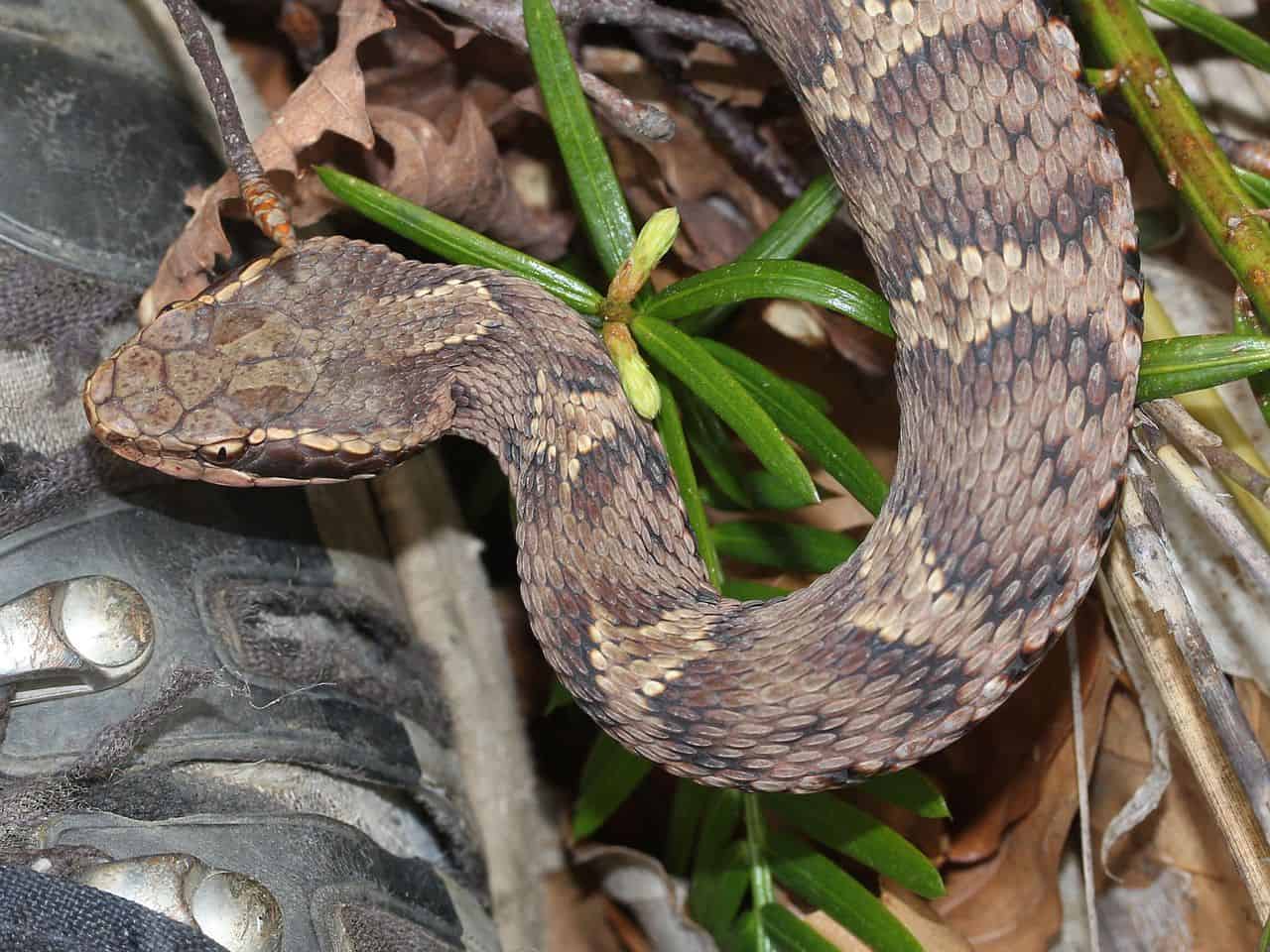
Maximum length: 93cm.
Gloydius is a large genus of venomous snakes found in eastern Asia, which are most closely related to the copperheads and cottonmouths of the USA (Agkistrodon genus). There’s 25 members, every species is venomous, and one of the most notorious is the Japanese mamushi (Gloydius blomhoffii).
This species inhabits virtually all of Japan, including the main island of Honshu and the frostier Hokkaido to the north. It’s common in woodlands and mild countryside areas, and bites hundreds of Japanese people per year, killing an estimated 10. One particularly deadly feature of a mamushi bite is that victims’ internal organs begin to liquefy.
Mamushis produce a handful of neurotoxins, but their venom is mainly cytotoxic and haemotoxic, attacking skin tissue and causing necrosis. The main cause of death, if it happens, is kidney failure. Spontaneous bleeding is a strong feature of mamushi bites, from the fang marks themselves, but also the gums and old half-healed cuts.
Mamushis are saved from causing even more terror by their inability to jump, and that they only attack when victims draw near. Most victims are farmers working in their rice paddies and crop fields, or villagers foraging for herbs, berries and mushrooms, while sifting through long grasses. Mamushis love to camouflage in this overgrown vegetation, effortlessly blending in.
Like all Gloydius members, this is an ambush snake, which spends hours without moving, rather than charging after people like a cobra.
| 2 | Ussuri pitviper |
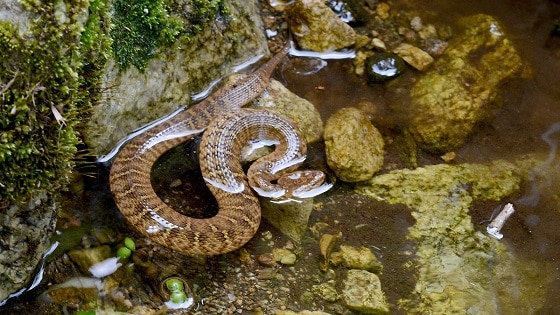
Maximum length: 68cm.
South Korea is a surprising hotbed of venomous snakes, and the Ussuri pitviper is one of three Gloydius pitviper species native to the country. This cunning snake is found across the entire Korean peninsula, as well as a swathe of far eastern Russia and northeast China.
Ussuri pitvipers are abundant in forested valley floors, particularly areas close to streams. This is a fairly lazy snake, as a 2015 study from South Korea found that some radiotagged individuals moved just 3-32 metres from their original position in 300 days.
Ussuri pitvipers prey heavily on amphibians, with their favourite species including Japanese tree frogs, Boreal digging frogs and black spotted frogs. Bites in humans are rarely fatal, but typically result in spontaneous bleeding, swelling, and necrosis.
While lacking in neurotoxins, Ussuri pitvipers attack blood clotting, and do so from many angles. The first is destroying fibrinogen, the substance which directly leads to fibrin creation, the physical backbone of blood clots. A more subtle angle is disabling factor X in the bloodstream. Factor X transforms prothrombin into thrombin, and thrombin is what acts upon fibrinogen to create fibrin.
Like the mamushi, Ussuri pitvipers are common near villages and human settlements. Consequently, they’re believed to cause the highest number of venomous snakebites annually in South Korea.
| 3 | Tsushima Island pitviper |
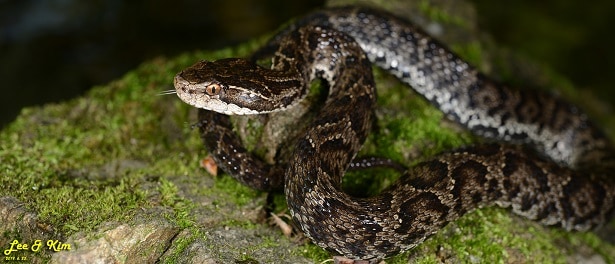
Maximum length: 66.1cm.
The second Gloydius pitviper on Japanese soil. This version is found on a single island – Tsushima Island (population 30,000), which lies at the very southern end of Japan, not far from the Korean peninsula.
Tsushima Island pitvipers (Gloydius tsushimaensis) live in forests, rice fields, and the edges of swamp land, where they feed on shrews and amphibians such as Tsushima brown frogs (Rana tsushimaensis). This menacing viper has orange eyes, and is most frequently sighted in September, when males embark upon their annual quest for females.
The mamushi causes 10 deaths per year in mainland Japan, but a 2011 study suggested that Gloydius tsushimaensis is significantly deadlier. Its LD50 dosage (the quantity required to kill 50% of animals) was half that of the mamushi, while its minimal haemorrhaging dosage was just 1% of the mamushi’s.
Additionally, the antivenom for the mainland mamushi was only partially effective against this rare island species. The Tsushima Island pitviper has no specific antivenom, and there are currently no plans to manufacture one. Watch your step if ever find yourself on this obscure Japanese island. Rather than the mamushi, the Tsushima Island pitviper is most closely related to the Ussuri pitviper of South Korea.
| 4 | Short-tailed mamushi |
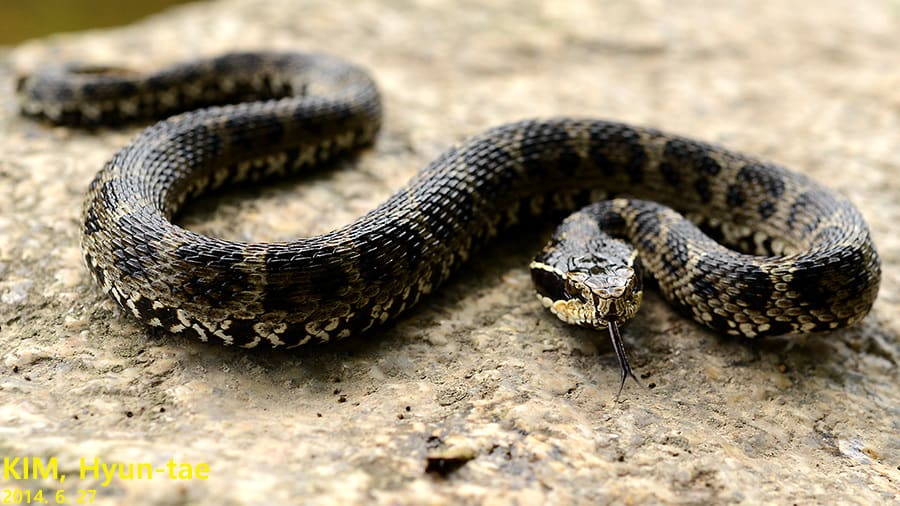
Maximum length: 71cm.
The second of South Korea’s 3 Gloydius pitvipers. This species is widespread all over the Korean peninsula, as well as eastern China, where it has a lethal stronghold around Shanghai. Locations where it doesn’t appear include Hong Kong, Japan and Vietnam.
Rather than rugged mountains, short-tailed mamushis (Gloydius brevicauda) prefer low altitude areas with higher temperatures and humidity. This includes agricultural areas, forests, and rivers. Short-tailed mamushis produce very few neurotoxins, instead specialising in local skin tissue destruction. According to a 2014 study, 64.4% of the venom in adults consists of metalloproteinases, which dissolve amino acid bonds in proteins.
In one bone-chilling incident, a 16 year old boy who owned an imported short-tailed mamushi in Hong Kong ended up being bitten on the left middle finger. His left hand rapidly swelled up, and he was admitted to the emergency room, but experienced no systemic symptoms, such as paralysis, vomiting or faintness. The boy survived, but 2 months later, his finger was still crooked when flexed.
South Korea has three Gloydius pitvipers in total, but the short-tailed mamushi is the one used by national authorities to manufacture antivenom. It’s the usual system: injecting raw venom into horses and collecting the rapidly generating immune system antibodies.
Originally, the short-tailed mamushi was considered to be a subspecies of the Japanese mamushi, and was dubbed Gloydius blomhoffi brevicauda. Now it’s been granted full species status, but the two are still each other’s closest relatives within the 25 member Gloydius genus.
| 5 | Himalayan pitviper |
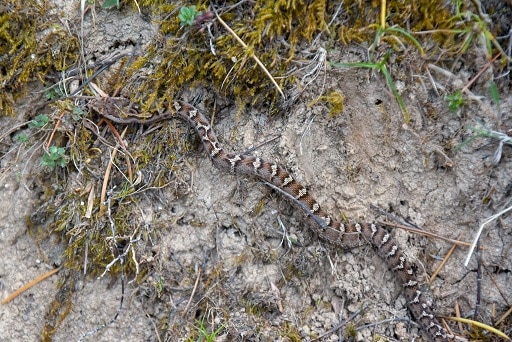
Maximum length: 86cm.
A mountainous pitviper which lives in extremely rugged, remote habitats, but also close to villages in valleys. This is the only Gloydius pitviper found to the south of the Himalaya, which act as a titanic barrier to any migrating snake. But there’s also a more interesting record: this is officially the highest altitude snake in the world. The Himalayan pitviper (Gloydius himalayanus) has been found at 4900 metres above sea level, with Nepal and northeastern Pakistan being particular hotspots.
Everest base camp on the Nepalese (south) side lies at 5364 metres, meaning that mountaineers on the ten day trek from Kathmandu could easily bump into this species. Himalayan pitvipers are common in open alpine meadows, and are rumoured to appear at the sides of glaciers. However, Himalayan pitvipers also appear at lower altitudes of 2000-2500 metres, where they roam thick forests.
An aggressive Himalayan pitviper will enter into a strike pose, with its body relatively close to the ground (unlike a cobra). A telltale sign is a neck kinking sharply at a right angle, with the face facing the aggressor’s face (see here).
This is also the only Gloydius pitviper found in Pakistan, straying into the harsh, mountainous northeast (home to K2). Gloydius himalayanus is an outlier on the Gloydius family tree, with a more distant genetic relationship to the others.
| 6 | Shedao island pitviper |
Maximum length: 99cm.
This Gloydius pitviper is found in just one location: the tiny Shedao island 7 miles off China’s northeast coast. This is a proper island’s island, with steep cliffs and frequent howling winds, and snakes absolutely everywhere.
Shedao Island measures just 0.73 km², and reaches a maximum altitude of 215 metres. Yet estimates of the snake population range from 10,000-20,000 individuals. A century ago, before the snake wine industry boomed, the figure was an estimated 50,000. In certain hotspots, this island can have one Shedao Island pitviper every square metre. Their activity peaks in May and September, at which point the temperature is 10-20C.
Winters on Shedao Island are severely cold, yet this poses no problem for the resident pitvipers. They have a lengthy hibernation season, deactivating for up to 8 months straight. Most of their diet consists of migratory birds, which dock on the island temporarily, only to face a snake surprise. As these birds are seasonal meals, there’s no point in Shedao Island pitvipers even staying awake for most of the year.
Some birds like the Chinese egret and northern white-rumped swift live on the island permanently, but a further 84 species use it as a migratory outpost, sometimes landing for just a few days. Shedao Island pitvipers have a fun tendency to jump out of trees, although this might not be fun for visiting researchers.
| 7 | Central Asian pitviper |
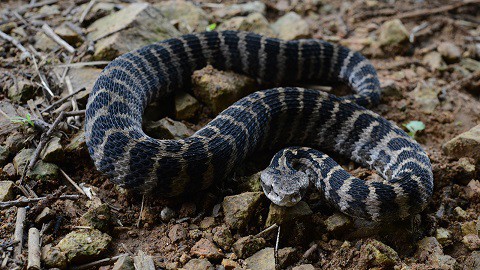
Maximum length: 80cm.
The last of South Korea’s 3 Gloydius pitvipers, and the one found most commonly at high altitudes. Unlike Gloydius brevicauda and G. ussuriensis, this species prefers open, rugged, mountainous fields with minimal tree cover, and plenty of sweeping views to admire.
Central Asian pitvipers (Gloyidius intermedius) prey heavily on mammals, with confirmed prey including the house mouse and royal vole (Craseomys regulus). This snake once had a massive empire across Asia, reaching as far west as Iran – hence the name. However, genetic testing revealed that Gloydius intermedius is actually limited to the Korean peninsular, and an area of far eastern Russia just north of Korea.
Unlike most Gloydius pitvipers, this species has a strongly neurotoxic venom. A bite can unleash trembling fingers, respiratory failure, twitching eyelids, drowsiness, and a variety of unpleasant brain signal disruption consequences.
One great study compared Ussuri pitvipers and Central Asian pitvipers in the same nature reserve (Cheonma-san Mountain County Park), located in South Korea. The verdict was that Central Asian pitvipers strongly disliked forests. They never appeared in areas with 100% tree canopy cover, while Ussuri pitvipers were abundant under heavy cover.
Central Asian pitvipers gravitated towards areas of 0-20% tree canopy coverage, while Ussuri pitvipers were scarce in those areas. The two species had different altitude preferences, as Gloydius intermedius stuck to above 600 metres, while Ussuri pitvipers were common in forested valleys below 400 metres. These pitvipers are able to coexist in South Korea because of their completely separate habitat niches.
| 8 | Siberian pitviper |
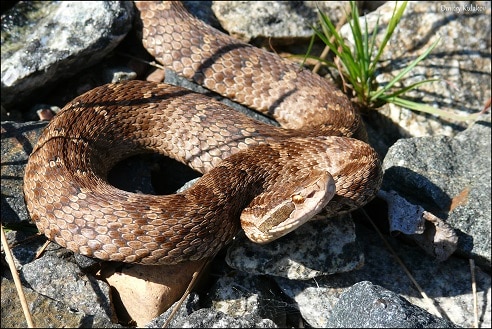
Maximum length: 75cm.
A species of rugged realms with few human inhabitants. The Siberian pitviper (Gloydius halys) is the most widespread of its genus, ranging from Azerbaijan in the west to Beijing in the east. This title was originally held by Gloydius intermedius, the central Asian pitviper, which was thought to roam Iran, Kazakhstan and northern China. However, recent genetic investigation led to most of these colonies being switched to the Siberian pitviper instead.
Siberian pitvipers never appear in flat valley bottoms or dense forests. They prefer rocky upland areas, including the banks of mountainous streams and rugged mountain steppes.
This species is especially abundant in the vast wilds of Mongolia, and is missing from Korea, Japan and far eastern Russia. Siberian pitvipers hibernate on south-facing slopes in order to maximise sun absorption, burying themselves deep underground in twisting burrows, and not emerging for several months.
Given that this snake lives in the middle of nowhere, bites are uncommon. However, its venom is strongly cytotoxic and hemotoxic, unleashing local symptoms like swelling and necrosis. A unique peptide called halysase has been isolated from its venom, which causes the apoptosis of endothelial cells, destroying the extracellular membrane, including a variety of proteins such as type 4 collagen. Another peptide identified cleaved through fibrinogen, a key ingredient in properly clotting blood.
| 9 | Nuijang pitviper |
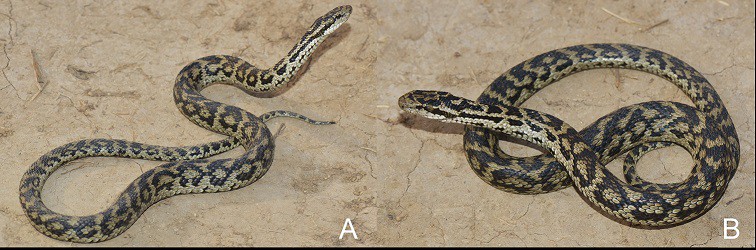
Maximum length: 62.8cm (so far).
The Gloydius pitviper clan is far from done expanding. We’re now into the 20s, and given how vast the steppes of central Asia are, it’s likely that we’ll pass 30 members in the next couple of decades.
A recent addition was the Nuijang pitviper in 2021, AKA Gloydius lipipengi. This is a Tibetan species which is known from just one location: Muza village, Zayu County. This lies in southeastern Tibet, just over the border with India.
Gloydius lipipengi was found in a hot, dry valley not far from the Nujiang River. The snake was spotted resting on leaf litter in a dry forest, at 9:00am. The scientists only found this one snake, yet this was sufficient to identify it as a new species.
One special feature was a pair of black markings atop its head, which look somewhat like two people bowing while shaking hands. Its belly was grey, interspersed with random black squares. Its closest relative was deemed to be Gloydius rubromaculatus, found on the Tibetan plateau 500km away.
The snake measured 62.82cm, from head to tail tip. It had a distinctive greyish-brown base of colour, with vivid patterns of interlocking black rings. The new Gloydius lipipengi was whisked away to captivity, where it happily swallowed some pinkie mice, the standard captive snake food all around the world.
| 10 | Jiuzhai pitviper |
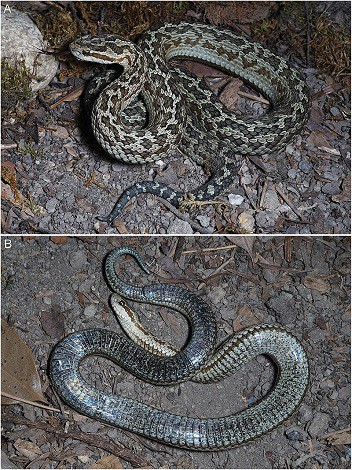
Maximum length: 53.3cm (so far).
An even more recent discovery came in 2022, from the Jiuzhaigou National Nature Reserve of China. This is an official world heritage site, covering 651 square kilometres, a glorious nature sanctuary where endangered panda bears and golden-snub nosed monkeys can roam freely. Knowledge about reptiles in the reserve was much poorer, so in 2021, some Chinese scientists embarked on an expedition in which they scooped up several Gloydius pitvipers.
The verdict: they had discovered an all-new species, which they dubbed Gloydius lateralis, or the Jiuzhai pitviper. The species ranged from 42.4-53.3cm, and had a tendency to hang out by hot, sunny roads. A couple were actually found dead on the roads.
A brown stripe extending backwards from each eye and continuing along much of the body was a distinctive physical feature. So far, the Zharu valley is the sole known domain of this new pitviper.
Technically, Gloydius lateralis was “discovered” centuries ago: villagers have almost certainly been tiptoeing around it for eons, warning their kids not to walk down a particular trail. Yet it was only identified as a new species in 2022, separate from all other Gloydius members.
Worldwide, the Jiuzhai pitviper was deemed to be most closely related to the glacier pitviper (Gloydius swild). This was yet another new discovery, identified in the same 2021 study as the Nuijang pitviper. Gloydius swild was found in Heishui County, southern China, hiding under rocks on a sunny mountain slope. Who knows which obscure valley will cough up a new Gloydius pitviper in 2026, 2027 or 2032.