
| 1 | Ribbon coral snake |
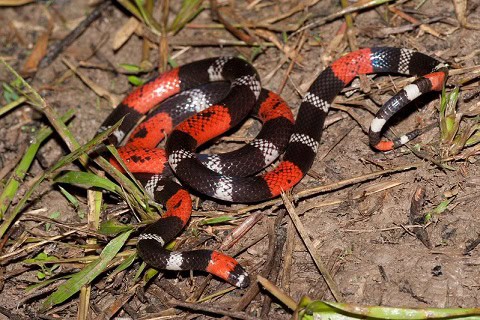
Maximum length: 145cm.
One of the most widespread coral snakes in South America in terms of sheer territory covered. While no coral snake inhabits all of Brazil, the ribbon coral snake (Micrurus lemniscatus) covers virtually the entire northern half, as well as Peru and Ecuador over the western border. This species has flexible habitats, including humid forests, dry forests, savannahs, and deforested areas.
Ribbon coral snakes average at 60-90cm, and were named for their especially thin body. Their bite is particularly nasty, as one Ecuadorian male victim experienced excruciating pain down his entire arm. The neurotoxic symptoms were slow to arrive, appearing at 14 hours, but when they did, they included severe breathing difficulties.
The man was soon placed on supplemental oxygen, followed by a full mechanical ventilator. He also experienced bacterial pneumonia, bronchial obstruction via mucous plugs, and rhabdomyolysis. There were only mild blood clotting difficulties, so it seems that this venom strongly targets the lungs.
One ingredient is a powerful neurotoxin called lemnitoxin, identified in 2016. This was closely related to a neurotoxin found in the Central American coral snake, called nigrotoxin. It was also structurally similar to two Australian neurotoxins: notexin in the tiger snake, and textilotoxin in the eastern brown snake.
Ribbon coral snakes have a varied diet, including snakes, eels, fish and amphisbaenians. They bite their prey at the mid-section, before releasing their hold and waiting for 30 minutes. They then return to their weakened prey, and swallow by the head.
| 2 | Eastern coral snake |
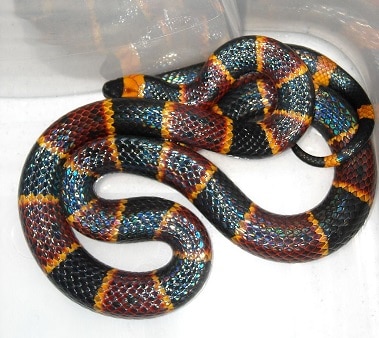
Maximum length: 129.5cm.
The eastern coral snake is the most famous Micrurus member of all. It’s a species which has inspired endless folk nursery rhymes – specifically, “red touches yellow, kill a fellow”, to distinguish it from its harmless neighbours (red touches black, venom lack).
The eastern coral snake is found in Florida, Georgia, South Carolina, and Alabama. It almost never attacks humans, preferring to rest calmly on the forest floor. Unlike the timber rattlesnake, which can rear up and start hissing angrily from several metres away, the eastern coral snake prefers to remain silent and not draw attention to itself. Despite this, its venom is significantly deadlier drop for drop, with an LD50 score of 0.2mg, versus the timber rattlesnake’s 1.64mg.
Eastern coral snakes have barely any variation in appearance, between the sexes or individuals. The red touches yellow rule is always consistent. They also have very little variation in venom, according to a 2015 study, which found consistent neurotoxic qualities across their entire range.
Eastern coral snakes are commonly found in slash pine, wireglass flatwoods and oak hammocks. They’re non-burrowing, preferring to rest on the forest floor amid fallen leaves and loose soil. They’re also decent swimmers, but only use these skills when strictly necessary. Like other Micrurus members, the eastern coral snakes preys on fellow serpents, including the rough green snake and mud snake.
| 3 | Variable coral snake |
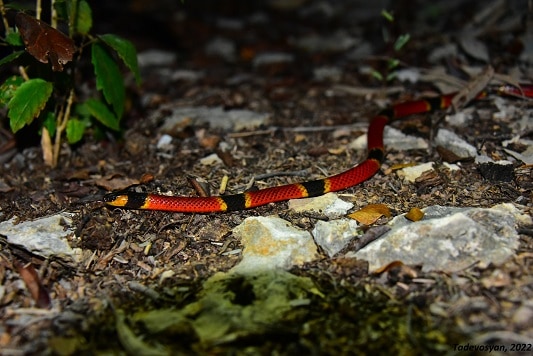
Maximum length: 98.2cm.
A species with several morphs, with red and black nearly always being present, but the yellow sometimes absent or barely visible. In fact, this is probably the most variable Micrurus coral snake out of all 82. The morph above is fairly typical, but then you have editions like this and this.
Variable coral snakes (Micrurus diastema) inhabit southern Mexico, Belize and Guatemala. The longest ever measured 98.2cm, and was found in Mexico’s Yucatán peninsula. This is a neurotoxic species, containing an abundance of alpha-neurotoxins and three finger toxins.
Micrurus diastema has the typical coral snake diet, mostly eating fellow serpents. At least 5 species are confirmed, including blotched hooknose snakes (Ficimia publia) and red coffee snakes (Ninia sebae). This is the most abundant coral snake in Mexico’s Yucatán peninsula, where it lives alongside such venomous snakes as the Yucatán cantil and Tzabcan rattlesnake.
The Micrurus coral snake genus contains 82 members, but according to a 2016 evolutionary tree, variable coral snakes are part of a 4 member subgroup within this, which are genetically linked. The other members are the eastern coral snake, Texas coral snake, and Costa Rican coral snake (Micrurus mosquitensis).
| 4 | Texas coral snake |
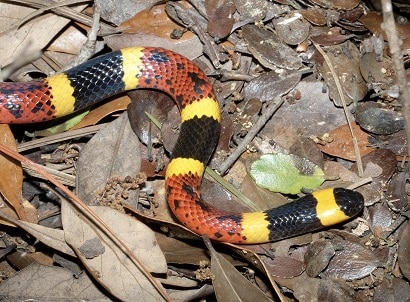
Maximum length: 121.3cm.
A coral snake of the deep south, which possesses a potentially lethal arsenal of neurotoxins. The Texas coral snake (Micrurus tener) was originally a subspecies of the eastern coral snake found in Florida, but is now recognised as an independent species. Back in the glory days, the eastern coral snake had 5 subspecies, but after this great separation, 4 were switched to the Texas coral snake.
Of the two species, the Texas coral snake is easily the more common, though slightly shorter. This potentially lethal snake inhabits most of Texas and western Louisiana, but also a vast chunk of Mexico, including the outskirts of Mexico City down south. Texas coral snakes have relatively flexible habitats for the Micrurus clan, inhabiting arid areas, woodlands and moist forests alike. They’ve even been found at 2155 metres above sea level in Guanajuato, Mexico.
At first glance, the eastern and Texas coral snakes are impossible to distinguish. The colours and ordering of the colours are identical, but there’s one subtle difference.
Both species have a fully black face, a yellow lower head (starting behind the eyes), and a pitch black neck collar. In the Texas coral snake, the black neck band is larger, extending further up the head, reaching the tips of the parietal scales (two large scales on the top of the head). In the eastern coral snake, the black doesn’t touch the parietal scales – essentially, the yellow band on the head is larger.
Texas coral snakes have a relatively mild venom. According to a study on 82 bite victims, systemic symptoms were rare, while swelling, pain and tingling affected nearly 90% of patients. One weird skill is producing a popping sound when threatened, which is startling to people who have never heard it before.
Texas coral snakes also hold the record of most northerly coral snake in the world, crossing into south central Arkansas on the northeast limit of their range.
| 5 | Argentinian coral snake |

Maximum length: 124.1cm.
This species holds the opposite record: the world’s most southerly coral snake. Argentinian coral snakes (Micrurus pyrrhocryptus) inhabit roughly the upper two thirds of the country, reaching as far south as Niequen, 39° S in latitude. They also cross the northern border into Paraguay, Bolivia, and southern Brazil. Rather than humid forests, their main habitat is dry chaco, a large swathe of savannah-like grassland and dry woodlands.
Argentinian coral snakes are most commonly sighted during the wet season, when males embark on their annual quest for females. Their diet consists of snakes, and two confirmed prey are La Villa’s slug-eating snake and Brongersma’s worm snake. The latter is also confirmed prey for the painted coral snake (Micrurus corallinus), southeastern Brazil’s most common species.
A 2011 study analysed Argentinian coral snake venom, and found that it was firmly in the neurotoxic category. It had virtually no myotoxic (muscle-assaulting) activity, unlike the Amazon coral snake, as there was no rise in the bloodstream biomarker creatine kinase.
As well as biting, Argentinian coral snakes will also flatten their body when confronted, and raise their tails to distract their enemies. However, they have to be touched vigorously for this to happen.
| 6 | Central American coral snake |

Maximum length: 115cm.
A widespread species which ranges from extreme southern Mexico, to extreme northwest Colombia. Inbetween, they inhabit all 7 Central American countries, and have a bounty of sightings in Guatemala and Costa Rica. Central American coral snakes (Micrurus nigrocinctus) reach a maximum of 115cm, and feed on neighbouring snakes in order to survive, with many confirmed species to their name…
- Costa Rican worm snake (Amerotyphlops costaricensis).
- Banded cat-eyed snake (Leptodeira rhombifer).
- Whitenose blind snake (Liotyphlops albirostris).
- False coral snake (Erythrolamprus bizona).
While they mainly eat snakes, any elongated animal that resembles a snake will whet their appetite, including worm lizards like the Varagua caecilian (Gymnopis multiplicata).
Central American coral snakes have relatively flexible habitats, inhabiting thickets, cattle pastures, coffee plantations and urban gardens, as well as forests. Their venom is highly neurotoxic, causing paralysis, and they’re recognisable by a tail where the red completely disappears, giving way to alternating yellow-black.
Micrurus nigrocinctus faces many predators in the forests of Central America. Nine-banded armadillos have been seen running up to this species, flipping them over in mid-air, and bashing them repeatedly with their hard shells until dead. Bird predators include the Lesson’s motmot, which was once observed smashing this coral snake against the ground for 3 minutes straight, before flying away into the jungle.
| 7 | Balsan coral snake |

Maximum length: 72.8cm.
The Balsan coral snake (Micrurus laticollaris) lives solely in southern Mexico, where it has a large chunk of land to call home, including the outskirts of Mexico City. This coral snake mainly inhabits tropical deciduous forests, particularly along the course of the Balsas river.
This is a powerfully neurotoxic species, containing both post and presynaptic neurotoxins, the latter being significantly harder to treat with antivenom. According to a 2014 study, the venom produced an “irreversible time- and concentration-dependent neuromuscular blockade” in mice. In 2013, scientists identified a new alpha-neurotoxin in Balsan coral snake venom called MlatA1, believed to be one of the most important.
In Mexico, the Balsan coral snake is known as “Coralillo de Doble Collar”, as there’s two white bands around its head/neck area. This snake has a purely black face, which obscures its small beady eyes. Then there’s a white lower head, followed by a black neck band.
Balsan coral snakes have very little variation in colour and pattern. Compared to the Texas coral snake, the pale bands are clearly white rather than yellow. So far, this species’ diet is completely unresearched.
| 8 | Red-tailed coral snake |
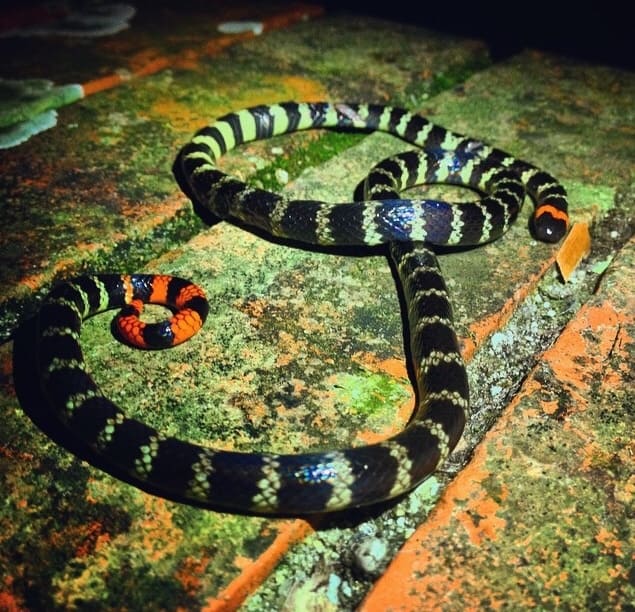
Maximum length: 140.6cm.
An easily recognisable coral snake, which can be found at up to 2410 metres above sea level, and is especially abundant in sugarcane and coffee plantations. Red-tailed coral snakes (Micrurus mitipartus) are common, but found only to the west of the Andes mountain range. This means Colombia, Venezuela, Panama, and the western half of Ecuador. The deepest into Central America they reach is eastern Costa Rica.
With a bright red tail and neck, but no red elsewhere on the body, Micrurus mipartitus is one of the easiest coral snakes to recognise. One of its local names is coral rabo de ají, or chilli pepper tail coral snake. This species has a black face, so black that its eyes are barely visible. Its body is mainly black and white, in rapidly alternating bands, which number 34-84.
Micrurus mipartitus is also one of the longer coral snake species. For years, the maximum length was reported at 122cm, but in August 2015, this record was demolished. A red-tailed coral snake was collected in the municipality of El Agrado, Colombia, on the west bank of the Magdalena river, and measured at 140.6cm. The scientists also tried feeding this snake a San Antonio anole (Anolis antonii), but this was rejected in disgust.
Red-tailed coral snakes mainly feed on elongated prey. This includes caecilians, and fellow snakes such as the obscure Villmaria spindle snake (Atractus manizalesensis) and Werner’s ground snake.
Red-tailed coral snakes possess a severely neurotoxic venom, but rarely bite. It’s estimated that just 0.4% of snake envenomations in Colombia are caused by coral snakes, meaning that for red-tails, the percentage will be even tinier.
| 9 | Brown’s coral snake |

Maximum length: 100cm.
Another of Mexico’s 16 coral snake species. Brown’s coral snake (Micrurus browni) sticks to southern Mexico, also crossing into Guatemala, and usually measures 50-70cm. This coral snake is most common in tropical deciduous forests, where it can be spotted by the sides of roads, in a sudden flash of red and yellow as you drive past.
Brown’s coral snake can be found from sea level to above 2000 metres on the rolling Mexican plateau, just north of Mexico City. This species is firmly a snake eater, and southern Mexican neighbours it’s confirmed to prey on include…
- Freminville’s scorpion-eating snake (Stenorrhina freminvillei).
- Middle American burrowing snake (Adelphicos quadrivirgatum).
- Big Bend black-headed snake (Tantilla rubra).
- Bakewell’s blind snake (Epictia bakewelli).
- Sallae’s earth snake (Geophis sallaei).
Kidney damage isn’t a speciality of coral snake bites, but Micrurus browni does wield this deadly skill, according to a 2020 study. The viability of kidney cells was reduced, while the antioxidant glutathione was decreased. A biomarker of oxidative damage called malondialdehyde significantly increased, and the venom of the Balsan coral snake acted similarly.
Elsewhere, Brown’s coral snakes have the usual diabolical mixture of alpha-neurotoxins and three-finger toxins. One toxin called MitTx causes intense pain all over the body – this is also found in the Costa Rican coral snake (Micrurus mosquitensis).
| 10 | Desert coral snake |

Maximum length: 88cm.
This obscure species lives exclusively in northern Peru and southern Ecuador, in a thin belt to the west of the towering Andes mountains. This is a small coral snake, with an all-time record of 88 centimetres, but an average of only 35cm.
Desert coral snakes (Micrurus tschudii) aren’t found in true deserts, and neither is any member of the Micrurus genus. However, they do gravitate towards drier areas, including dry tropical forest, dry deciduous forest, and desert thorn scrub.
Desert coral snakes have a particularly extreme venom, which consists of 95% three finger toxins. Among the most potent was a unique neurotoxin called tschuditoxin-I, which is structurally similar to the MS-1 neurotoxin found in aquatic coral snakes. This was also similar to an alpha-neurotoxin found in the Central American coral snake (Micrurus nigrocinctus), yet strangely, the antivenom of that species was barely effective against the desert coral snake.
Desert coral snakes have a typical Micrurus colour pattern: red, black, white, black, white, red, then rinse and repeat. However, the red bands are far thinner compared to species like the decorated coral snake. In some individuals, all the bands are evenly spaced, while in others, the red bands are the thinnest. Desert coral snakes have a black face, with a red skull cap.
| 11 | West Mexican coral snake |

Maximum length: 107.5cm.
The resident coral snake of western Mexico, a realm it shares with the Mexican west coast rattlesnake. The West Mexican coral snake (Micrurus distans) averages at 50cm, and is predominantly a snake of tropical dry forests, where it loves to bury itself under leaf litter. Unusually for a coral snake, this species also climb trees on occasion. Members have been observed 4.5 metres high in trees, before becoming startled when scientists approach, and rapidly descending to the forest floor.
This is apparently a vengeful coral snake. In western Mexico, one coral snake mimic is the milk snake, which is non-venomous, but shares the same red, white and black banding in an attempt to stay alive. Angry at this insult, a Micrurus distans was photographed eating a milk snake in March 2008, in a tropical deciduous forest in Mexico’s Jalisco state.
Both measured 70cm, and the milk snake fought back, attempting to constrict its predator, but weakened within 10 minutes from the neurotoxic venom. The coral snake took 20 minutes to fully swallow its prize, starting with the head, and then vanished into leaf litter.
Other confirmed prey in this coral snake’s diet include longnose snakes (Rhinocheilus lecontei), southwestern cat-eyed snakes (Leptodeira maculata), and middle American indigo snakes. The venom of Micrurus distans contains the usual neurotoxins, with a bonus helping of myotoxins.