
Costa Rica is a complete snake pit of a country, and there’s well over a dozen snakes which are capable of inflicting serious damage. Some may kill you, while others may necessitate amputation or a strong injection of antivenom.
Costa Rica’s one advantage is having no venomous snake which regularly invades homes, like the Mozambique spitting cobra of southern Africa, or monocled cobra of Thailand. Nevertheless, you’re virtually guaranteed to meet at least one venomous snake if you venture to Costa Rica’s jungles, mountainous forests or traditional wooden villages. The abundance varies significantly, as some cover almost the entire country, while others appear in just a couple of regions or mountain sub-ranges.
Whether you’re desperately hoping to avoid venomous snakes or are excited to find one, here are the main venomous snakes of Costa Rica ranked in order, from most widespread to least. These species aren’t ranked by venom toxicity, or number of bites, but by raw territory covered, and your likelihood of meeting one.
| 1 | Fer-de-lance |
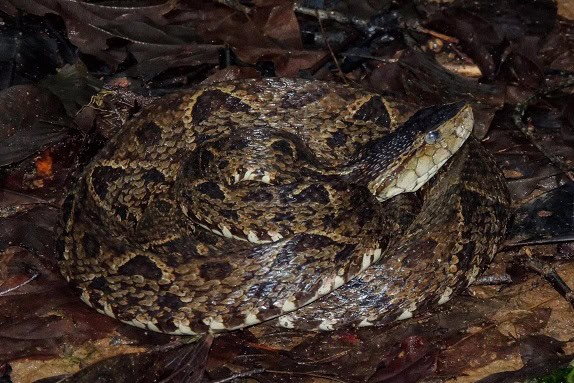
Maximum length: 250.1cm.
Not only the most widespread venomous snake in Costa Rica, but the most dangerous. The fer-de-lance (AKA the terciopelo) has many infamous qualities, such as making sudden directional changes, latching onto arms and injecting multiple pulses of venom, and a tendency to cause intracranial haemorrhaging in victims. Rather than neurotoxins, its venom primarily contains cytotoxins and haemotoxins, and victims typically perish due to kidney failure.
One survey found that the fer-de-lance caused nearly 80% of all venomous snakebites in Costa Rica, and when you look at their territory map, this isn’t surprising. Fer-de-lances cover virtually the entire country, and have an abundance of dots representing sightings where they do appear.
There’s only two main exceptions, the first being high mountainous areas, as fer-de-lances are most common below 1000 metres. The other is the northwest of the country, specifically the province of Guanacaste, and far western Puntarenas.
The other factor in the fer-de-lance’s high bite rate is its exceptionally aggressive personality. This species appears in multiple habitat types, from forest to plantation to bushy, overgrown village.
| 2 | Central American eyelash viper |
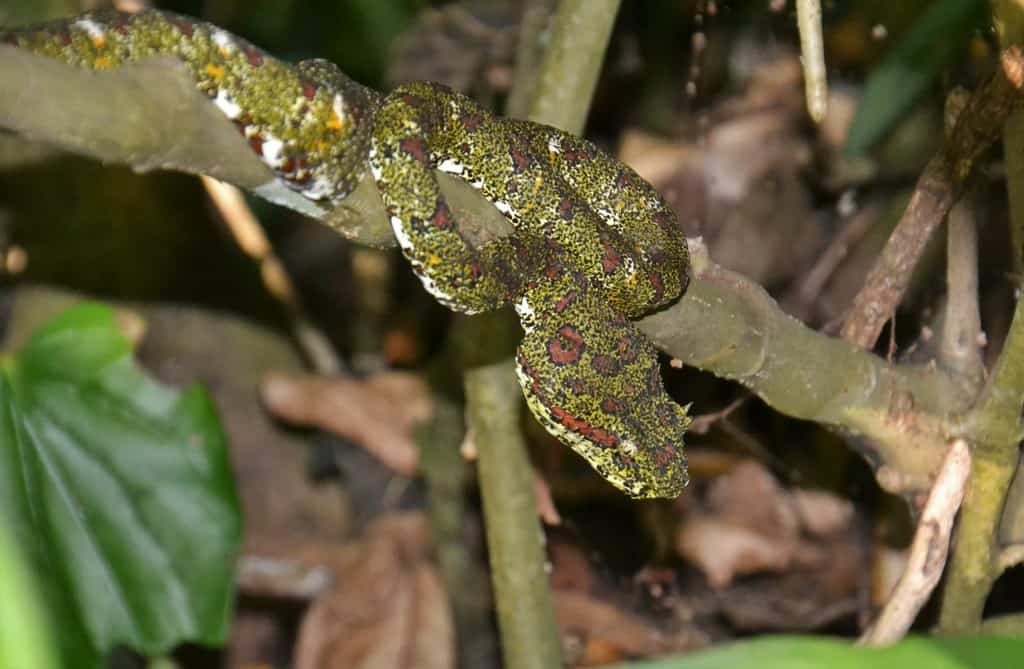
Maximum length: 91.6cm.
The most common branch-dwelling venomous snake in Costa Rica. This species ranks second after the fer-de-lance, but while that species rests on the ground, the Central American eyelash viper (Bothriechis nigroasperdus) makes its home on branches or tall bushes at approximately 1-3 metres in height.
Eyelash vipers are dangerously venomous, and capable of sending victims to hospital, even killing them, although death is relatively rare. The main symptoms include swelling and perhaps necrosis, the sloughing off of formerly alive skin tissue.
This species is immensely variable in colour, ranging from bright yellow to red-green to tree trunk grey. However, the namesake “eyelashes” are a consistent ID sign, the enlarged scale ridges above each eye.
Central American eyelash vipers appear across almost all of Costa Rica, with similar caveats to the fer-de-lance: rarer in mountainous regions, and relatively sparse in Guanacaste province and western Puntarenas. Above 1000 metres, several lookalike cousins of this species take over, including the side-striped palm pitviper and black-speckled palm pitviper (see lower down).
| 3 | Allen’s coral snake |
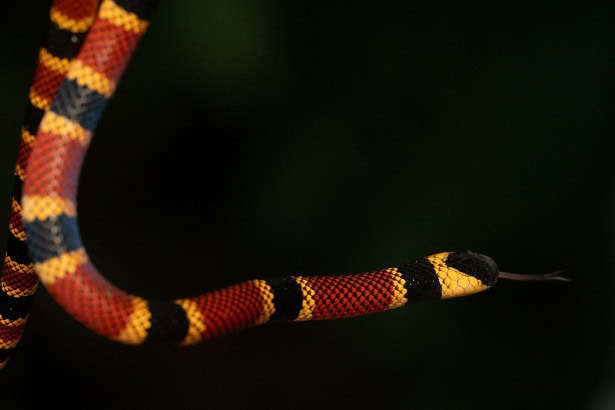
Maximum length: 132cm.
The most widespread coral snake on Costa Rican soil, out of at least 5 species nationwide. Allen’s coral snake is just as dangerously neurotoxic as its relatives, with bites potentially leading to respiratory failure and ultimately death. The one advantage is a relatively non-aggressive personality, meaning that this species bites far fewer people per annum than the notoriously aggressive fer-de-lance.
Allen’s coral snake appears in forests, plantations nearby and possibly rural gardens. This species appears across a huge area of Costa Rica, occupying lowlands rather than towering mountainous peaks. In Costa Rica, a belt of high mountains runs through the centre of the country, which this species is missing from, but Allen’s’ coral snake has the advantage of appearing on both sides, in the Caribbean lowlands to the north, and Pacific regions to the south. This makes it the most widespread coral snake across the country.
This species is recognisable by its bright red patterns, which always consist of red touching yellow, and never red touching black. The red disappears completely on the tail, giving way to alternating yellow and black, although the yellow can occasionally be white.
Most importantly, the patterns on the body always occur in formations of red-yellow-black-yellow-red. Allen’s coral snake also has a lookalike cousin, which we will get to in a moment…
| 4 | Rainforest hognose pitviper |
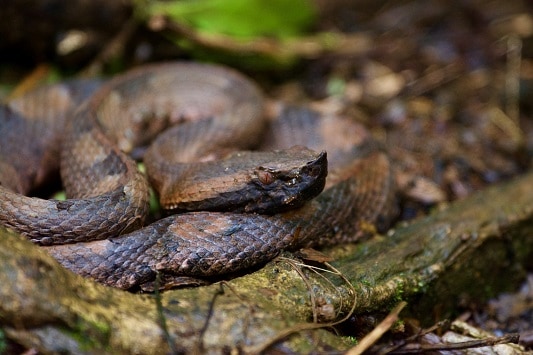
Maximum length: 63.5cm.
The third most widespread viper in Costa Rica. This species is far smaller than the fer-de-lance, and causes far fewer deaths. Rainforest hognose pitvipers are found across the vast majority of the north and west, but are missing from the south, including the vast majority of Guanacaste and Puntarenas provinces. Like the fer-de-lance, this is mainly a creature of lowland forests below 1000 metres rather than mountainous areas.
Rainforest hognose pitvipers are easy to recognise, firstly due to their vastly shorter maximum length, and secondly, due to their namesake hognose, which angles upwards, and appears in most individuals. This is a ground-dwelling species, with exceptional camouflage in leafy forests, making walking past them a likely event. Bites are moderately common, and not especially deadly, but intracranial haemorrhage has been reported in Colombia to the south.
This species is sometimes recognisable by a thin bright stripe down its flanks. This can be white, orange or even bright brown, and appears in over half of individuals. As a rule, rainforest hognose pitvipers are abundant to the north of Costa Rica’s central mountains, but almost completely missing to the south (Pacific lowlands).
| 5 | Central American coral snake |

Maximum length: 115cm.
The trickiest lookalike, but an extremely common species in Costa Rica, which western tourists can and have stumbled into over the years. The Central American coral snake (Micrurus nigrocinctus) is the most widespread member in Central America overall, and occupies virtually the entire southern half of Costa Rica, skipping the north. Here, it overlaps significantly with its close relative Allen’s coral snake, which was originally deemed to be one of its subspecies before being split off in the mid-20th century.
The Central American coral snake is just as dangerously neurotoxic, just as potentially lethal, but again, relatively shy in temperament. It’s one of the more flexible coral snakes in habitat, appearing not just in forests and plantations, but villages and gardens.
Physically, this species is very tricky to distinguish from Allen’s coral snake. The red touches yellow, and the progression of the bands is identical, but there’s one cool ID sign to remember: a more even black band on the head. In Allen’s coral snake, the blackness atop the head sharpens into a point which faces down the neck. This feature is consistent across the species. Another difference is that Allen’s coral snake has a greater number of ventral scales, but this is impossible to see from a distance.
Across southern Costa Rica, the Central American coral snake is a ubiquitous species, which you have a high chance of encountering in your various wanderings.
| 6 | Side-striped palm pitviper |
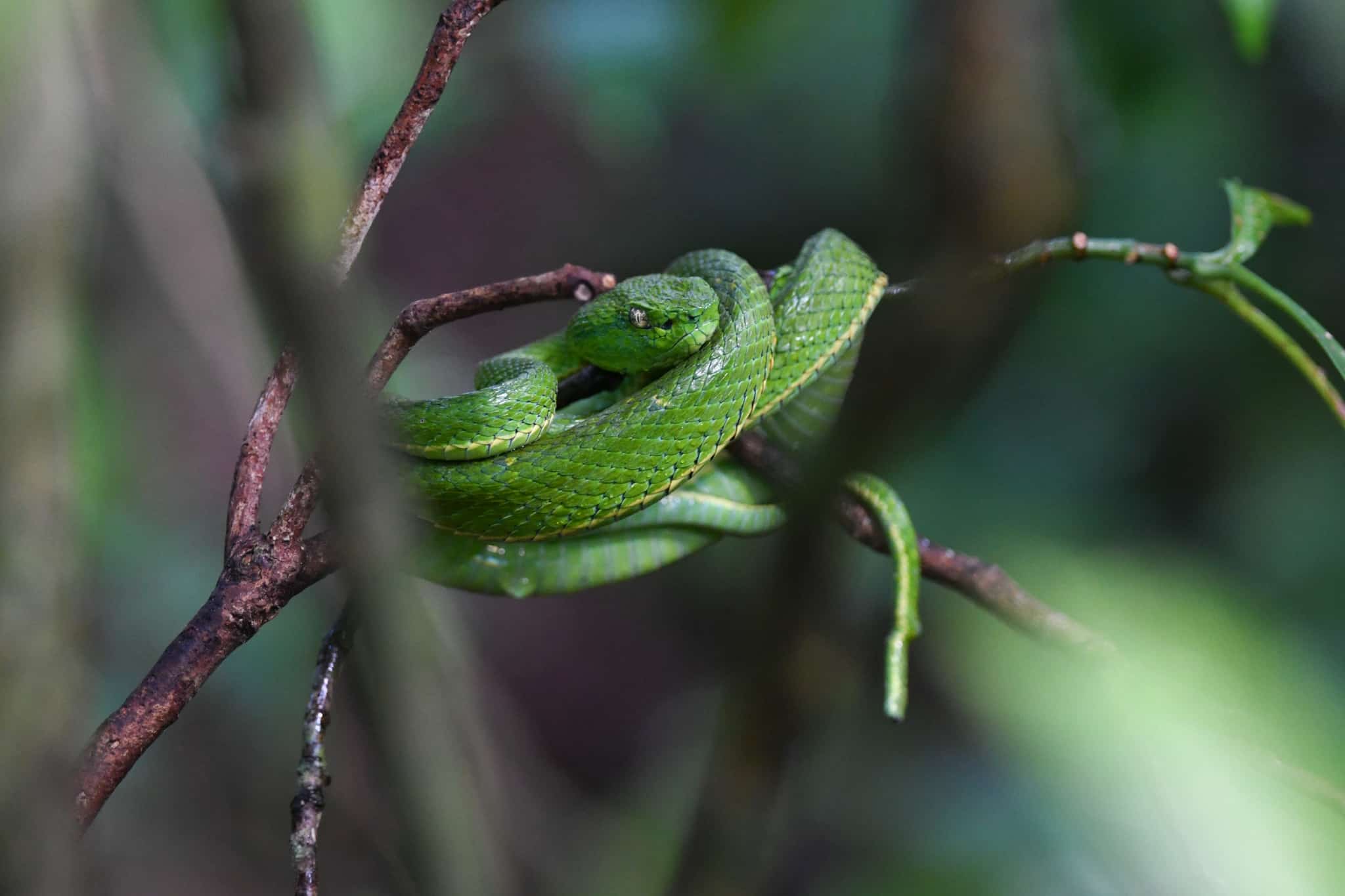
Maximum length: 95cm.
The most common pitviper in mountainous areas of Costa Rica. This species belongs to the same Bothriechis genus as the eyelash viper, and has similar habits; resting on branches 1-3 metres high, a moderately aggressive personality, and a venom which rarely kills but can necessitate several days of hospital treatment. The difference is that this species appears at significantly higher altitudes, usually at 1000 metres or more, with confirmed appearances at 2100 metres.
The side-striped palm pitviper (Bothriechis lateralis) is generally bright green in colour, lacking the eyelash viper’s massive variation in appearance. The one exception is juveniles, which are fully brown instead, before the first green scales appear within a few years and gradually spread to cover their entire bodies. Adults are also recognisable by the namesake bright thin line on their flanks, alongside the usual vertical viper pupils.
Because of their mountainous range, side-striped palm pitvipers appear in a spine running through the centre of the country, skipping the lowlands to the north and south. Within these mountains, they’re very common, appearing in thick forests most of the time, including those with popular hiking trails. They’re fairly flexible, but always need some sort of trees or high bushes to rest on.
| 7 | Costa Rican coral snake |
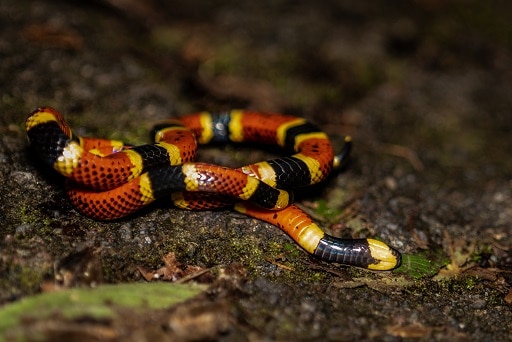
Maximum length: 100cm.
The third most common coral snake in Costa Rica. Unlike the Central American coral snake, this version lives exclusively to the north of Costa Rica’s central mountain belt, in the Caribbean lowlands. This means that it overlaps with Allen’s coral snake, which appears on both sides, but this species is fully distinct.
At first glance, this is another relatively samey coral snake, with the same red touching yellow (never black), and progression of red-yellow-black-yellow-red. However, there’s a much more obvious difference this time, which is easy to remember once you know it: a smaller number of repetitions. The colourful segments repeat less commonly, meaning that there are far less black bands overall, typically numbering 18-20 in the Costa Rican coral snake, versus 25-29 for the two species above. That number includes the face and tail.
Costa Rican coral snakes (Micrurus mosquitensis) are not to be underestimated, with a lethal LD50 rating of 0.16-0.2mg, outstripping the fer-de-lance, rainforest hognose pitviper, and eyelash viper for raw toxicity, only falling short in the venom yield. They generally appear on forest floors amid rotting logs and mulch, and stand out easily due to their bright colours. Show the Costa Rican coral snake respect, keep walking, and your holiday won’t end prematurely.
| 8 | Black-speckled palm pitviper |
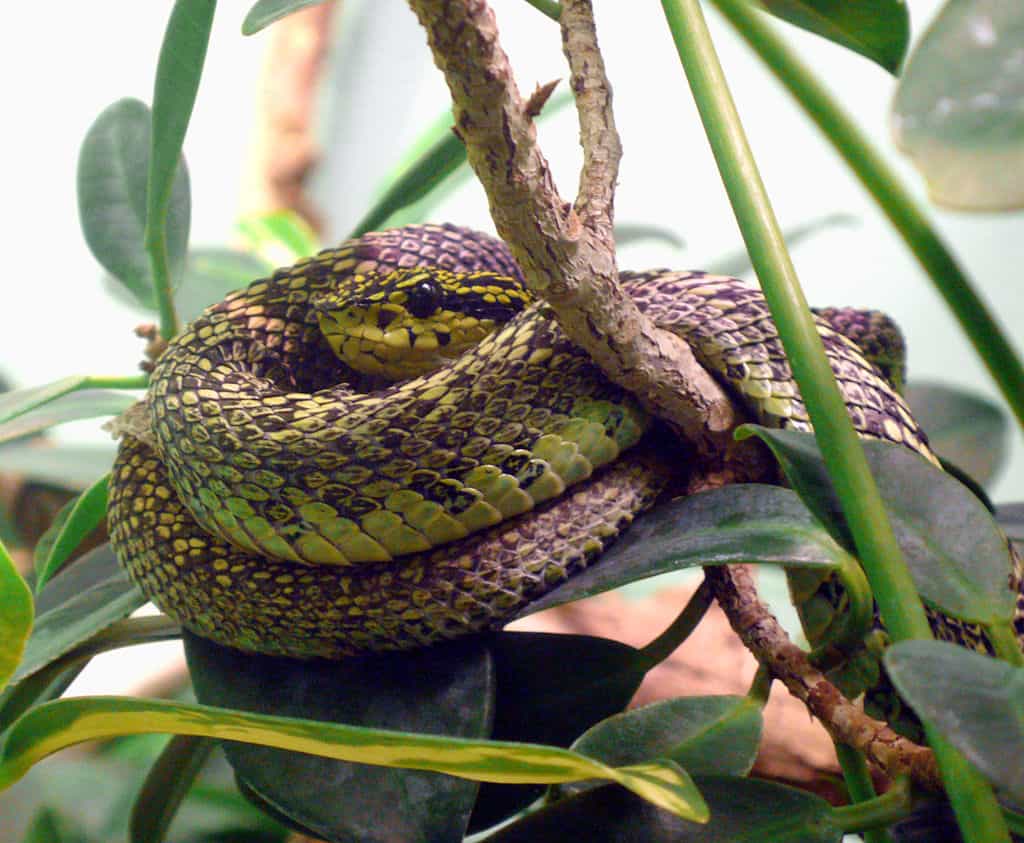
Maximum length: 93.7cm.
The fer-de-lance and eyelash viper are undoubtedly the top 2 most widespread venomous snakes in Costa Rica, while 3-7 form the secondary tier. Now we’re into tier 3: less widespread but still with a decent heartland, which a tourist has a chance of entering unawares, to their detriment. The first entry here is the black-speckled palm pitviper (Bothriechis nigroviridis), another member of the Bothriechis eyelash viper clan.
Like the side-striped palm pitviper, this is a more mountainous species, appearing at altitudes of up to 3000 metres. It shares the usual branch-dwelling habits, often appearing at eye height on trees, making them relatively easy to spot.
Black-speckled palm pitvipers appear in central Costa Rica, in a stretch of long, mountainous territory running down the country. This has a slight eastwards bias, as their range crosses the border into Panama to the south, but doesn’t quite reach Nicaragua to the west. You can find black-speckled palm pitvipers in the mountains directly north of San José, and tourist heavy spots such as Cloudbridge Nature Reserve, Cerro Dantas Wildlife Refuge and Juan Castro Blanco National Park.
Black-speckled palm pitvipers are relatively dangerous, with a more neurotoxic venom than the main eyelash viper. Nevertheless, avoid mountains, and you will avoid this species. If you encounter a giant viper on an open road, slithering along the ground, it’s almost certainly not the black-speckled palm pitviper (or any Bothriechis member).
| 9 | Costa Rican montane pitviper |
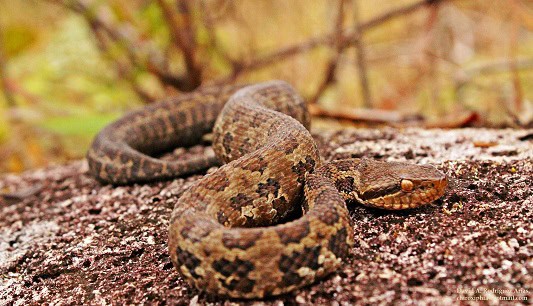
Maximum length: 71.3cm.
Another mountainous pitviper, this time appearing at altitudes of over 1400 metres, and up to 2800 metres. This species appears in the mountains of central Costa Rica once again, but differs to the side-striped and black-specked palm pitvipers in sticking almost exclusively to the ground. This species is rarely found on tree branches, and has the colour scheme to match: dull brown rather than foliage green.
Costa Rican montane pitvipers (Cerrophidion sasai) are quite generic as vipers go. They lack the upturned snout of the rainforest hognose pitviper, and are covered with multiple rounded blotches, which are dark brown contrasting against a lighter brown below. This species lacks any dedicated antivenom, and has a powerfully anticoagulant venom, completely disrupting blood clotting so that blood spews randomly from old wounds.
Being a mountainous species, you won’t find the Costa Rican montane pitviper in the north or south of Costa Rica. It could be confused with the fer-de-lance, but is significantly smaller, and has virtually no area of overlap due to its love of higher altitudes.
In the mountains, this species appears in forests, but also grassy highland areas, and perhaps the centre of your hiking trail, blocking access to your car just when your 10 hour hike is almost over.
| 10 | Central American rattlesnake |
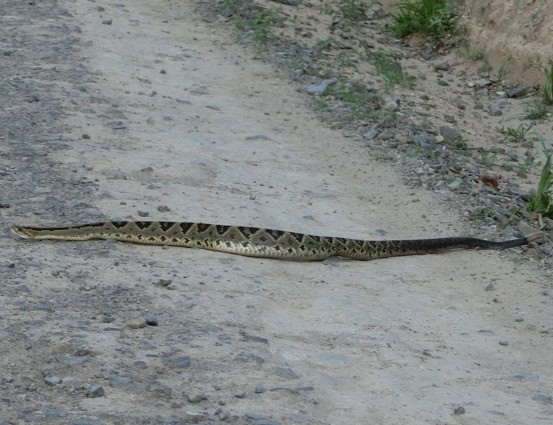
Maximum length: 1.8 metres.
Found only in one region, but a plentiful species where it does appear. The Central American rattlesnake (Crotalus simus) ranges from southern Mexico to Costa Rica, and has a venom containing a mixture of neurotoxins and haemotoxins, covering both rattlesnake bases.
Within Costa Rica, this species appears only in the far northwest, appearing in lowland areas rather than mountains. Its heartlands are Guanacaste province and far western areas of Puntarenas province, where Central American rattlesnakes generally stick to the ground. These northwesterly regions are drier than the rest of Costa Rica, in line with the typical rattlesnake habitat.
Memorise the sight above, as that photo was taken in Costa Rica, seemingly on a rural dirt road. Central American rattlesnakes prefer relatively open areas, giving them a high chance of blocking your way. The individual above is typical in appearance, with beige contrasting against black, and diamond-shaped markings along the spine.
The Central American rattlesnake is one of the more lethal rattlesnakes worldwide, due to its higher amount of neurotoxins. This is the only rattlesnake in the country, meaning that the vast majority of Costa Rica is free from this group.
| 11 | Blotched palm pitviper |
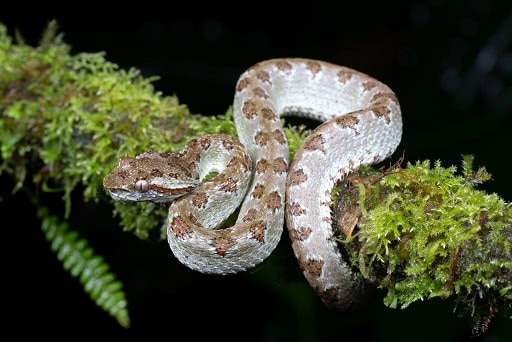
Maximum length: 58.3cm.
Costa Rica has an abundance of pitvipers appearing in certain mountain ranges, and this is the version of southeastern provinces. The blotched palm pitviper (Bothriechis supraciliaris) is found in eastern Puntarenas and San José provinces, at altitudes of 800-1700 metres. While it looks similar to the main eyelash viper, it appears at higher altitudes, and isn’t found anywhere in the north or west of Costa Rica.
Blotched palm pitvipers are moderately dangerous, but far from the worst pitviper, unleashing moderately swelling, moderate myotoxicity (muscle tissue damage) and moderate hemorrhaging. This species rests on branches, but compared to other Bothriechis pitvipers, it’s more comfortable on the ground, appearing in forest clearings or relatively sparse areas of trees, as well as thicker forests.
Greenness is the key to this species, but not relatively plain green like the side-striped palm pitviper. This species is adorned with multiple rounded blotches, and also has a minty green morph, as well as leafier green.
Like the eyelash viper (Costa Rica’s 2nd most common viper), this species has enlarged scales above each eye, which are easily noticeable, but its patterns tend to be cleaner between the blotches, rather than messy. Altitude is the other simple key, as if you’re exploring a trail at 1200 metres, it’s much likelier to be this species. The eyelash viper is more common at 1000 metres or lower.
| 12 | Central American bushmaster |
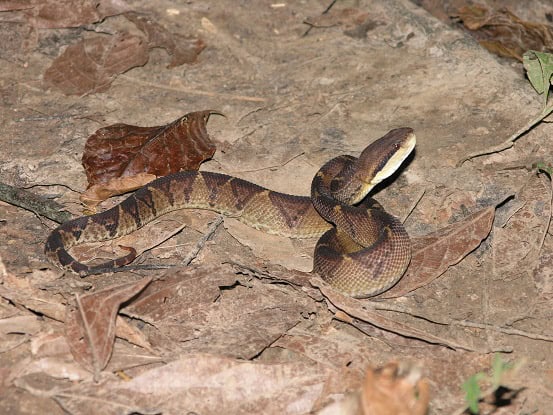
Maximum length: 3.6 metres.
The longest venomous snake in Costa Rica, and the 4th longest venomous snake worldwide, just behind the South American bushmaster in 3rd place. This species is thick-bodied as well as long, and virtually never climbs trees, preferring to rest in dark underground burrows. Central American bushmasters are potentially lethal, injecting hundreds of milligrams of a cytotoxic, haemorrhagic venom. Fortunately, this species is dramatically less common than the eyelash viper or fer-de-lance.
Central American bushmasters only inhabit the Caribbean lowlands to the north of Costa Rica’s central mountainous belt. They mainly appear in the eastern half of these lowlands (closer to Panama), and even where they do exist, they’re relatively sparse in numbers.
Central American bushmasters spend much of their lives in forests, and are less energetic and active than the fer-de-lance. They’re also less aggressive, and more content to simply let a human being walk past (though still not to be underestimated).
This species generally appears at 0-1000 metres in altitude, avoiding mountains. Compared to the fer-de-lance, this species is recognisable by its far more sharply contrasting facial colours. There’s a brown skull cap, followed by a thick, jet black eye stripe, followed by a far paler chin area. The fer-de-lance vaguely follows this pattern, but the contrast is less clearly defined, and messier overall. Both species have large, bulky heads, but the Central American bushmaster’s is more rounded (while still being large), while the fer-de-lance’s ends in a sharp snout.
| 13 | White-tailed hognose pitviper |
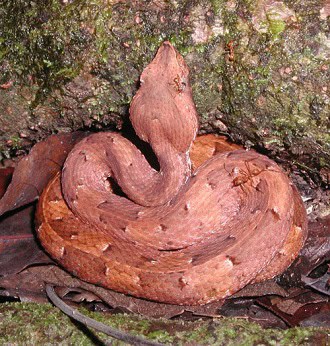
Maximum length: 70cm.
The southern cousin of the rainforest hognose pitviper. This species is found exclusively in one province: Puntarenas, mainly in the southern peninsular areas to the west of Panama.
The white-tailed hognose pitviper is very similar in appearance and lifestyle to its cousin. It’s lazy, blends perfectly with leaves in forests, and ambushes its prey. It shares the namesake hognose, and even the thin vertebral stripe, which adds an additional ID sign. The main bonus feature is the namesake white tail, which covers just the tip, but is present in most individuals and fairly easy to recognise from a distance, despite this species’ small size.
The white-tailed hognose pitviper has no area of overlap with the rainforest hognose pitviper. Consequently, if you see these qualities in eastern Puntarenas, but don’t get a glimpse of the tail, it’s guaranteed to be the white-tailed hognose pitviper anyway.
This is a non-mountainous species, appearing in forested lowlands. A 2019 study found a relatively weak venom, which was easily neutralised by a non-specific antivenom. This species might be rare nationally, but is fairly common in the southeast where it does appear.
| 14 | Many-banded coral snake |
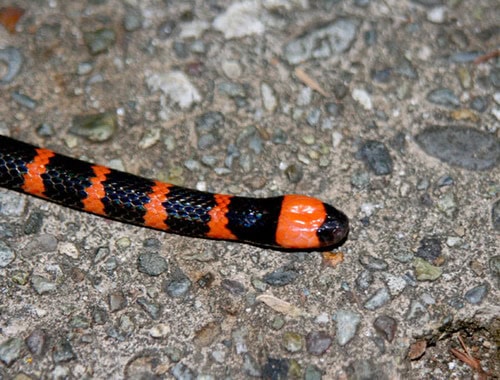
Maximum length: 120cm.
A rare coral snake, which you’re unlikely to stumble across, but will surely be able to recognise if you do, thanks to several differences to its Costa Rican neighbours. The most important is that this species only has two main colours: red and black. There’s no white or yellow on its body, like the 3 coral snakes we’ve discussed so far.
Many-banded coral snakes avoid the south of Costa Rica, and live to the north of the central mountains, mainly in the north and northwest. They have a black face, beginning at the eyes and continuing forward, but the neck area immediately behind is bright red, contrasting against all other coral snakes in Costa Rica. The one caveat is that the red bands on Micrurus multifasciatus can occasionally be orange instead, or even appear dark yellow. Nevertheless, this species always has two colours alternating, rather than three.
Many-banded coral snakes appear in lowland tropical forests and are severely deadly, with two rare toxins called MmTX1 and MmTX2. These target GABA receptors, the same receptors that alcohol targets, and cause victims to have seizures, similarly to alcoholics who go cold turkey too quickly. Wherever this species appears, it is rarely common.
| 15 | Black-headed bushmaster |
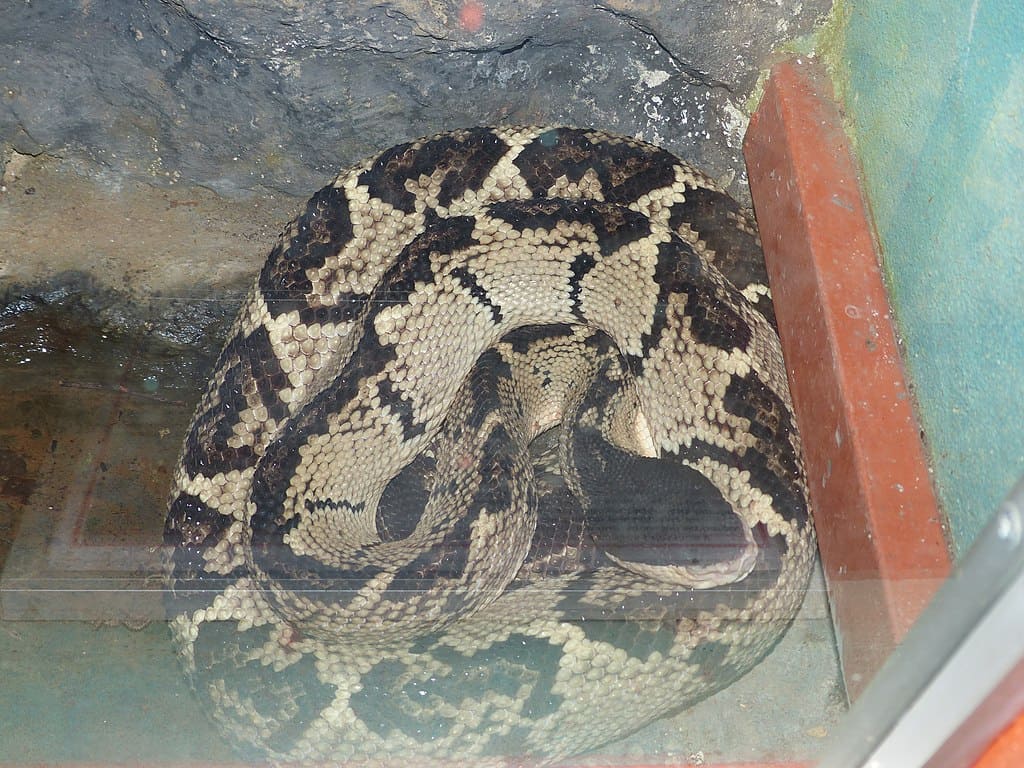
Maximum length: 2.4 metres.
This species is in the same category as the white-tailed hognose pitviper: found exclusively in the southeast of Costa Rica, in the peninsular areas of Puntarenas province. Again, it’s narrow in range, but fairly common where it does appear, a regular presence in tropical, humid forests, where it sticks mainly to the ground.
The black-headed bushmaster (Lachesis melanocephala) is one of 4 bushmasters worldwide, and the 2nd of two in Costa Rica after the Central American form. Living in Costa Rica’s far south, the black-headed bushmaster has no overlap with its cousin, and is easily recognisable anyway, due to its namesake black head. This species is shorter, but still a hefty size, with 2 metres being typical.
Black-headed bushmasters use the intelligent trick of positioning themselves near fruit trees, waiting for tasty fruit to drop, before devouring curious rodents once they stray too close. The venom of this species is myotoxic, haemorrhagic and cytotoxic, but fortunately, a general viper antivenom succeeded well in neutralising most of its effects.
| 16 | Talamancan palm pitviper |
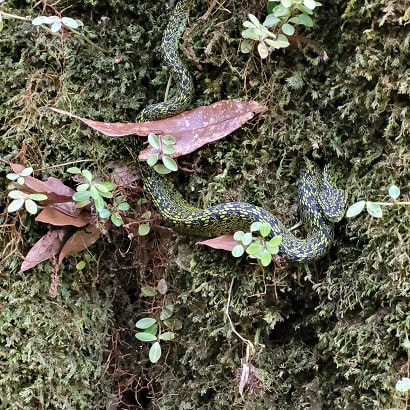
Maximum length: at least 91.1cm.
The rarest of the various Bothriechis eyelash viper members in Costa Rica. This species is closely related to the black-speckled palm pitviper, having diverged around 6 million years ago, and bears a close resemblance in its appearance. However, it’s significantly more restricted in territory, appearing only in mountain ranges up to 3000 metres above sea level, and even then, appearing only in the Talamanca Cordillera range of southern Costa Rica.
If you come across a hissing green viper on a tree branch in Costa Rica, it’s almost certainly not the Talamancan palm pitviper, but if it is, be wary of its bite. This species isn’t particularly neurotoxic, but possesses high amounts of metalloproteinases, which physically dissolve skin tissue and possibly the lining of blood vessels.
Rather than a clean pastel green, this species is more of a rich, mossy green overlaid with subtle black markings. Some are brighter green, while others are murkier, but the patterns are always more complex than with the side-striped palm pitviper.
| 17 | Clark’s coral snake |
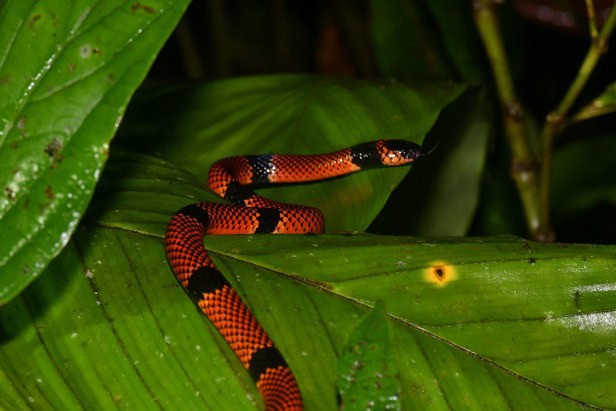
Maximum length: 92cm.
The final of Costa Rica’s 5 coral snake species, and easily the rarest. Clark’s coral snake is an odd species, as it covers a decent area of land, with pockets in the south, far east and central east. Yet within those areas, it’s extremely rarely observed, naturally spread out rather than dense and concentrated like Allen’s coral snake.
This is another species with similar patterns: red touching yellow (not black), and an order of red-yellow-black-yellow-red. Its face is black again, like the Allen’s, Central American and Costa Rican coral snakes. However, this species is recognisable by a yellow neck band which enlarges on the sides of the face, spreading to the chin (see above). Unlike the Costa Rican coral snake, this species has a higher number of black bands again, typically around 27 (similar to the Allen’s and Central American species).
One interesting study on this species found that its main toxin was clarkitoxin 1, a three-finger toxin. Yet this abundant ingredient had very little lethal effect in mice, hinting that it is specialised against other animal types, and therefore possibly weak against humans as well.
In the north of Costa Rica, there’s no chance of a coral snake being Clark’s coral snake. This species appears nowhere north of San José, and doesn’t even come close to the city. It’s also completely missing from westerly areas like Guanacaste.