
| 1 | Calabar burrowing python |
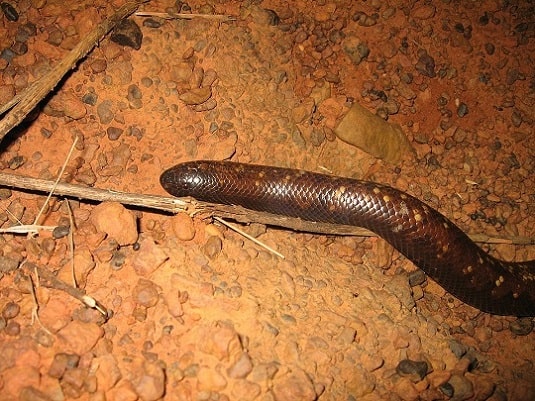
Maximum length: 103cm.
One of the world’s most unusual snakes. Calabar burrowing pythons have extremely thick skin, consisting of densely interwoven fibres which give them an impenetrable hide equivalent to a rhino’s. They lay just 1 to 5 massive eggs, and have a narrow head with virtually no neck. This species is actually a boa, yet is an evolutionary anomaly whose relationship to other boas remains mysterious.
You might think that such an anomaly would be a nightmare to feed, but Calabar burrowing pythons swallow up fuzzy mice as happily as the average corn snake. In fact, their thick skin is theorised to be an armour against gnawing rodents.
Calabar burrowing pythons eat 80% mammals, according to a Nigerian study, including black rats and Temminck’s mice. They invade dark burrows and swallow up their sleeping occupants, weaving through tight tunnels and shifting fallen debris aside. But they’ll also accept effortless meals which they get for free from their captive keepers.
Calabar burrowing pythons rarely exceed 90cm, and rats and mice are more than acceptable for them. This is a docile snake, which can be picked up with little risk of a sudden bite storm.
| 2 | Brazilian rainbow boa |
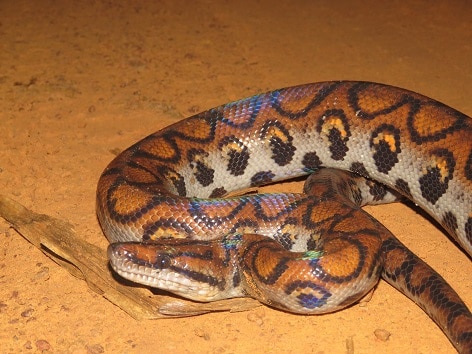
Maximum length: 192cm.
A thick, tank-like snake of South America, which is found in humid woodlands and caves within them. This is a popular captive snake worldwide, particularly for its glimmering iridescent scales, revealing rainbow tones under a bright light (hence the name). It’s easy to replicate the rainbow boa’s wild lifestyle, as this species spends hours and hours in stationary ambush posture amid foliage, with stupendous camouflage.
A terrarium with dimensions of several metres is enough to satisfy this boa’s wild instincts, and its diet is equally simple. In the wild, Brazilian rainbow boas eat warm-blooded creatures like neotropical water rats, and in captivity, they’ll happily eat the more common house mouse or black rat. You can feed them the same meals as a boa constrictor. The latter ranks in the top 5 pet snakes worldwide, so any pet shop should have a plentiful supply of rainbow boa food.
This is actually only a distant cousin of the boa constrictor, the two species having diverged tens of millions of years ago. Excluding other rainbow boas, its closest relatives are the anacondas, which prefer rivers and wetlands.
There are very few records of Brazilian rainbow boas eating frogs or toads. They’ve seized the niche of a lazy mammal muncher, and this makes them the perfect pet.
| 3 | Blood python |
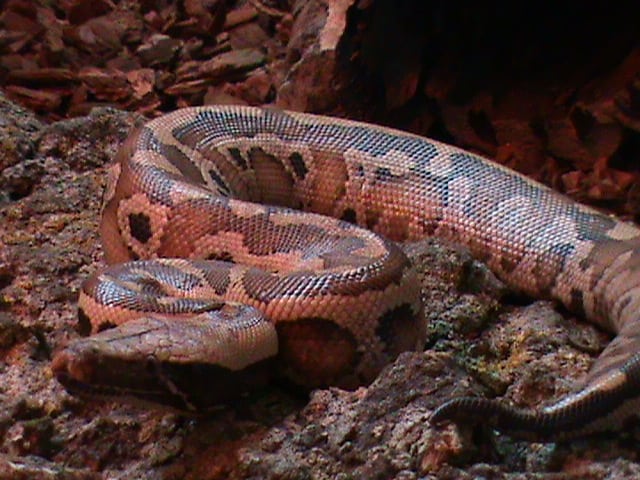
Maximum length: 260cm.
An actual python this time. Blood pythons are highly popular in captivity, for two main reasons: their striking colours, and the exceptional ease of feeding them. This species naturally occurs in humid, swampy forests, but is now abundant in manmade palm oil plantations as well.
Blood pythons derive the majority of their calories from rodents and mice, hoovering up unwanted agricultural pests. It’s no different in captivity, and a steady supply of rats from the pet shop will keep them happy for years.
The only obstacle with blood pythons is a reputation for aggression. They have brutal front fangs, which swing down onto your arm like an iron clamp. However, they only tend to launch these brutal assaults when touched, and they generally calm down with age, going from crazed bezerkers to trusted companions.
The blood python’s wild lifestyle simply involves waiting calmly for rodents to appear, and this is simple to replicate in the corner of your living room (ideally in an terrarium). Meanwhile, you have the reticulated python, which would be simple to feed, if it wasn’t so huge and required equally huge prey, like deer and pigs. A pinkie mouse would be the equivalent of a great white shark swallowing a tadpole.
| 4 | Four-lined snake |
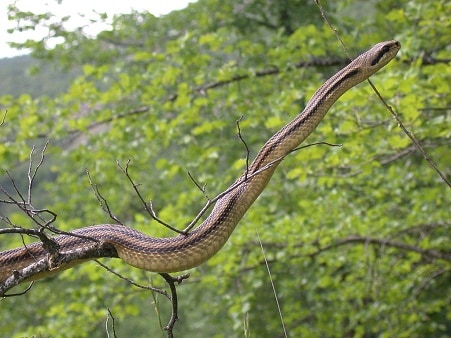
Maximum length: 250cm.
A slow, steady Italian species which can exceed 2 metres. Four-lined snakes are common in grassy, rocky areas like fields in villages, as well as woodlands. Another place where they’re happy and comfortable is a terrarium, and feeding them is exceptionally easy.
Four-lined snakes have the power to eat eggs, by slithering directly up tree trunks and raiding birds’ nests. They crack these eggs open using sharp contractions with their belly, aided by sharpened hypapophyses on their vertebrae. But this is more of a bonus, and in captivity, they’ll happily swallow a neverending stream of mice to their dying day.
Standard defrosted mice are perfectly acceptable, as are live mice. Their taste buds are well attuned to them, as a 1997 study from Italy’s Tolfa Mountains found that the wood mouse (Apodemus sylvaticus) was their absolute favourite prey. Their overall diet consisted of 77% mammals and 23% birds.
Four-lined snakes tend to focus on small prey as well. An Italian study found an average prey mass of 18% of their own weight, versus 36% for vipers. Four-lined snakes are conservative and avoid stomach bursting meals; this makes a showering of fuzzy mice perfect for them.
| 5 | Gopher snake |
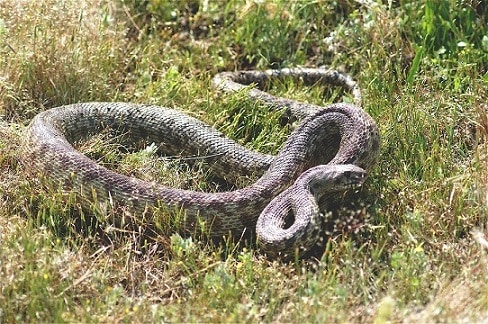
Maximum length: 267.7cm.
This western US species has been proven to love mice in the wild, so feeding a captive pet should be a cakewalk. A Canadian study searched inside roadkill gopher snakes. It found a diet of 84% mammals, with their single favourite prey being the eastern deer mouse (Peromyscus maniculatus). Voles, shrews and Great Basin pocket mice were also plentiful.
Gopher snakes are fairly slow-moving, and hunt using constriction. They may be slow in responding to a fresh mouse, but don’t mistake that for lack of enthusiasm. When you re-enter the room, the mouse will have mysteriously disappeared, with only a satisfied gopher snake in the enclosure’s corner. Gopher snakes don’t mysteriously lose their appetite when transferred from a grassy field to an indoor enclosure.
Gopher snakes are harmless to keep as well. Their teeth are jagged and curved, and can rip your skin if the lights of aggression suddenly flip in their eyes. But gopher snakes rarely bite at all. Their signature move is a harmless thudding bash where they close their mouth and lunge forward.
| 6 | Trinket snake |
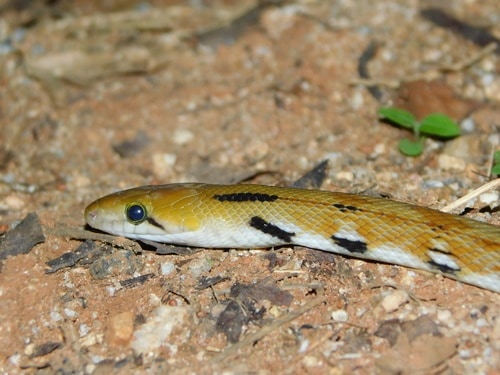
Maximum length: 168cm.
A non-venomous Indian snake with a reputation for sudden aggression. Trinket snakes are able to frighten a cobra into backing off, and acquire their prey through manual charging and grabbing. They live on the edge of farmland and eat a healthy chunk of small mammals, which makes them easy to feed in captivity, albeit with a feisty temperament.
Trinket snakes are very aware of their surroundings, and they’ll know if a meal is coming. In fact, they may detect the mouse before you show it to them. Don’t be surprised if your trinket snake catches a mouse in mid-air like a sealion catching a fish.
Trinket snakes are able to swallow small mice within minutes. This snake has a high metabolism and requires feeding every 7-10 days, but its meals are easily available from the local pet shop. A fed trinket snake will lose some of its edge and rest happily in the corner and digest for a while. Gradually, the antsiness will seep back in. Trinket snakes are more short-lived, rarely exceeding 15 years.
| 7 | Prairie kingsnake |
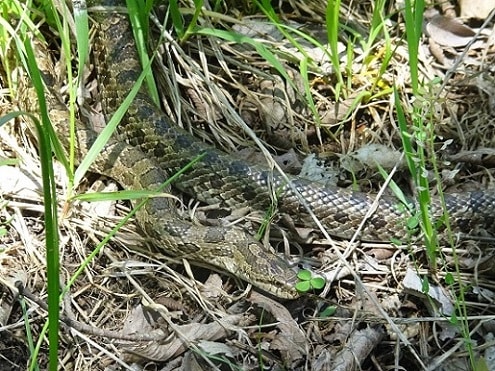
Maximum length: 155cm.
A lot of US kingsnakes (Lampropeltis genus) look similar, but prairie kingsnakes are distinctive in several ways. They’re browner in colour, overlaid with unevenly shaped, darker brown blotches. They’re skillful burrowers which spend over 60% of their time underground, usually in grassy meadows or spacious woodlands.
Finally, this is the most heavily mammal-eating kingsnake, which makes it an easy (though not too common) captive serpent to maintain. Prairie kingsnakes prey on small, scurrying mammals like eastern moles, northern short-tailed shrews and white-footed mice. The house mouse (Mus musculus) is also confirmed wild prey, and literally the species sold by pet shops in bulk.
When not underground, prairie kingsnakes lurk below logs or mulch, or make sudden journeys of over 50 metres. You may not see them swallow the mouse the second you fling it in; they may drag it to below cover (which their enclosures should ideally have) before swallowing. Then the prairie kingsnake will emerge with the mouse mysteriously gone.
A much trickier species to keep is the scarlet kingsnake. This is heavily dependent on skinks, eating virtually no mammals at all.
| 8 | Hispaniola boa |
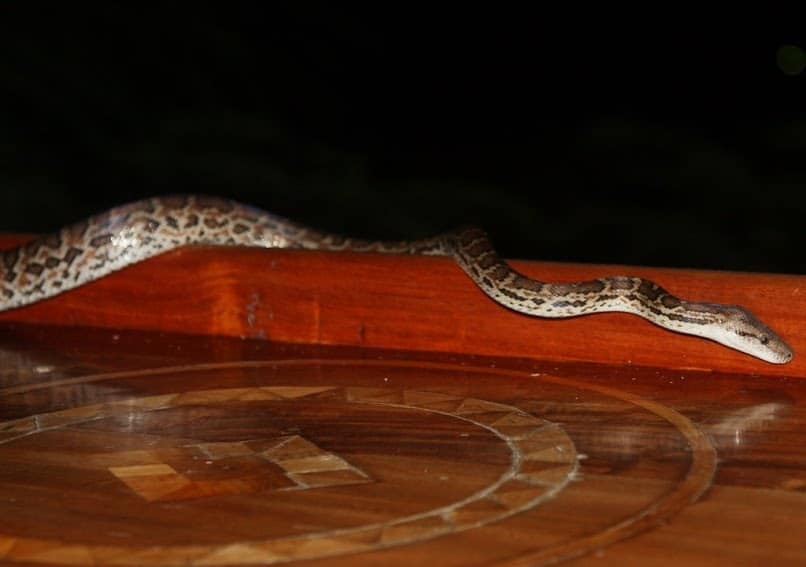
Maximum length: 250-300cm.
The native boa of Hispaniola, the island split between Haiti in the west and Dominican Republic in the east. This is a thick-bodied constrictor, which likes forests but also open areas, and coexists peacefully with humans.
Prior to European colonisation in the 15th century, Hispaniola boas ate native mammals like montane hutias and Hispaniola edible rats. These were decimated by invasive black rats and mice, with many going extinct. But the Hispaniola boas happily switched to eating the invaders, and never looked back.
Mammals make up 60% plus of their wild diet, with supplementary meals of birds. This adaptiveness carries over to captivity. There are no weird quirks to speak of, as Hispaniola boas will keep eating the mice and rats you fling at them for 20 years (an age this species easily reaches).
Hispaniola boas measure 1.5-2 metres on average, and could easily exceed 2.5 metres after years of comfortable captivity. While you’ll need to buy slightly larger meals, you won’t have to raise a family of small pigs or deer in order to feed them. Hispaniola boas have no reputation for aggression. In fact, some Haitian families keep them on their homesteads, seeing them as watchful guardians.
| 9 | Steppe ratsnake |
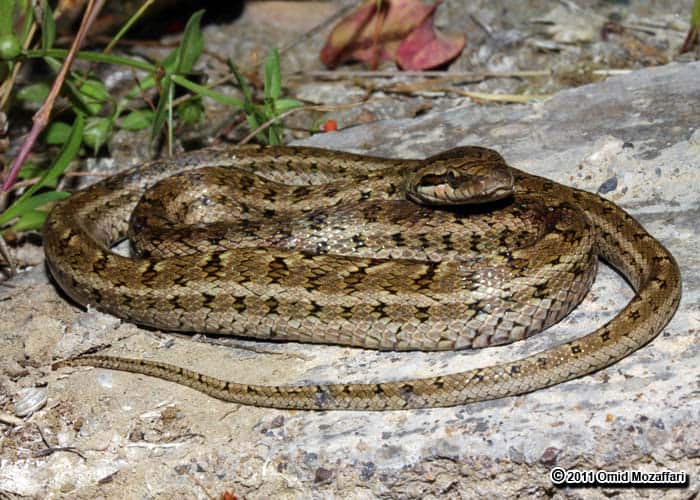
Maximum length: 160cm.
An extremely common constricting snake, found in Russia, which inhabits woodlands, fields, rugged plains and nature reserves. Steppe ratsnakes (Elaphe dione) measure 60-100cm, and inhabit a huge swathe of sparsely populated steppe, from eastern Ukraine to Kazakhstan to deep within Mongolia. But they’re also at home in a cosy terrarium in your house, where they can survive on a diet of store bought mice and rats, and be perfectly happy.
In the wild, this species’ prey includes the Korean field mouse and Korean red-backed vole. This a calm snake as well, which won’t bite your fingers off within seconds to snatch away the mouse they’re holding.
This snake prefers to flee rather than fight. In a study from Red-Crowned Crane Park in China, the steppe ratsnakes were masters at vanishing into gaps in walls or dark burrows the moment hungry birds appeared. The only feeding obstacle might be if they’re hiding in a dark corner of the terrarium that day.
Steppe ratsnakes can also eat voles, shrews, birds and their eggs, yet they don’t seem to crave variety. They can eat the same meals for years and years with no complaint. Steppe ratsnakes also have unusual eggs, which are laid after heavy maturation inside the body, causing them to hatch after just 10-15 days.
| 10 | Aurora house snake |
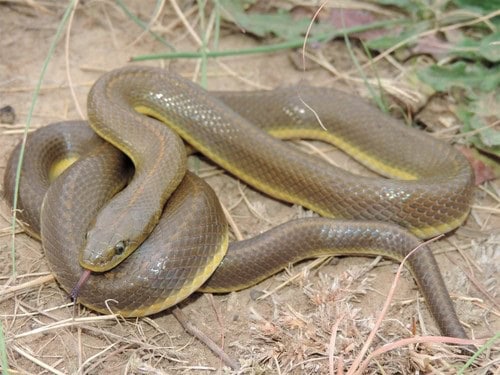
Maximum length: 90cm.
A humble snake of South Africa, often found in people’s yards. This is a species you could scoop up and adopt if you had a steady pet shop a few miles away, as it’s eager and excited to eat most things, including the usual pinkie mice. It has no issues with small lizards and frogs either, but these aren’t necessary, as aurora house snakes have no need for a balanced diet like a human.
Aurora house snakes are harmless, and will rarely bite even if picked up. They tend to lurk under assorted objects like cardboard, piles of cuttings and discarded tyres.
As a small 60cm snake, a small defrosted mouse is enough to satisfy this species’ needs for several weeks. This snake also has glowing colours, so you always know where to fling the mouse to.
The brown house snake is a relative of the aurora house snake, and is far more common in Africa, but duller in colour. Aurora house snakes lack offensive weapons such as venom, or vicious tearing teeth, but their flexible diet has allowed them to survive while other species are forced over the brink.