
| 1 | Rhombic skaapsteker |
Maximum length: 150cm.
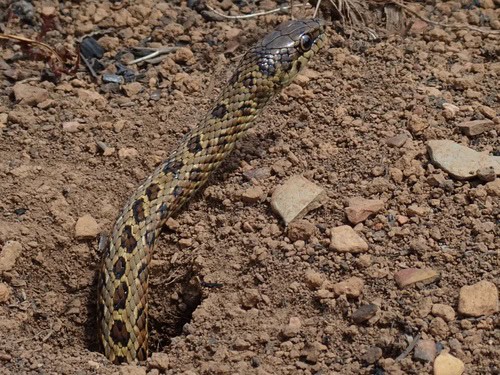
A mildly venomous species, which may be capable of subduing a small mammal, but poses no threat to human beings, zebras, lions or hyenas. The spotted skaapsteker is a fast-moving species found in savannahs and bushland, across a large swathe of South Africa, including the southwestern coast and the moister northeast.
Wherever this species lives, it rarely climbs trees, sticking to the ground. It also travels downwards, entering a subterranean world of tunnels and burrows, definitely for shelter, and possibly for hunting opportunities. This species has a varied diet, including rain frogs and grass mice, though with a bias towards mammals (over 80% according to one study).
This species is believed by locals to be aggressive, but is actually shy, preferring to escape, including into burrows, or perhaps between dark rock cracks. Rhombic skaapstekers have spotted patterns, differentiating them from their close relative the striped skaapsteker. They always have a paler base overlaid with dark spots, but the colour scheme can be white-brown or grey-darker grey. Some individuals have tiny red scales overlaying the white.
| 2 | Sonoran gopher snake |
Maximum length: 233.7cm.
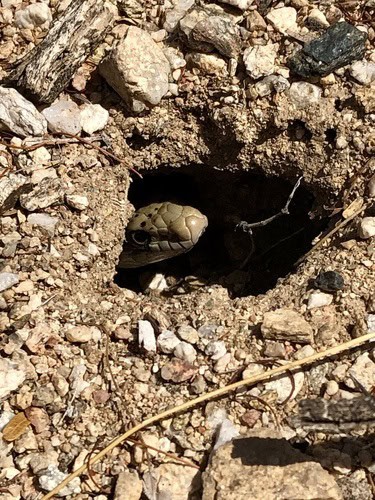
The gopher snake is the most widespread snake in the entire western US, and this is a southerly subspecies, inhabiting Arizona and New Mexico. Wherever gopher snakes live, they favour dark underground burrows, and this subspecies is no different.
Gopher snakes disappear into burrows not just for shelter, but for meals. Ordinarily, gopher snakes derive around 80% of their meals from mammals. Crop fields are an easy place to acquire rodents, but another of their schemes is heading into burrows to ambush sleeping rodent families at night. It’s a brutal yet effective strategy, as the sleeping mammals can be completely cornered, unless they have a helpful side passage to dart away into.
The banded sea krait must retreat to a rocky shoreline after swallowing an eel. The orange-bellied swamp snake must retreat to the swamp’s edge and find a secure spot after grabbing a fish. Meanwhile, the gopher snake has no such worries; it can just stay in the dark underground where it acquired its rodent meal. The burrow is both cool and safe from bird predators, and there’s no reason to move on.
Bird predators are particularly real for the gopher snake, as the red-tailed hawk is known to favour this species above all other snakes. Gopher snakes are non-venomous, but occasionally aggressive.
| 3 | Prairie rattlesnake |
Maximum length: 151.5cm.
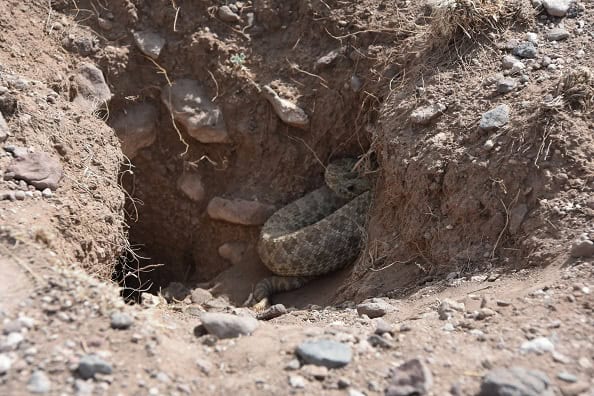
The USA is crawling with rattlesnakes, but this is one of the most likely to be found in a dark burrow. Prairie rattlesnakes appear in the US Midwest, including Colorado, Kansas and New Mexico, and cross the northern border into Canada. They’re moderately lengthy, and moderately venomous, rarely killing human victims but perhaps causing severe swelling.
Prairie rattlesnakes (Crotalus viridis) hibernate in burrows, and rest in burrows. They also ambush prey outside burrows, by deliberately flattening down long grasses in order to provide a line of sight to emerging mammals. Their diet mainly consists of mammals such as shrews, prairie dogs and even squirrels.
One of the prairie rattlesnake’s most extreme tendencies is its migrations – travelling up to 25km during spring to migrate to summer feeding grounds. In autumn, they reverse the migration, and the ultimate destination is a dark burrow, the exact same burrow they hibernated in the previous winter. Other possibilities are dark rock cracks, or even the foundations of old buildings.
| 4 | Dwarf beaked snake |
Maximum length: 50cm.
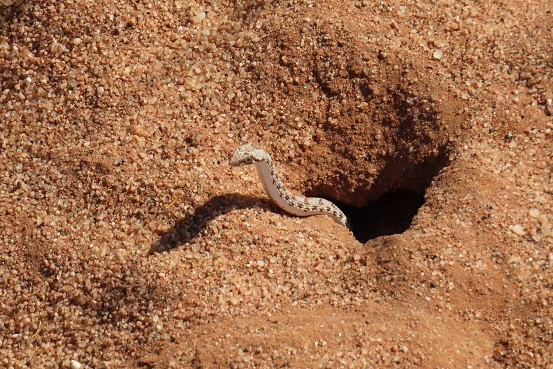
A very small, lizard-eating snake which appears in dry dusty realms of southwestern Africa. Its heartlands are western South Africa, and southern Namibia, including the Namib Desert. Trees are unavailable here, but dark burrows are, and the dwarf beaked snake (Dipsina multimaculata) takes advantage of them in order to stay alive. Its colours consist of parched beige and brown, and it’s completely non-venomous, with no ability to kill, maim, or inflict any kind of injury.
This is one of the weakest snakes in Africa, when you consider its neighbours. The black mamba can kill you within 20 minutes, the rock python has the ability to swallow hyenas, and even the diminutive night adder can cause a severely swollen arm.
The dwarf beaked snake has no such skills, but it does have a strong instinct for finding shelter, including dark burrows, some of the most inaccessible of all. One of its other survival skills is coiling up and making mock strikes, to convince aggressors that it’s a more serious threat.
| 5 | White-bellied mangrove snake |
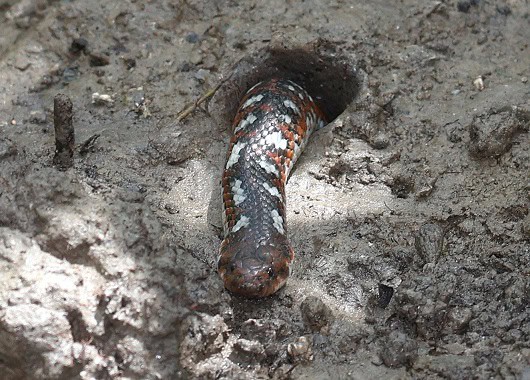
Maximum length: 95cm.
A species which combines shyness with extremely brutal hunting. White-bellied mangrove snakes (Fordonia leucobalia) hunt crabs, and particularly hard-shelled crabs, which they turn into a meal by ripping off large chunks with their mouths, before swallowing the bite-sized pieces. Fortunately, they never do this to human limbs, and fortunately, they’re completely non-venomous.
This species is relatively sparse in numbers, but appears across a large swathe of the eastern hemisphere. To the north, it reaches eastern India. It then covers the coastlines of Thailand, Malaysia, Indonesia, before coming to a halt in northern Australia. Its territory is enormous, yet the white-bellied mangrove snake is rarely encountered, partly because of its fondness for burrows.
This species is already known to lurk in the burrows of fiddler crabs, and the image above backs up the old reports. White-bellied mangrove snakes appear in mangrove areas and coastal tidal flats, and are the sole member of their Fordonia genus, with no known relatives. Given their huge territory, it’s possible that another species will be discovered lurking in an isolated inland lake somewhere, stranded by fallen sea levels.
| 6 | Collared whipsnake |
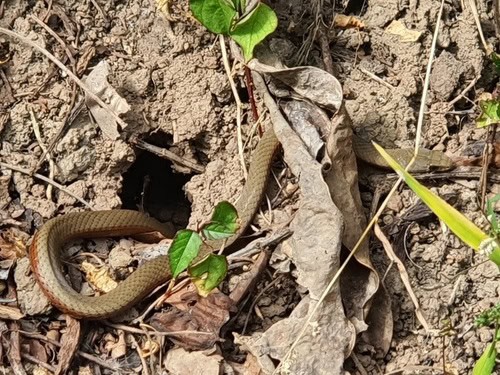
Maximum length: 70cm.
The collared whipsnake (Demansia torquata) is an Australian species which appears in tropical woodland areas, which possesses a venom, but isn’t particularly dangerous to humans. It’s a member of the same Demansia genus as the yellow-faced whipsnake, but is much less common, appearing exclusively in Queensland. It’s especially abundant in certain hotspots, such as Magnetic Island and Townsville City.
Like other Australian whipsnakes, this species is diurnal rather than nocturnal, and preys heavily on fast-moving skinks. This is partially because it’s a fast-moving species itself, and one of the few snakes fast enough to catch them, unlike a death adder, which is far too cumbersome. Collared whipsnakes slither actively and alertly over open ground, moving quickly, but also take shelter in dark burrows, perhaps during the hottest portions of midday.
Despite the name, only some individuals of this species possess a neck collar. Its body is usually olive, but sometimes with red flanks.
| 7 | Cape gopher snake |
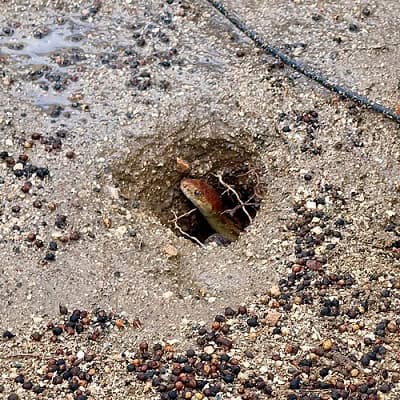
Maximum length: 168cm.
A close relative of the common gopher snake, but restricted to the Baja California peninsula, located directly south of US California in northwestern Mexico. This species is adapted to even hotter temperatures, but has similar habitats otherwise, prowling around the countryside slowly but aggressively, and invading dark burrows in search of food.
In Baja California, as in Arizona and New Mexico, this is particularly important due to the scorching temperatures. Baja California has no jungles – it’s a hot, dusty land where shelter can only be gained by travelling downwards into the Earth’s crust rather than upwards into the tree canopies.
Cape gopher snakes (Pituophis vertebralis) pose no threat to humans unless manhandled, and they’re completely non-venomous. They prey heavily on mammals, and inhabit the lower three quarters of Baja California, failing to reaching the border with US California. This species also appears on various outlying islands such as Islas Magdalena, Santa Margarita and Isla San Jose.
| 8 | Short-snouted whipsnake |
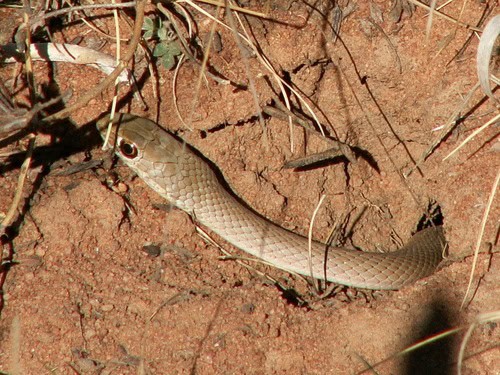
Maximum length: 1.2 metres.
The short-snouted whipsnake (Psammophis brevirostris) is a southern African species, which is moderately widespread, appearing across a large area of northeastern South Africa, and extreme southern Mozambique. It’s non-venomous, but extremely fast-moving, and sometimes hisses loudly when cornered by humans.
This species never has the following colours: green, red, blue and black. Instead, it’s always some combination of beige, brown or yellow at the most. It’s a fairly dull snake from a distance, but the patterns grow more complex up close, taking the form of parallel stripes.
More importantly, these colours are perfect for disguise in soil, or in tunnels dug into soil, which this species loves to lurk in. Although the short-snouted whipsnake is highly energetic, it still needs a comfy home to rest and recuperate in, and while trees and forests are plentiful in South Africa, enough species have taken those over already (e.g. the deadly green mamba).
Consequently, the short-snouted whipsnake has been given the shelter of dark burrows instead, which generally work well. Potential enemies of this snake include cape cobras, brown snake eagles and secretary birds, all of which have a taste for serpent flavours. You can find this snake in savannah areas and on grassy hillsides.
| 9 | California kingsnake |
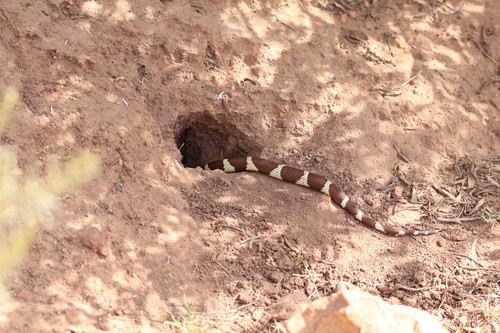
Maximum length: 142.2cm (mainland), 2 metres (islands).
California kingsnakes already seem to be everywhere in southern California, but they’re actually even more abundant than they seem, because a good portion are lurking in underground burrows, aware and alert, but out of sight of predators. This species is non-venomous, and one of the most powerful constrictors in the world in proportion to body size.
California kingsnakes (Lampropeltis californiae) appear in California, southern Nevada, Arizona, southwest Oregon and southwest Utah. They prey on a mixture of mammals and snakes, even including venomous snakes like sidewinders. They forage actively, and their quests take them far and wide; over dry and dusty plains, up shrubby hillsides, and into the underground, via the dark entrances of mammal burrows.
A dark burrow is like the serpent equivalent of a cave – fun to explore, and with the possible reward of treasure inside, the treasure in this case being a tasty rodent to eat. California kingsnakes might poke their head out, or you might just spot their tail disappearing. Either way, this is a very easy species to recognise, with its black and white or sometimes brown and white markings, which always contrast vividly.
| 10 | Sonoran whipsnake |
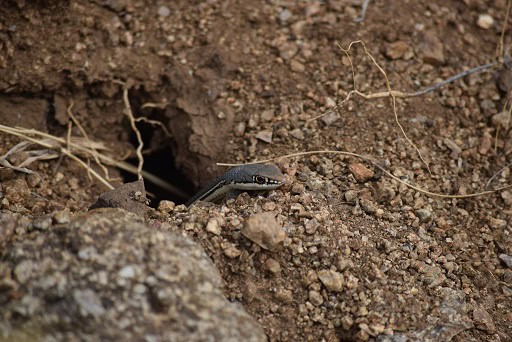
Maximum length: 186.3cm.
A whip-like snake found in two US states: over 50% of Arizona, and southwestern New Mexico, as well as northern Mexico. This species inhabits dry shrubland, plains of creosote bushes, dry hillsides and rocky canyons. It avoids true deserts, but sometimes appears in semi-deserts, where it hunts for fast-moving lizards, its main prey.
This species belongs to the same Masticophis genus as the more common coachwhip, and like that species, it lacks any venom, but may turn vicious if picked up. Sonoran whipsnakes (Masticophis bilineatus) are fast, agile and come across as highly impatient, although that’s just their natural slithering speed. They move by day rather than night, and have some of the strongest heat resistance of any US snake.
Nevertheless, they can still burn and frazzle at the uppermost desert extremes. They’re still vulnerable to predatory birds, and their solution is the safety of an underground burrow. Each Sonoran whipsnake has its own safehouse it can retreat to, where few creatures can harm them, except the gnawing rodents within or other slithery serpents.
| 11 | Indian python |
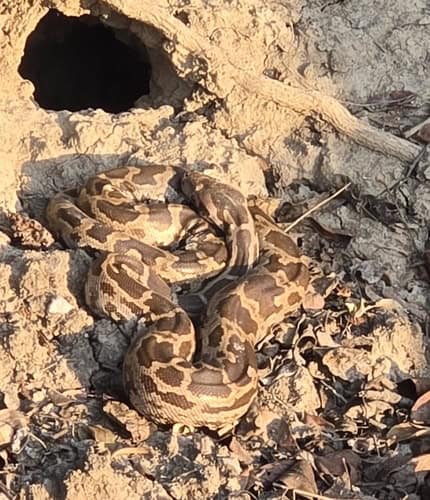
Maximum length: 4.6 metres.
The longest snake on our list, and one of the longest snakes worldwide. This snake is huge and thick, and inhabits almost the entire Indian subcontinent. It’s easy to notice while on the move, but tricky to observe while stationary due to its amazing camouflage. It’s also tricky to discover when lurking completely out of sight in the dark underground.
Indian pythons (Python molurus) have a tendency to lurk in shallow waters, and lunge out at passing animals such as deer. They inhabit most of India, as well as all of Sri Lanka. To the northeast, they’re suddenly replaced by their close relative the Burmese python. Indian pythons have a variety of surprising skills; they’re excellent tree climbers, resting on incredibly thin branches. However, they occasionally feel exposed like any snake, and retreat to a safe, cosy hideaway in order to digest their latest meal.
Another huge burrow snake is the African rock python, which is the 2nd or 3rd longest snake in the world. Virtually all mammal burrows are too small for this titan, except for one – the burrows of the aardvark, which African rock pythons are known to favour.