
| 1 | Eastern garter snake |
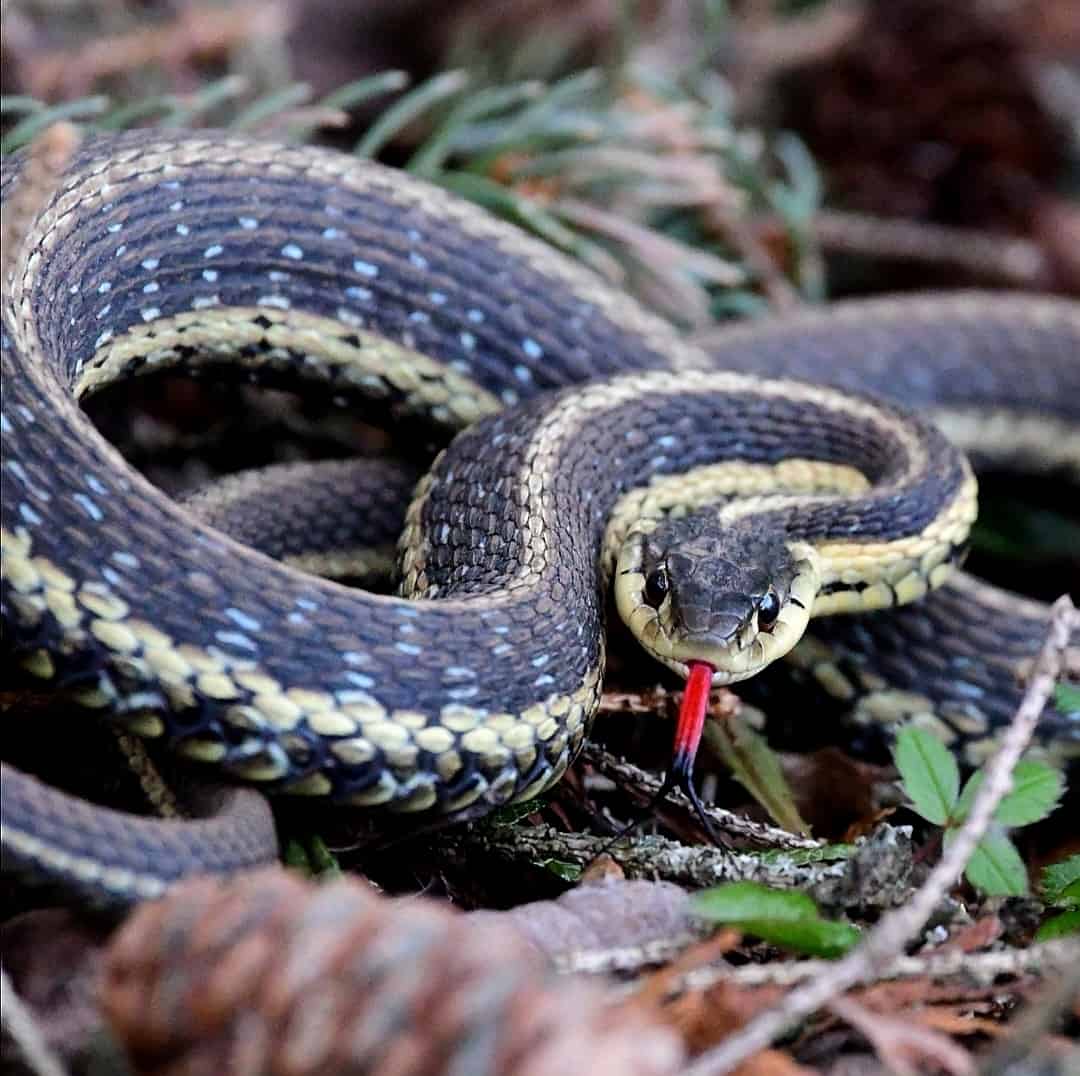
Latin name: Thamnophis sirtalis sirtalis.
The archetypal common garter snake, and the most common subspecies of the 12. When people think of this snake, they think of this subspecies: a dark base colour, overlaid with three beige stripes, one on each flank, and another down the spine. This is combined with a maximum size of just over 1 metre, a docile personality, and a mild venom which has no chance of hurting a human being.
As the name suggests, the eastern garter snake inhabits every state of the eastern USA. Its westernmost points are southeast Texas and eastern Oklahoma, after which other subspecies take over. But anywhere to the east, you’re firmly in its domain: Florida, Alabama, New York, Mississippi, Ohio, Michigan, Delaware and more. This subspecies also spreads well into eastern Canada.
Eastern garter snakes prey on a mixture of amphibians and earthworms, with the occasional mammal. Although they have the “standard” colour, many colourful individuals pop up across their vast range. You can find completely black individuals, individuals with red stripes, or red bellies, or even blue stripes.
Consequently, identifying this subspecies can be tricky at times, but there’s one helpful fact: across the majority of the eastern seaboard, it’s the only subspecies full-stop. The exceptions include Florida (2 subspecies), and New England states such as Maine, New Hampshire and Vermont, where the maritime garter snake also exists.
| 2 | Red-sided garter snake |
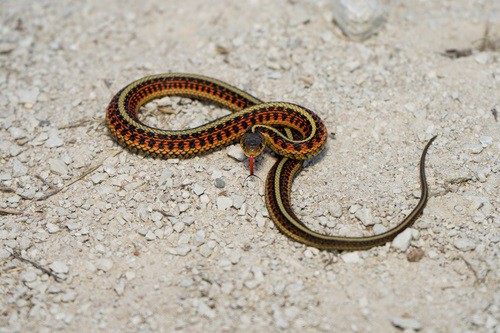
Latin name: Thamnophis sirtalis parietalis.
The second most widespread subspecies, and the one which inhabits the coldest territories. The red-sided garter snake is found in the US Midwest, reaching a southernmost point of Oklahoma. However, it’s also the most northerly subspecies of the 12, and the most northerly snake in the entirety of North America. Red-sided garter snakes appear in large areas of Alberta and Manitoba, and just cross the border into Northwest Territories.
Red-sided garter snakes are distinctive in appearance, with the usual beige stripes, but many complex red-black blotches inbetween. Yet another distinctive fact is their communal tendencies. While all subspecies gather together in large numbers, to preserve winter warmth, the red-sided garter snake has produced the most extreme examples, including a gathering of 20,000 individuals beneath a collapsed underground stream in Manitoba.
When a female red-sided garter snake leaves her hibernation chamber, hundred of males will sometimes be waiting. The red-sided garter snake also produced one of the largest individuals on record, a 134cm brute found by Jenpeg dam in Manitoba.
| 3 | California red-sided garter snake |
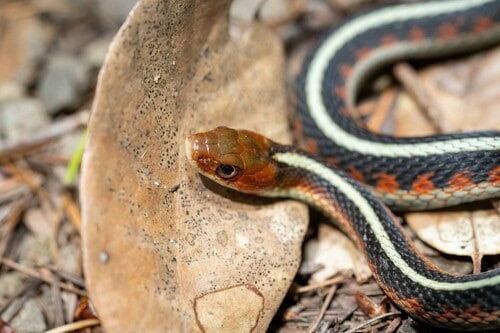
Latin name: Thamnophis sirtalis infernalis.
The main subspecies of California’s west coast, mainly in the northern half of the state, where it reaches enormous numbers. This is one of the most consistently colourful subspecies overall. It’s easily confused with the red-sided garter snake further east, but the difference lies in the stripes. These are much brighter, often electric blue, or sometimes close to white, rather than the standard beige. The areas between the stripes have red in both forms.
This subspecies is found only in California. It becomes scarcer the further south you travel, and in inland areas, such as the Sacramento and San Joaquin Valleys, it doesn’t exist at all, being replaced with the valley garter snake, which covers the majority of territory in California. This subspecies lacks any blue, with far more beige instead (but some red still).
Resistance to toxic newts is another characteristic of this subspecies, with the ability to gulp down lethal species like the rough-skinned newt (Taricha granulosa). These contain tetrodotoxins (TTX), which stop the hearts of human beings stone dead, and indeed most other snakes, but the California red-sided garter snake only suffers a minor slowdown before slithering on its way again. Several other subspecies possess these mutations as well, but they’re well documented in this subspecies and our next, the San Francisco garter snake.
| 4 | San Francisco garter snake |
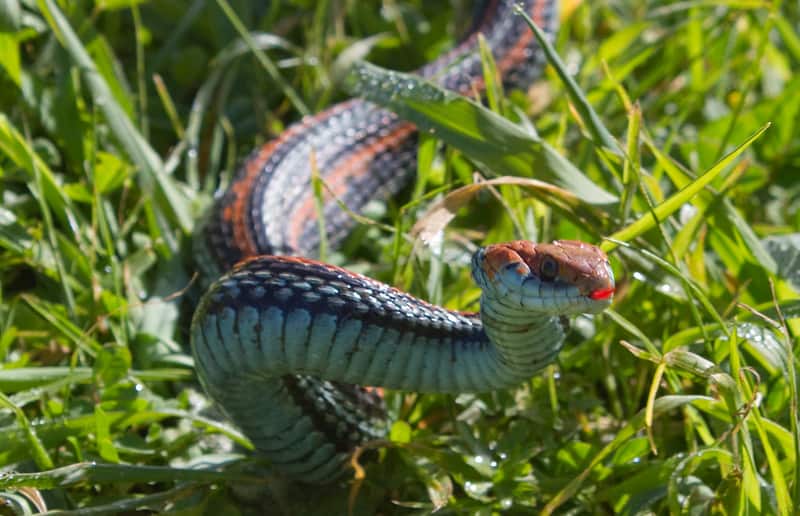
Latin name: Thamnophis sirtalis tetrataenia.
The most endangered common garter snake subspecies, with as few as 2000 individuals estimated to exist. In colour, this might be the most colourful subspecies of all. It possesses the red and blue patterns of the California red-sided subspecies, but with the vividness and contrast dialled up even further.
This subspecies also occupies west coast California exclusively, but further south along the coast. The problem: these are some of the most heavily populated areas in California.
The subspecies’ highest densities are around San Francisco, where scenic streams and lush grassy meadows have been swallowed up remorselessly over the last 200 years. It’s believed that the San Francisco garter snake still exists in undiscovered locations on private land, as surveying the entire countryside is impossible. Nevertheless, it’s still listed as “endangered”.
One saviour of this subspecies has been surprising: San Francisco International Airport. Decades ago, the authorities earmarked a small parcel of land adjacent to the airport as a protected wildlife zone. It was a patch of rugged wildness, with overgrown plants and possibly lethal surprises. The San Francisco garter snake is thriving on this slice of land, which is now its best studied surviving population. This did lead to a headline in 2014 when a San Francisco garter snake slithered onto the runway and stopped traffic.
| 5 | Chicago garter snake |
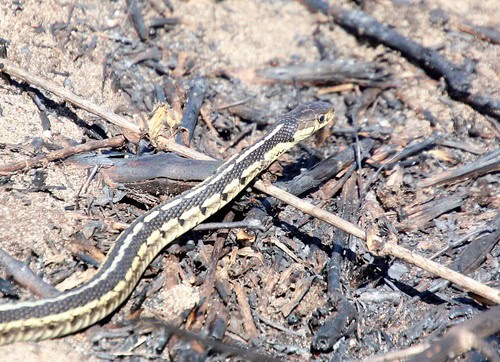
Latin name: Thamnophis sirtalis semifasciatus.
One of the dullest, least colourful subspecies, yet also one of the more recognisable. The Chicago garter snake has one of the smallest territories of the 12. It’s found exclusively in the regions bordering the south of Lake Michigan, including northwest Indiana, northeast Illinois and southeast Wisconsin. It covers 3 states and only narrow portions of each, but within those areas, it’s commonly encountered and not elusive at all.
Chicago garter snakes are common near water bodies, often along forest edges. Their diet is believed to consist of the usual amphibians, and earthworms for juveniles. One observation of this subspecies was particularly unusual; a snake eating a piece of beaver meat used in a trap for weasels.
As for the patterns, Chicago garter snakes have not a trace of blue or red. They have the usual garter snake colours, with beige stripes contrasting against a dark brown base. Yet the patterns are distinct, as rather than a single orderly stripe, each flank has a series of black circular blotches as well. These are easy to observe, and assuming you’re in the correct region, make this subspecies very easy to pinpoint, whether it’s in your hands or in a grainy photograph taken by your friend at the local lake.
| 6 | Maritime garter snake |
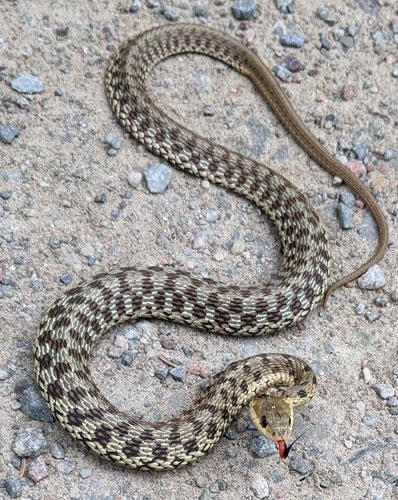
Latin name: Thamnophis sirtalis pallidus.
One of the trickiest garter snake subspecies to recognise by appearance, for one simple reason: this subspecies is extremely variable. Maritime garter snakes can be clean, speckled, or adorned with endless complex patterns which defy categorisation. Scientists have stumbled across melanistic morphs (fully black), and even an erythristic morph, a version where red pigments go into overdrive and predominate. The latter was found in West St. Andrews, Nova Scotia.
The maritime garter snake is the most northeasterly of the 12 garter snake subspecies, and one of 6 to inhabit Canada. Its heartlands include Maine, Quebec and Nova Scotia, and it’s the only subspecies found on Newfoundland. Its diet consists of the usual amphibians and earthworms.
One extreme hotspot of this subspecies is Georges Island in Nova Scotia. The densities here are huge, according to a report from 2006, reaching 120 snakes per hectare, excluding those under 1 year old. The scientists found an unusual number of melanistic individuals here, and a particularly docile personality, even among fully-grown adults. The prey base was less diverse than on the mainland, but according to the researchers, “the island population appears to thrive“.
| 7 | Blue-striped garter snake |
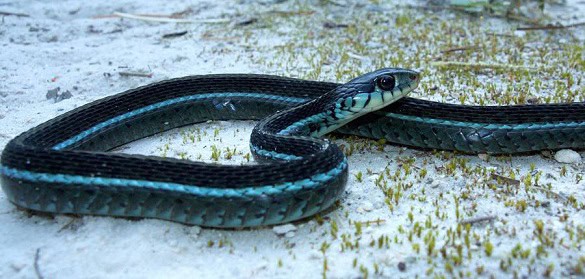

Latin name: Thamnophis sirtalis similis.
Florida contains two of the 12 common garter snake subspecies. The first is the eastern garter snake, the massively widespread form with generic beige-black colours. The second is a distinctive subspecies which nobody could fail to recognise: the blue-striped garter snake. This version possesses 2 vivid blue stripes, one on each flank, plus a thin stripe down the spine which is greyer and duller.
Blue-striped garter snakes appear in northwestern Florida only, along the Gulf Coast. There are no populations in Georgia to the north or Alabama to the west. Blue-striped garter snakes aren’t even found near Tampa or Orlando, and come nowhere close to Miami. While this subspecies is restricted in territory, it isn’t endangered, as it’s common within that territory.
Virtually all individuals of this subspecies are blue-striped, rather than just 50% or 75%. Between the stripes, the patterns vary, as some have no markings, just clean bluish-black colours. Other individuals have a series of tiny blue speckles, but there are never beige markings on this subspecies.
| 8 | Valley garter snake |
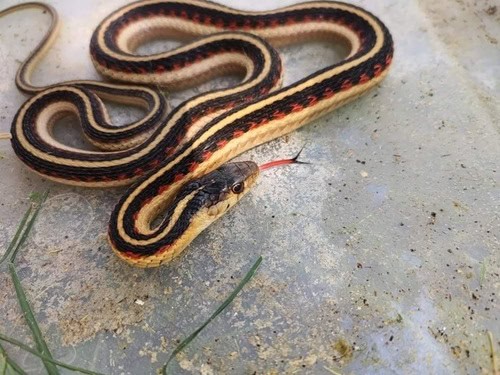
Latin name: Thamnophis sirtalis fitchi.
The most common garter snake of the western USA. This subspecies inhabits the vast majority of California, as well as Oregon, Washington and most of the Canadian west coast. There’s even theories that this subspecies reaches Alaska; sightings have been made, including one garter snake which plummeted onto a man’s head, but some theorise that they were stowaways.
Valley garter snakes are identifiable by the unusually large cream/beige areas of their bodies. This is the 4th western subspecies to have red scales, but these cover the smallest area, consisting of a smattering of red markings just above the beige stripe on the flanks. These beige sections are clean, with no dark speckles. They also spread to the face, giving the valley garter snake the palest head of the 12 subspecies, although the top of the head is still dark.
Valley garter snakes are known to shelter in many strange places. These include the burrows of woodrats, anthills, old wells, beaver bases, and more traditional snake hideouts like rotting logs. As usual, they pose no threat to human beings.
| 9 | Texas garter snake |
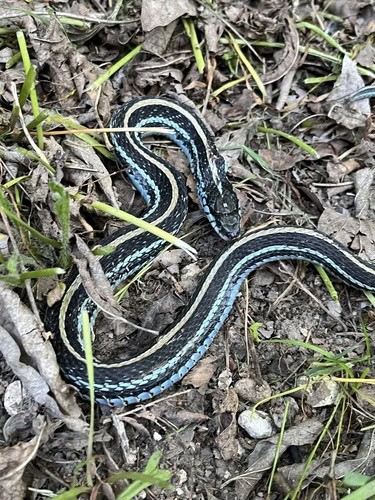
Latin name: Thamnophis sirtalis annectens.
This subspecies is found in two states: Texas and Oklahoma, and only in narrow areas of each. In Texas, this form is found on the outskirts of Fort Austin, and in its biggest population, the Dallas-Fort Worth region. There’s also a population near towns like Temple and Pendleton, while in Oklahoma, the largest population lies to the west of Oklahoma City.
Everywhere else in Texas, this subspecies completely disappears. In fact, the entire western half of Texas is virtually free from common garter snakes. The main additional populations lie in southeast Texas, along the Gulf Coast, and these consist of the main subspecies, the eastern garter snake. These populations are separate from the Texas garter snake strongholds.
The Texas garter snake is a subspecies without any bright red, unlike the fabulous west coast forms. It sticks to the traditional yellow/cream and dark brown colours, but these are brighter and more sharply contrasting. The yellow spinal stripe is commonly a rich orange, and there’s black speckles on the pale flanks which contrast sharply with the colour below.
The main habitat of this subspecies is tall grass prairie land, particularly the Texas Blackland Prairies, but oak savannah and woodlands are another possibility. Wherever it lives, it tends to appear near water bodies.
| 10 | Puget Sound garter snake |
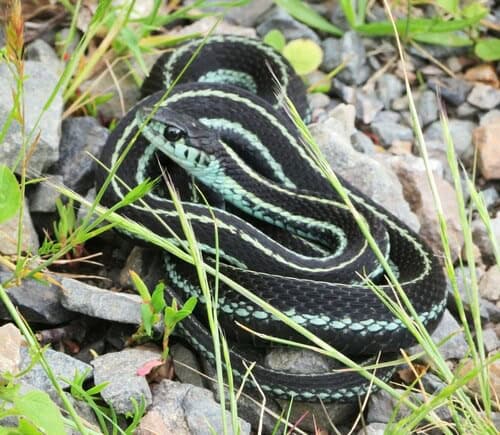
Latin name: Thamnophis sirtalis pickeringii.
This subspecies is found in 3 regions: extreme northwestern Oregon, southwestern Canada (British Columbia) and western Washington state. The latter is its main base, but compared to other west coast subspecies, this garter snake is the least likely to contain red markings. Its patterns consist of two thick pale stripes (either blue or white), one on each flank, plus a thinner pale stripe down the spine, which covers just 1 scale in width.
This is the 2nd bluest garter snake subspecies of the 12, after Florida’s blue-striped garter snake. If this subspecies does have red markings, then they’re generally small, insignificant speckles on the side. This version shares Washington state with the valley garter snake, but the latter is much creamier in appearance, and is more likely to appear in mountainous areas.
Puget Sound garter snakes appear in various habitats, assuming a fresh water source is nearby. These include coastal dunes, the outskirts of forests, swampy zones, river shores, and by creeks within forests. A confirmed meal of this subspecies is the northern red-legged frog (Rana aurora aurora).
| 11 | New Mexico garter snake |
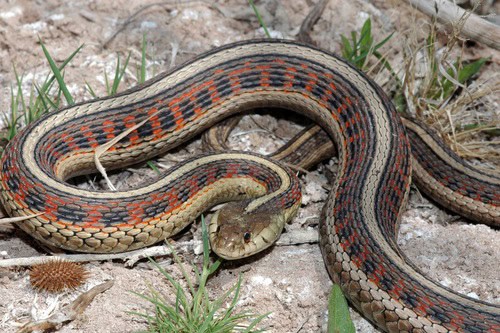
Latin name: Thamnophis sirtalis dorsalis.
New Mexico is a parched state, and garter snakes gravitate towards water. Nevertheless, common garter snakes thrive here in certain areas, and specifically one subspecies: the New Mexico garter snake, which is abundant along the course of the Rio Grande and its various tributaries. This subspecies also inhabits extreme western Texas, but no other state.
This subspecies has hints of red, but is much murkier than other colourful subspecies. It has beige, brown and grey interlocking in complex patterns, with faded fiery red blending with black along the flanks.
The New Mexico garter snake is one of the most poorly researched, though it has the usual love of semi-aquatic habitats. This subspecies could hold many strange secrets, as shown by one odd observation from July 2013, Socorro County. A New Mexico garter snake was spotted on a small branch 7.6cm below a bird’s nest, swallowing the nestlings of a southwestern willow flycatcher. Birds are unusual meals for the common garter snake – maybe this restricted subspecies has developed some strange tendencies, in its rocky Rio Grande realms.
| 12 | Red-spotted garter snake |
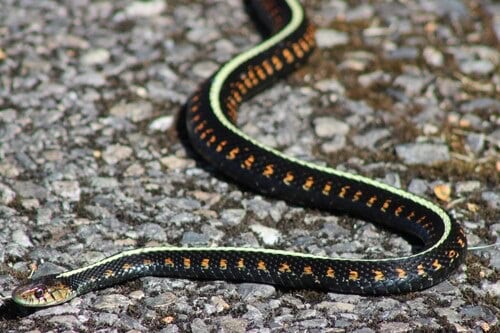
Latin name: Thamnophis sirtalis concinnus.
Our final subspecies is another fabulously patterned form of the west coast. This version is found in two states: western Oregon and southwest Washington, where it inhabits coastal regions straddling the border, covering a relatively small territory, but with plentiful populations inside.
This is another subspecies which abolishes the usual brown/beige, replacing it with red and jet black. At first glance, it looks similar to the California red-sided garter snake. There’s a red head, bright white stripe, and massively exaggerated paintbox colour palette.
The key difference lies with the red markings on the flanks. These are smaller than in neighbouring subspecies, and consequently, the red spots take the form of dots rather than large, interlocking blotches. This explains the common name.
This subspecies is particularly abundant near Portland, Oregon. One of its favourite prey is the American bullfrog, which is actually an invader from the east coast, but got more than it bargained for from the local garter snakes. This subspecies lives near water bodies, and grows more intense in colour with age, unlike a few snakes worldwide, such as the red-necked keelback of Thailand, which grow duller.