| 1 | Many-horned adder |
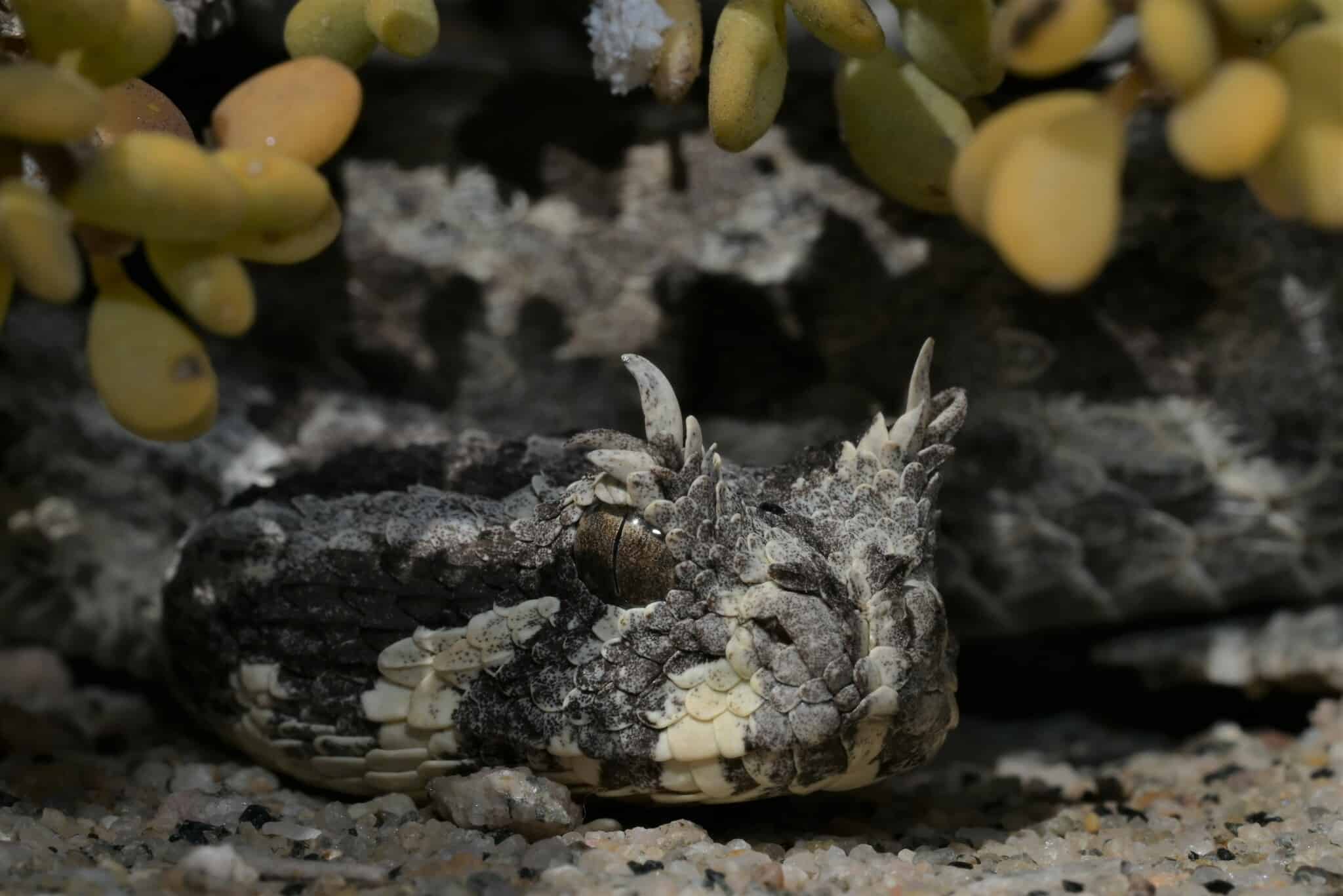
Maximum length: 75cm.
An African species with a horn above each eye, sometimes called the “hornsman”. The many-horned adder not only has horns, but horns springing out of horns springing out of more horns.
This snake is part of the same Bitis genus as the puff adder and gaboon adder, but is shorter, reaching a maximum of 75cm, and usually just 30-50cm. It lives in just two countries: South Africa (extreme west) and southern Namibia. It’s most common on rocky plains and gravel flats, where it takes shelter in dark rock crevices, which its grey scales and jagged horns are perfect for blending into.
Many-horned adders (Bitis cornuta) have no need to pierce people with their horns, as they’re mainly used for intimidation purposes. Instead, they have a cytotoxic venom, which is reputed to be extremely painful and can cause local necrosis.
Luckily, these symptoms aren’t life-threatening, and no deaths are known. This species looks far more menacing than a black mamba at first glance, yet the black mamba’s neurotoxic mixture can kill within minutes.
Many-horned vipers vary in colour, depending on the soil type in each locality. They range from clay red to stone grey, to beige with dark brown blotches.
| 2 | Saharan horned viper |
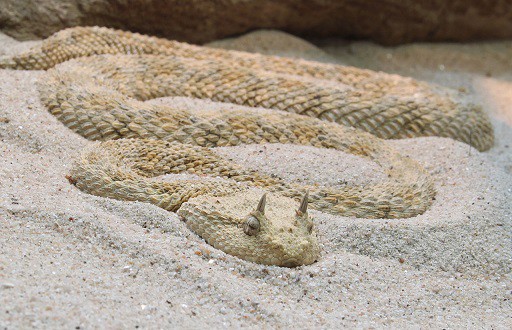
Maximum length: 85cm.
The mascot for horned snakes around the world. This is a dweller of North African sand dunes, and semi arid areas with dry shrubs. It has a menacing presence in Tunisia, Libya, Egypt, Morocco and more, and measures 40-60cm, with a venom that’s literally heart-squeezing.
Saharan horned vipers (Cerastes cerastes) have particularly bulging eyes, which sit on the side of their head, allowing them to scan the rolling desert dunes in all directions. Each savage horn is actually a single enlarged scale, like a mutant tooth that grew way too far.
The exact reason these horns evolved isn’t known, but one theory relates to hunting. This species buries itself in sand dunes in order to ambush gerbils. It then springs out and grabs the unsuspecting victim, but it’s also thought that the sharp horns act as lures, poking out from the sandy desert surface.
This snake looks like a being of pure sand. Its eyes look sandy, and even its tongue has a sandy beige upper half, with a browner base. This horned snake mainly eats rodents, with two confirmed species being the Greater Egyptian gerbil and Anderson’s gerbil.
| 3 | Fan-Si-Pan horned pitviper |
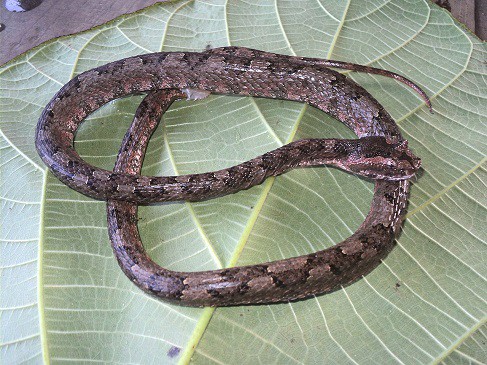
Maximum length: 69.6cm.
This horned snake lives in Vietnam and southern China, and has a fragmented range, with various disconnected pockets of territory.
The Fan-Si-Pan horned pitviper (Protobothrops cornutus) is one of the thinner vipers worldwide, and varies in appearance. Some are stony grey, while others have reddish tinges. But a consistent feature is a pair of sharp horns, whose purpose is completely unknown, but definitely adds to the fear factor.
This snake is almost fully nocturnal, and dwells in karst mountainous regions, where it hide in limestone outcrops. It lurks out of sight all day, waiting patiently until its moment arrives. When the sun sets, Protobothrops cornutus pokes its head out, scans its surroundings briefly, and begins the night’s hunting.
Fan-Si-Pan horned pitvipers can appear on the edges of mountain trails, sometimes climbing trees to 0.5-1 metres high. They particularly like areas near cool, running water.
This species has a defensive temperament, reacts quickly to movements, and has a rapid and accurate strike. Luckily, its venom isn’t especially severe. Protobothrops cornutus also has a pale tongue, and an extremely triangular head when viewed from a bird’s eye.
| 4 | Rhinoceros ratsnake |
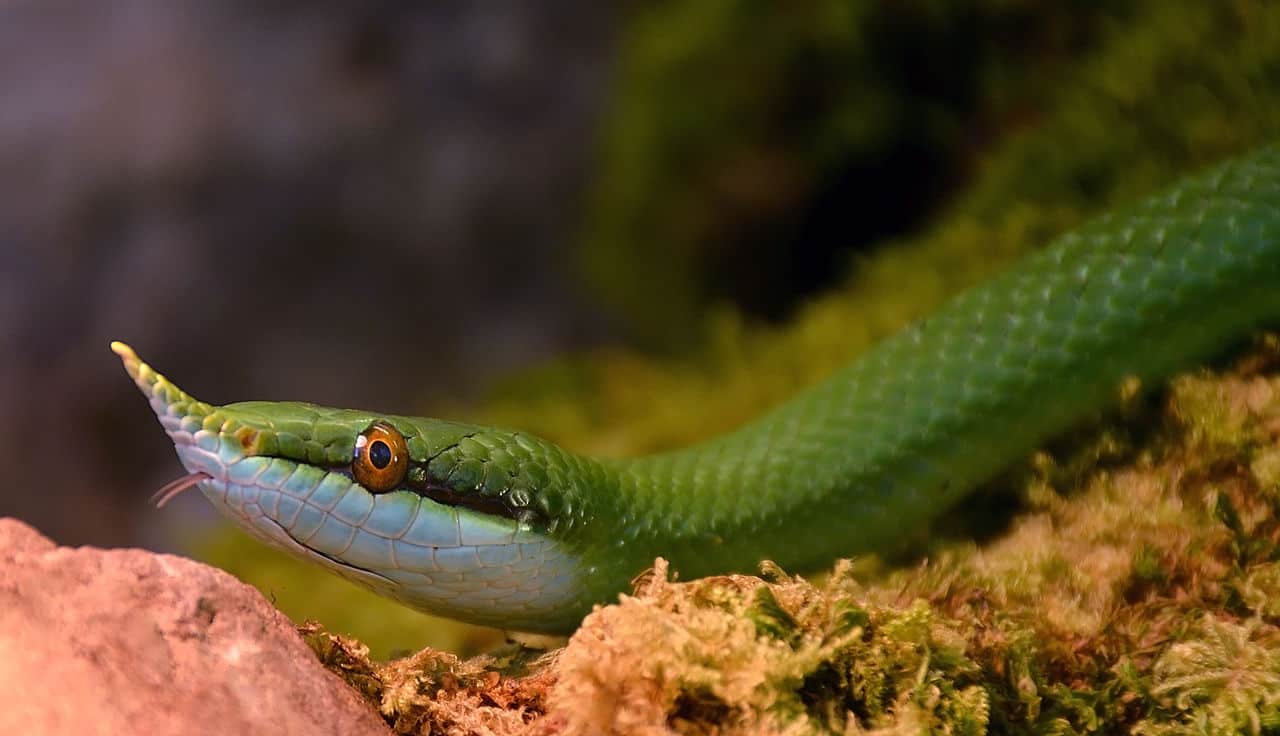
Maximum length: 163cm.
A close relative of the red-tailed green ratsnake, which is famous for its blue tongue. Closer inspection reveals a not so subtle difference: a huge rhinoceros-style horn sprouting from its face.
Rhinoceros ratsnakes (Gonyosoma boulengeri) live in riverside forests and mountainous areas, far from busy towns. They range from southern China to Vietnam, and are mostly non-venomous, posing no threat to human beings, except maybe if poked and prodded.
This is the only non-viper on our list, proving that other snakes can sprout a horn too if they concentrate hard enough. As well as the gigantic horn, this species is also recognisable by a black stripe surrounding each eye.
The exact purpose of the horn is still a mystery of science. Rhinoceros ratsnakes were first discovered in 1897, when 6 were spotted in Vietnam’s Gulf of Tonkin. It’s fair to assume that the scientists knew they were looking at a new species right away.
As of 2021, this horned snake is now divided into two species. A population was discovered in the mountains of Hainan Island, China, which lacked the black stripe spreading backwards from each eye. This was dubbed Gonyosoma hainanese. These are the only two Gonyosoma members (with 8 in total) to have the rhinoceros horn.
| 5 | Persian horned viper |
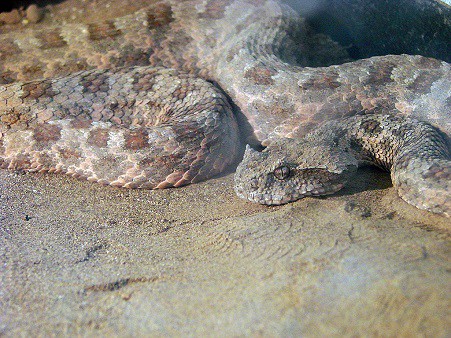
Maximum length: 129cm.
A snake of parched, arid habitats. Persian horned vipers (Pseudocerastes persicus) inhabit Iran, Pakistan, Afghanistan and northern Oman. They belong to the small Pseudocerastes genus, which also contains the disturbing spider-tailed viper.
With its vertical pupils and keeled scales, this snake would already be intimidating, but a horn above each eye seals the deal. With Pseudocerastes persicus, the horns consist of multiple scales built on top of each other, unlike with the Saharan horned viper, where they’re just a single super-enlarged scale.
This snake is venomous, but usually survivable. A 33 year old man was bitten in Kerman province, southeastern Iran, and suffered only local pain and swelling. The worst bites can cause haemorrhaging in the classic viper style.
Persian horned vipers like to lurk in shaded rock formations and below boulder piles, in order to avoid the burning sun. Mammal burrows are another favourite hangout. They like arid environments, so if you get lucky, the sun might strike at the perfect angle and create a nightmare silhouette, with a serpent head and a pair of noticeable horns sticking up as the snake gazes down a hill.
| 6 | Mexican horned pitviper |
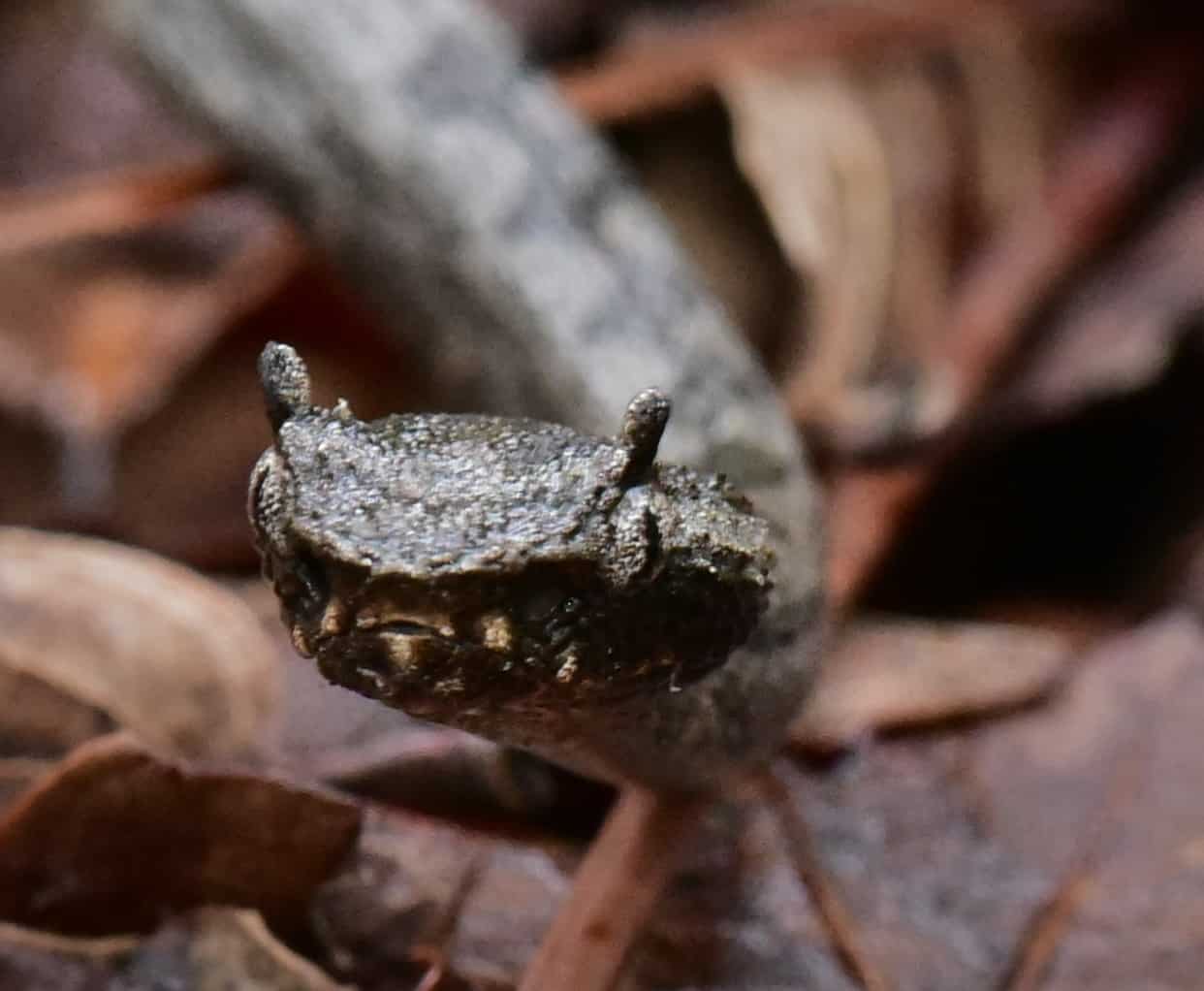
Maximum length: 70cm.
A species of mountainous southern Mexico, particularly Oaxaca state. Mexican horned pitvipers (Ophryacus undulatus) live at altitudes of 1800-2800 metres, in lush pine-oak forests and cloud forests well away from cities. You won’t find this snake terrorising wheat farmers, as it prefers scenic spots with crisp air.
Mexican horned pitvipers are challenging to find, as their camouflage is excellent. Their scales are a complex mixture of grey and green, which blends perfectly with a mossy boulder or forest floor. But if you catch one out of the corner of your eye, there’s no doubting what you’ve found, as their horns are a dead giveaway.
Mexican horned pitvipers have a single horn above each eye. These horns are more rounded, compared to the razor sharp appearance of the Saharan horned viper’s. They also have a sharply triangular head, and their eyes are rich with detail.
This southern Mexican species is venomous, yet not particularly deadly. A 2019 study found its venom to be milder than that of its cousin, the broad-horned pitviper. Mexican horned pitvipers mainly stick to the ground, climbing low branches and bushes on occasion. They’re found solely in southern Mexico, with no crossover into Guatemala next door.
| 7 | Butterfly viper |
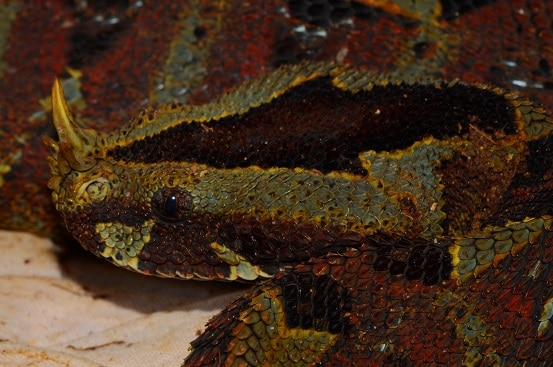
Maximum length: 120cm.
A sub-Saharan African species which was named for its striking colours, but also possesses a collection of deadly horns. Rather than two neat horns above each eye, these sprout from the same spot and twist at unnatural angles.
Butterfly vipers (Bitis nasicornis) inhabit central Africa, from Kenya to Nigeria to Ghana. This is a jagged snake in every way. Its scales are so sharply keeled that they sometimes slice open snake handlers’ fingers. Their sharpness is easy to see from a photograph, and the last piece of the puzzle is the jagged horns.
Once again, nobody knows why these horns evolved. They may simply exist to intimidate predators, or there may be a subtler hunting angle. They might be weapons which they can swing upwards if a greedy eagle descends (though this is pure speculation).
Butterfly vipers have an extremely loud hiss, almost like a shriek. A study analysed their diet in Nigeria in 2003 and found mainly mammals, with a side helping of amphibians. This snake tends to lurk in the undergrowth like a dormant tank, and spring to life whenever rodents pass.
| 8 | Nose-horned viper |
Maximum length: 110cm.
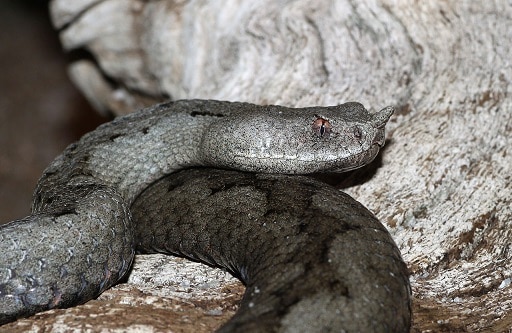
This 50-70cm species is instantly recognisable by two features, the first being its rhino-style horn, which juts from the tip of its snout. The second is its stony grey scales, which are designed to blend into rock fields, allowing it to disappear completely, including in areas where hikers walk past obliviously.
The nose-horned viper (Vipera ammodytes) lives in Greece, Albania, Macedonia, Slovenia, and other southeastern European countries. Its horn consists of not one scale, but 7 to 19 scales piled on top of each other. Touch the horn, and your finger won’t start bleeding instantly, or shrivel up and drop off, as the horn is actually flexible and soft.
Many of our horned snakes actually have a milder venom, but not Vipera ammodytes. It’s the 1st or 2nd deadliest viper in Europe, and is more than capable of killing adults, with two soldiers dying in Croatia in the 1990s. Its venom contains a mixture of neurotoxins and haemotoxins, and is specialised against mammals.
The horns of this species vary wildly in angle. In some members such as above, they point diagonally forwards at 45 degrees. In others, they tilt sharply upwards, almost vertically. In this image, a Vipera ammodytes even has a backward-curving horn.
| 9 | Arabian horned viper |
Maximum length: 85cm.
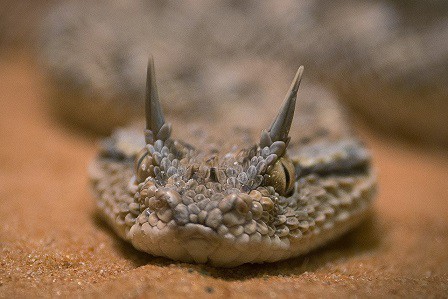
The easterly cousin of the Saharan horned viper. The Arabian horned viper (Cerastes gasperatti) inhabits the entire Arabian peninsula, except for a small portion of central Saudi Arabia, where the land is so scorched that even they can’t cope.
Cerastes gasperatti inhabits Saudi Arabia, Oman, UAE, Yemen, and far southwestern Iran. Both this species and the Saharan horned viper live in southern Israel, but it’s unknown whether they actually have any overlap. The two live a similar lifestyle, lurking in soft sands interspersed with arid shrubs, waiting patiently for rodents to come their way.
This species typically measures 30-60cm. Not every member of this species has horns. About 50% have flat heads, but when the horns appear, they’re hard to miss.
Arabian horned vipers could probably poke you with their horns if they realised what a great weapon they have, but prefer to rely on their venom instead. This consists primarily of metalloproteinases (SVMPs) and phospholipase A2s (PLA2s). Their venom targets internal organs like the kidneys, and causes severe drops in antioxidants such as glutathione and superoxide dismutase.
Originally, this was a mere subspecies of the Saharan horned viper, until 1988 when the two were split. One of the main differences in Cerastes gasperatti is that the black diagonal line behind the eye is thinner and significantly longer.
| 10 | Rainforest hognose pitviper |
Maximum length: 65.3cm.
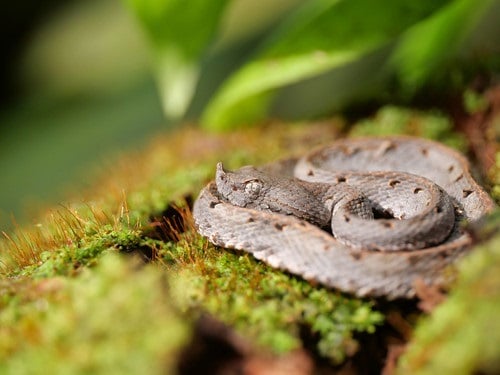
A common species of Central America, which ranges from extreme southern Mexico all the way to western Ecuador. This species is another rhinoceros stylist, with a singular large protruding horn above its nose. This horn is similar to the hognose snakes of the USA, yet significantly more noticeable.
Rainforest hognose pitvipers measure 50-60cm, and lurk on forest floors rather than branches, blending in almost completely. They dwell in forests almost exclusively, and it’s extremely rare to find them slithering through open grassland.
The rainforest hognose pitviper has an LD50 score of 4.6mg, versus a black mamba’s lethal 0.05mg. This horned creature has a relatively weak venom, but has highly targeted toxins against blood clotting. This 2022 study found that rainforest hognose pitviper venom disabled multiple clotting enzymes: Factor IXa, factor Xa and prothrombinase.
These each have multiple roles. Factor Xa is the enzyme which cleaves prothrombin to finally create thrombin, the enzyme which creates fibrin (the backbone of all blood clots). Factor X is the raw material for factor Xa, and this conversion is facilitated by factor IXa. A rhino horn is not the only weapon of this common Central American snake.
What amazing animals snakes are. Each snake has it’s own set of skills, venom and ways to kill anyone without quilt.