
| 1 | Usambara green snake |
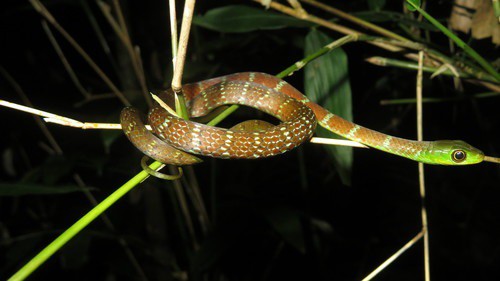
Maximum length: 95cm.
Of the 54 African countries, Tanzania hosts a particularly large amount of rare species relative to its size, and snakes are no exception. The reason is the Usambara mountain range, which was formed 2 million years ago. This low, hilly range peaks at just 2289 metres, but was originally coated with misty rainforest, and today is a global bodiversity hotspot. The range is divided into the East Usambara mountains in northeastern Tanzania, which are wetter but lower in elevation, and the West Usambara.
One species that lives here is the Usambara green snake, a harmless member of the large Philothamnus genus (which has 24 members). This species averages at 50-80cm, moves mainly by day, and has round pupils. Usambara green snakes are variable in colour, with many being green-brown like above, and others having unusual blue tinges. They’re also flexible in habitat, roaming both closed forests and open grasslands.
Usambara green snakes lack venom, and hold prey in place with their sharp teeth instead. They lay 14 eggs with an elongated shape, and hatchlings measure 18-20cm. As you can see, this snake has a friendly-looking face, and for once that friendliness holds no deception.
Originally, Usambara green snakes were thought to be endemic to Tanzania, but a handful of individuals were discovered in the Shimba Hills in extreme southern Kenya. Then colonies were found in Mozambique to the south, beginning in 1997. Still, Tanzania contains the vast majority of their territory, and especially the Usambara mountains. This species also inhabits Zanzibar island off the Tanzanian coast.
| 2 | Usambara bush viper |
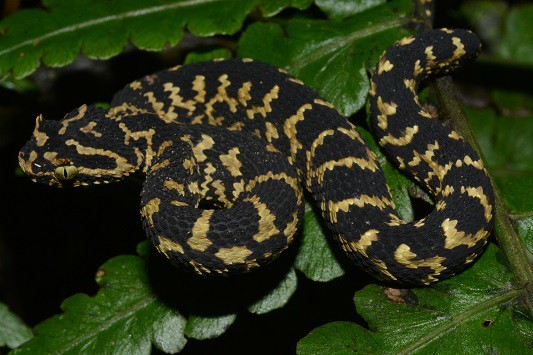
Maximum length: 54cm.
Part of the Atheris genus containing the infamous hairy bush viper, this version lives exclusively in Tanzania, and exclusively within the Usambara mountain range. This dangerous viper rarely appears below 1400 metres, and has distinctive enlarged scales above each eye which resemble eyelashes.
Usambara eyelash vipers (Atheris ceratophora) are normally found on branches 1 metre above ground, but also on the forest floor amid leaf litter, often near small forest streams. Sometimes, they can be found resting proudly on tree stumps 1 metre above ground. This is a fairly short venomous snake, as one record was a 51cm individual found in Mazumbai Forest Reserve, while another reported maximum was just 54cm. But their yellow-black colours make them difficult to overlook, even in the thickest forests.
Usambara eyelash vipers are confirmed to prey on African reed frogs (Hyperolius) in the wild, and in captivity, they happily eat frogs and geckos. Their closest relative is Matilda’s horned viper, from which they’re estimated to have diverged 2.5 million years ago.
There’s also subtle difference within the species, namely between those in the West and East Usambara mountains. These colonies are believed to have diverged 0.9 million years ago. Originally, this species was considered to be endemic to the East Usambara mountains, until individuals were found in the West Usambara in 1982.
| 3 | East African garter snake |
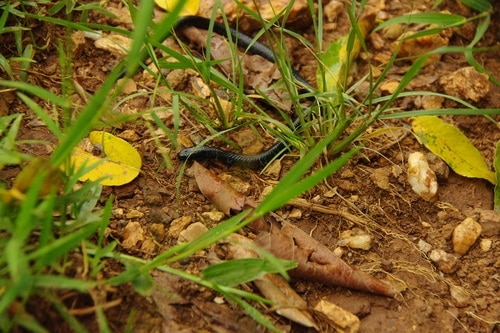
Maximum length: 64.5cm.
A shy snake with burrowing tendencies, which prefers to avoid human contact. This isn’t a member of the US garter snake clan (Thamnophis), but instead belongs to the Elapsoidea genus, with 10 members, all found in sub-Saharan Africa. The East African garter snake (Elapsoidea loveridgei) moves sluggishly through the African landscape, rather than quickly and alertly.
This is a black or dark grey snake. There’s variation in patterns, as some are monolithic, while others are decorated with gold bands, but the darkness always remains. Elapsoidea loveridgei feeds on various reptiles such as geckos and skinks, and has a moderately sized empire, spanning Kenya, Tanzania, Rwanda and Uganda. This snake first became an official species in 1971, when it was split from Sundevall’s garter snake.
East African garter snakes are venomous, but cannot exceed local pain and moderate swelling in humans. Some report their venom to be neurotoxic, yet they’re so non-aggressive towards humans that there’s little risk.
Their habitats are varied, including woodlands, savannah and grassland, but it’s more about the ability to burrow with this snake. East African garter snakes rarely climb trees, and it’s much more likely that they lurk below your feet, just a few inches down, yet still safely secure from your Earth-quaking footsteps, out of sight from even the most sophisticated detecting machinery.
It’s rare for this snake to appear below 800 metres in altitude, and the upper limit is 2400 metres. Like many burrowing snakes, they’re more likely to emerge after heavy rains.
| 4 | Red-snouted wolf snake |
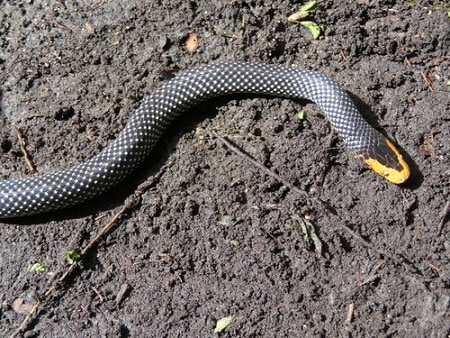
Maximum length: 60.5cm.
Another creature endemic to not just Tanzania, but the fantastical Usambara mountain range, a wonderland of rare creatures. The Lycophidion wolf snake genus has 10 members, and while we know a little about the group overall, research for this rare Usambara species is almost non-existent.
Red-snouted wolf snakes average at 30cm, and are believed to be nocturnal. Photos show a metallic grey snake with subtle white spots, and a bright yellow head which even spreads to its bright yellow eyes. This contrast makes them extremely easy to recognise.
Lycophidion members have large, recurved teeth which are believed to aid in extracting lizard prey from their hidey-holes. Once captured, they constrict these lizards to death. Lycophidion members lay eggs, usually between 3 and 10.
Like the rest, red-snouted wolf snakes prefer damp locations, which are plentiful in their Usambara forests. Deforestation is rife in the Usambara mountains, as its residents are some of the poorest within Tanzania, reliant on subsistence agriculture. 70% of original forest cover has been lost in the East Usambara, while 10% of West Usambara forests were cleared from 1970 to 2000. Fortunately, the mountains were so cloaked in forest initially that vast swathes remain.
| 5 | Usambara forest snake |
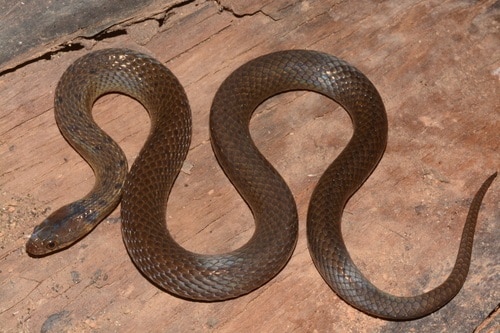
Maximum length: 52cm.
A Tanzanian snake you probably won’t ever meet. An Usumbara eyelash viper might hiss at you from a branch, not bothering to disguise itself, but Usumbara forest snakes (Buhoma vauerocegae) are shier and prefer to blend with the forest.
This species comes in varying shades of brown, from dark to light. Usambara forest snakes have round pupils, and are thought to be diurnal (day-faring). Thick forests are their home, where they lurk under a variety of objects.
Usambara forest snakes have been found under fallen logs, thick overhanging branches, and loose bark, as well as on the forest floor. So far, their confirmed prey has included two frogs. This species is found only in the East Usambara mountains and the Ulguru mountains, both contained within Tanzania. It’s possible that they inhabit the West Usambara mountains as well, given how easily they vanish within their rainforests.
This is a short snake, as the longest Buhoma genus member ever reached just 52cm. When picked up, Usambara forest snakes release an intolerable snake smell to deter predators, and supposedly, the smell is identical to the European grass snake’s (Natrix natrix) foul stench.
| 6 | Uluguru centipede-eater |
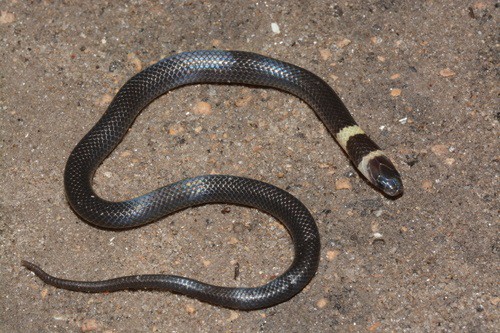
Maximum length: 50cm.
One of 11 Aparallactus centipede-eating snakes found in sub-Saharan Africa. This version inhabits eastern Zimbabwe, northern Mozambique, and finally Tanzania, where it seems to be most abundant.
Uluguru centipede-eaters (Aparallactus guentheri) have a mild venom, which simply bounces off humans ineffectually. They’re decent burrowers and are constantly rummaging around in loose soil, stones and under rocks for their centipede prey. They’re also known to eat scorpions.
This species measures 30-45cm, and is completely dependent on forest, specifically lowland or submontane forest. You won’t find Ulguru centipede-eaters roaming dry plains or grassland.
Ulguru centipede-eaters are recognisable by their double white collar: a black head, followed by a white scarf, another small black patch, then a final white ring. This is followed by a sea of dark brown. In some individuals, the white bands are dark yellow instead. By contrast, the giant centipede eater (A. modestus) is a plain black with no collar, while the black-headed centipede eater (A. capensis) of Zimbabwe had a red body.
| 7 | Usambara vine snake |
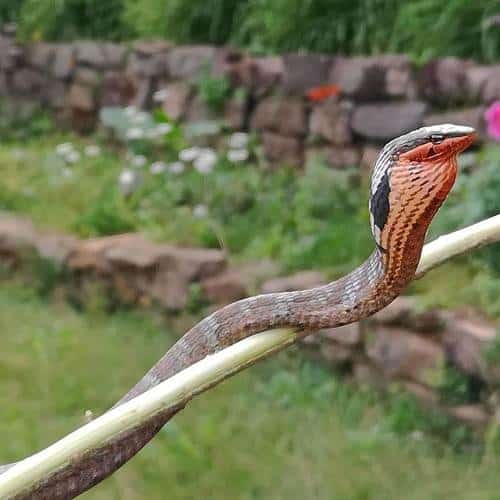
Maximum length: 140cm.
This tree-dwelling snake mostly inhabits coastal forests and mountains in northeastern Tanzania, but also spills into the mountains of southern Kenya. Usambara vine snakes measure 90-130cm on average, and rarely leave their tree branches, travelling through forests or backgardens by leaping between them. They have a thin body, and a very long tail at 37-40% of total body length, and can range from 0-2000 metres above sea level.
This is the second dangerously venomous snake on our list, but no detailed bite case studies exist. The reason we suspect danger is its close relative the bird snake (Thelotornis kirtlandii), which lives further west, and once caused a death in an 80 year old woman. Likewise, the eastern vine snake (T. mossambicus) of Mozambique can cause uncontrollable haemorrhaging.
Usambara vine snakes are confirmed to prey on fellow Tanzanian snakes such as the spotted bush snake. Somehow, there’s a remnant outpost of this snake on Vamizi Island, a small island off the northern Mozambique coast. This was discovered in 2012, and is separated from the main Tanzanian range by hundreds of miles.
| 8 | East African shovel snout |
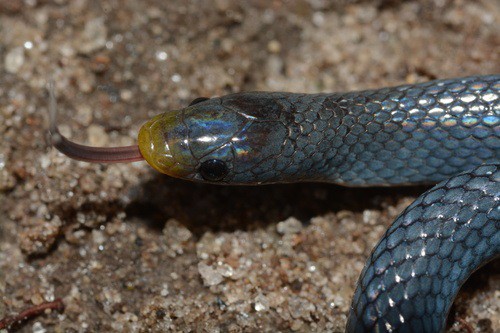
Maximum length: 35cm.
A small Tanzanian snake which lacks any kind of venom. This species also inhabits Mozambique and eastern South Africa, and may have an odd diet, as it’s been reported reported to feed on flying ants. One day, a lucky photographer may capture a mesmerizing scene of an East African shovel-snout lunging repeatedly upwards, trying to bite them out of mid-air. Confirmed prey include gecko eggs and juvenile lizards.
This species belongs to the Prosymna genus of shovel snouts, with 18 members. These are usually fossorial, AKA underground-dwellers, but East African shovel snouts are less fossorial than the rest. They sometimes climb 1 metre high into trees, and invade fissures in bark in order to swallow reptile eggs. They swallow the eggs whole, and prefer freshly laid eggs to old ones where embryos are more fully developed.
East African shovel snouts remain calm when confronted. Other shovel snout members coil and uncoil in order to intimidate, but this species stays completely still. This species has a grey back overlaid with tiny white dots, contrasting against a plain yellow belly.
| 9 | Green mamba |
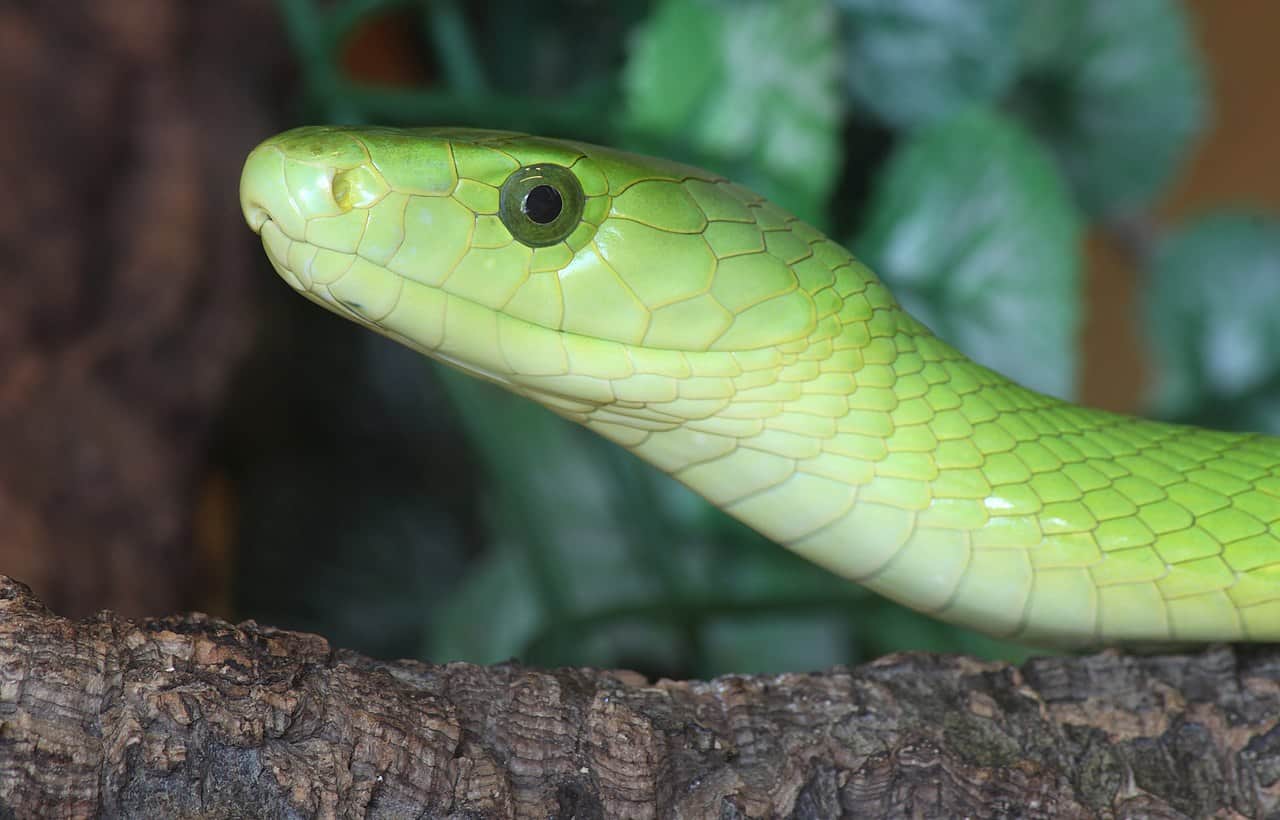
Maximum length: 230cm.
The black mamba’s leafy cousin. The green mamba (Dendroaspis angusticeps) spends far more time in trees than its cousin, is fully green rather than grey-black, and is shorter, never reaching 3 metres (unlike the black mamba’s 4 metres).
Green mambas are mainly found in coastal areas of southeastern Africa. Their heartlands include far eastern South Africa, Mozambique, Kenya and Tanzania, where they have several strong colonies in forests along the coast. Another of their hangouts is Zanzibar island, the offshore tourism paradise.
The green mamba is a dangerously neurotoxic species which isn’t especially aggressive (unlike a black mamba), but should never be touched in any circumstances. The death toll is low, but ignore this warning, and you may add to it slightly.
The diet of this species consists of slightly over 50% birds, with the rest consisting of mammals. It’s very rare to find this species outside of a tree, as when seeking a new ambush spot, green mambas simply travel through the canopies of overlapping branches, which provide an effortless corridor for them.
The green mambas in Tanzania look no different to the rest of their range: solid leafy green with virtually no patterns. The group you’re most likely to confuse them with is the Philothamnus genus, which has members in Tanzania like the spotted green snake (Philothamnus punctatus) and western green snake (Philothamnus angolensis). Both of these are extremely green, but adorned with either tiny black spots or subtler black markings, which the green mamba completely lacks. The Philothamnus members are also smaller, although they might overlap with juvenile or smaller adult green mambas.
| 10 | Common lined worm snake |
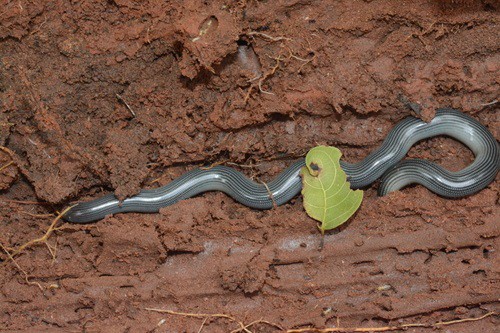
Maximum length: 64cm.
One of Africa’s many blind snakes. This species is relatively large for a blind snake, exceeding 60cm, and with a thicker body. It’s most common in northern Tanzania and southern Kenya, and has the appearance of being lined, but actually has multiple tiny white dots that fuse together from a distance, meaning that its name is false.
Common lined worm snakes (Afrotyphlops lineolatus) are found from sea level to 2600 metres, and can tolerate various habitats, including savannah, woodland and grassland. They only avoid the driest areas where burrowing becomes more difficult. For example, they’re rarely sighted in the drier central areas of Tanzania.
Common lined snakes eat termites, and even hide in the nests of safari ants (Dorylus molestus). One was observed following the trail of a safari ant colony on their way to construct a new nest. Like most blind snakes, the best time to spot Afrotyphlops lineolatus is post heavy rains, when the increased moisture attracts them to the surface.
This Tanzanian snake has very few defensive abilities. They rarely bite, and injecting venom is out of the question (because they don’t have any). If harassed, Afrotyphlops lineolatus will vomit up its last meal, release a foul snake smell that forces people to flee, and poke enemies with its spiny tail, which is only slightly painful.
| 11 | Northern marbled tree boa |

Maximum length: 63cm (male), 61cm (female).
A strikingly coloured snake, with a white or yellow base overlaid with chocolatey brown blotches. Despite the name, the marbled tree boa (Dipsadoboa flavida) is far less of a tree snake than the green mamba. It spends some time coiled around branches, and ascends them with ease, but spends equal amounts of time on the ground.
Northern marbled tree boas reach as far north as southeast Kenya, and as far south as central Mozambique, meaning that Tanzania is their heartland. Rather than the Usambara mountains, they prefer Pacific coastal areas, reaching a few dozen miles inland.
This species appears in coastal thickets, woodlands and wet savannahs. It’s often found near water sources, as a study from southeast Kenya found 3 in a pond, lurking in overgrown reed beds, most likely hoping to ambush frogs. When one was captured and placed in a cage, it eagerly swallowed an Afrixalus reed frog.
Dipsadoboa flavida poses no genuine threat to humans, but has an aggressive defensive display. This species will gape its mouth madly and strike repeatedly at the aggressor, in mock lunges. Its diet consists of geckos and frogs, though is still poorly researched.
| 12 | Werner’s water snake |
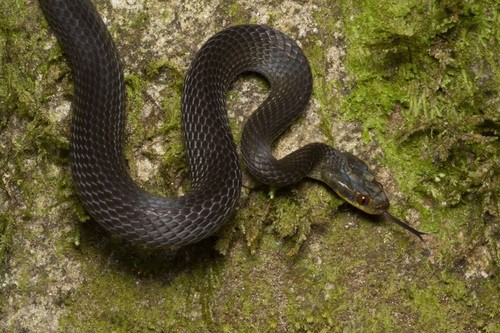
Maximum length: 63cm.
A relative of the red-lipped snake which often appears in suburban South African gardens. Werner’s water snakes (Crotaphopeltis tornieri) inhabit a swathe of Tanzania, northeastern Zambia and extreme southern Kenya. This snake has bulging red eyes (with vertical pupils), but most of its body is a plain dark grey.
Werner’s water snakes measure 30-50cm and inhabit moist forests and their edges. They lurk under cover objects like logs, rotting leaves and forest debris whenever possible. They even invade insect tunnels, and seem to lay eggs communally. Individuals lay 10-12 eggs, but a clump of 78 Werner’s watersnake eggs was once found together, with 3 females nearby.
This species is the opposite of the Usambara vine snake; instead of 37-40% of its body, its tail is stumpy and short, at 10% of its body. That’s because this snake mainly sticks to the ground (long tails are commonly for support on branches).
The largest female Werner’s water snake measured 58cm, and the largest male 63cm. Hatchlings are a mere 13cm. While apparently dull, this snake gains an iridescent sheen immediately after shedding its skin.