
| 1 | Central America’s main branch viper |
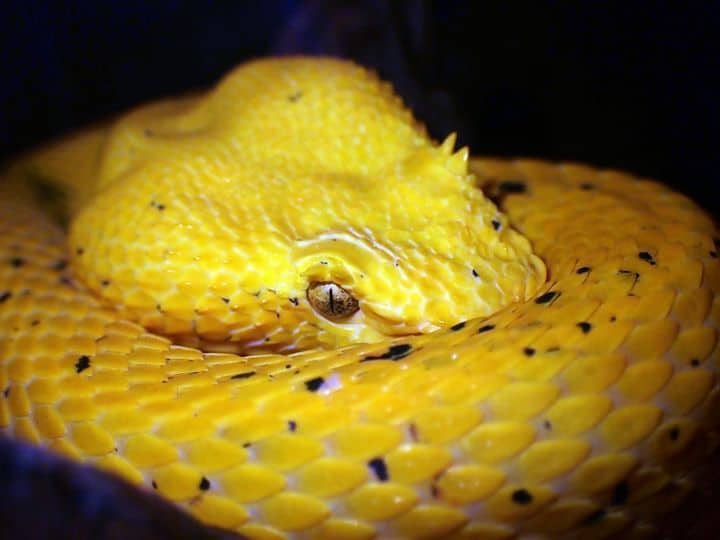
The eyelash viper (Bothriechis nigroadspersus) is a venomous pitviper found in Central America, which is mainly found in forests, and reaches a maximum length of 91.6cm. Unlike the fer-de-lance or most coral snakes, it’s mainly a branch-dwelling pitviper, which spends the vast majority of its day clinging to tree limbs 1-3 metres high, lunging aggressively at anyone who strays too close.
Central America is absolutely bursting with pitvipers, but the eyelash viper is easily one of the most widespread of all. This species appears in 6/7 Central American nations: Panama, Costa Rica, Nicaragua, Belize, Honduras and Guatemala, with the sole exception of El Salvador. It also appears in southern Mexico, and possibly western Colombia.
Not only are eyelash vipers widespread, but they’re extremely abundant too. Sightings of this species are constant in Costa Rica, whether on a leafy bush or the branches of a cocoa tree. In fact, this is the second most widespread venomous snake nationwide, behind only the infamous fer-de-lance.
The one rule of this species is that it tends to stick to low altitudes, usually below 1000 metres above sea level. In more mountainous areas of Costa Rica and Panama, its cousins such as the side-striped palm pitviper (Bothriechis lateralis) take over. However, eyelash vipers are even able to appear in manmade villages occasionally, as long as there’s plenty of forest and thick bushes nearby.
| 2 | A viper of many colours |
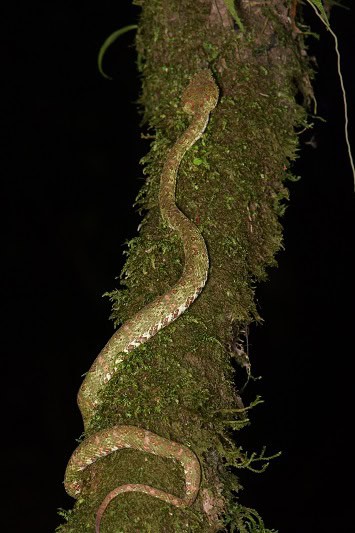
Eyelash vipers are dangerously venomous, with the ability to inflict painful swelling and necrotic patches of skin, but aren’t as lethal as the nearby fer-de-lance found on the ground. Instead, this pitviper’s most notable feature is the colossal variety of colours it possesses.
The eyelash viper might be not just the most variable viper, but the most variable snake in the whole of Central America. Without the slightest bit of captive breeding, this viper naturally has all the colours of a candy store.
The three most common varieties are banana yellow, mossy green, and brick red, but there’s also white and pink. One of the more memorable varieties has been dubbed “Christmas” – green with festive red stripes interspersed with occasional white scales. Emerald tree boas might have variety in the precise shade of green, or the number of white stripes, but eyelash vipers are on a whole other level of variation.
These colours don’t just appear at random either. They have a close correlation with the environments in which eyelash vipers appear. Yellow individuals tend to pop up in banana fields, while brick red ones are more common next to towering bromeliad plants.
That said, the colour of an eyelash viper is very difficult to predict. With other snakes, the varying colours are normally found in a certain region, e.g. Sicily and its tendency to have blue grass snakes. Eyelash vipers obey no such rules – it’s possible for 3 snakes within the same 5 miles to be wildly different colours. Even hatchlings from the same litter can be completely different colours.
| 3 | Jagged scales to touch |
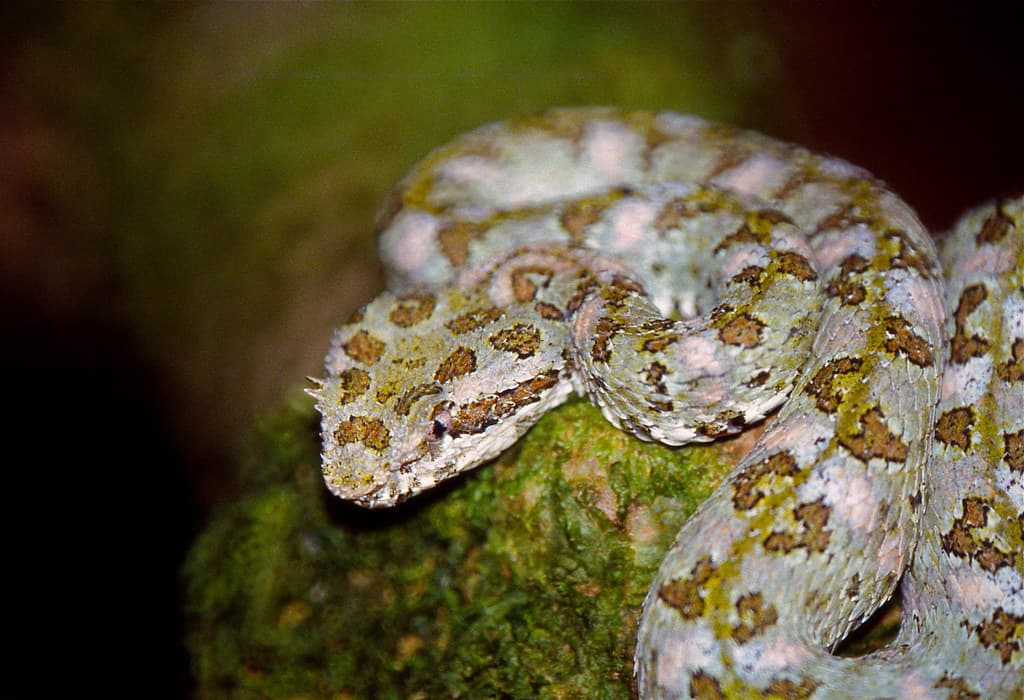
Running your hand along an eyelash viper’s body isn’t a particularly pleasant experience. Rather than slotting in neatly, its scales are keeled, and overlap on the edges to create an extremely rough texture like a pineapple. The reason is this species’ tree-dwelling nature. Eyelash vipers live in the jungles of Panama, Colombia and Costa Rica, and rough scales allow them to dig into the branches which they hang from, like bristly velcro digging into a shoe.
The nearby fer-de-lance (Bothrops asper) is completely different, with smooth scales instead. Eyelash vipers are also known for their bulky, triangular heads, which grow massively larger than their necks.
Their heads also look particularly huge considering their small body length. Males average at 37-69cm, while females are slightly larger at 35-82cm. Their fangs are much larger than average, and like most vipers, they can fold neatly into the mouth when not being used. Their pupils fall into the freaky vertical category, rather than the deceptively cute, black and round family.
| 4 | Eyelash facts |
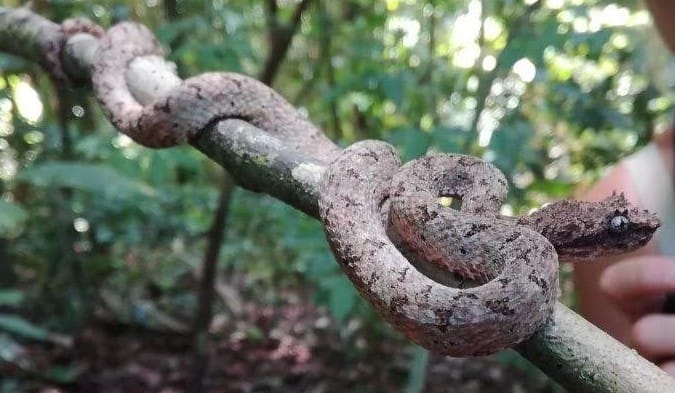
Many people feel wronged when they first see this snake, as it doesn’t literally have eyelashes which it bats seductively at you. But the eyelash viper does have a ridge of hardened scales above each eye which closely resemble eyelashes, a feature which is found in few other species. These scales number just two or three above each eye, but stick out sharply like spikes.
Nobody is sure why these eyelashes exist, but one theory is that they warp the species’ silhouette against the horizon, offering it camouflage against predators. Alternatively, they could protect the eyelash viper’s eyes as it moves through foliage, by sticking out further and brushing obstacles aside.
These “eyelashes” have created some funny myths in local villages as well. One legend is that after viciously striking and biting a victim, this species will wink at them, flashing its thick eyelashes. The truth is that snakes don’t even have eyelids, and that winking is physically impossible for them.
| 5 | Common in banana plantations |
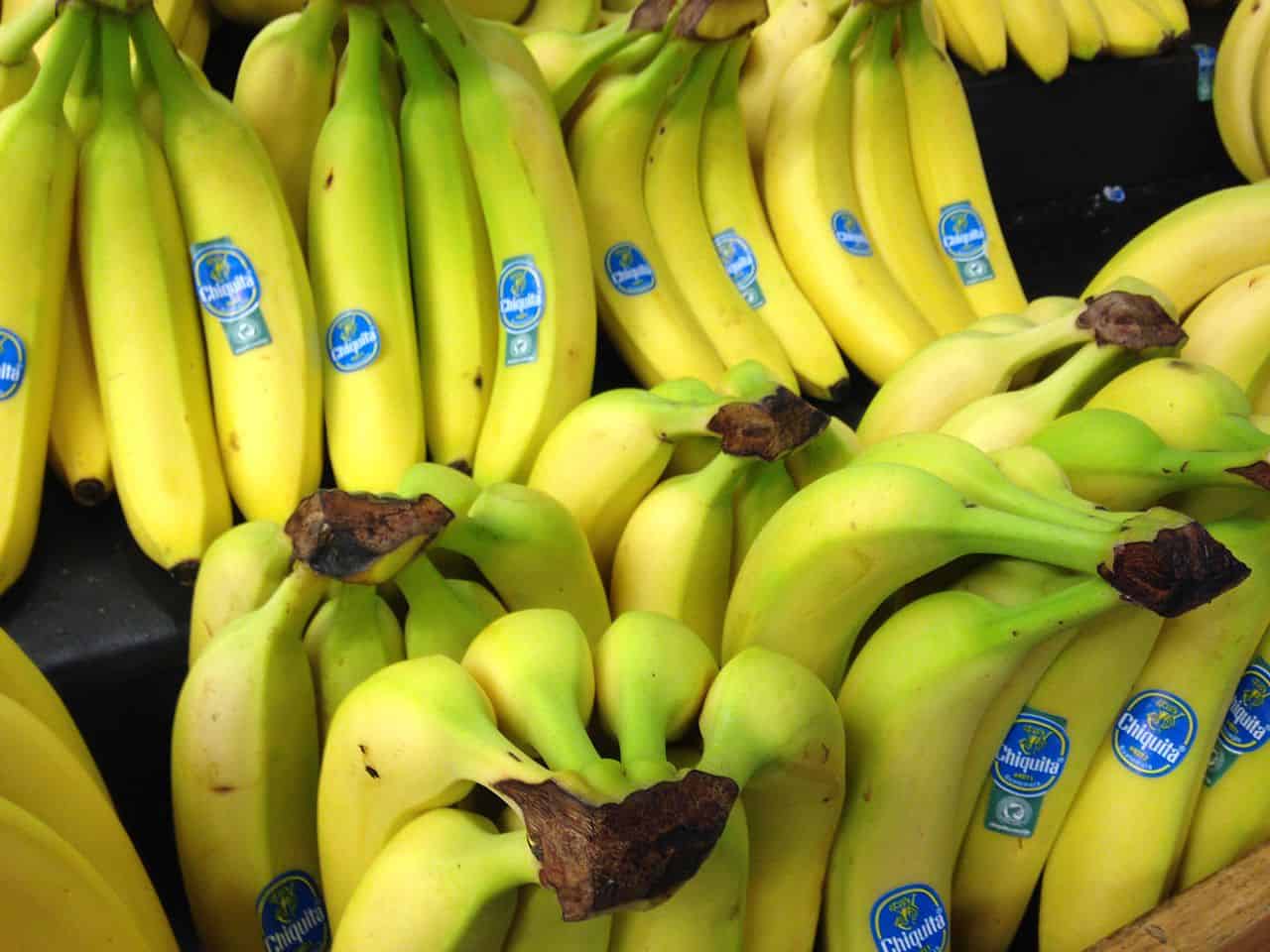
Eyelash vipers are notorious for hanging out in crop fields, particularly near cacao trees or banana plantations. Coffee fields are another classic hideout, where they cling to the branches in shadow. Legendary snake expert Raymond Ditmars warned explorers to stay away from heavily bushed areas of Costa Rica in case of meeting this snake, and in coastal Ecuador, up to 10.3% of total snakebites come from eyelash vipers, many of whom are farmers.
The weird consequence is that decades ago, eyelash vipers were commonly shipped off to Western countries by accident in boxes of fruit. Many a grocery seller in America has opened a wooden crate to find an eyelash viper’s vertical pupils staring back at them.
In the 1950s, a New York man was bitten by an eyelash viper hiding in a banana shipment, and in Indianapolis, one wholesale fruit dealer used to visit the medical school regularly with exotic animals taken from crates, including an eyelash viper. Nowadays, heavy bombardment by pesticides makes it harder for small stowaways to survive.
| 6 | Eaten by spiders |
Eyelash vipers are one of several snake species confirmed to be hunted by spiders, sometimes about 5% of their own size. The nemesis in question here is the golden silk orb weaver, also known as the banana spider, which occupies a huge range from the southernmost reaches of the US to northern Argentina.
This spider appears in forests and shrubland, and its web is particularly strong, with each thread matching a Kevlar bulletproof vest. Its venom is almost harmless in humans, and it rarely acts aggressively. But with snakes, it’s a different story. These images shows a 40cm eyelash viper caught in the web of a golden silk orb weaver in Tortuguero, Costa Rica, on a night time trail.
A hunted snake’s first mistake is slithering into a web, normally designed to catch grasshoppers, but still sticky enough for an eyelash viper. The watchful spider will then bite the eyelash viper, and the venom remains weak: it can sometimes take a snake 1 hour to die from golden silk orb weaver venom. Once dead, the spider will spew digestive enzymes over a section of the snake’s body, breaking it down into a more easily swallowable mush.
| 7 | Active by day and night |
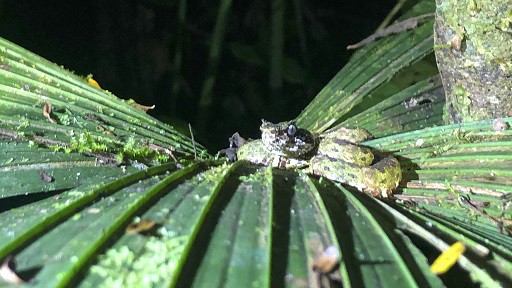
In most wildlife books, the eyelash viper has the word “nocturnal” jotted down next to it. But the fact is that this snake is alert and aware at all times of the day. Daytime is simply when the eyelash viper uses stationary ambush tactics, clinging to a branch and staying as still as a statue, similarly to an emerald tree boa.
Scientists in Panama found that across 111 encounters with eyelash vipers during the day, they were only moving 3 times. Yet when they released a frog onto the nearby branches, the seemingly catatonic snake activated and lunged for the frog 81.25% of the time.
At night, the eyelash vipers became more active and sought out new branches to ambush from. 68% of 50 eyelash vipers encountered were found on a different perch the next day, and only 10% remained on the same perch for over 2 days.
There are no hard rules though: one eyelash viper was spotted 14 times on the exact same perch over 22 days. Eyelash vipers also have a long term memory, returning to a branch from a year ago in time for the new season of migrating birds. Compared to emerald tree boas, which stay stuck on branches for weeks, eyelash vipers generally move around much more.
| 8 | Diet: a super-flexible viper |
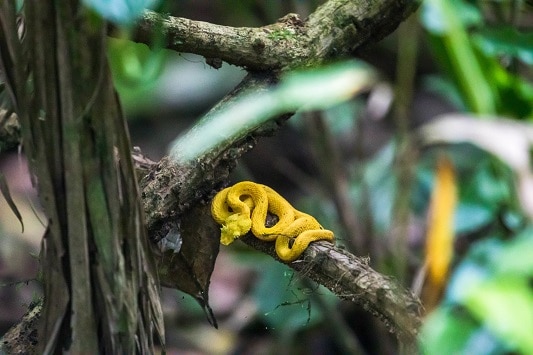
Eyelash vipers have a massively varied diet, so varied that it makes them very difficult to defeat. From their perch on branches, they can eat lizards, rats, voles, frogs, and birds with no dislike and with no digestive problems. They’re particularly known to grab hovering hummingbirds out of mid-air.
Such is their lack of fussiness that keeping them in captivity is extremely easy. Eyelash vipers are common in zoos worldwide, and will gobble down mice for years on end, both live mice and defrosted hairless pinkie mice.
In the wild as well, their diet makes them a very sturdy species. In frogs, there’s a notorious fungal disease called chytrid which causes peeling, pale skin, sluggishness and ultimately death. By the early 1990s, the disease had hit Costa Rica, and in 1997, scientists camped out in Panama where they monitored the local snakes.
The disease finally struck in 2004, wiping out 75% of the frog population, leaving scores of dead frogs littering the countryside. Both the northern cat-eyed snake and elegant litter snake fell in close parallel with the frogs, as did the Argus goo-eater, a rare snake which eats gooey frog spawn. But the eyelash viper was a rare snake to take the hit and actually become more numerous. Essentially, by not following a narrow diet, the eyelash viper isn’t putting all its eggs in one basket.
| 9 | Can’t cope with bats |
Occasionally though, the eyelash viper meets its match – Central American bats. Eyelash vipers are more than capable of eating them, but the road forward is beset with obstacles.
In 2015, a tourist exploring a national park in Costa Rica came across an eyelash viper on a mossy branch, 2 metres above ground. The viper was lemon yellow, and in its grip was an unidentified species of bat, angled headfirst towards the snake’s mouth.
The fascinated tourist took a picture, and when she returned to the same spot three hours later, the bat and snake were still there, alive, but in exactly the same position. Apparently, the eyelash viper got more than it bargained for, and a tale from December 2020 went even more awry. An eyelash viper, this time hanging from a banana tree in Costa Rica, tried to bite and envenomate a Thomas’s flying fruit bat, looking for a meal.
The problem was that its bite landed on the lower inner jaw, which allowed the imperilled bat to bite down with full strength. After struggling for 15 minutes on the ground, both bat and snake died in each other’s embrace, the bat from venom, and the snake from a savaged trachea.
| 10 | Survivable venom (usually) |
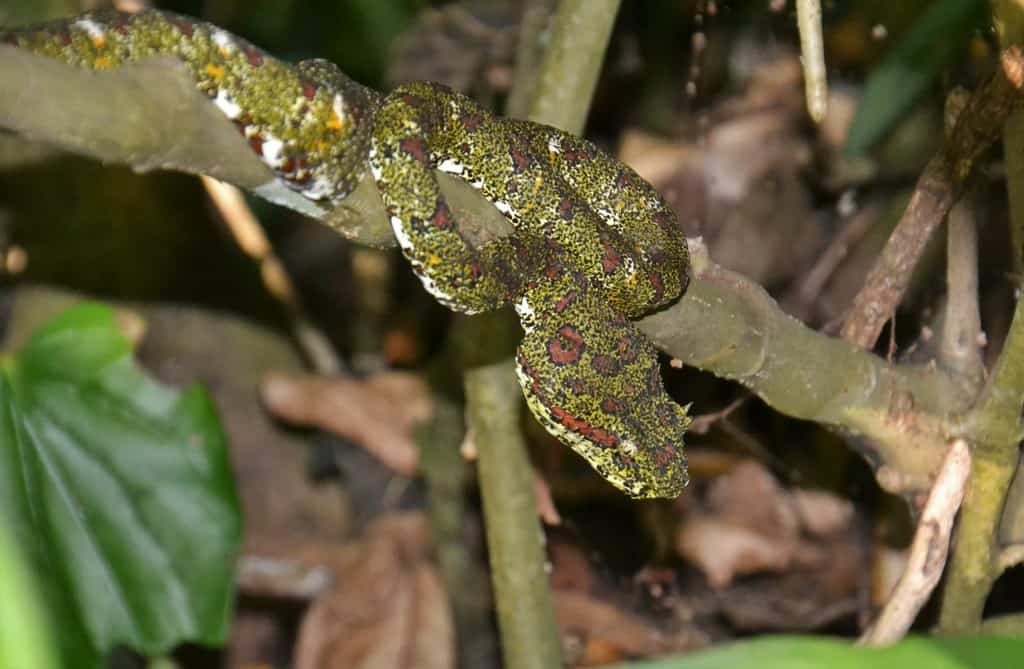
A bite from an eyelash viper is more serious than a scratch, but it’s far from a death sentence. Compared to a cottonmouth, it has slightly more potent venom drop for drop, at an LD50 value of 1.6mg (versus 2.04mg). But its venom yield is far lower, at 10-20mg versus 80-170mg for the most generous cottonmouths.
A Colombian study revealed the average consequence of a bite. Case study 1 followed a 55 year old coffee farmer as he was bitten on the hand while harvesting. 2 hours later, a 2cm thick swollen zone (edema) appeared on the right hand, alongside tingling (paraesthesia) and moderate pain. There was no bleeding at the bite zone, and the bite marks were invisible.
Case 2 was significantly worse, but still not fatal, involving yet another agricultural worker who was bitten on the third finger. He developed paraesthesia, a 1cm edema, vomiting, and a cold sweat. When doctors noticed that his blood was failing to clot, they pumped him with two extra doses of antivenom. By 48 hours post bite, the man was healed.
| 11 | Swelling and spontaneous bleeding |
Eyelash viper venom has few neurotoxins, but specialises in blood chaos. It’s rich in phospholipase A2 and metalloproteinases, and causes red blood cells to haemorrhage and clotting to fail. The rare deaths that happen are caused by internal bleeding and kidney failure.
The first farmer might have been saved by the small size of the snake, just 25cm long. The locations were very mismatched, as the first farmer had swelling on his right hand but also his left forearm. The second victim had a swollen right hand but also a swollen left shoulder. Somehow the venom seems able to jump whole body regions.
A bite isn’t massively likely anyway, as this snake has a non-aggressive temperament. Among its nicknames in Central America, there are few references to savagery: colgadora (hanger), papagayo (parrot), Cabeza de candado (padlock head), and “false gold” (from early Western explorers) are just a few.
Eyelash vipers aren’t twitchy and nervous like the Mozambique spitting cobra, but if pushed and pressured, they are liable to explode in a lightning fast strike. Eyelash vipers have a decent jump range, and can be extremely quick. Gaping their mouths wide is their main defensive posture.