| 1 | Saharan horned viper |
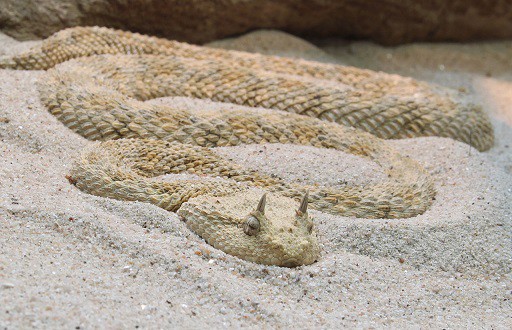
Maximum length: 85cm.
Location: North Africa.
Perhaps the most sand-adapted snake on Planet Earth. The Saharan horned viper (Cerastes cerastes) looks like it spawned from the very sands themselves, rather than gradually evolving from other vipers. Rather than a living snake, it looks like a sand sculpture which would crumble into thousands of individual particles the moment you touched it.
The Saharan horned viper is officially the most widespread snake in the Sahara Desert, appearing on majestic sand dunes and in arid semi-deserts alike. It inhabits at least 10 countries, including far northern states like Egypt and Libya, but also the upper, more deserted halves of Chad, Mali, Niger and Sudan.
To survive in such parched environments, the Saharan horned viper has evolved a variety of intelligent skills. This snake is a master of burrowing, diving below to bury itself all the way up to the eyeballs. This species is so fond of hiding in sand that it even mates while buried below. Many North Africans have been exploring deserts before and been shocked to see a pair of vicious viper eyes glaring at them from a sand dune.
Saharan horned vipers are able to store drops of morning dew on their scales, which they later drink. They’re famous for their horns, which aren’t fully understood, but are believed to mimic worms and act as tempters for prey, which are later ambushed.
This desert species also inspired the Greek legend of Cerastes, a colossal desert serpent which leapt from sand dune tunnels and swallowed any travellers who dared to approach. Cerastes was supposedly horrifically flexible, and had the horns of a ram. Today, this legend has evolved into the colossal sandworms of science fiction.
| 2 | Western patch-nosed snake |
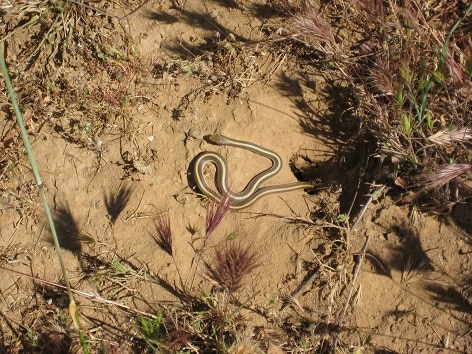
Maximum length: 107.5cm.
Location: northern Mexico, southern US deserts.
This desert snake is right at home in the kind of parched, minimally vegetated desert which every cowboy/outlaw has ridden across on the big screen. The western patch-nosed snake (Salvadora hexalepis) is a completely harmless species which inhabits 4 US states: California, Arizona, Nevada, and southwestern Utah.
This species is a desert snake through and through, and its colour scheme is finely tuned for this lifestyle, with beige to mimic sand, and dusty grey to match loose rocks. Western patch-nosed snakes average at 65-90cm, with the oldest and toughest exceeding 1 metre.
One of this snake’s special features is a massively enlarged scale above its snout, which is free at the edges. This is theorised to be for digging in the soft desert sands, but possibly for scooping up buried lizard eggs. The western patch-nosed snake eats whatever creatures dare to live in the harsh desert alongside it. That includes not just reptiles, but their egg stashes, and fellow snakes.
Patch-nosed snakes use neither venom nor constriction – they wrap around body lengths simply to hold prey, and then swallow. This species withstands the onslaught of the sun by moving at a particularly fast pace, lowering contact with the burning desert sands. While usually diurnal, this species becomes nocturnal during the hottest parts of summer.
| 3 | Sidewinder rattlesnake |
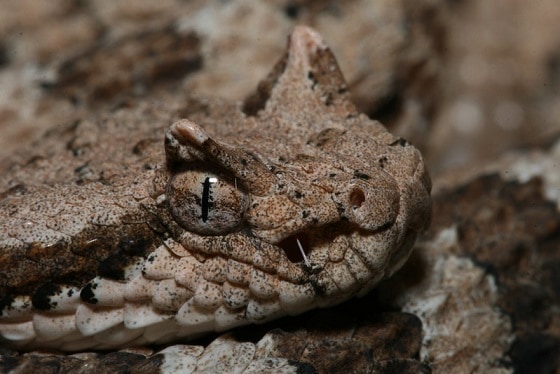
Maximum length: 82.4cm.
Location: California, Arizona, Utah, Nevada, northwest Mexico.
Out of over 40 rattlesnake species in the Americas, the sidewinder rattlesnake is the only exclusive desert dweller. Why its ancestors decided to enter the desert in the first place is a mystery. Maybe mountain lions were trying to eat them, or maybe coachwhips and ratsnakes were outcompeting them for food.
Regardless of why, the sidewinder rattlesnake (Crotalus cerastes) is now the master of its desert domain, even residing in Death Valley, the hottest place on Earth. It’s famous for occupying the Mesquite Sand Dunes, the largest dunes in the USA.
Sidewinders are named for their sideways mechanism of motion, which is designed to minimise contact with the burning sands. They lead with their belly, but the head and tail do all the work, touching the ground on only two very small points.
This movement is weirdly smooth in motion, as though they’re floating. Sidewinder rattlesnakes can move at incredible speeds, achieving up to 18mph on a sand dune. Their other desert adaptions include becoming nocturnal during summer, and fleshy horns which shield their eyes from sunlight. Their scales change colour in the sun, becoming lighter during summer for improved camouflage.
Sidewinder rattlesnakes can be dangerous, with an LD50 toxicity rating of 2.6-5.5mg, but no deaths have been recorded, due to the remoteness of their oppressive desert domains.
| 4 | Namaqua dwarf adder |
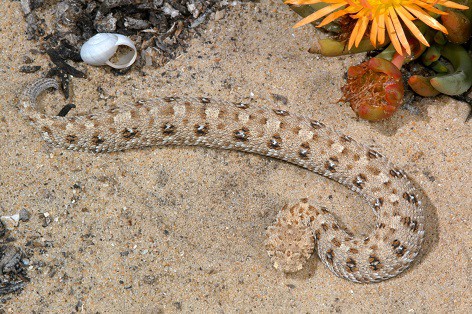
Maximum length: 27.6cm.
Location: Namibia, South Africa.
Possibly the world’s shortest viper, among nearly 250 species worldwide. This desert species ranges from 15 to 25cm as an adult, with an all-time record of just 27.6cm.
The Namaqua dwarf adder lives in the coastal Namib Desert of Namibia, a series of pristine yet harsh white dunes, and strays as far as 30km inland in the desert. Its main colour is beige in order to mesh with the endless sand, intermingled with small, yet complex brown patterns.
Combined with its small size, the Namaqua dwarf adder is nearly impossible to spot on the sand dunes of Namibia. The only chance to spot this species is when it moves, using the classic sidewinding style. The Namaqua dwarf adder is sometimes left off the list of sidewinding snakes worldwide, but the photos don’t lie.
Being in the centre of a bone dry desert, you probably won’t meet this snake, but its bite can produce swelling, intense pain, discoloration and oozing, according to one victim’s report from 1981 (he survived). Namaqua dwarf adders are shy, and default to flight before fight. If cornered, they initially try to intimidate their enemy using hissing and bluff strikes, before rapidly unleashing the real thing.
| 5 | Afro-Asian sand snake |
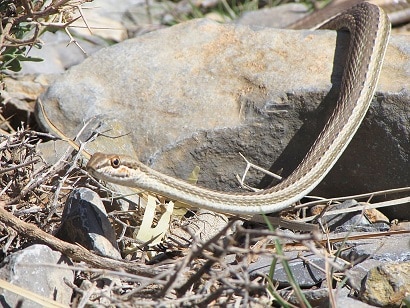
Maximum length: 148cm.
Location: central Asia, Middle East, North Africa.
Also known as the Schokari sand racer, this mildly venomous snake inhabits over a dozen countries. This snake isn’t strictly adapted to deserts like the Saharan horned viper, lacking adaptions such as sidewinding, but is tough enough to slither wherever it wants without a worry in the world.
The Afro-Asian sand snake (Psammophis schokari) is particularly known for its speed and agility. Its camouflage doesn’t match the horned viper either, but is more than sufficient to hide from lost trekkers. It’s an extremely thin desert snake, with focussed, orderly beige and brown stripes in parallel formation. Its face looks focussed as well, with large clear eyes.
Afro-Asian sand snakes range from Morocco in the far west to India in the far east. One desert-survival trick they’ve developed is a nasal secretion from their nose, which they rub along their entire body. This substance is rich in lipids, and is theorised to seal in water against the forces of evaporation, granting them immunity against the oppressive yellow sun. A study found that these rubbing sessions took 79 seconds from start to finish.
One desert zone they’re abundant in is India’s northern Rajasthan region, particularly the Thar Desert, which straddles the border of India and Pakistan. This is the world’s 20th largest desert, a land of sweeping white sand dunes and 50 degree temperatures.
| 6 | Péringuey’s adder |
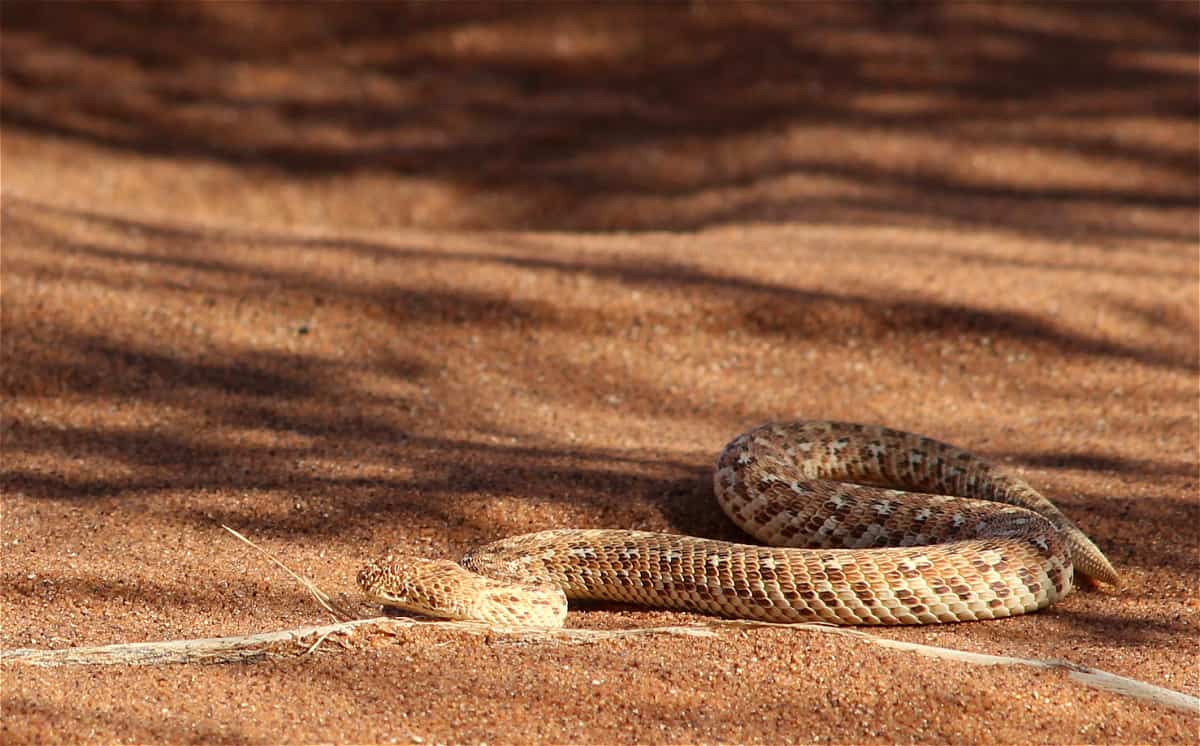
Maximum length: 32cm.
Location: Namibia, Angola.
Peringuey’s adder is a neighbour of the Namaqua dwarf adder, coexisting with them on their Namib Desert sand dunes. It’s another tiny viper at 18-28cm, occasionally reaching 32cm. At first glance, the two species look very similar, with sandy shades for blending in, and sharply keeled scales. However, Peringuey’s adder has beadier, more orange eyes, which are positioned high on its head in order to view the sky when buried in sand (like the Saharan horned viper).
Peringuey’s adder glides across the white sand dunes, only occasionally straying to harder soils below. It’s completely sequestered in the ecological niche it chose long ago, but has many nifty survival adaptions.
Firstly, Peringuey’s adders are able to drink water droplets collected on their scales, when fog moves in from the Atlantic Ocean and condenses. Secondly, they’re another sidewinding snake, almost floating above the sand using just their head and tail to propel them, minimising contact with the burning sand. They stick to sidewinding even when on harder, rockier soils – their desert lifestyle has caused them to forget other methods.
Peringuey’s adder has another secret way to acquire water as well. Rather than drinking, it just obtains a big proportion from the lizards it swallows. Barking geckos (Ptenopus genus) are its favourite prey species, along with rain frogs.
| 7 | Saw-scaled viper |
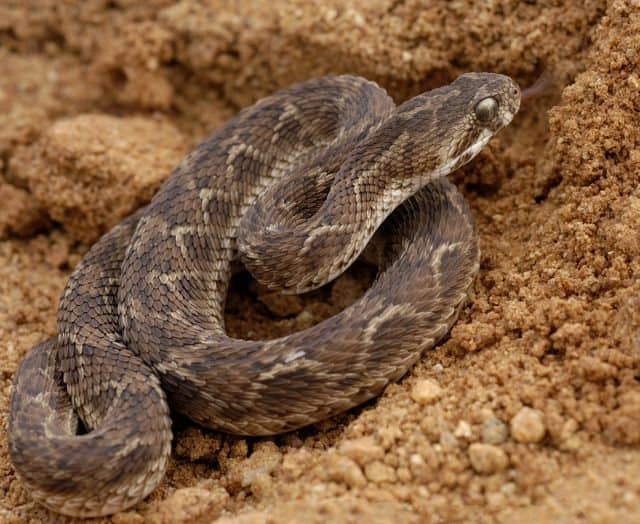
Maximum length: 50cm (80cm in certain locales).
Location: Indian subcontinent, central Asia, Middle East.
If you’re walking through the Thar Desert and hear weird raspy noises coming from a cactus, then you know your life is in danger. You’ve probably just met the saw-scaled viper, a small (usually 40cm) yet extremely dangerous snake, part of India’s “big 4” of annual snakebite inflictors.
Saw-scaled vipers have a huge range stretching from Bangladesh to Oman, and trigger such horrifying symptoms as uncontrollable bleeding and deep necrosis. They have the desert-surviving skill of sidewinding again, using a nearly identical method to the sidewinder rattlesnake 1000s of miles away, despite the two being far removed in evolution.
Saw-scaled vipers also survive the desert heat using their nocturnal nature. For shelter, they don’t burrow into sand, but seek out existing mammal burrows instead.
The saw-scaled viper is easily the deadliest desert snake of our list. Before striking, it creates a double coil in a figure of 8, allowing it to pounce like a spring. It produces only 15mg of venom per bite, but 9mg is more than sufficient to kill a human being. The wound begins swelling at just 3 minutes post-bite, and after an hour, the entire limb can be swollen.
Indian desert dwellers have some weird traditional remedies to combat these symptoms. They believe that in the desert landscape, the peacock is the saw-scaled viper’s mortal enemy. Hence, they wrap a tourniquet of peacock feathers (called a morpunki) around the bite wound, topped off with a mulch of neem leaves, and a helping of butter or ghee to expel the venom.
| 8 | Mojave shovelnose snake |
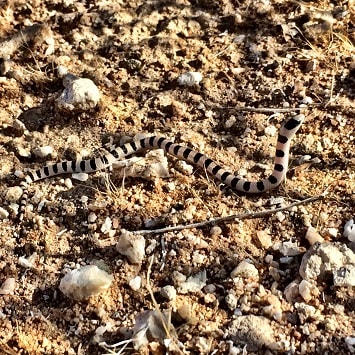
Maximum length: 39.6cm.
Location: Arizona, California, Nevada.
It must be fun for desert snakes. No matter how small and weak they are, they have their own undisputed kingdom which the boa constrictor and king cobra would wither and die in if they tried to invade, even if they teamed up.
The Mojave shovel-nosed snake (Sonora occipitalis) is one such example of the perfect niche occupier. This species is found in 3 southern US states, and is particularly common in the dry hills to the northeast of Los Angeles. It’s very small at 25-35cm, and has no venom, but somehow manages to survive in Death Valley, the hottest place on Earth.
Mojave shovel-nosed snakes are named for their deeply inset lower jaw, which frees up the top half for highly efficient burrowing, deep into underground soils where they can escape the sun. They also have a surprisingly muscular body, designed to “swim” through the sand.
Mojave shovel-nosed snakes can be found in lightly vegetated deserts, featuring creosote bushes, cacti, and mesquite. However, they’re naturally drawn to areas with sand, which allow their numerous desert skills to rise to the forefront. Sonora occipitalis has a more vibrant colour scheme than some desert snakes, with alternating black and cream bands plus the occasional orange splash, looking slightly like a gift shop souvenir.
| 9 | Sindh awl-headed snake |
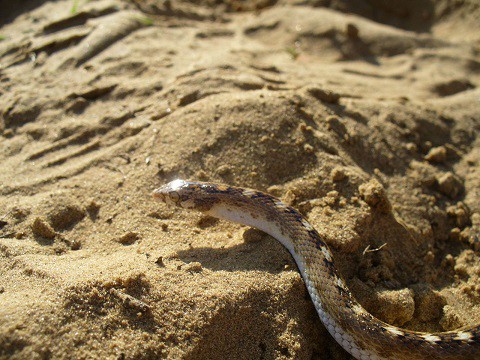
Maximum length: 36cm.
Location: India, Pakistan.
A mysterious sand serpent from the Thar Desert of India. The Sindh awl-headed snake (Lytorhynchus paradoxus) is a true desert snake, inhabiting dry and parched places exclusively. This species measures 36cm at most, and has an unusually shaped facial profile when you zoom in. Its tongue is light pink, but the rest is pure desert in snake form, just as Asian vine snakes seem to embody the jungle.
This desert snake has a mild venom at the worst, focusing on camouflage for its survival. Its colour scheme is sandy beige with occasional dark brown patterns, and a white underside. Even its irises are a sandy colour, surrounding a round black pupil. Nature has apparently concluded that this is the ultimate colour scheme for desert creatures (green wouldn’t do much good).
The awl-headed snake has the usual pointed snout for burrowing in soft sands, and it tends to burrow when alarmed by intruders, seeking a quick escape. Its diet consists of skinks and geckos, and not tourists whose cars have broken down.
Lytorhynchus paradoxus is a relatively unresearched desert snake. As recently as 2021, it was being found in new areas of Indian Rajasthan, and another 2021 study expanded its range in Pakistan.
| 10 | Desert sand boa |
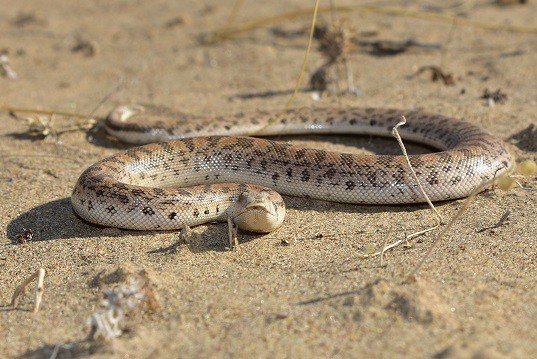
Maximum length: around 80cm.
Location: Iran, Central Asia.
A short yet relatively thick-bodied snake, which constricts its prey after grabbing them from soft sands. The desert sand boa (Eryx miliaris) is interesting for having a head and tail which are almost the same width. This is believed to be for confusing predators, as this species is heavily hunted by birds, including the long-legged buzzard, to which it contributes up to 18% of calories.
Desert sand boas are most common in sandy areas of semi-deserts. They sometimes inhabit harder, rockier places, but any place where they can effortlessly burrow is their ultimate home.
This species regularly dives in and out of sand in order to lurk in ambush, much like other Eryx sand boa species. Zoom in and you can witness its special desert adaptions, including eyes orientated slightly upwards, to create superior vision with only its head popping out.
The desert sand boa is non-aggressive, and rarely tries to bite humans, but can launch from soft desert sands like an arrow being shot if potential prey is walking past. Its range is huge, and in the western reaches of Kalmykia and Cechynya, there’s a subspecies called Eryx miliaris nogaiorum which is far blacker than normal.
Overall, desert sand boas are most common in the various ex-Soviet “stans”, such as Kazakhstan, Turkmenistan and Uzbekistan, as well as Iran.