
| 1 | The Andes mountain pitviper |
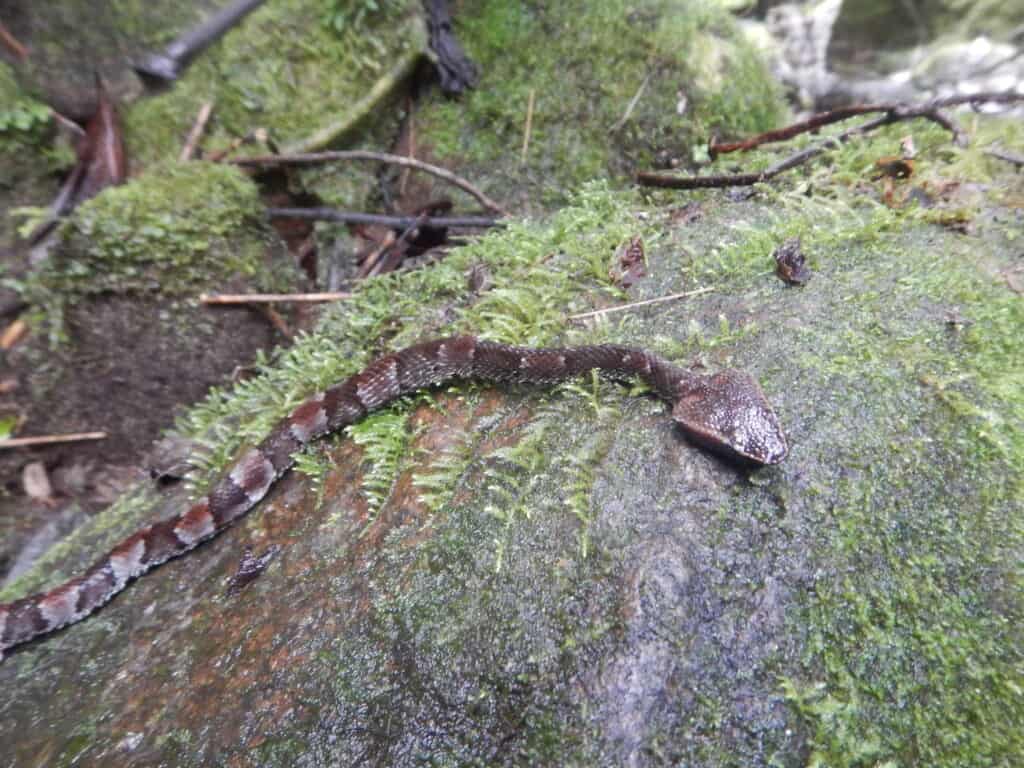
The entire lowland rainforests of the Amazon are crawling with one pitviper or another. There’s the common lancehead on the forest floor, green jararaca clinging to branches, and even the South American bushmaster lurking in dark mammal burrows. But even if you look up at the Andes mountains and decide to take refuge at higher altitudes, you’re still not safe, for these areas are home to their own species: the small-eyed toad-headed pitviper (Bothrocophias microphthalmus).
This is a medium length species, which is mainly found in two countries, Ecuador and Peru. Bothrocophias microphthalmus reaches a confirmed record (so far) of 132cm, and has a medium width body. One recognisable sign is an extremely triangular head, even compared to most other pitvipers. Its colours are fairly dull, with alternating shades of grey and brown, which blend perfectly with the moist forests they call home, particularly in areas of rain-soaked mossy boulders.
Small-eyed toad-headed pitvipers cover a much smaller area than the common lancehead, which covers virtually the entire northern half of South America. They mainly appear at over 1000 metres, in thickly forested mountain slopes. Nevertheless, this is a potentially aggressive species which you should never underestimate.
| 2 | Part of an offshoot viper clan |
The small-eyed toad-headed pitviper belongs to the Bothrocophias genus, which has 9 members, and is an offshoot of the much larger Bothrops pitviper genus containing the common lancehead. The most widespread member is probably the Amazon toad-headed pitviper (Bothrocophias hyoprora), but the small-eyed form ranks in second.
These two are mostly divided in territory, as a study found that Amazon toad-headed pitvipers appear at elevations of 0-1000 metres, also in forests, while the small-eyed toad-headed pitviper mainly appears at 1000-2350 metres. Nevertheless, there’s believed to be small areas of overlap between the two in Morona Santiago province, southeast Ecuador, at altitudes of around 410-600 metres. The Amazon toad-headed pitviper generally has a lighter, more orange colour as well.
Other members include Campbell’s toad-headed pitviper, found in western Ecuador, but the small-eyed toad-headed pitviper lives exclusively to the east of the Andes, and therefore has no overlap with this species.
Other recognisable signs of Bothrocophias microphthalmus include an upturned snout, and thick bands with a triangular or trapezoid shape. There’s also the usual vertical pupils, and like many Bothrops or Bothrocophias members, each blotch has a lighter brown inside, with a dark, near black outline.
| 3 | Plentiful in eastern Ecuador |
Small-eyed toad-headed pitvipers aren’t close to endangered, mainly because they inhabit some of the largest swathes of pristine, untouched forests in South America. The eastern slopes of the Andes in Ecuador and Peru remain a pristine oasis of funky life forms to this day. You can barely move without bumping into a golden arrow frog, snail-eating tree snake, or indeed a cunning pitviper.
Small-eyed toad-headed pitvipers live in forested realms which have barely changed for millions of years. They can also appear in cassava plantations, and within forests, they’re most likely to appear close to streams or small rivers. They sometimes move to more open areas in order to bask in the sunlight as well.
This species is an ambush predator, which waits patiently on the forest floor for hours at a time, often coiled up in herbaceous vegetation or thick root beds. Small-eyed toad-headed pitvipers occasionally climb branches up to 3 metres above ground, but generally stick to the ground. Their camouflage is optimised for the forest floor rather than branches, as this species lacks a single scale of green on its body.
| 4 | A terror in certain areas |
Nationally in Ecuador and Peru, this species contributes only a modest number of snakebites, due to its preference for higher altitudes. But in certain mountainous regions, that all changes.
A 2025 study gathered snakebite data from a hospital in Morona Santiago province, southeastern Ecuador. 66 snakebites were analysed, and of those, the small-eyed toad-headed pitviper contributed 41 (62.12%).
In second was the common lancehead (Bothrops atrox), at 9 bites, or 13.64%. This species normally dominates Amazonian snakebite statistics, contributing up to 80% in certain regions, such as northwest Brazil. But on slopes of the Andes at over 1000 metres, the story changes – common lanceheads are still around, as they’re probably the most flexible pitviper in South America, but the thinner air allows their toad-headed cousin to come to the forefront.
Also included in the study were 14 non-identified snakes, 1 non-venomous rainbow boa, and 1 speckled pitviper (Bothrops taneitus), which is the most tree-dwelling of the three.
The symptom story was more positive, as 59.09% of cases were mild, and 71.21% lacked any complications. Although these symptoms weren’t broken down by species, the toad-headed pitviper made up such a large share of total bites that it still gives us a strong indication.
| 5 | Specialises in blood chaos |
Before 2000, barely anything was known about the small-eyed toad-headed pitviper’s venom, but more and more studies are beginning to appear. In 2025, a study compared several pitvipers found in Ecuador, also including Campbell’s toad-headed pitviper (Bothrocophias campbelli) found in the west, and the desert lancehead (Bothrops pictus) and Lojan’s lancehead (Bothrops lojanus), both found in the south.
All of these species had a strong effect on blood clotting, but the nature was different. The two Bothrops species were powerfully anticoagulant, cleaving through clotting materials directly. However, the two toad-headed pitvipers (Bothrocophias) were the opposite: they were powerfully procoagulant.
The small-eyed toad-headed pitviper activated factor X and factor VII, in turn activating prothrombin, which converts to thrombin, which itself converts raw fibrinogen to fibrin strands. This led to multiple clots forming in the bloodstream.
Prothrombin is one of the key players in healthily clotting blood, but Bothrocophias microphthalmus venom rapidly accelerated its conversion to thrombin, not just forming clots, but depleting the supplies available for healthy blood clotting. The result could be a tiny cut spewing copious amounts of blood, from a paper cut to a grazed knee. This is termed “consumption coagulopathy” – essentially when clotting elements are far too rapidly consumed.
| 6 | Possibly deadlier further south |
The study also revealed a strange fact: regional differences in the venom potency of the small-eyed toad-headed pitviper. The samples from Ecuador came from two locations: Pastaza in eastern central Ecuador, and Zamora Chinchipe in the far south (both to the east of the Andes mountains).
While both venoms were strongly procoagulant, there were more subtle, yet significant differences. Factor X is one of the enzymes which closely controls prothrombin’s conversion into the thrombin enzyme, whether in a snakebite victim or healthily clotting blood. The small-eyed toad-headed pitvipers from Zamora Chinchipe caused a strong increase in factor X (a 38% increase), but those from Pastaza had no effect.
Factor VII is another enzyme closely involved in the clotting process. Again, those from Zamora Chinchipe caused a strong increase (66.65%), while those from Pastaza caused a tiny increase (1.76%).
As you’d expect, the colonies from Pastaza had a far slower prothrombin clotting time overall. Of the 3 Bothrocophias pitviper colonies tested, the small-eyed toad-headed pitvipers from Zamora Cinchipe (far southern Ecuador) triggered blood clotting most rapidly, with Campbell’s toad-headed pitviper (western Ecuador) just a hair behind. The Pastaza small-eyed colonies were well behind both in potency.
| 7 | Unanswered questions |
All this means that the exact potency of this species may vary strongly depending on where you’re bitten. In the far south, they could be deadlier, and dangerous but more survivable in the central east. The hospital study from earlier tested Morona Santiago province, which lies approximately between the two states above, and found relatively mild results.
We also have a 2016 study (in Spanish), which tested 5 small-eyed toad-headed pitvipers, again in Morona Santiago province. This found the species to be significantly less potent than the South American bushmaster, the longest viper in the world (up to 3.65 metres), and the fer-de-lance, which causes the most bites in many regions of Colombia. Its venom was also less potent than its Ecuadorian relative, Campbell’s toad-headed pitviper (Bothrocophias campbelli).
But then there’s these quotes from the book Venomous Reptiles of the Western Hemisphere. According to the authors Campbell and Lamar, the small-eyed toad-headed pitviper “appears to have especially toxic venom, and necrosis and amputation are reported to be more common in areas inhabited by this snake in Ecuador”. They stated that the species was more toxic than its lowland relative the Amazon toad-headed pitviper.
| 8 | No cure (sort of) |
The small-eyed toad-headed pitviper has no antivenom, or at least, no dedicated antivenom. There’s no specific mixture of antibodies generated against its own venom when injected into horses, as with the fer-de-lance. Instead, doctors use one of two widely available commercial antivenoms, and these were both tested in the study from earlier. The two antivenoms were…
SAB – Brazil’s most common used antivenom. Raised against 5 Bothrops pitvipers. The mixture includes antibodies raised against venoms of the following species: jararaca (50% of the mixture), jararacussu (12.5%), Neuwied’s pitviper (12.5%), Brazilian lancehead (12.5%), and crossed pitviper (12.5%). All of these are found in southern Brazil, well away from Ecuador and Peru.
PoliVal-ICP – a central American antivenom. This contains antibodies raised against three species: the Central American rattlesnake, Central American bushmaster, and fer-de-lance. Again, none of these coexist with the small-eyed toad-headed pitviper.
Neither of these antivenoms contained a member of the Bothrocophias genus that the small-eyed toad-headed pitviper belongs to. It was anyone’s guess as to which would work, and the victor turned out to be PoliVal-ICP. The Central American antivenom neutralised both populations of the B. microphthalmus more effectively than the Brazilian standard, SAB, although this was still decently effective.
For Campbell’s toad-headed pitviper in western Ecuador, the opposite was true; SAB was more effective. This was despite it being even further away geographically.
Although it wasn’t miraculous, and didn’t fully deactivate the species’ toxins, PoliVal-ICP was potent enough against B. microphthalmus for scientists to be optimistic in recommending it to hospitals.
| 9 | Capable of killing |
Despite all this technical information, there’s one question that really matters: whether this snake has ever killed anyone. A small child is reported to have died in 6-7 hours, while a dog succumbed within 2 hours. The common lancehead kills its victims via kidney failure, and it’s likely that the small-eyed toad-headed pitviper does the same.
Nevertheless, deaths are relatively rare with this species. As you long as you hold your nerve and drive to hospital without entering a full blown panic attack, you’re likely to survive.
Testimonies from the rainforest suggest that this species is relatively placid, often not biting humans when 1 metre away. Small-eyed toad-headed pitvipers can attack if threatened, but they can also sink deeper into the forest floor and vibrate their tail against leaf litter, making a buzzing sound. They have predators of their own, including eagles, and sometimes don’t move a muscle, relying on their excellent camouflage.
That said, don’t get overconfident – this species can still attack without warning, lunging from its hidden leaf litter sanctuary.
| 10 | Eats a generalist diet |
Like all South American pitvipers, small-eyed toad-headed pitvipers lay live young, which arrive in relatively large clutches of up to 47. Newborns measure up to 20cm, and as usual, are venomous from day one.
Another difference of this species is preferring slightly lower temperatures, as you’d expect from living at high altitudes. A study found that small-eyed toad-headed pitvipers enjoyed a mean temperature of 21C, versus 25C for the lower altitude Amazon toad-headed pitviper.
Small-eyed toad-headed pitvipers appear to have a relatively flexible diet, enjoying multiple prey types, sometimes at once. For example, a juvenile B. microphthalmus was collected in Zamora Chinchipe province, southern Ecuador, in January 2017. It regurgitated two meals: a Gunther’s banded treefrog and brown dwarf gecko.
Rodents have also been found in this species’ stomach. A 2019 study examined 7 museum specimens of the small-eyed toad-headed pitviper. 6 had empty stomachs, but one contained two prey items: an Almendariz’s tree frog and a Basin tree frog.
| 11 | More diet facts |
This snake also possesses a skill which any human would be jealous of: snatching insects out of midair.
In a November 2015 survey, scientists were trudging around the eastern slopes of the Andes in Ecuador, when they came across an emaciated looking B. microphthalmus individual. It was stabbing at mid-air, at a large unidentified insect measuring 3-5cm. The snake itself measured 30cm. The snake contorted its neck as though swallowing, and the scientists believed it to have succeeded, although in conditions of low light (e.g. dense rainforest conditions), they weren’t completely sure.
This study observed 27 small-eyed toad-headed pitvipers overall, and of these, 13 were in ambush posture. This takes a similar form to other pitvipers: an immobile set of coils, with the snake’s head resting on the top, with the bulk of the body behind the head, allowing the pitviper to lunge forward at any point, from a statue-like position of immobility.
Of the 13 ambush posture snakes, 11 were found during the day, showing that this a diurnal hunter rather than nocturnal. However, they were decently flexible, as a few preyed at night as well.