
| 1 | Plains garter snake |
Maximum length: 109.3cm.
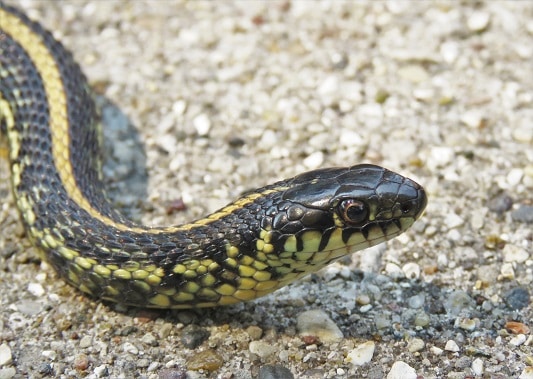
The most colourful of Canada’s 6 garter snakes, this species occupies not just a small territory near the border, but a large swathe of land stretching deep into Alberta, Manitoba and Saskatchewan. Plains garter snakes usually reach 90cm and have a black head, with a yellow chin that extends from a yellow belly.
The plains garter snake is a moisture-loving species. It’s a flexible snake, even appearing in urban areas within towns, such as vacant lots with scattered rubbish. Nevertheless, its favourite areas are easily grassy fields and plains directly adjacent to water bodies.
Plains garter snakes cannot cope with bone dry habitats, and are often spotted hunting along the overgrown edges of streams and ponds. Their diet consists of 85% frogs and toads, with two favourites being the wood frog and boreal chorus frog.
The signature way to identify this snake is an orange to yellow stripe running down the centre of its back. This contrasts vividly with the black on either side, and its flanks also have a yellow stripe apiece.
Plains garter snakes are one of Canada’s least endangered reptiles. Scientists have found that when living side by side with common garter snakes, plains garter snakes are superior at keeping a high body temperature.
| 2 | Eastern massasauga |
Maximum length: 100.3cm.
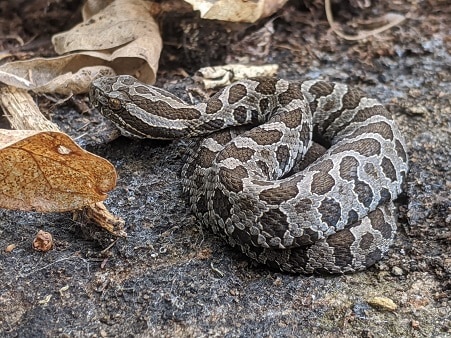
The only venomous snake eastern Canadians need to worry about. Canada has three rattlesnakes, but the prairie and Pacific rattlesnakes are found significantly further west. Meanwhile, the massasauga is found in populous Ontario, in the peninsular area bordered by Michigan and the Great Lakes.
Massasaugas measure only 60-75cm on average, and are easy to miss on a weekend stomp through the countryside. Their venom is mainly cytotoxic, attacking and dissolving skin cells. The venom is potent enough to partially digest mouse prey before even swallowing them.
That said, the massasauga has only killed two people in Ontario. Both were over 40 years ago, and neither received antivenom. The main risk is hiking through tightly vegetated areas with poor visibility. Massasaugas have no wish to harm human beings, but will quickly shift into an aggressive state if brushed past or stepped on.
For most of the year, massasaugas favour marshes, swamps, wet prairies and lakesides, but in the drier summer months, they move to grasslands adjacent to these water bodies. These habitats are gradually being destroyed, and the massasauga is now listed as threatened under Ontario’s Endangered Species Act.
| 3 | Common garter snake |
Maximum length: 137.2cm.
The most widespread snake in Canada, with the plains garter snake ranking in second. The common garter snake (Thamnophis sirtalis) can live just about anywhere as long as a water body is nearby, including forests, shrublands, fields and wetlands.
Things are confusing with this garter snake, as the amount of subspecies is endless. There’s the eastern, red-sided, valley garter snake and more, but while superficially different, these are still technically part of the common garter snake species. The plains garter snake and terrestrial garter snake, meanwhile, are separate species altogether.
This species has the lowest temperature tolerance of any North American snake, and there are even rumours of sightings in Alaska. Common garter snakes dig their dens below the frost line, and hibernate in communal burrows with dozens of fellow species members, in order to preserve warmth. The record den contained 8000 snakes. Likewise, males will dogpile females when mating, forming breeding balls of up to 100 snakes.
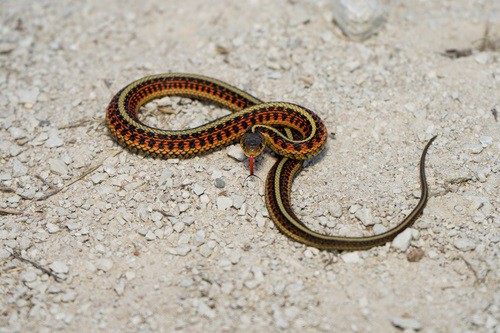
In Canada, the most common subspecies is the red-sided garter snake (Thamnophis sirtalis parietalis), which extends all the way to British Columbia. This is one of the most fabulously patterned subspecies, as the red stands out vividly against the black, and some even have electric blue stripes.
| 4 | Smooth green snake |
Maximum length: 79.7cm.
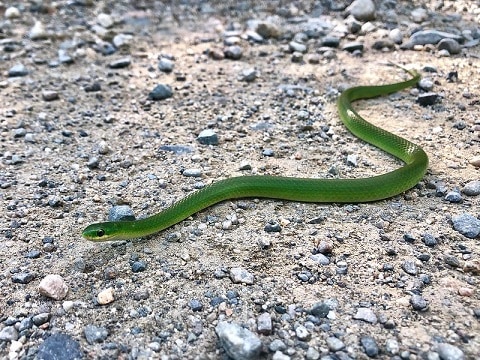
An extremely green snake, which lives in extremely green environments. Only someone with cyborg vision could spot this 30-60cm snake while resting in a field of overgrown grass.
Smooth green snakes have a decent range in Canada, occupying southern Ontario and Quebec. They favour not just grassy areas, but moist, herbaceous grassy areas with an overload of vegetation. They sometimes appear on the edges of marshes too. Their lookalike cousin is the rough green snake (Opheodrys aestivus), but this inhabits the southeastern US, whereas smooth green snakes (Opheodrys vernalis) live significantly further north – hence why they cross into Canada.
This snake has one of the most insect-rich diets, as one study discovered a menu of 37% caterpillars, 32% spiders, and 20% grasshoppers. Smooth green snakes are non-venomous, and incapable of hurting a human being even if picked up. This is a lazy snake which moves an average of 10 metres per day.
Smooth green snakes hardly ever climb trees, preferring to stick to the safety of overgrown grass. While widespread, they’re believed to be vulnerable to the march of agriculture. Insecticides are a grave danger, as they poison their main food supply. But hope remains, as in 2016, a survey was launched to rediscover them on Prince Edward Island in eastern Canada. Smooth green snakes were originally one of three native snakes there, alongside common garters and northern redbellies, but hadn’t been seen in 15 years. Thankfully, a rash of sightings came in from citizens, using an app called P.E.I. Nature Tracker.
| 5 | Sharp-tailed snake |
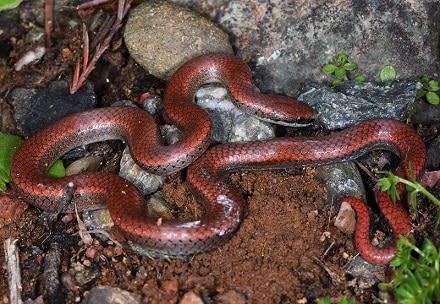
Maximum length: 48.3cm.
An ultra rare snake which lives solely in British Columbia. The sharp-tailed snake is non-venomous, and thin like a pencil. Its adult average is 30cm, with newborns measuring a miniscule 6-7cm. Its signature sharp tail is designed for hunting, allowing it to skewer slimy slugs like a kebab.
Sharp-tailed snakes are considered to be in mortal peril in Canada, but some believe that they’re more common than people realise. The crux is their shy personalities. Sharp-tailed snakes live on forest floors covered with mulch, debris and fallen leaves, where they burrow into underground chambers below and emerge to feed on slugs.
In Canada, they rely on one specific forest type: coastal Douglas-fir forests, ever more of which are being cut down. Many of the remaining patches are no more than 3km wide. One of their bases was Vancouver Island, but this heavily populated island now has only 0.5% of its original Douglas-fir forest cover remaining. The situation seemed grim.
In 2011 though, scientists were searching for rubber boas along a forested ridge near Pemberton, which had been targeted by builders for development. Instead, they came across 10 small sharp-tailed snakes. A new colony had been discovered, and this raised the question of how many more undiscovered colonies exist in southwest Canada. Compared to a rattlesnake, the sharp-tailed snake’s shy personality makes it very easy for them to go undetected.
| 6 | Prairie rattlesnake |
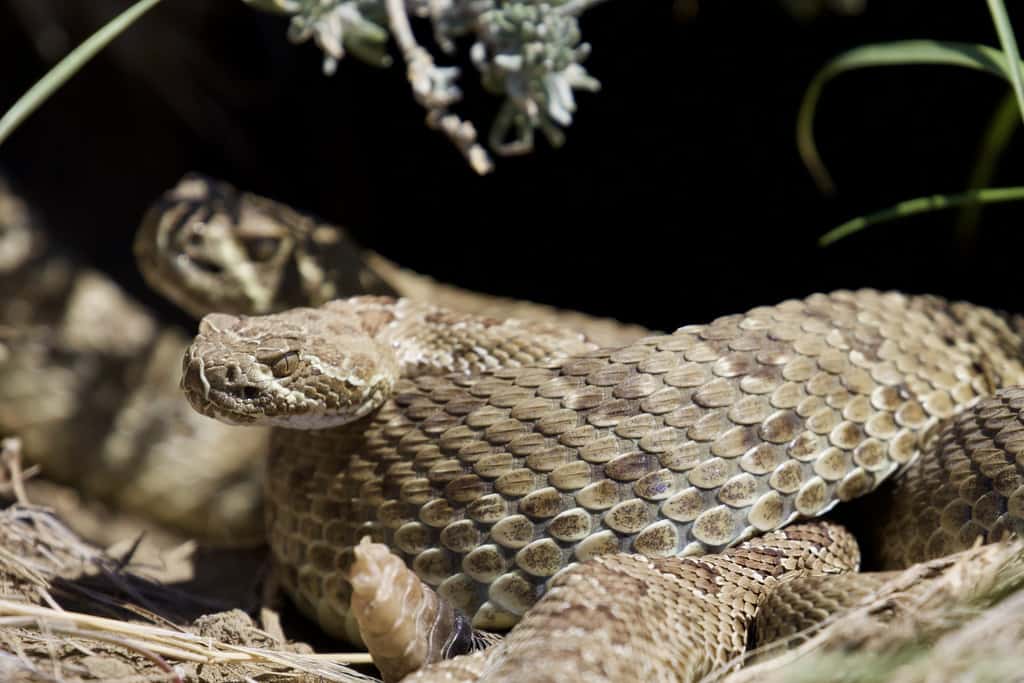
Maximum length: 151.5cm.
The signature rattlesnake of southern Saskatchewan and southeastern Alberta. Prairie rattlesnakes inhabit a swathe of the mid-western US, but also spill over the northern border for several hundred miles. They prefer wide open, sweeping terrain like short grasslands and prairies (duh), usually avoiding forests.
Their venom is middling for a rattlesnake, but significantly stronger than the massasauga. Prairie rattlesnake venom changes with age, as youngsters possess more metalloproteinases, which cause blood vessels to burst, while adults accumulate more muscle-attacking myotoxins. This is one of the paler rattlesnakes, which gives them superb camouflage in their wispy grasslands.
There’s estimated to be 22,300 prairie rattlesnakes living in Canada today. Nevertheless, their habitats are shrinking, particularly their open sandy prairies. A problem is that prairie rattlesnakes are the opposite of stationary; they love to make long migrations away from their winter dens, to summer feeding grounds, meaning that they need plenty of open space.
Prairie rattlesnakes have the cool feature of returning to the same winter den each year, always remembering its location. Over the last 3 decades, there have been less than 10 prairie rattlesnake bites in Alberta. However, a girl was sent to hospital in 2015, after being bitten in the rugged Alberta badlands region, a hotbed of dinosaur fossils. All she was doing was walking through a campsite.
| 7 | Eastern milksnake |
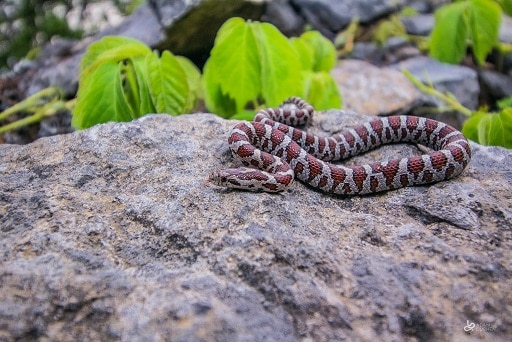
Maximum length: 132.1cm.
A subspecies of the milk snake found all over the United States. This is a harmless snake which lacks any venom, and hunts via crushing constriction instead. Eastern milksnakes begin life with red and black bands, but gradually become duller with age.
Eastern milksnakes (Lampropeltis triangulum triangulum) are most common in areas with plenty of forests, but also grassy meadows and clearings which they can move to to control their body temperature. They cope fairly well with human buildings, and sometimes appear in crumbling foundations or old basements. Away from forests, they require cover objects to survive, such as rotting logs or sheet metal.
The eastern milksnake is under some pressure from habitat loss, particularly in southwest Ontario, where 90% of original forest cover has been converted to heavy agriculture, and 72% of wetlands. Nevertheless, there’s still estimated to be 10,000 eastern milk snakes inhabiting Canada.
Their main realm is Ontario and southern Quebec, but eastern milk snakes may reach further north than people realise, as there are scattered, mysterious records from the northern shores of Lake Heron and Lake Nipissing. Their main limit to northward migration is their eggs, which require incubation at 24C for 50-70 days.
| 8 | Terrestrial garter snake |
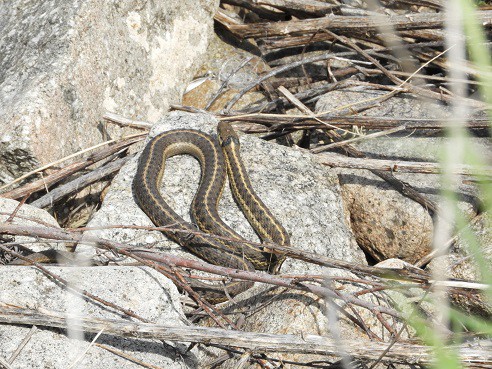
Maximum length: 109.2cm.
Another fully independent garter snake species. The terrestrial garter snake (Thamnophis elegans) is common on Vancouver Island, as well as in western regions like British Columbia and Alberta. This snake can be difficult to identify, as its base colour varies from beige-grey to almost black, sometimes with red patches between. However, a consistent feature is a bright yellow line running down its back.
Like all garter snakes, this species lacks traditional front fang venom, and cannot kill a human. However, Thamnophis elegans does possess a mildly venomous saliva, with myotoxins that wreak havoc on the muscles of mice.
Terrestrial garter snakes often take to ponds and streams to hunt down fish, but eat more mammals than the average garter snake. In one study, their favourite was crayfish, making up 56.2% of prey, yet they’re also keen on slugs and the Townsend’s vole. This is also a rare garter snake to constrict its prey.
Another of this snake’s specialties is reaching unusually high altitudes. Terrestrial garter snakes are immune to the troubles of thinning air; they just slither and slither upwards until they reach as high as 3900 metres. It’s not surprising that another of their names is the wandering garter snake. That said, this species extends less further north into Canada compared to the plains and common garter snake.
| 9 | Western hognose snake |
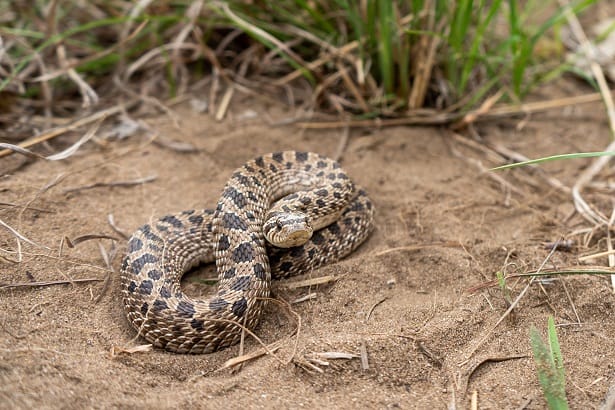
Maximum length: 100.6cm.
A common snake in the USA, but an endangered one in Canada. The western hognose snake (Heterodon nasicus) appears in short grasslands and prairies, and particularly inland sandy areas. The Spirit Sands 118 miles west of Winnipeg are one of its Canadian capitals.
Western hognose snakes average at 50cm, and are named for their upturned snout, which is used for digging in soft sands. They possess a mild venom, which is only capable of swelling a finger at worst. One of their freaky characteristics is diet-adapted adrenal glands; when they swallow American toads and the lethal bufotoxins they contain, they release a burst of adrenaline to counteract the decreased heart rate.
On most maps, western hognose snakes occupy a decent chunk of western Canada, primarily in Alberta and Saskatchewan. The problem is that their range is discontinuous, divided into several subpopulations which don’t interact and replenish each other.
One hotspot lies in Grasslands National Park, and this is located 190km from the western Saskatchewan subpopulation. In Alberta, the northern and southern subpopulations are separated by 60km. Again, the gradual erosion of the species’ wide, sweeping natural habitats is to blame.
| 10 | Bull snake |
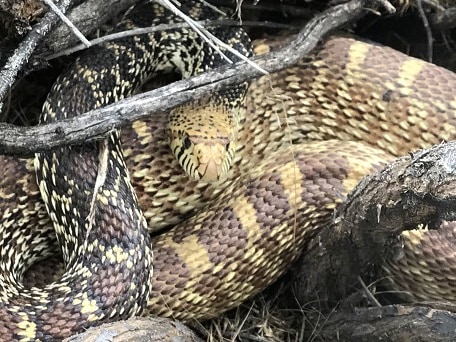
Maximum length: 267.6cm.
The range of the bull snake stretches from the southern tip of Texas, to a decent way into Alberta and Saskatchewan. This is one of 7 subspecies (Pituophis catenifer sayi) of the gopher snake, and the one with the most massive range. Bull snakes are thinner than the main gopher snake, but more aggressive, and have brighter colours.
With a record length of 267.7cm, the bull snake is the longest snake in western Canada, and the USA. Bull snakes are excellent constrictors, and most of their prey consists of rodents. Like the main gopher snake subspecies, they’re common in crop fields, which act as magnets and draw in bull snakes from far and wide, seeking to feed on the pests there. Some Alberta farmers have even been known to pick up bull snakes and relocate them to particular rodent hotspots.
Bull snakes are non-venomous, and their first move when threatened is to stay absolutely still, not bite. The Red Deer river area is one of their hotspots within Alberta, while in Saskatchewan, the south Saskatchewan river is their northern limit.
Bull snakes look vaguely similar to rattlesnakes, and are believed to be imitating them in a survival strategy. The rattling style is one difference, as rattlesnakes raise their tail into the air and shake segmented scales together, while bull snakes keep their tail low and vibrate against leaves to create a fake rattle.
| 11 | Eastern fox snake |
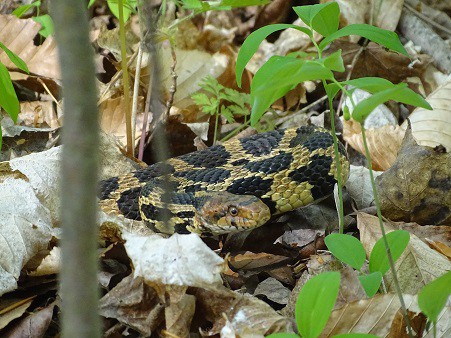
Maximum length: 179.1cm.
One of Canada’s most endangered snakes. The eastern fox snake is a non-venomous constrictor which regularly exceeds 1.5 metres. It’s found exclusively in Ontario, overlapping with the likes of the smooth green snake and massasauga. Eastern fox snakes pose no threat to humans and prey heavily on bird eggs, including those of pheasants, pigeons, quails and sparrows, which they swallow whole and crack open using bodily contortions.
The eastern fox snake (Pantherophis vulpinus) only has two populations in Canada, which are fully separated from each other. The first is a scattered series of locales in southwest Canada, and the second is a stronger but still vulnerable colony along the shores of Georgian Bay.
The big problem for the eastern fox snake is its aversion to agriculture. When wheat, corn or soybeans are planted in intensive fields, they completely disappear. The colony in Ontario has been particularly vulnerable to this destruction. Nor are eastern fox snakes able to live in streets among houses. Their colonies generally consist of wet, open areas, such as wetlands, marshes, prairies, and shorelines, with occasional excursions through forests.
For the time being, this species still has high numbers in the areas of Ontario where it survives. The eastern fox snake has round pupils, and is easily recognisable by its sharply contrasting yellow base colour overlaid with black blotches.
| 12 | Pacific rattlesnake |
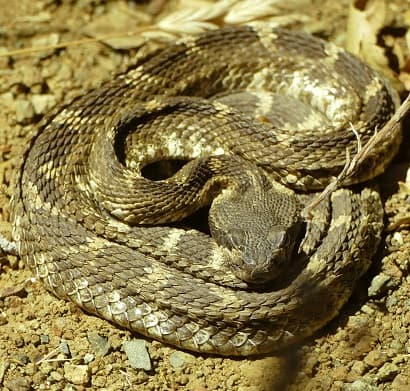
Maximum length: 162.6cm.
The third and final rattlesnake of Canada. This is the westernmost species, which is highly abundant in California, Oregon and Washington states, and spills over the border northwards for a few dozen miles.
Within Canada, Pacific rattlesnakes (Crotalus oreganus) are found exclusively in British Columbia. This species has a moderately toxic venom, which usually lacks the neurotoxins of the deadly tiger rattlesnake, except for one unusually deadly spot in the US (the San Jacinto Mountains). Pacific rattlesnakes have a decent death toll in California, but not because they’re unusually deadly, more because they easily live in towns and cities.
This species is more flexible than the prairie rattlesnake in its habitats, while its diet was found to consist of 76.1% mammals in a study from California, followed by 14.8% lizards. In frosty Canada, where lizards are less abundant, it’s likely that mammals make up an even greater share.
Pacific rattlesnakes have a few mega hotspots dotted around western Canada. One is the White Lakes protected area, a beautiful tourist area of pine and fir trees and low mountains. Sightings of Pacific rattlers are legion around here. The city of Vernon, British Columbia is so surrounded with them that it’s like they’re mounting a siege, and the same is true for the riverside town of Kamloops. This town is almost their northernmost point.
| 13 | Eastern hognose snake |
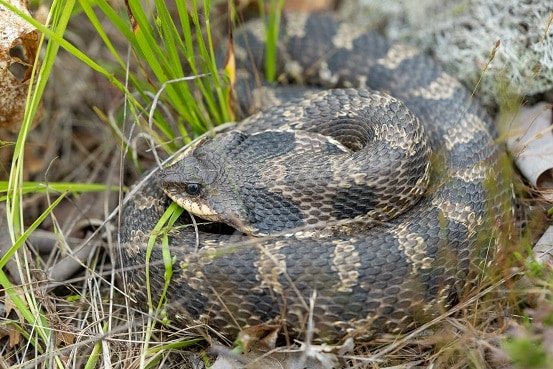
Maximum length: 126.8cm.
The other hognose snake species in Canada. The eastern form, AKA Heterodon platirhinos, is found exclusively in Ontario, north of Michigan and Ohio. Like the eastern fox snake, it’s divided into two separate colonies, one in far southwestern Ontario, and another on the eastern shorelines of Georgia Bay. Eastern hognose snakes are found in extremely high densities around Georgia Bay islands such as Beausoleil Island, Portage Island, Roberts Island, etc.
Eastern hognose snakes are harmless to humans, though they’re often mistaken for rattlesnakes, or whacked to death due to their common nickname of “spreadin’ adder”. They only have a mild venom, and their main defensive trick is an elaborate death-faking routine, where they flip onto their back and go completely limp. Eastern hognose snakes primarily prey on frogs and toads, and are found in fields, forests, forest clearings, beaches and dunes.
This species is easy to recognise. It has the least upturned snout of the three hognose snake species in North America, but still more upturned than any species nearby in southern Canada. If you’re lucky, it’ll treat you to an unmistakable ID sign: flattening its neck and chest to enlarge itself, creating a false impression of size. Unlike a cobra, which faces the aggressor head on, eastern hognose snakes nearly always enlarge themselves while flat to the ground.